

Why an Omnichannel Contact Center Matters
An omnichannel contact center brings phone calls, email, text messages, web chat, social messages, and other customer conversations into one connected system. When a customer switches channels, their history, account details, and previous messages follow them, so they do not have to start over.
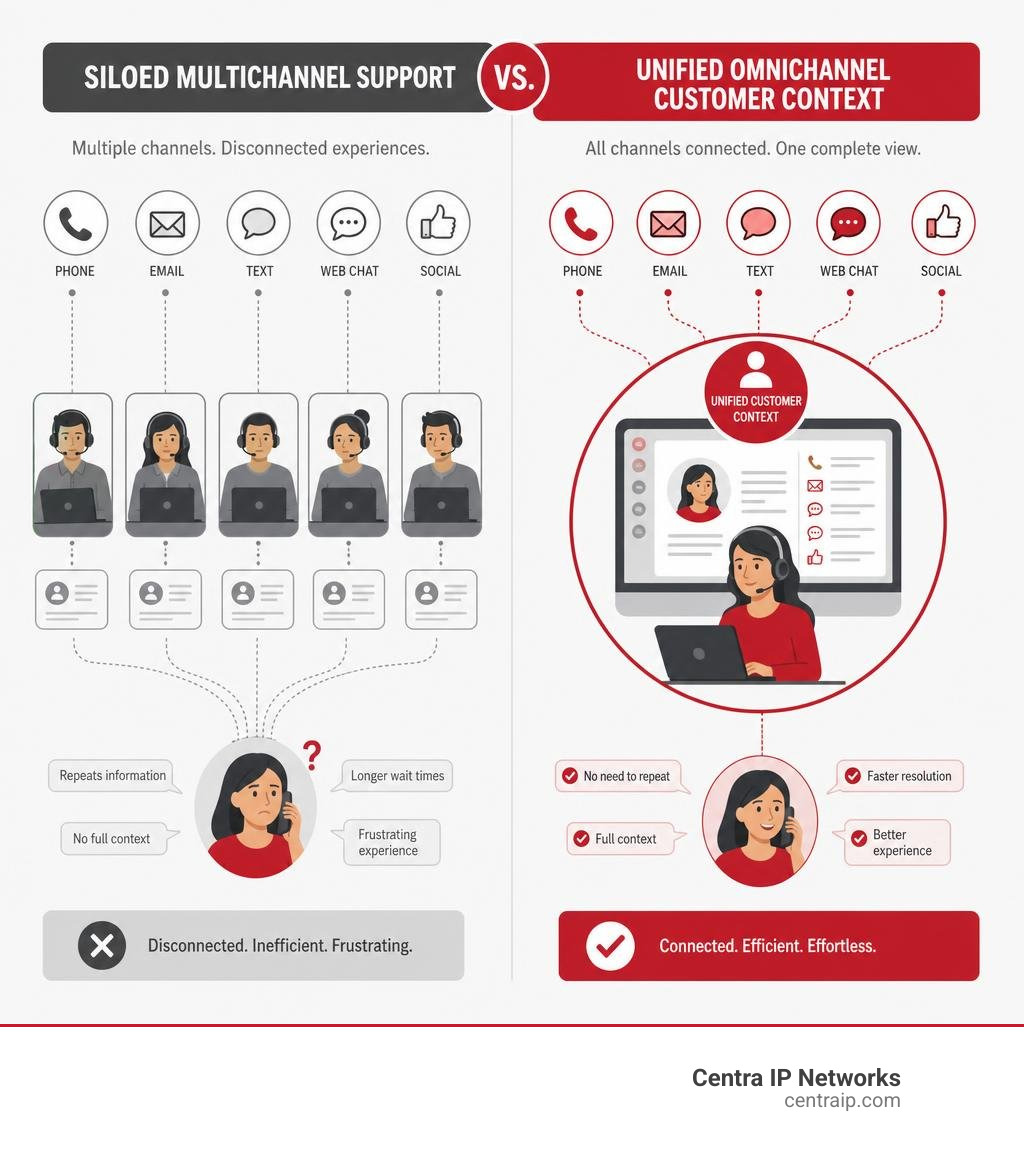
That is the key difference from a multichannel setup. Multichannel support offers several ways to contact a business, but each channel may operate separately. Omnichannel support connects them behind the scenes.
Customers now move between channels constantly, and 70% expect every person they contact to understand their situation. A unified contact center helps your team respond faster, reduce repeat questions, and give agents one clear view of each customer instead of a pile of disconnected apps.
I am Patrick Brangan, with more than 20 years of experience helping small and midsize businesses simplify communications, managed IT, and connected technology. In this guide, I will explain how an omnichannel contact center works and what to consider before bringing your customer channels together.
Omnichannel contact center glossary:
What Is an Omnichannel Contact Center and How Does It Work?
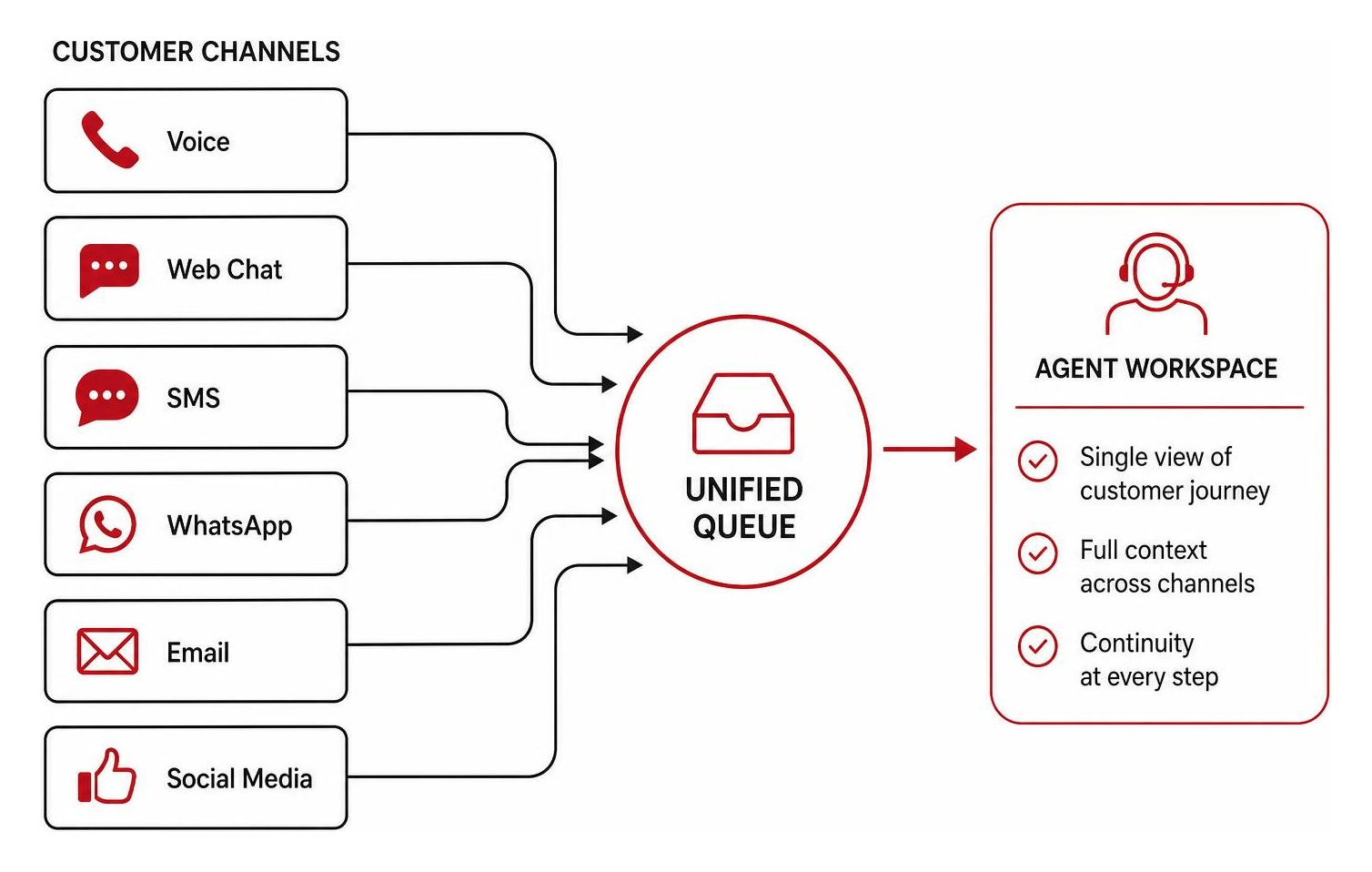
At its heart, an omnichannel contact center synchronizes customer interactions across every available communication medium in real time. Rather than treating an incoming phone call, an SMS inquiry, a WhatsApp thread, and an email ticket as four isolated events, the platform weaves them into a unified chronological timeline attached to a single customer profile.
When an inquiry hits your network, the underlying system captures conversation context, metadata, intent, and previous ticket history. If a customer starts by chatting with an automated bot on your website, moves to SMS while commuting, and finally calls your support team, the live agent who answers the phone sees every step of that journey.
| Feature | Multichannel Contact Center | Omnichannel Contact Center |
|---|---|---|
| Channel Integration | Disconnected channels operating in separate silos | All voice and digital touchpoints unified in one system |
| Customer Data & Context | Fragmented across separate apps and inbox queues | Centralized in real time with continuous timeline tracking |
| Customer Experience | Customers must repeat account information across channels | Seamless channel switching with zero loss of context |
| Agent Interface | Agents toggle between multiple disparate tools | Single pane of glass for all incoming and outbound interactions |
| Routing Intelligence | Basic channel-specific queues | Cross-channel, skills-based intelligent routing |
| Reporting & Analytics | Fragmented metrics measured per channel | Consolidated end-to-end customer journey analytics |
Omnichannel vs Multichannel: Breaking Down the Silos
The fundamental flaw of traditional multichannel customer care is data isolation. When channels function independently, the left hand rarely knows what the right hand is doing. Poor service remains the primary reason consumers walk away from a brand, and 73% of customers will jump to a competitor after experiencing multiple frustrating interactions.
Forcing people to re-explain their billing problem, ticket number, or delivery delay each time they reach out generates immediate friction. Discovering why your business needs an omnichannel cloud contact center boils down to removing customer effort while ensuring your internal teams never drop conversational context.
Core Architecture of an Omnichannel Contact Center
Modern omnichannel infrastructure moves away from clunky on-premises hardware in favor of hosted cloud environments. Understanding what is a cloud native contact center helps clarify how modern software pairs with robust cloud PBX technology:
- Intelligent Ingestion Layer: Collects inbound interactions from phone lines, web chat widgets, social networks, SMS gateways, and email servers.
- Universal Automatic Call Distribution (ACD): Uses intelligent business logic, customer tiers, and skills-based criteria to route any incoming interaction to the most qualified agent.
- Unified Desktop Interface: Displays conversation history, active channels, customer sentiment, and attached data within a single screen.
- Data Sync Engine: Connects with CRM records, enterprise databases, and external tools to update customer records continuously.
Key Business and Customer Benefits of Unified Support
Connecting your support channels does more than make life easier for callers; it transforms operational efficiency. Research from McKinsey shows that companies executing comprehensive omnichannel transformations experience revenue growth between 5% and 15% alongside cost-to-serve improvements of 3% to 7%.
Public sector organizations and enterprise operations alike benefit from connected touchpoints—for example, residents who Connect with Sarasota County Government! rely on coordinated multi-channel options to access civic services smoothly. Organizations adopting enterprise omnichannel contact center solutions and unified platforms find that breaking down communication barriers directly improves service reliability.
Driving Customer Retention and Loyalty
Consumers are increasingly channel-agnostic. In fact, 85% of customers expect consistent interactions across every touchpoint, and 86% expect their conversations to flow naturally between channels without interruptions. When you deliver that level of consistency, loyalty follows: organizations adopting a unified omnichannel strategy see a 91% increase in year-over-year customer retention rates according to Aberdeen Group research.
Furthermore, exploring how a CRM integration can benefit your business demonstrates that arming frontline teams with personalized purchase histories and immediate contextual data boosts customer lifetime value, as omnichannel consumers spend up to 13% more over time.
Boosting Agent Productivity and Slashing Handle Times
Constantly switching between separate browser tabs and software tools drains energy and wastes time. Eliminating tab fatigue directly reduces Average Handle Time (AHT) while preventing agent burnout. When representatives handle inbound calls, live chats, and follow-up emails from a single queue, they resolve issues faster and stay engaged.
Implementing small business benefits unified communications across your organization allows agents to balance high-priority voice calls during peak hours with asynchronous messaging during slower periods, keeping utilization steady without causing workplace exhaustion.
Must-Have Capabilities for Modern Support Platforms
Evaluating software platforms requires looking past flashy sales demos to confirm the software delivers true functional value. Tracking ongoing trends in business communications ensures your tech stack stays modern and capable.
Essential Features in an Omnichannel Contact Center
A comprehensive support solution must natively manage multiple contact touchpoints while maintaining unified routing rules. Reviewing our in-depth guide to contact center solutions highlights several vital components:
- Integrated Telephony: High-definition cloud voice with IVR, visual call routing, call queuing, and predictive outbound dialing.
- Digital Messaging Channels: Web chat, SMS, Apple Messages for Business, WhatsApp, and social direct messaging.
- Universal Intelligent Routing: Automatic routing rules based on agent specialization, customer tier, language, and queue volume.
- Supervisor Management Consoles: Real-time queue dashboards, silent call monitoring, whisper coaching, and interaction barge-in capabilities.
Built-in Conversational AI and Real-Time Agent Assist
Modern platforms leverage built-in conversational AI to streamline service without losing the human touch. Natural language understanding (NLU) bots can handle routine tier-1 inquiries—like checking order statuses or resetting passwords—deflecting up to 34% of routine tickets before they ever reach an agent.
When complex interactions require live intervention, conversational AI assists agents in real time. It transcribes active voice calls, conducts live sentiment analysis, suggests relevant knowledge base articles, and generates automated post-call interaction summaries, saving minutes of manual data entry on every contact.
Deep CRM and UCaaS Platform Unification
True operational alignment happens when your customer service software connects directly with internal communication tools and customer databases.

Understanding what is UCaaS? clarifies how bringing internal collaboration tools (chat, video meetings, team presence) together with external contact software (CCaaS) allows agents to consult internal subject matter experts instantly while on a live support call. Pairing this with a robust cloud phone system CRM integration ensures that every ticket, call log, and chat transcript logs directly to your primary database automatically.
Implementation Best Practices and Network Infrastructure
Rolling out an omnichannel transformation successfully requires thoughtful planning. Rather than launching ten channels simultaneously, follow a structured framework:
- Map Non-Linear Customer Journeys: Identify the primary channels your customers currently use and where handoff friction occurs.
- Prioritize High-Impact Channels: Deploy two or three core channels (such as voice, web chat, and SMS) before expanding to social platforms.
- Establish Clear Escalation Workflows: Ensure automated bots always provide an immediate, frictionless escape path to a live human representative.
- Train on Soft Skills and Tooling: Train your staff on navigating the unified interface, managing concurrent digital chats, and delivering empathetic service.
- Collect Frontline Feedback: Regularly survey support agents to identify workflow bottlenecks and refine self-service knowledge base content.
Selecting a future-ready architecture allows you to future-proof with a unified communications solution that scales as business needs evolve.
Telecom Infrastructure, Bandwidth, and Managed Connectivity
Cloud software is only as dependable as the underlying network powering it. Real-time voice and video traffic cannot tolerate high latency, jitter, or packet loss.
Deploying robust contact center VoIP solutions: why your business needs to make the call requires solid network architecture. This includes properly provisioned SIP trunking, dedicated fiber connectivity, and Quality of Service (QoS) configurations configured across local routers. Choosing to streamline your business: the benefits of managed communication services ensures your voice connectivity, internet bandwidth, and network security remain monitored by experienced engineers.
Security, Recording, and Regulatory Compliance
Consolidating payment details, medical records, and customer communications across multiple channels introduces strict regulatory responsibilities. Support platforms must adhere to stringent industry standards like PCI-DSS for handling financial details and HIPAA for protected health information.
Consulting the complete guide to contact center recording and compliance ensures your operations maintain encrypted audit trails, automated sensitive-data redaction, and strict access controls. Implementing secure cloud-based call recording: why it’s essential for modern businesses guarantees that all digital transcripts and voice files are stored safely in compliance with regional and industry regulations.
Frequently Asked Questions About Contact Center Solutions
What is the primary difference between a call center and an omnichannel center?
A traditional call center focuses entirely on handling inbound and outbound voice phone calls over telephony lines. In contrast, an omnichannel center integrates voice with digital channels—including live website chat, email, SMS messaging, video, and social networks—synchronizing conversation history across every touchpoint so context is never lost.
How does combining UCaaS and CCaaS improve operations?
Combining Unified Communications as a Service (UCaaS) and Contact Center as a Service (CCaaS) merges internal employee communications with external customer service tools. Reviewing our guide on bringing it all together: mastering unified communications management shows how this integration lets frontline reps message back-office specialists instantly, speeding up resolution times without placing callers on lengthy holds.
What metrics best measure cross-channel support success?
Key performance indicators for measuring unified service performance include:
- First Contact Resolution (FCR) across the entire multi-channel journey
- Customer Satisfaction (CSAT) and Net Promoter Score (NPS) by channel
- Average Handle Time (AHT) across voice and text queues
- Self-Service Containment Rate of conversational AI assistants
- Context Continuity Rate (tracking successful data handoffs during channel escalations)
Conclusion
Modern customer support is no longer confined to standalone phone calls or isolated email inboxes. Delivering frictionless, memorable experiences requires unifying every conversation into a continuous, data-rich stream.
At Centra IP Networks, we eliminate technical complexity by delivering comprehensive Managed IT and Cloud Communications on a single unified platform. With locations across Dallas, Fort Worth, Orlando, Tampa, St Petersburg, Clearwater, and Sarasota, we provide voice systems, high-speed Internet connectivity, and managed cloud solutions backed by over 35 technology partnerships—all on one clear bill from a single dedicated provider.
Ready to transform your customer experience and modernize your communications? Explore how our tailored Contact Center and comprehensive Cloud Services can elevate your operations today.