

Secure Internet Fax: What Makes It Secure?
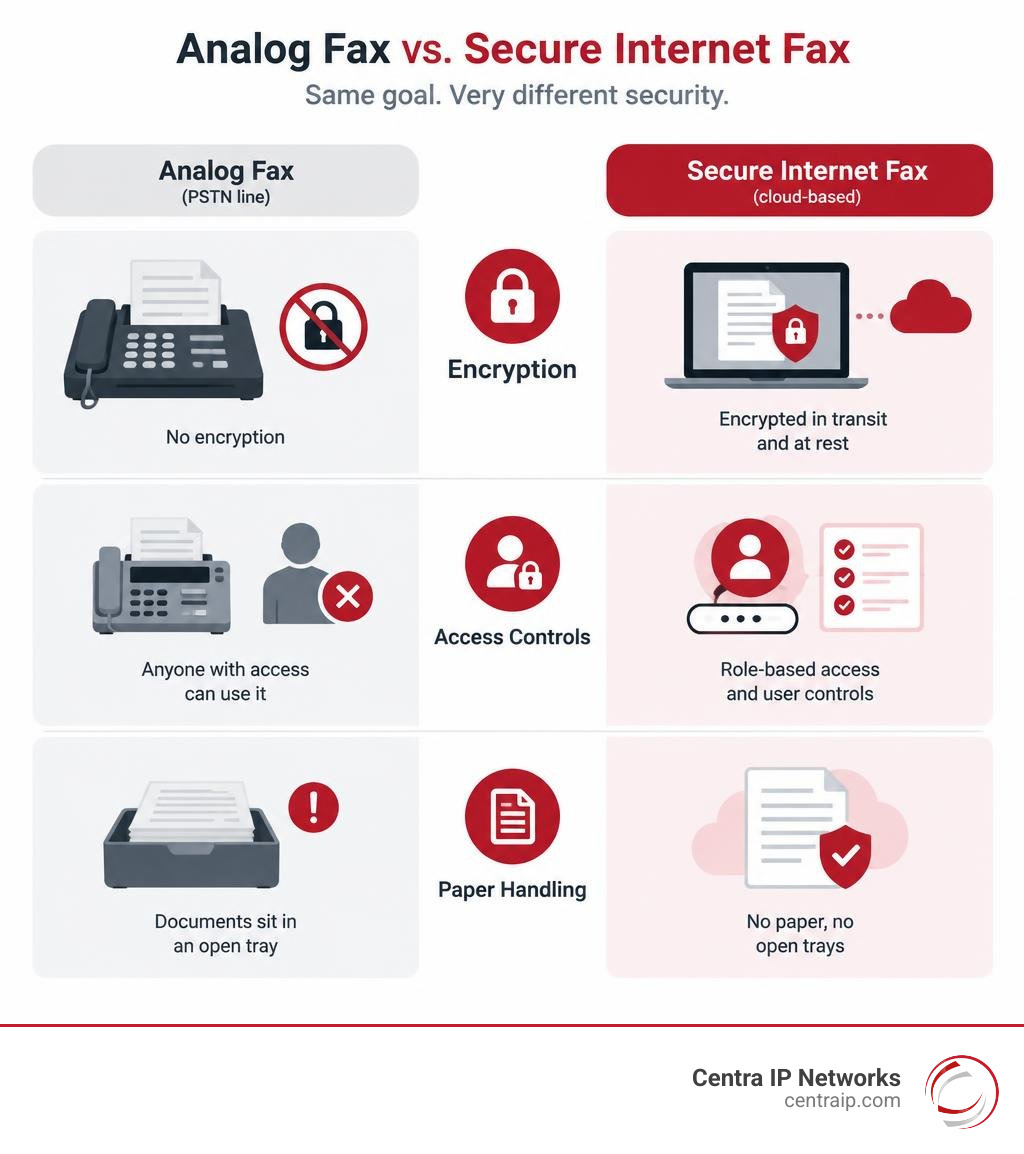
Secure internet fax lets you send and receive documents through an online service instead of a fax machine. Look for encryption while files travel and while they are stored, access controls, and delivery records. Unlike a shared fax machine, it can keep documents out of an open paper tray. But security depends on the provider and your settings; an online fax is not automatically HIPAA compliant. If you send protected health information, confirm that the provider will sign a Business Associate Agreement (BAA) before you use it.
Free services can work for an occasional, non-sensitive fax. They often limit pages or cannot receive faxes, and a free account should not be treated as a substitute for a signed BAA. This guide compares those trade-offs with paid services so you can choose what your business needs.
I’m Patrick Brangan. My 20-plus years helping small businesses manage communications and IT systems shape how I evaluate secure internet fax: it needs to protect documents and fit the way a team works.
What Is Secure Internet Fax and How Does It Protect Data?
Traditional analog faxing relies on copper Public Switched Telephone Network (PSTN) lines. While historically considered private because tapping a dedicated telephone line required physical line interception, analog fax machines have glaring vulnerabilities in modern business environments. Physical pages sit exposed in communal output trays, misdialed numbers blast sensitive records to unintended recipients with zero recovery options, and paper transmission confirmations offer no tamper-proof cryptographic audit trail.
Modern organizations need a business guide on transitioning from analog risks to cloud protection to secure their everyday communications. Cloud fax platforms replace physical hardware by digitizing document exchange across encrypted web protocols, transforming faxes into protected digital files like PDFs.
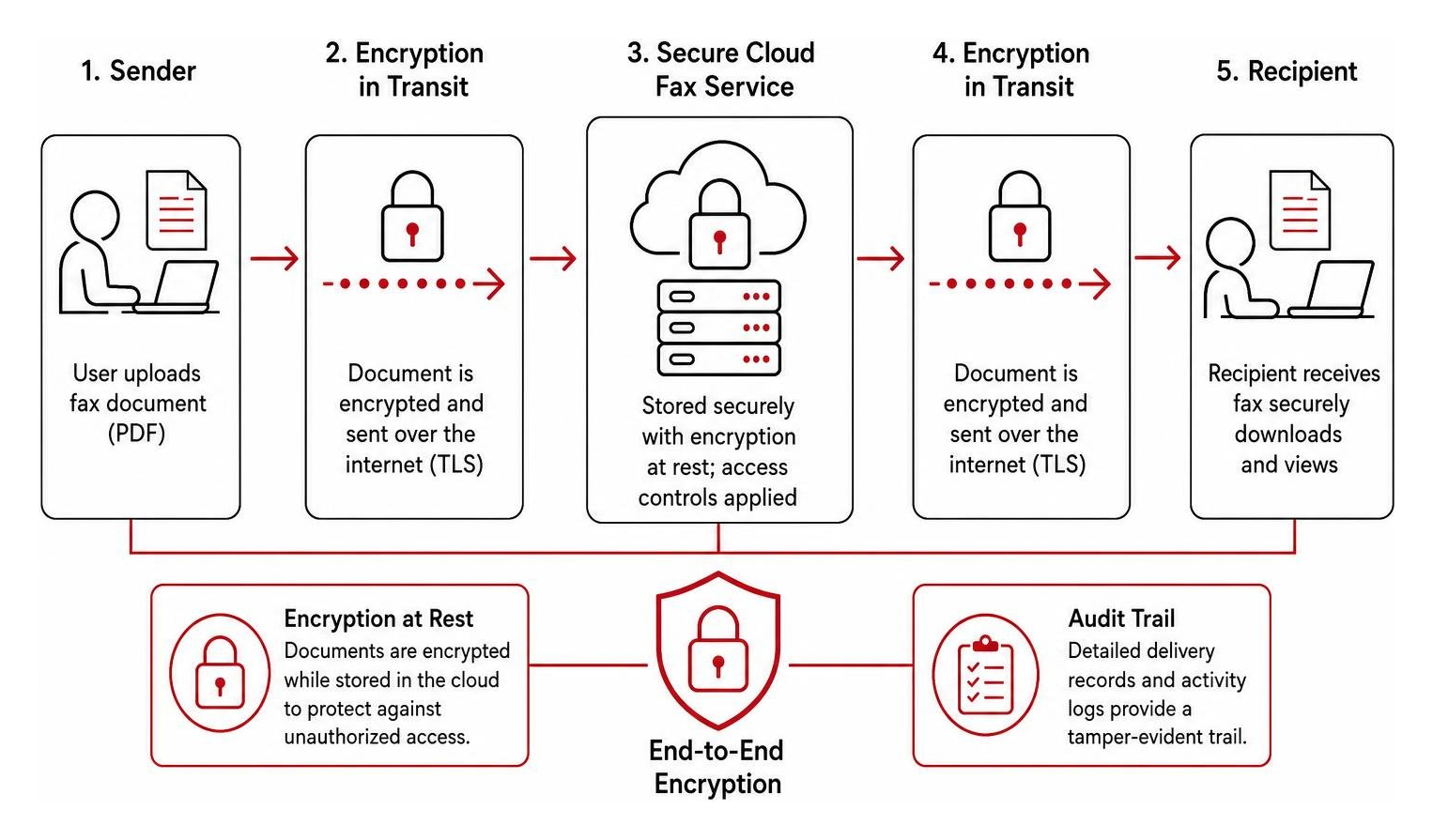
By routing transmissions through audited data centers rather than unmonitored office hardware, organizations gain granular control over access permissions, document lifecycle management, and detailed activity logs. Reviewing the security features that leading corporate fax providers build into their platforms highlights why Fortune 500 companies have moved away from physical machines.
Encryption Protocols and Infrastructure Standards in Secure Internet Fax
True security requires complete protection across the document lifecycle. That means keeping files safe in transit while traversing the internet, as well as at rest when stored in cloud repositories:
- Data in Transit: When an outbound fax is uploaded via a web dashboard, mobile app, or email-to-fax client, it must be shielded using Transport Layer Security (TLS 1.2 or TLS 1.3). This prevents man-in-the-middle interception between your local endpoint and the cloud fax server.
- Data at Rest: Once received and archived, documents must be stored using Advanced Encryption Standard (AES) 256-bit encryption. Without the appropriate cryptographic keys, unauthorized parties or rogue actors cannot read raw stored files.
- Perimeter and Delivery Safeguards: Premium platforms implement HTTPS web portals, Pretty Good Privacy (PGP) encryption, and password-protected PDF attachments for inbound email delivery.
- Infrastructure Hosting: Reliable enterprise providers host their services in SSAE-16 Type 2 or SOC-audited data centers with physical biometric access controls, redundant power, and hourly encrypted backup routines.
Regulatory Frameworks: HIPAA, SOC 2, and ISO 27001
Deploying cloud faxing requires adhering to strict regulatory frameworks to avoid massive statutory fines:
- HIPAA (Health Insurance Portability and Accountability Act): Regulates Protected Health Information (PHI). Requires strict technical safeguards, access control management, audit logs, and a signed Business Associate Agreement. We outline these healthcare standards in our complete guide to HIPAA compliant cloud fax.
- SOC 2 Type II: An independent audit demonstrating that a cloud vendor consistently maintains rigorous controls over security, availability, processing integrity, and data confidentiality over an extended observation window.
- ISO 27001: An international certification proving an organization has implemented a comprehensive Information Security Management System (ISMS) to manage risk systematically.
- GLBA, FERPA, and PCI-DSS: Protect consumer financial records, educational student data, and credit card processing streams against unauthorized digital leaks.
The Business Associate Agreement (BAA) and Free vs Paid Tiers
A common pitfall for growing practices is assuming that high-grade encryption automatically equals legal compliance. You can evaluate the top secure online fax services for small business to understand the practical boundary between technical encryption and legal liability.

Can You Rely on Free Tiers for Secure Internet Fax Needs?
Free online fax tools provide convenient one-off sending for simple tasks like submitting a rebate form or returning a signed gym membership cancellation. However, they are unsuitable for business-critical operations.
To create a truly paperless office, check out the top digital fax service picks for a paperless office to see why business-grade software is necessary.
| Feature / Capability | Free Fax Tiers | Paid Enterprise Plans |
|---|---|---|
| Page Allowances | Strict caps (e.g., 3–10 pages total or per day) | Scalable pools (hundreds to thousands monthly) |
| Two-Way Faxing | Almost exclusively send-only | Dedicated inbound numbers (DID/Toll-Free) |
| Branding & Watermarks | Provider ads/logos forced on cover sheets | 100% white-labeled custom cover pages |
| BAA Availability | Never included on free tiers | Standard inclusion on regulated tiers |
| Storage & Retention | Temporary (frequently purged within 24–48 hours) | Configurable long-term encrypted archiving |
| Customer Support | Community forums or unmonitored ticket queues | 24/7 direct telephone and priority engineering |
Business Associate Agreements Explained
Under federal HIPAA guidelines, any third-party service provider that touches, processes, stores, or transmits electronic Protected Health Information (ePHI) on behalf of a covered entity is legally classified as a Business Associate.
A Business Associate Agreement (BAA) is a legally binding contract that explicitly outlines the vendor’s responsibilities:
- Enforcing administrative, technical, and physical safeguards matching HIPAA Security Rule mandates.
- Agreeing to report any potential security incidents or breaches directly to the covered entity without delay.
- Subjecting internal infrastructure and personnel to regular compliance audits.
Transmitting a single patient document through an online fax vendor that has not executed a signed BAA with your organization is a direct statutory violation, carrying severe financial penalties regardless of the underlying AES-256 encryption. For an example of a healthcare-focused platform, review Sfax’s secure cloud fax offering, then confirm the specific BAA terms and safeguards that apply to your organization.
Comparing Leading Enterprise Cloud Fax Providers
Selecting the right enterprise fax solution requires balancing compliance certifications, operational integrations, volume scalability, and cost transparency. When evaluating your organization’s options, reviewing an essential guide comparing cloud fax services will help clarify market standards, alongside our breakdown of cloud fax providers that deliver reliable uptime.
| Provider | Primary Focus | Compliance & Certifications | Core Integrations | Key Differentiator |
|---|---|---|---|---|
| eFax Corporate | Enterprise & Regulated Industries | HIPAA, HITRUST, SOC 2, FedRAMP High, PCI-DSS | SAP, ERP, EMR/EHR, REST APIs | 30-year track record; AI-powered data extraction tools |
| iFax | Small Teams to Mid-Market | HIPAA, SOC 2, ISO 27001, GLBA | Zapier, Google Drive, Dropbox, Cloud API | User-friendly dashboard; multi-platform apps |
| Sfax | Healthcare-First Deployments | HIPAA, HITECH (SSAE-16 Type 2 Hosting) | Healthcare EHRs, Developer SDKs, Web Portals | Restricts email transmission to notifications for privacy |
| eGoldFax | Distributed Office Hardware & Archiving | HIPAA, PCI-DSS, GDPR, FERPA | Multi-Function Printers (MFP), Email Clients | Automated 10-year encrypted PDF compliance archiving |
| Fax.Plus | General Business & International Reach | ISO 27001, SOC 2 Type II, HIPAA (Advanced Plans) | Google Workspace, Zapier, Microsoft 365 | Global coverage across 180+ countries with intuitive UI |
Workflow Integrations: EHR, Cloud Storage, and API Automation
Modern cloud fax systems should not operate in an isolated silo. Modern organizations depend on connected data flows to keep work moving efficiently. You can explore a complete digital fax service comparison for business to evaluate native integrations across several platforms.
- EHR/EMR Systems: Medical practices require integration with Electronic Health Record systems via HL7 and modern FHIR protocols, allowing incoming patient referrals and lab orders to index directly into patient charts.
- Cloud Document Management: Integrating with platforms like Google Drive, Dropbox, Box, and Microsoft OneDrive enables automatic routing of incoming faxes to shared project folders.
- API & Webhook Automation: REST APIs and Zapier connectors allow developers to trigger programmatic workflows, dispatch automated outbound faxes from CRM events, and process incoming faxes through Optical Character Recognition (OCR) engines for automatic indexing.
Zero-Downtime Fax Number Porting and Deployment
Switching your organization’s communications to the cloud should never disrupt incoming transmissions or risk dropped client orders. Following an in-depth guide to choosing efax solutions makes planning this transition straightforward.
The porting lifecycle uses an established telecommunications protocol:
- Letter of Agency (LOA): You complete a formal authorization document providing proof of ownership via a recent copy of your existing telephone carrier bill.
- Carrier Coordination: Your new cloud fax provider coordinates directly with your current carrier via the Fast Track Local Number Portability (LNP) clearinghouse.
- Bridge Forwarding: While the porting window processes (typically 3 to 10 business days), you can enable temporary call forwarding on your legacy analog line directly to a temporary cloud Direct Inward Dial (DID) number, guaranteeing zero downtime.
- Cutover & Hardware Retirement: Once the carrier release date arrives, the number transitions instantly to your cloud platform, allowing you to disconnect physical copper lines and decommission legacy multi-function printer fax boards.
Frequently Asked Questions About Cloud Fax Compliance
Can you send HIPAA-compliant faxes for free?
No. While several free fax services utilize TLS transport encryption, legitimate HIPAA compliance requires an executed Business Associate Agreement (BAA). Providers do not offer signed BAAs on free, ad-supported, or trial accounts. Transmitting ePHI across a free tier creates non-compliance liability under federal privacy regulations.
How does number porting work when moving to online fax?
Number porting transfers your existing legal phone number from your old telecommunications carrier to your cloud fax provider without changing what customers dial. By submitting a Letter of Agency (LOA) alongside a recent phone bill, your new provider handles the transfer behind the scenes. Temporary call forwarding ensures you never miss an incoming transmission during the transition.
What encryption standard is required for legal and medical faxes?
Industry compliance benchmarks require end-to-end data protection. Transmissions over the internet must be shielded using TLS 1.2 or TLS 1.3 encryption, while stored documents must use AES-256 bit encryption at rest within audited, sovereign data center environments.
Conclusion
Transitioning your organization from vulnerable analog hardware to a secure internet fax solution safeguards private communications, cuts overhead costs, and satisfies compliance mandates like HIPAA, SOC 2, and ISO 27001.
At Centra IP Networks, we help businesses across Dallas, Fort Worth, Orlando, Tampa, St. Petersburg, Clearwater, and Sarasota simplify their technology footprints. We deliver comprehensive Managed IT, cloud voice, high-speed connectivity, and modern business communications on a single platform with one clear bill and dedicated support.
Ready to modernize your document exchange workflows with carrier-grade reliability? Explore our fully managed enterprise faxing solutions to protect your organization’s communications today.