

Why Managing Unified Communications is More Critical Than Ever
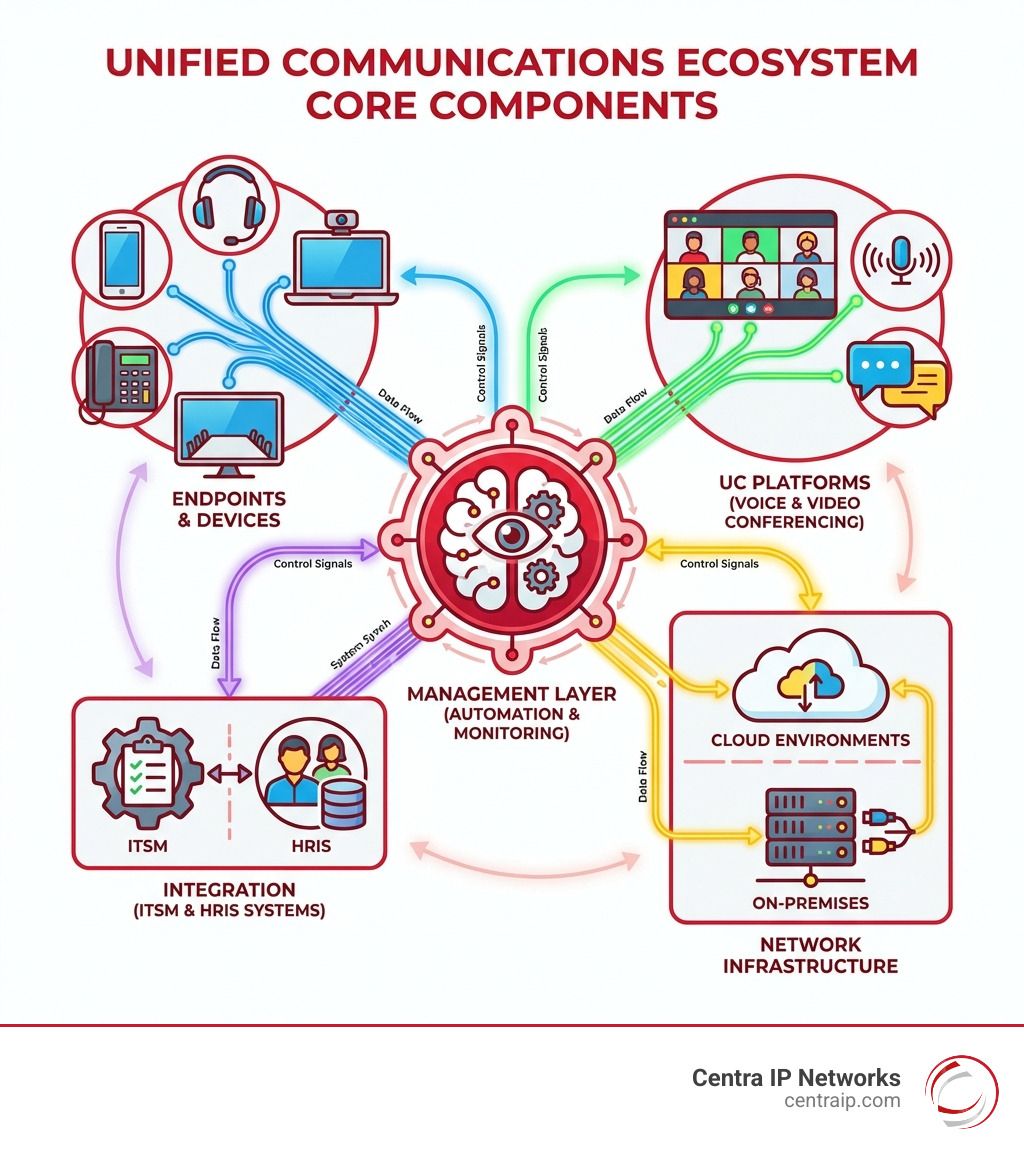
Unified communications management is the centralized system organizations use to automate and control their enterprise communications services—including voice, video, messaging, and collaboration tools—across their entire network infrastructure. If you’re managing UC platforms, here’s what you need to know:
Key Components of UC Management:
- Automation – Eliminates manual configuration of phones, users, and network devices
- Centralized Control – Single platform for multi-vendor environments (Cisco, Microsoft Teams, Zoom)
- Lifecycle Support – Handles Day 0 design through Day 3 upgrades and scaling
- Integration – Connects with ITSM, HRIS, and CRM systems to prevent errors
- Visibility – Monitors performance across on-premises, cloud, and hybrid deployments
Most organizations already have some form of UC management—often pieced together with in-house tools and manual processes. But as your environment grows beyond 1,000 employees or 500 devices, that informal approach breaks down fast.
The numbers tell the story. Companies managing up to 135,000 endpoint devices face mounting complexity. At 99.9% uptime, an organization with 10,000 employees still loses $1.35 million annually to downtime. Video conferencing boosts knowledge transfer to 70%, compared to just 20% for audio-only calls. And the global UC market is growing at 20% annually as businesses embrace hybrid work models.
The real challenge? Managing fragmented systems from multiple vendors—especially when you’re juggling on-premises infrastructure, cloud services, and the security risks of BYOD environments. Without a formal UC management platform, IT teams spend their days firefighting instead of optimizing performance.
I’m Patrick Brangan, and over my 20+ years in business technology, I’ve helped SMBs in Dallas, Tampa, and Orlando streamline their Unified Communications Management by consolidating vendors and implementing proactive solutions. Whether it’s deploying systems in under 10 days or integrating voice, data, and security into one manageable platform, I’ve seen how the right approach transforms IT operations.
The Strategic Importance of Unified Communications Management
In the early days of telephony, management meant moving a few wires in a closet. Today, Unified communications management is a sophisticated discipline that covers the entire lifecycle of a communication service. Whether we are operating out of Fort Worth or St. Petersburg, our goal is the same: ensuring that every user has a seamless, high-quality experience every time they hit “Join” or pick up the handset.
Strategic management isn’t just about fixing things when they break; it’s about Lifecycle Management for Successful UC. This involves four critical stages:
- Day 0 (Design): Planning the architecture to ensure the voice network infrastructure can handle the load.
- Day 1 (Migration): Automating the move from legacy systems to modern platforms without losing data.
- Day 2 (Operations): Handling the daily “Moves, Adds, Changes, and Deletes” (MACDs) that keep an IT team busy.
- Day 3 (Optimization): Using analytics to scale the system and plan for future upgrades.
When we talk about service fulfillment, we are talking about speed. In a manual environment, it might take an IT staffer 30 minutes to provision a single user across three different platforms. With configuration automation, that time drops to seconds. This shift is what separates a “surviving” IT department from one that drives What is UCaaS? adoption and digital transformation.

The Evolution of Unified Communications Management
The history of UC is a journey from hardware to software. We started with the Legacy PBX—those heavy, beige boxes in the basement that only one person in the company knew how to program. As we moved toward the cloud transition, the focus shifted from “Does it work?” to “How efficiently can we manage it?”
Modern Unified communications management platforms now support multi-tenancy, allowing large organizations to manage different branches or departments as separate entities within a single system. We’ve also seen the rise of “PhoneOS,” a unified operating system for devices that allows a Cisco desk phone to behave much like a smartphone, complete with AI-powered audio and one-button meeting joins.
Millennials and Gen Z workers have also influenced this evolution. For many modern workers, a traditional phone call is actually their fourth choice for communication, trailing behind messaging, social media, and apps. This means our management tools must be just as good at handling a Slack message or a Webex chat as they are at handling a dial tone.
Addressing Complexity in Large Enterprises
Complexity is the natural enemy of efficiency. For enterprises in cities like Clearwater or Sarasota, managing anywhere from 500 to 30,000 devices is a massive undertaking. Without a centralized management suite, IT teams often find themselves trapped in “manual ticketing hell.”
When a new employee joins, someone has to create an account in the HRIS, then the ITSM, then manually provision a phone in the Cisco Unified Communications Manager (UCM), then set up a Microsoft Teams account. This fragmented process is rife with human error.
By implementing Small Business Benefits Unified Communications, even smaller organizations can start to see the value of automation. For the big players, it’s a necessity. Research shows that knowledge transfer rates jump to 70% when video conferencing is managed correctly, compared to only 20% for audio. If the system is too complex for users to understand, they simply won’t use it, and that’s a massive waste of investment.
The Business Case for a UC Management Platform
“Why do we need another platform?” is a question we hear often from CFOs in Dallas and Orlando. The answer lies in the ROI. Organizations exceeding 1,000 employees typically realize a positive ROI on Unified communications management platform investments almost immediately.
The primary driver is the reduction of Operating Expenses (OpEx). It is Tough to Argue With Data: UCC Management Slashes Opex. By automating the mundane tasks of provisioning and troubleshooting, we free up our highly-paid engineers to work on projects that actually grow the business.
| Feature | Manual Provisioning | Automated UC Management |
|---|---|---|
| Time per User | 20-45 Minutes | < 2 Minutes |
| Error Rate | 10-15% (Human Error) | < 1% (Template Based) |
| Visibility | Fragmented / Siloed | Single Pane of Glass |
| User Self-Service | Non-existent | High (Self-care portals) |
| Scalability | Linear (Needs more staff) | Exponential (Software-driven) |
Maximizing ROI with Unified Communications Management
The cost of downtime is the “silent killer” of enterprise budgets. Let’s look at the math: For an organization with 10,000 employees, even 99.9% uptime (which sounds great!) results in about 525 minutes of downtime per year. If 4,500 of those employees are affected, and the average salary is $70,000, the annual cost of that “tiny” bit of downtime is $1,352,894.
A management platform minimizes this by offering proactive alerts. Instead of waiting for a user in Tampa to call and complain that their video is laggy, the system identifies the jitter on the network and alerts IT before the call even drops. This is how you Future-proof with a Unified Communications Solution. You move from reactive firefighting to proactive service delivery.
Reducing Operational Risk and Shadow IT
Shadow IT happens when the official tools are too hard to use. If your UC system is clunky, employees will start using their personal WhatsApp or Zoom accounts for business. This creates a massive security hole.
Post-pandemic, the surge in BYOD (Bring Your Own Device) has exposed organizations to malware and data loss. A formal Unified communications management platform provides centralized control, ensuring that every device—whether it’s a company-issued Cisco phone or an employee’s personal iPhone—adheres to the same security protocols. Following 4 Tips for Picking a Unified Communications Provider can help you select a partner who understands these risks and provides the necessary guardrails.
Navigating Multi-Vendor and Hybrid Environments
The “single-vendor” shop is becoming a myth. Most of our clients use a mix of Cisco Webex for calling, Microsoft Teams for internal collaboration, and Zoom Workplace for external webinars. Managing this “Frankenstein” environment is one of the biggest challenges in modern IT.
A hybrid cloud architecture allows you to keep your secure, on-premises infrastructure (like Cisco UCM) while leveraging the agility of the cloud for new features. Cisco’s “Cloud Connected UC,” for example, allows us to manage on-premises systems through the Webex Control Hub. This gives us a global view of the network without requiring us to move everything to the cloud at once. This is the beauty of Cloud-based Phone Systems; they offer a bridge to the future without burning the past.
Managing Endpoints and Device Interoperability
The average enterprise now handles up to 135,000 endpoint devices. That’s a staggering number of potential failure points. From the new Cisco Desk Phone 9800 series—which runs on a versatile “PhoneOS”—to softphones on laptops, every device needs to be tracked, updated, and secured.
Interoperability is the key. You want your Cisco hardware to play nice with your Microsoft Teams Integration. Modern management tools provide a “single pane of glass” where you can see the status of every device in your fleet, regardless of the manufacturer. This allows for multi-line support and seamless switching between devices. You could start a call on your desk phone in Fort Worth and switch it to your mobile app as you walk to your car without the person on the other end even noticing.
Streamlining Interoperability with ITSM and HRIS
One of the most exciting developments in Unified communications management is the use of RPA (Robotic Process Automation) to link UC with other enterprise systems.
Imagine this: A new hire is entered into your HRIS (like Workday or Oracle). That system automatically triggers the ITSM (like ServiceNow) to create a ticket, which then talks to your UC management platform to provision a phone number and a Teams account. No human intervention required.
This level of Cloud Phone System CRM Integration ensures that customer data is popped onto the screen the moment a call arrives, improving the customer experience and employee productivity. To get these results, you have to Get the Most Out of Your Integrations by ensuring your management platform has robust APIs and pre-built connectors.
Best Practices for Optimizing UC Performance
Optimizing a UC environment is a game of milliseconds. In real-time communications, latency and jitter are the enemies. If a packet of data arrives 150 milliseconds late, the audio clips. If it arrives out of order (jitter), the video freezes.
Proactive monitoring is the only way to stay ahead. We recommend setting up threshold alerts that notify the team when network performance dips below a certain level.
Best Practices for High-Performance UC:
- Shift to Proactive: Use data analytics to spot trends before they become outages.
- Benchmark Everything: You can’t manage what you don’t measure. Know your “normal” latency.
- Pilot Before You Pivot: Always run a pilot program involving a cross-section of the company before rolling out a new platform.
- Prioritize Quality of Service (QoS): Ensure your network gives voice and video traffic “the fast lane” over standard data.
By following these steps, you can Unlock Seamless Communication: A Deep Dive into Cloud PBX Platforms and ensure your team stays connected.
Future Trends in Unified Communications Management
The future of UC management is powered by AI. We are already seeing the rollout of “AI Receptionists” that can handle basic inquiries and route calls with incredible accuracy. Cisco is also expanding its hypervisor flexibility, with upcoming support for Nutanix AHV in 2026, giving enterprises more choices in how they host their private clouds.
AI-powered collaboration is also changing the “Day 2” experience. AI can now automatically summarize meetings, translate speech in real-time, and even adjust camera angles to ensure everyone in a room is seen clearly. As we look at Microsoft Teams Hosted PBX Integration, the focus will continue to be on making these complex technologies feel simple and intuitive for the end-user.
Frequently Asked Questions about UC Management
What are the primary costs of UC downtime?
Beyond the obvious loss of employee productivity (which can exceed $1.3 million annually for large firms), downtime leads to lost sales opportunities, damaged brand reputation, and potential SLA penalties. In industries like healthcare or emergency services, the cost can even be measured in human safety.
How does UC management support hybrid cloud migration?
UC management platforms act as a translation layer. They allow you to manage your “old” on-premises equipment and your “new” cloud services through a single interface. This “slow and steady” approach reduces the risk of a “big bang” migration failure and allows you to move users to the cloud at your own pace.
What features are essential in a UC management solution?
Look for a platform that offers multi-vendor support, automated provisioning (MACDs), real-time performance analytics, and deep integration with your existing IT stack (ITSM/HRIS). A “single pane of glass” view and a user self-service portal are also critical for reducing the load on your IT staff.
Conclusion
Mastering Unified communications management is no longer optional for the modern enterprise. As we’ve seen, the complexity of managing thousands of devices across multiple vendors and locations—from Dallas to Sarasota—requires a shift from manual processes to automated, intelligent platforms.
At Centra IP Networks, we specialize in bringing all these moving parts together. Our managed IT and cloud communications services are designed to give you a single platform, a single bill, and a single point of contact for all your connectivity needs. By leveraging our 35+ partnerships, we provide tailored, cost-effective solutions that allow you to focus on your business while we handle the millisecond-by-millisecond complexity of your communications.
If you’re ready to stop firefighting and start optimizing, explore our Advanced SIP Trunking solutions or contact us today to see how we can streamline your UC environment. Let’s build a communication strategy that doesn’t just work—it excels.