
What Are Contact Center Solutions?
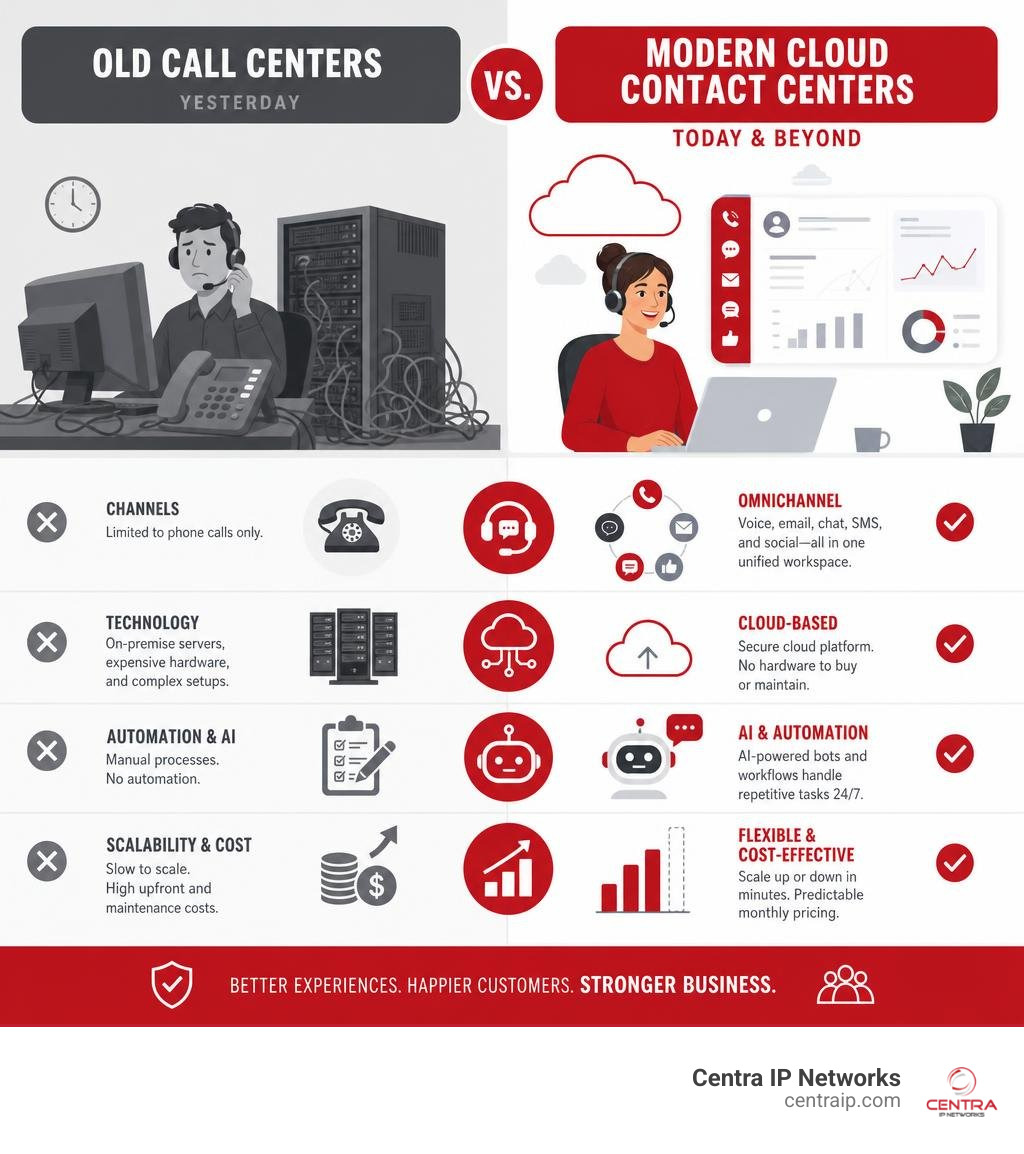
Modern contact center solutions are cloud-based software platforms that unify voice, email, chat, SMS, and social media into a single interface to help businesses manage all customer interactions in one place. Unlike old-fashioned call centers that only handle phone calls, these modern platforms use artificial intelligence (AI), smart routing, and deep customer data integrations to resolve issues faster and improve customer satisfaction.
Here is a quick summary of what these solutions deliver:
- Omnichannel Support: Customers can reach you via phone, text, email, or chat, and your agents can see the entire history in one window.
- AI and Automation: Smart virtual agents handle simple, repetitive questions 24/7 so your team can focus on complex cases.
- Predictable Costs: Simple monthly subscriptions replace the need for expensive on-site servers, physical hardware, and massive IT teams.
- Easy Scaling: You can add or remove agent seats in minutes to match seasonal demand without waiting weeks for new phone lines.
I am Patrick Brangan, and over the past 20 years, I have helped small and mid-sized businesses implement high-performing contact center solutions that drive efficiency without high costs. As a technology expert specializing in unified communications and managed IT, I focus on cutting through tech clutter to design simple, one-vendor communication tools that keep your business connected.
Contact center solutions terms explained:
At their core, contact center solutions are the central nervous system of modern customer service. They are software suites—most commonly hosted in the cloud as Contact Center as a Service (CCaaS)—that collect every incoming and outgoing customer interaction and funnel them into a single, organized interface. Whether a customer sends a direct message on social media, fires off an email, starts a live web chat, or picks up the phone, the software ensures that the conversation is routed to the right person with all the relevant context intact.

In 2026, customer expectations have reached an all-time high. Recent industry data shows that 82% of service professionals report that customer expectations are significantly higher than they used to be. Customers no longer tolerate repeating their account numbers or explaining their problems multiple times when switching from a website chat to a phone call.
Modern SaaS applications solve this friction by maintaining a continuous customer journey. When an agent answers a query, they have immediate access to the history of that customer’s digital interactions across all digital channels. To understand how these cloud platforms have evolved to support this seamless workflow, you can read our breakdown of What is a Cloud-Based Call Center? Features and Benefits.
Call Center vs. Contact Center Solutions
While the terms are often used interchangeably, there is a massive operational difference between a traditional call center and a modern contact center.
Traditional call center software is built almost exclusively for voice calls. It handles inbound routing (sending calls to available agents) and outbound dialing (for sales campaigns). If a customer wants to email or chat, those channels are handled by entirely separate, disconnected software programs. This siloed approach leads to disjointed customer experiences and frustrated agents who must constantly switch between different browser tabs.
In contrast, contact center solutions are inherently omnichannel. They unify customer communications by blending:
- Voice Calls: Traditional inbound and outbound telephony, enhanced with high-definition audio and smart interactive voice response (IVR).
- Email Support: Automated sorting, prioritizing, and routing of customer emails.
- Web Chat & Messaging Apps: Real-time chat on your website, alongside integrations with popular messaging apps like WhatsApp, Facebook Messenger, and SMS messaging.
- Social Media: Monitoring and responding to customer queries or public comments on social channels.
By bringing all these digital interactions into a unified desktop, agents can seamlessly pivot from one channel to another without losing the thread of the conversation.
Key Deployment Models: Cloud vs. On-Premises
When deciding how to deploy your contact center, you generally have three architectural paths: cloud-based, on-premises, or a hybrid model.
- Cloud-Based (CCaaS): This is the modern standard. Hosted entirely on the provider’s servers, CCaaS requires zero physical hardware on your site. Updates are handled automatically, security patches are deployed instantly, and agents can work securely from anywhere with an internet connection—whether they are in an office in Dallas, working from home in Tampa, or operating in a hybrid setup in Fort Worth.
- On-Premises: This traditional model requires buying and maintaining physical servers, PBX hardware, and dedicated telephone lines in your own office building. While it offers maximum control over data storage, it comes with massive upfront capital expenses, expensive software licensing, and requires a highly specialized, in-house IT team to keep it running.
- Hybrid Migration: For businesses with significant investments in legacy infrastructure, a hybrid approach is often the most practical path. Utilizing flexible subscription programs, like the Cisco Flex Plan, businesses can connect their existing on-premises systems to cloud applications. This allows you to modernize your legacy infrastructure at your own pace, moving key features like AI virtual agents to the cloud while keeping core voice routing on physical servers until you are ready for a full migration.
Essential Features of Modern Contact Center Solutions
When evaluating different contact center solutions, it is easy to get overwhelmed by the long list of features. However, a high-performing system relies on a core set of features designed to maximize agent efficiency and deliver a frictionless customer experience.

From basic call routing to advanced security, these features work together to keep your business running smoothly. For a deep dive into how to manage call logging and regulatory requirements, check out The Complete Guide to Contact Center Recording and Compliance.
Omnichannel Routing and ACD
The foundation of any great contact center is its ability to route interactions intelligently.
- Automatic Call Distribution (ACD): This system acts as the digital traffic cop, automatically directing incoming calls, chats, and emails to the most appropriate queue.
- Skills-Based Routing: Instead of simply sending a customer to the first available agent, skills-based routing uses contact-attached data to match the customer with an agent who has the exact skills required to solve their problem (such as technical expertise or bilingual support). This dramatically improves First Contact Resolution (FCR) rates.
- Media Blending: This allows agents to handle multiple media types simultaneously. For example, an agent can respond to low-priority emails or web chats during quiet periods between inbound voice calls, maximizing their productivity.
- Queue Callback: No one likes waiting on hold. Queue callback features let customers hang up the phone while retaining their virtual place in line. The system then automatically calls them back when an agent becomes available.
- Unified Desktop & Interaction History: By giving agents a single view of the customer’s entire interaction history, you eliminate the need for customers to repeat themselves, resulting in streamlined customer support workflows.
AI-Powered Automation and Analytics
Artificial intelligence is no longer a futuristic concept—in 2026, it is a core component of contact center efficiency.
- Generative AI & Virtual Agents: AI-powered virtual agents can handle up to 45% to 50% of routine customer inquiries (like tracking a package or resetting a password) without any human intervention.
- Sentiment Analysis: By analyzing the customer’s tone of voice or text in real time, AI can flag frustrated customers and automatically escalate them to a supervisor before the interaction goes downhill.
- Voice Transcription & Automated Summaries: AI can transcribe calls in real time and automatically generate summaries of the conversation. This reduces after-contact work for agents—which is crucial, considering that service reps typically spend only 46% of their work hours directly helping customers due to administrative tasks.
- Real-Time Coaching: During a live call, AI can suggest answers, pull up relevant knowledge-base articles, and guide agents through complex troubleshooting steps.
To learn more about how to leverage these data-driven insights to scale your business, take a look at our guide: Stop Guessing and Start Growing with These Call Center Analytics Tools.
Comparing Contact Center Platform Architectures in 2026
To help you navigate the busy CCaaS market, we have broken down how some of the leading contact center platforms compare across deployment models, ease of use, and overall customer satisfaction based on industry reviews.
| Platform / Vendor | Primary Deployment | Ease of Use | Key Strength / Unique Angle | Gartner Peer Rating |
|---|---|---|---|---|
| Cisco Webex | Cloud / Hybrid | High | Trusted enterprise security and flexible hybrid migration paths | 4.7 / 5 (278 reviews) |
| Genesys Cloud CX | Cloud | Medium-High | Deep customer journey mapping, personalization, and 350+ pre-built integrations | 4.6 / 5 (1,033 reviews) |
| Five9 Intelligent CX | Cloud | High | Excellent agent empowerment tools, automated notes, and open API integrations | 4.5 / 5 (869 reviews) |
| NiCE CXone | Cloud | High | Massive omnichannel scale, supporting over 40 communication channels | 4.7 / 5 (555 reviews) |
| storm CONTACT | Cloud | High | Highly customized, enterprise-grade cloud communications and reliability | 4.8 / 5 (243 reviews) |
| Dialpad Support | Cloud | Very High | Proprietary built-in AI, automated transcriptions, and rapid setup | 4.4 / 5 (G2 / Peer) |
| Nextiva | Cloud | Very High | Simple, all-in-one platform blending UCaaS and CCaaS for growing teams | 4.5 / 5 (G2 / Peer) |
Enterprise-Grade Architectures
For large organizations—especially those operating across multiple sites in major business hubs like Dallas, Fort Worth, or Orlando—enterprise-grade architectures are essential. These systems are designed to manage complex customer journeys across thousands of agents while maintaining strict enterprise security standards.
Key elements of enterprise-grade architectures include:
- Multi-Site Routing & High Availability: Ensuring that if one call center location experiences an outage, traffic is instantly rerouted to another location without any disruption to the customer.
- Deep CRM and ERP Integrations: Syncing your contact center directly with enterprise databases (like Salesforce, SAP, or ServiceNow) so that every agent has instant access to real-time customer data, billing history, and past purchases.
- Strict Security & Compliance: Enterprise platforms often carry advanced security certifications (such as SOC 2, HIPAA, PCI DSS Level 1, and GDPR compliance) to protect sensitive customer data and secure call recordings.
If you are looking for practical strategies to elevate your customer experience to an enterprise level, read our playbook on How to Master the Contact Center Customer Experience Without Breaking a Sweat.
Agile and AI-First Cloud Architectures
For growing businesses and agile mid-market companies in areas like Tampa, St. Petersburg, Clearwater, and Sarasota, heavy enterprise systems can sometimes feel like overkill. These businesses are better served by agile, AI-first cloud architectures.
These modern systems focus on:
- Rapid Deployment: While traditional systems can take months to configure, modern cloud solutions can be set up and deployed in a matter of weeks, or even days.
- Pay-Per-Use and Scalable Cloud Communications: Flexible subscription models allow you to pay only for the active agent seats you need, making it incredibly easy to scale your workforce up or down based on seasonal demand.
- No-Code and Low-Code Customization: Enabling business managers to adjust call routing, update IVR menus, and build simple workflow automations using drag-and-drop visual designers without needing to submit an IT ticket.
Choosing the Right Solution: SMBs vs. Enterprises
The best contact center solution for your business depends heavily on your size, your operational complexity, and your overall growth goals.
While small and medium-sized businesses (SMBs) prioritize rapid setup, lower costs, and ease of use, large enterprises focus on deep customization, global scalability, and strict security compliance. To see how businesses of all sizes have successfully navigated this technology decision, read our compilation of From Hold Music to High Praise: Contact Center Success Stories You Need to Read.
Evaluating Total Cost of Ownership and ROI
When calculating the budget for your new system, it is important to look beyond the initial monthly subscription price to understand the true Total Cost of Ownership (TCO).
- On-Premises TCO: Includes high upfront capital expenses for servers and licenses, ongoing hardware maintenance, energy costs to run server rooms, and the salaries of dedicated IT staff to manage the system.
- Cloud TCO: Consists of a predictable, monthly or annual subscription pricing model. While there are minimal upfront costs, you should factor in agent licensing tiers, potential add-on fees for advanced AI features, and internet bandwidth upgrades.
- Single-Provider Cost Efficiencies: This is where partnering with a provider like Centra IP Networks makes a massive difference. By consolidating your phone systems, internet connectivity, managed IT, and contact center software onto a single platform with a single bill, you eliminate the “finger-pointing” that often happens between multiple technology vendors. This single-provider approach drastically reduces administrative overhead and lowers your overall technology spend.
Key Selection Factors for Your Contact Center Solutions
Before signing a contract with any vendor, make sure to evaluate these five critical factors:
- Platform Reliability & Uptime SLAs: Look for providers that offer a guaranteed uptime of 99.999% to ensure your customer service lines never go dark.
- Integration APIs: Ensure the platform integrates seamlessly with your existing CRM, helpdesk, and internal collaboration tools (like Microsoft Teams or Zoom) out of the box.
- Compliance Standards: If you operate in regulated industries like healthcare, finance, or legal services in Florida or Texas, verify that the platform meets HIPAA, PCI, and SOC 2 security standards.
- Workforce Management (WFM) Alignment: Look for built-in tools for agent scheduling, volume forecasting, and quality monitoring to keep your team operating at peak efficiency.
- Local Vendor Support: Having access to 24/7 technical support from a partner who understands your local market—whether you are based in Fort Worth, Orlando, or Sarasota—is invaluable when you need quick assistance.
If you are looking for local support and staffing solutions to help scale your operations, you can explore resources like Call Center and Customer Service Hiring Solutions | Fort Worth … to find the right talent for your team.
Frequently Asked Questions about Contact Center Software
What is the difference between CCaaS and UCaaS?
While they sound similar, CCaaS (Contact Center as a Service) and UCaaS (Unified Communications as a Service) serve two different purposes:
- UCaaS is designed for internal collaboration. It unifies business phone systems, video conferencing, and internal chat for your employees.
- CCaaS is designed for external customer experience. It includes advanced routing, queue management, call recording, and customer analytics tools.
For the best results, look for a solution that integrates both platforms so your customer service agents can easily message internal back-office experts to resolve complex customer issues in real time.
How long does it take to deploy a cloud contact center?
A modern cloud-based contact center can typically be deployed in a matter of weeks. This is a massive contrast to traditional on-premises systems, which often require several months of physical hardware installation, provisioning, and complex configurations. Because cloud systems are hosted off-site, adding new agents or changing routing rules can be done in minutes via a web-based dashboard.
Businesses looking to outsource their operations or find local support during a transition can leverage regional experts, such as Call Center Outsourcing Tampa | St Petersburg | Clearwater | Orlando or Dallas Call Center Services – TeleDirect , to ensure a smooth deployment.
How does AI improve contact center agent productivity?
AI acts as a force multiplier for your agents. By handling routine, low-value tasks (like answering basic FAQs, resetting passwords, and summarizing call notes), AI frees up your team to focus on high-value, complex customer issues. Recent studies show that 81% of customer service representatives using AI say it frees up significant time in their day, allowing them to handle up to 45% more volume without adding extra stress to their workload.
Conclusion
Choosing the right contact center solutions is one of the most impactful technology decisions your business can make. The right platform will not only streamline your operations and lower your overhead, but it will also turn your customer service department into a powerful engine for customer loyalty and business growth.
At Centra IP Networks, we specialize in taking the complexity out of business communications. We deliver comprehensive Managed IT and Cloud Communications services—including enterprise-grade phone systems, high-speed internet connectivity, and advanced cloud contact center solutions—all on a single, unified platform with one clear bill and one dedicated provider. By leveraging our 35+ industry partnerships, we design tailored, cost-effective communication tools specifically for businesses across Dallas, Fort Worth, Orlando, Tampa, St. Petersburg, Clearwater, and Sarasota.
Ready to eliminate the headaches of managing multiple tech vendors and elevate your customer experience?
Optimize your customer experience with Centra IP Networks today, and let’s build a simpler, smarter way to keep your business connected.