

Why Managed Communication Services Are Changing How Businesses Operate
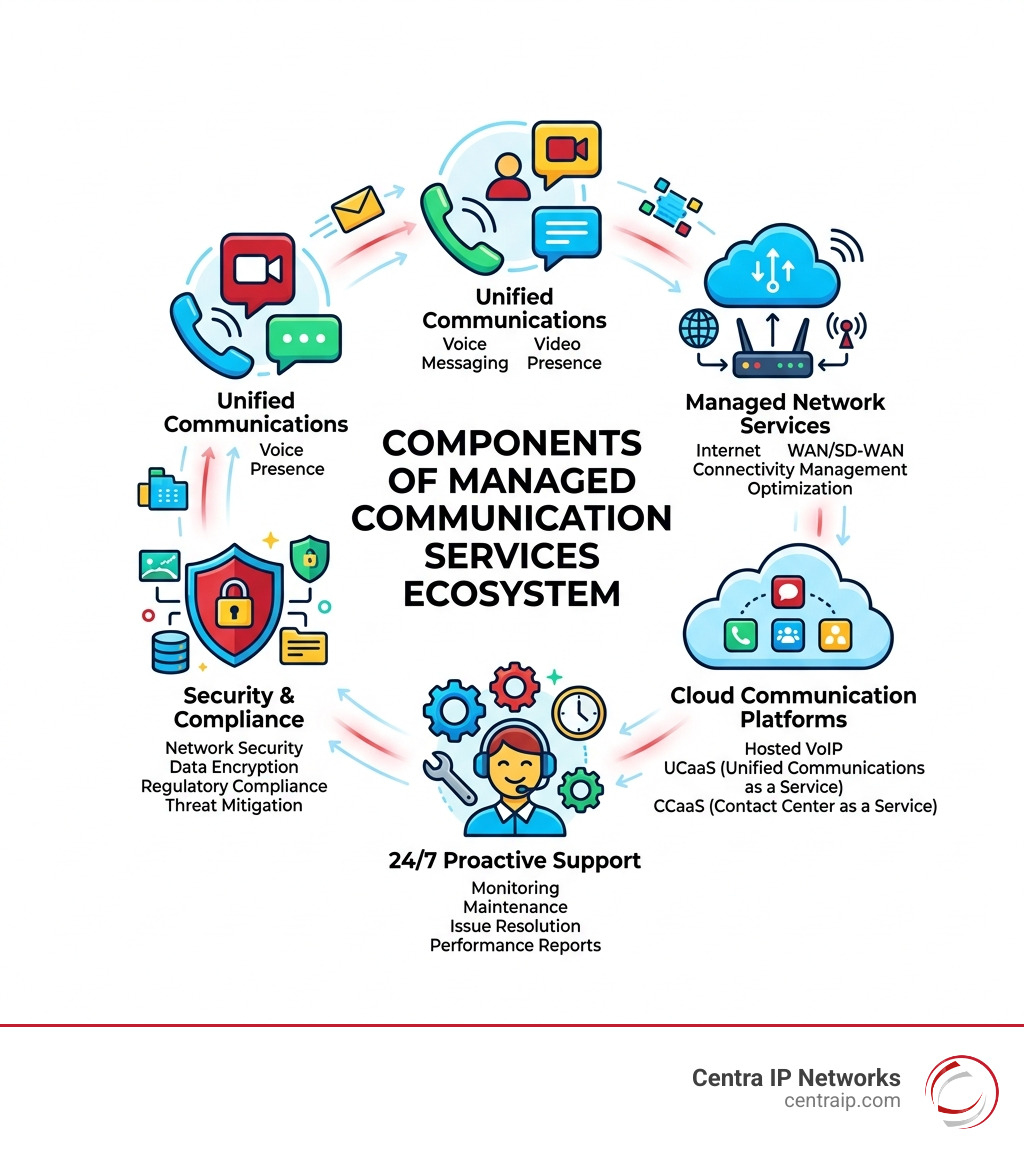
Managed communication services (MCS) are third-party solutions that handle all of your business communication infrastructure — including voice, video, messaging, and data — so your internal team doesn’t have to.
Here’s a quick summary of what MCS includes and why businesses use it:
| What It Is | What It Does | Why It Matters |
|---|---|---|
| Outsourced communication management | Monitors, maintains, and optimizes voice, video, and data systems | Frees up internal IT resources |
| Cloud-based platforms (UCaaS, CCaaS, VoIP) | Unifies all channels into one system | Reduces vendor complexity |
| 24/7 proactive support | Resolves issues before they cause downtime | Keeps operations running |
| Predictable subscription pricing | Replaces unpredictable IT maintenance costs | Simplifies budgeting |
| Carrier-grade reliability | Delivers 99.999% uptime SLAs | Protects revenue and reputation |
Managing phone systems, internet, video conferencing, and contact center tools across multiple vendors is a real burden. Most small and mid-sized businesses end up with a patchwork of providers, bills, and support contacts — and nobody owns the whole picture.
That’s where managed communication services come in. Instead of juggling five vendors, you work with one partner who designs, deploys, and manages everything for you.
The results speak for themselves. Businesses using managed services have reported an 18% reduction in network unavailability, 32% fewer customer complaints, and a 42% reduction in Mean Time to Resolution (MTTR) — meaning problems get fixed faster before they ever affect your customers.
This guide walks you through everything you need to know: what MCS includes, how it compares to traditional IT, which industries benefit most, and how to choose the right provider.
I’m Patrick Brangan, a business technology specialist with 20+ years of experience helping SMBs with managed communication services, unified communications, and managed IT — serving companies across Dallas, Tampa, and Orlando. Let’s break down exactly what these services can do for your business.
Must-know managed communication services terms:
What are Managed Communication Services?
At its core, managed communication services represent the outsourcing of your entire communication stack. Instead of purchasing hardware and trying to fix it when it breaks, you partner with a provider who takes full responsibility for the platforms that keep your staff and customers connected.
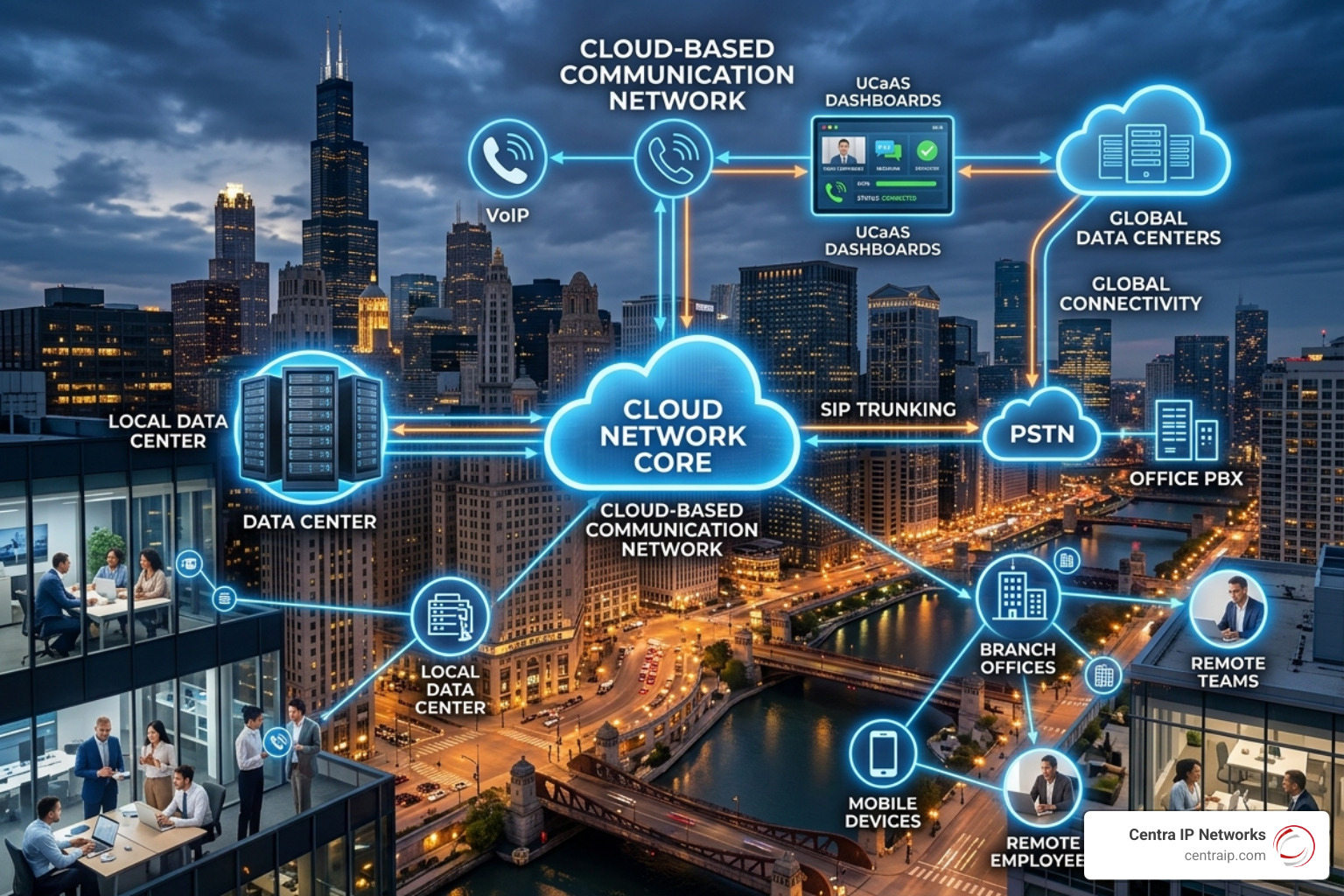
Modern MCS is built on a foundation of cloud-based network architecture. This includes:
- UCaaS (Unified Communications as a Service): Integrating voice, video, and messaging into a single dashboard.
- CCaaS (Contact Center as a Service): Advanced tools for customer support, including intelligent routing and AI assistants.
- SIP Trunking: Consolidating voice and data into one IP network to eliminate the need for traditional, expensive phone lines.
- Cloud PBX & VoIP: Moving your “phone brain” to a secure data center so you can take calls from anywhere.
By utilizing these tools, we help businesses move away from the “break-fix” mentality. Rather than reacting to a downed phone line, we provide Managed IT Services that ensure the system stays up in the first place.
Managed Communication Services vs. Traditional IT
Many business owners ask us: “Can’t my in-house IT guy just handle this?” While internal teams are great for day-to-day desktop support, communication infrastructure is a different beast. Traditional in-house IT often faces limitations in 24/7 monitoring and specialized vendor management.
When you use Managed IT Consulting Services, you gain a partner who manages the relationships with dozens of carriers and software providers. We handle the patching, security updates, and performance tuning that often fall through the cracks of a busy internal IT department. In the Managed IT vs. In-House IT debate, the “managed” side wins on scalability and proactive maintenance every time.
The Role of Carrier-Grade Infrastructure
In communication, “good enough” isn’t enough. If your phones go down, your business stops. That’s why we focus on carrier-grade infrastructure. This means delivering a 99.999% SLA (Service Level Agreement)—the “five nines” of reliability that translate to less than six minutes of downtime per year.
Achieving this requires deep redundancy and Managed Disaster Recovery Services. If an internet circuit in Dallas goes down, your calls should automatically reroute to a backup line or a mobile app without the caller ever knowing there was a glitch.
Key Benefits of Managed Communication Services for Modern Business
The shift to managed communication services isn’t just a tech upgrade; it’s a financial and operational strategy. By moving from a Capital Expenditure (CapEx) model-where you buy expensive servers-to an Operational Expenditure (OpEx) model, you stabilize your cash flow.
| Metric | Traditional In-House | Managed Communication Services |
|---|---|---|
| Network Availability | Variable | 99.999% SLA |
| MTTR (Resolution Time) | Hours/Days | 42% Faster Resolution |
| Upfront Cost | High (Hardware) | Low (Subscription) |
| Scalability | Slow & Expensive | Instant & Flexible |
Research shows that companies working with top-tier managed service providers see significant improvements in their bottom line. Specifically, businesses report 32% fewer customer complaints because their communication channels are always open and clear. When you realize the Benefits of Managed IT Services, you see that it’s about more than just technology-it’s about the customer experience. For additional context on how managed service providers are evaluated across the industry, you can also review Cloudtango’s MSP directory.
Enhancing Operational Efficiency and Productivity
Efficiency is the name of the game in 2026. Managed services lead to 47% less truck rolls per node, meaning fewer technicians need to physically visit your office to fix hardware. This is largely due to the shift toward software-defined networking and cloud hosting.
Furthermore, MCS can lead to 3-8% lower energy consumption by eliminating the need for bulky on-site servers that require constant cooling. When your communication workflows are automated, your team spends less time troubleshooting and more time working. This is exactly How Managed IT Service Providers Boost Efficiency for growing firms.
Security, Reliability, and Regulatory Compliance
Security is no longer optional. With the FCC requiring RMD (Robocall Mitigation Database) recertification by March 2026, staying compliant is a full-time job. We ensure your business is protected through:
- Branded Calling: Improving answer rates by showing customers your verified business name.
- Data Encryption: Ensuring that voice and video data are secure from end to end.
- 911 Service Compliance: Ensuring that your VoIP system provides accurate location data to emergency responders.
To stay ahead of threats, we recommend following The Managed Network Security Playbook, which integrates security directly into your communication lines.
Core Features and Technologies in Managed Communication Services
What does modern MCS actually look like under the hood? It’s a mix of smart hardware and even smarter software.

Key features typically include:
- SD-WAN: This technology intelligently routes your traffic, ensuring that a Zoom call gets priority over a large file download so the video doesn’t freeze.
- Managed WiFi: Seamless connectivity across your entire office, from the lobby to the warehouse.
- Omnichannel Support: Letting your customers reach you via text, chat, email, or phone, with all those conversations appearing in one place for your agents.
Whether you need Managed IT Services Dallas or specialized support in Fort Worth, these features ensure your infrastructure is “future-ready.”
The Impact of AI, Automation, and Cloud Integration
By April 2026, AI is no longer a buzzword; it’s a core component of managed communication services. AI phone agents can now handle 24/7 customer inquiries, while predictive operations use machine learning to identify a failing network node before it actually crashes.
Managed cloud services allow businesses to deploy Generative AI infrastructure on-premises or in the cloud, tailored to their specific data needs. This integration provides real-time insights, turning technical data into actionable business intelligence.
Major Providers and Market Leaders
The landscape is dominated by heavy hitters who set the standard for excellence. Verizon has been recognized as a Leader in the Gartner Magic Quadrant for Global WAN Services for 19 consecutive years. Ericsson manages nearly 800,000 RAN sites globally, proving the scale of modern managed networks.
When Choosing Your Tech Partner: The Premier Managed IT Services in Dallas, look for those who integrate with the tools you already use, such as Cisco Webex or Microsoft Teams. A great provider doesn’t make you change how you work; they make your work easier.
Supporting Hybrid Work and Industry-Specific Needs
The way we work has changed forever. Whether your team is in Orlando, Tampa, or working from a home office in St. Petersburg, they need the same high-quality experience.
How Managed Communication Services Support Hybrid Teams
Hybrid work requires more than just a laptop. It requires:
- Asynchronous Messaging: Keeping the conversation going without needing a real-time meeting.
- HD Audio and Video: Ensuring professional-grade communication regardless of location.
- Device-Agnostic Platforms: Your phone system should work the same on a desk phone, a laptop, or a smartphone.
For businesses in Florida, Managed IT Services Orlando are essential for maintaining connectivity during peak times. We’ve found that Managed IT Services in Orlando Are Critical for companies that need to scale their remote onboarding processes quickly. The same applies to those looking for Managed IT Service Providers Tampa, where reliable remote access is a top priority.
Vertical Solutions: Healthcare, Accounting, and Retail
Different industries have different “must-haves.”
- Healthcare: Requires strict HIPAA compliance and secure, encrypted communication to protect patient data. Managed IT Services for Healthcare focus on these high-stakes requirements.
- Accounting: Needs secure document sharing and reliable uptime during tax season. Managed IT Services for Accounting Firms ensure that communication never falters when deadlines loom.
- Retail: Benefits from multi-location connectivity, ensuring that a store in Sarasota can communicate seamlessly with a warehouse in Clearwater.
Future Trends: Managed Communication Services Through 2033
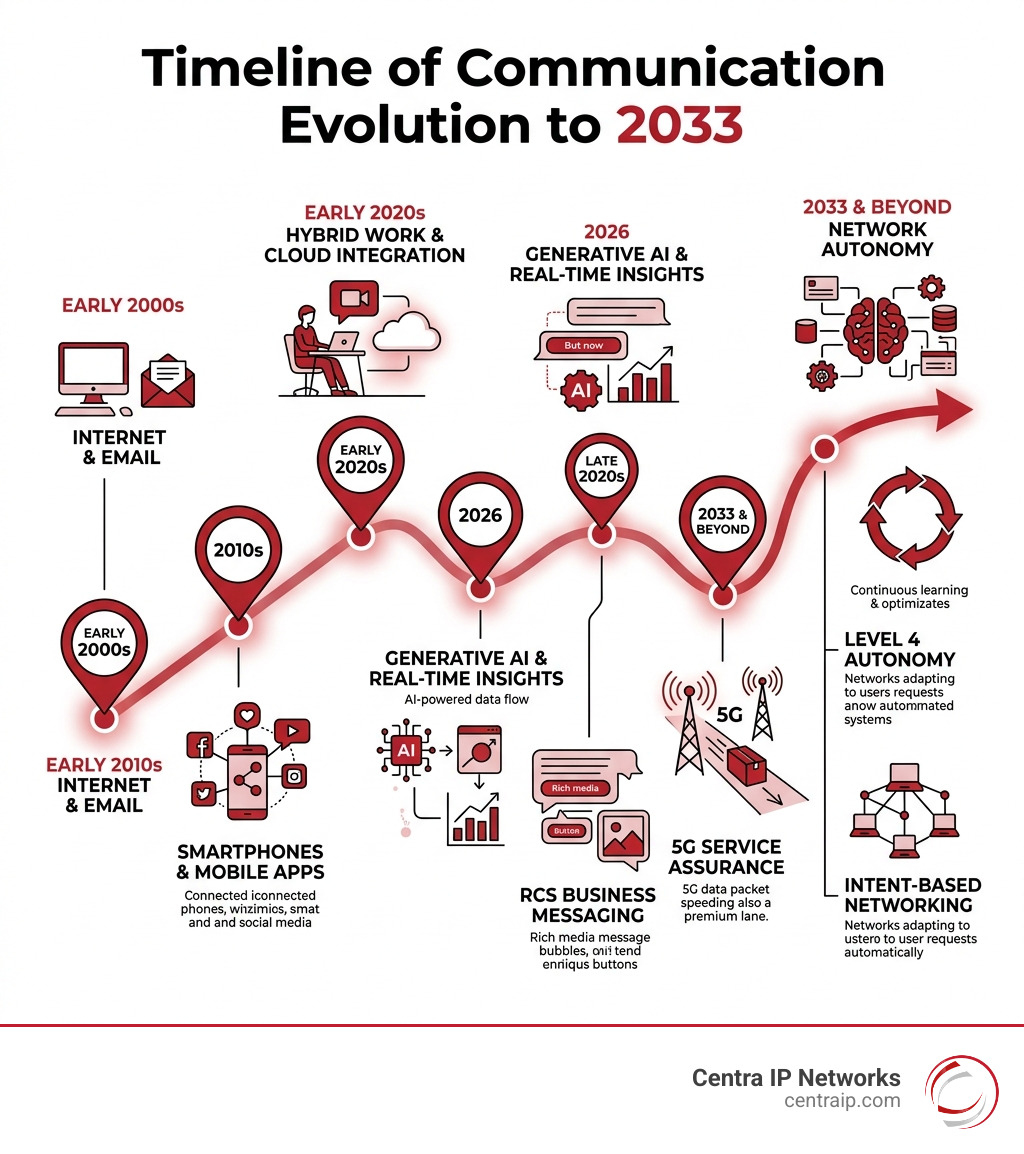
Looking ahead toward 2033, the goal is “network autonomy.” We are moving toward Level 4 Autonomy, where networks independently learn, predict, and resolve issues without human intervention.
Key trends include:
- Intent-Based Networking: You tell the network what you want to achieve (e.g., “Give all video calls 100% priority”), and the system automatically configures itself to make it happen.
- RCS Business Messaging: Moving beyond simple SMS to media-rich, interactive texting that includes buttons, carousels, and high-res images.
- 5G Service Assurance: Using 100% SLA compliance for “premium slices” of the 5G network, ensuring that critical business data always has a fast lane.
For businesses in the Florida Gulf Coast, staying on top of these trends with Managed IT Services Tampa can provide a significant competitive advantage.
Measuring Success: Key Performance Metrics
How do you know if your MCS adoption is working? Look at these metrics:
- SLA Compliance: Is your provider hitting that 99.999% uptime mark?
- Bandwidth Utilization: Are you paying for more than you use, or is your SD-WAN optimizing your existing circuits?
- Energy Efficiency: Have you seen a reduction in your power bill after moving to the cloud?
- Customer Experience KPIs: Are your hold times shorter and your call quality higher?
By tracking the Benefits of Managed IT Services Tampa, you can see the tangible ROI of your investment.
Frequently Asked Questions about Managed Communication Services
What is the typical pricing model for MCS?
Most managed communication services use a subscription-based, per-user “seat” model. This makes your costs highly predictable. You don’t have to worry about a $5,000 repair bill if a server dies; that’s the provider’s responsibility. This optimizes your Total Cost of Ownership (TCO) by reducing capital expenditure (CapEx) and moving it to a manageable monthly OpEx.
How do I select the right managed communication services provider?
Look for three things:
- Carrier Redundancy: Do they have relationships with multiple internet and voice providers?
- 24/7 US-Based Support: You don’t want to be stuck behind a chatbot when your phones are down.
- Industry Expertise: Do they understand the specific regulations of your field (like HIPAA or SEC rules)?
What are real-world examples of successful MCS implementation?
We’ve seen massive success stories, such as a service company that upgraded its IT infrastructure across 400 locations, transforming its ability to communicate with field technicians. Another example is a K-12 school district that migrated to cloud VoIP, saving 50% on their monthly bills while gaining the ability to broadcast emergency alerts to every classroom instantly. Even rapidly growing businesses with branches across Dallas and Fort Worth have used MCS to connect seven different offices into one unified “virtual” office in under a week.
Conclusion
At Centra IP Networks, we believe that communication should be the easiest part of your business, not the most stressful. Our approach to managed communication services is simple: we provide a single platform with one bill and one point of contact. By leveraging our 35+ partnerships, we design tailored, cost-effective solutions that fit your specific needs in Dallas, Fort Worth, Orlando, or Tampa.
Ready to stop juggling vendors and start growing your business? Streamline your business communications today and let us handle the technical heavy lifting while you focus on what you do best.