
Why Contact Center Customer Experience Determines Whether Customers Stay or Leave
Contact center customer experience describes every interaction a customer has with your support team — across phone, chat, email, SMS, and social media — and how those interactions make them feel about your brand.
Here’s what you need to know at a glance:
| What It Is | Why It Matters | How to Improve It |
|---|---|---|
| All touchpoints between customers and your support team | 65% of customers switch brands after just one bad experience | Reduce wait times and friction |
| Spans the full customer journey, not just phone calls | Happy customers are 3x more likely to buy again | Use omnichannel support |
| Measured by CSAT, NPS, CES, and FCR | 83% of customers say a good experience builds brand loyalty | Train agents and deploy AI tools |
| Involves both human agents and automated tools | Poor CX directly reduces revenue and retention | Personalize interactions with customer data |
Think about the last time you called a company for help. You waited on hold. You repeated your account details twice. You got transferred. By the end, you were frustrated — not because the agent was rude, but because the system failed you.
That’s the contact center experience problem in a nutshell. And in 2026, customers have less patience for it than ever. A full 82% of service professionals say customer expectations are higher than they’ve ever been, yet 83% of consumers believe the experience they’re getting is still far below where it should be.
The gap between what customers expect and what they actually receive is where businesses lose loyalty, revenue, and reputation — often without realizing it until it’s too late.
I’m Patrick Brangan, and with over 20 years in business technology — specializing in unified communications for SMBs across Dallas, Tampa, and Orlando — I’ve helped hundreds of growing companies close that gap and build a contact center customer experience that actually works. In this guide, I’ll walk you through everything you need to know to make that happen, without the complexity or the headaches.
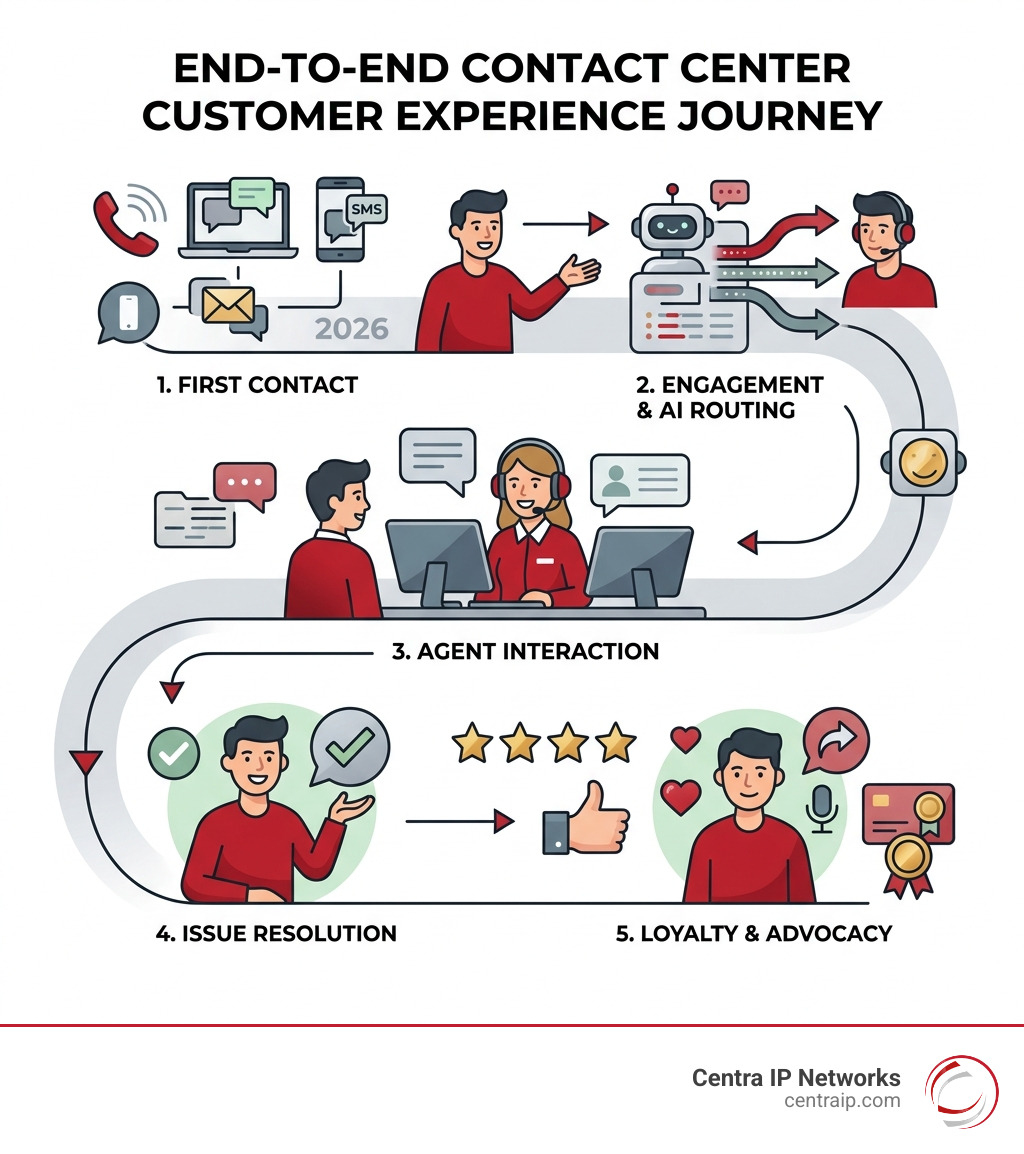
Common contact center customer experience vocab:
Defining the Modern Contact Center Customer Experience
In the “old days” (which, in tech years, was about five minutes ago), customer service happened in a silo. You had a problem, you picked up a phone, and you spoke to someone in a room full of ringing bells. Today, the landscape has shifted into what we call multimodal orchestration.
The modern contact center customer experience isn’t just a department; it’s a digital ecosystem. It encompasses every touchpoint from the moment a customer searches your FAQ page to the final “thank you” email after a resolution. It requires Contact Center Solutions for Premium CX that can track a customer’s journey across multiple platforms without losing the “thread” of the conversation.
In 2026, the trend is toward seamless continuity. If a customer starts a chat in Clearwater while drinking their morning coffee and finishes the interaction via a phone call while driving through Tampa, they expect you to know exactly where they left off. They don’t want to be a “ticket number”; they want to be a person. Understanding What is Cloud-Based Call Center: Features and Benefits is the first step in building this infrastructure, as cloud tech allows for the flexibility and data integration that on-premise hardware simply can’t match.
Contact Center vs. Call Center Experience
Many people use these terms interchangeably, but in our world, they are worlds apart. A call center is voice-only. It’s reactive. It’s the “hold music and transfer” model that everyone loves to hate. A contact center, however, is built on omnichannel integration.
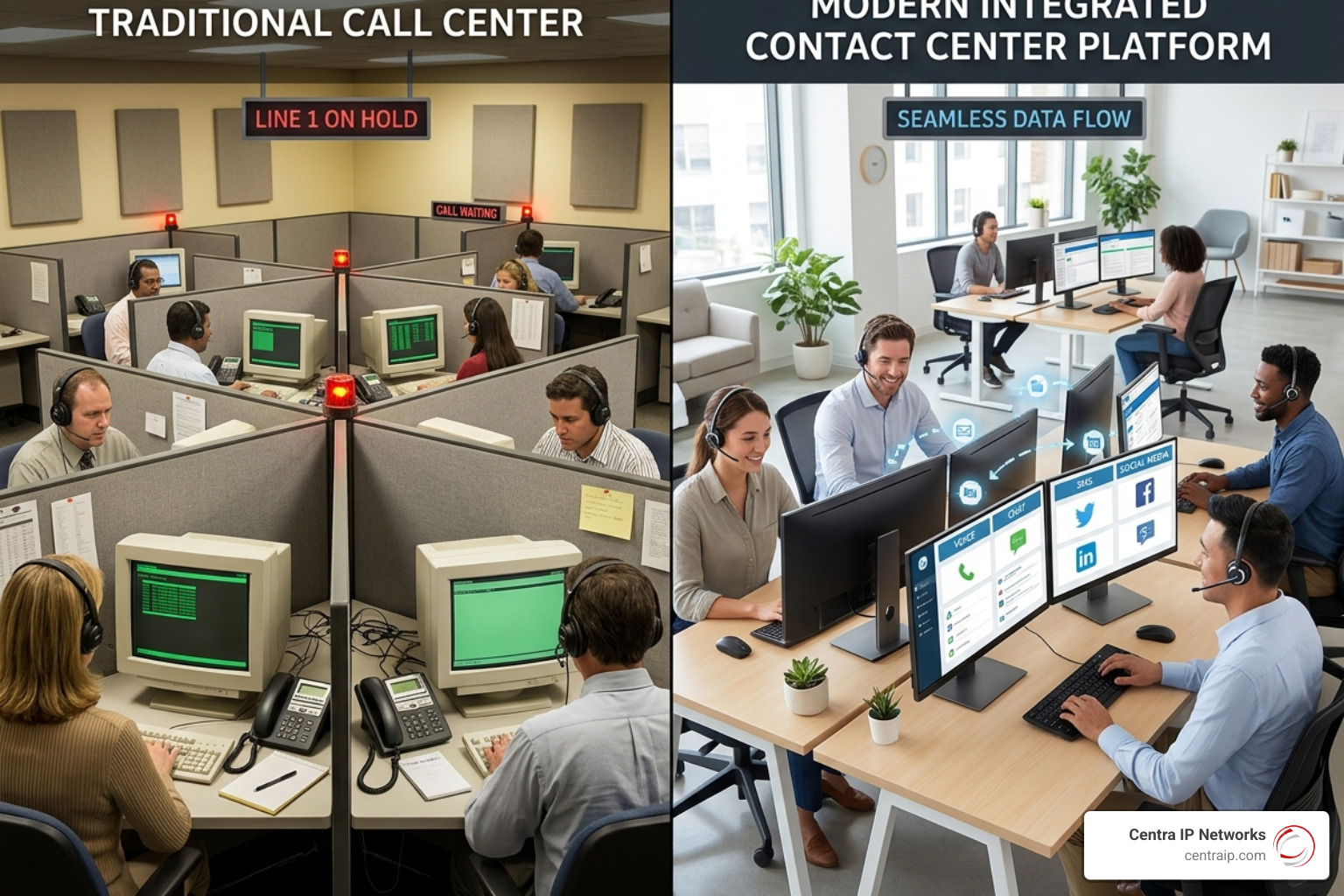
Here is how they stack up in 2026:
| Feature | Traditional Call Center | Modern Contact Center |
|---|---|---|
| Primary Channel | Voice (Phone) | Omnichannel (Voice, SMS, Chat, Social) |
| Strategy | Reactive (Wait for calls) | Proactive (Outreach and Self-Service) |
| Data | Siloed in the phone system | Integrated with CRM and Marketing |
| Context | Customer repeats info every time | Context follows the customer across channels |
| Tech Stack | Legacy hardware (PBX) | Centra IP Cloud Communications |
The biggest limitation of legacy systems is the “data silo.” When your phone system doesn’t talk to your email or your CRM, your agents are flying blind. This leads to the “I’ve already told you this” syndrome, which is the fastest way to kill your contact center customer experience.
Key Components of a Premium Experience
To move from “fine” to “premium,” you need to focus on six core pillars:
- Personalization: Using customer data to greet them by name and know their purchase history before they even speak.
- Speed of Resolution: It’s not just about how fast you answer, but how fast you fix it.
- Agent Empowerment: Giving your team the authority to make decisions without asking three managers for permission.
- Knowledge Management: A centralized “brain” where both customers (via self-service) and agents can find the right answers instantly.
- Proactive Support: Reaching out to a customer about a delay before they have to call you to complain.
- Emotional Intelligence: Training agents to handle the “human” side of the interaction—empathy, active listening, and patience.
Why CX Is Your Biggest Revenue Driver in 2026
If you think the contact center is just a “cost center” or a “necessary evil,” you’re leaving money on the table. In 2026, contact center customer experience is the primary engine for customer lifetime value (CLV).
The statistics are staggering. Happy customers are more than 3x more likely to buy from you compared to new customers. Conversely, 43% of consumers say a poor experience will prevent them from making a repeat purchase. When you realize that 80% of brand switches happen because of a negative experience—and 43% happen after just one bad interaction—the stakes become clear.
We’ve seen this play out in our own backyard. Whether it’s a medical group in Dallas or a logistics firm in Fort Worth, businesses that prioritize CX see a massive word-of-mouth impact. In fact, two-thirds of businesses that prioritize CX grow their customer lifetime value by an average of 2.3 times. You can read more about these transformations in our guide: From Hold Music to High Praise: Contact Center Success Stories You Need to Read.
Measuring Contact Center Customer Experience Success
You can’t manage what you don’t measure. But in 2026, we’ve moved beyond just counting how many calls an agent takes in an hour. To truly understand your contact center customer experience, you need to look at:
- CSAT (Customer Satisfaction Score): The classic “How did we do today?” survey.
- NPS (Net Promoter Score): “How likely are you to recommend us?” This measures long-term loyalty.
- CES (Customer Effort Score): This is the most important metric for 2026. It asks: “How easy was it to resolve your issue?” Low effort equals high loyalty.
- First Contact Resolution (FCR): The gold standard. Did you fix it the first time, or did the customer have to call back?
- Sentiment Analysis: Using AI to “read” the tone of a call or chat to see if the customer is frustrated, happy, or neutral.
To get these insights, you need Stop Guessing and Start Growing with These Call Center Analytics Tools. Real-time dashboards allow managers in Sarasota or St. Petersburg to see exactly what’s happening on the floor and intervene before a bad interaction turns into a lost customer.
Strategies to Elevate Your Contact Center Customer Experience
Elevating your CX isn’t about working harder; it’s about working smarter. It starts with removing the friction that makes customers (and agents) want to pull their hair out.
One of the most effective strategies is Intelligent Routing. Instead of just sending a call to the “next available” person, the system looks at the customer’s needs and the agent’s specific skills. If a customer in Orlando calls about a complex billing issue, the system routes them to an agent who specializes in finance, not a generalist. This is part of How to Provide a Great Contact Center Experience — Every Time.
Another key is the “Unified Console.” We’ve all seen it: an agent has 12 tabs open, jumping between a CRM, a billing tool, and a chat window. By unifying these into a single screen, you reduce “app switching” and allow the agent to focus entirely on the human on the other end of the line. For more tips on managing these interactions, check out Ring Ring Who’s There: Your Guide to Seamless Call Management.

The Role of AI and Agentic Orchestration
AI is no longer a futuristic concept; it’s the backbone of the 2026 contact center. But it’s not about replacing humans—it’s about augmenting them. We call this “Agentic Orchestration.”
- Generative AI: Can draft personalized email replies or chat responses that agents simply review and send, saving hours of typing.
- Virtual Agents: These aren’t the frustrating bots of 2020. Modern virtual agents use Natural Language Processing (NLP) to handle 24/7 self-service for routine tasks like password resets or order tracking.
- Automated Summaries: After a call ends, AI can instantly summarize the interaction and update the CRM, allowing the agent to move to the next customer immediately.
- Predictive Analytics: AI can look at current trends and predict a spike in calls (like during a Florida hurricane season), allowing you to staff up in advance.
By letting AI do the “chores,” your human agents can focus on the high-value, high-emotion interactions that actually build brand loyalty.
Improving the Agent Experience (EX)
Here is a hard truth: You cannot have a great customer experience if you have a miserable agent experience.
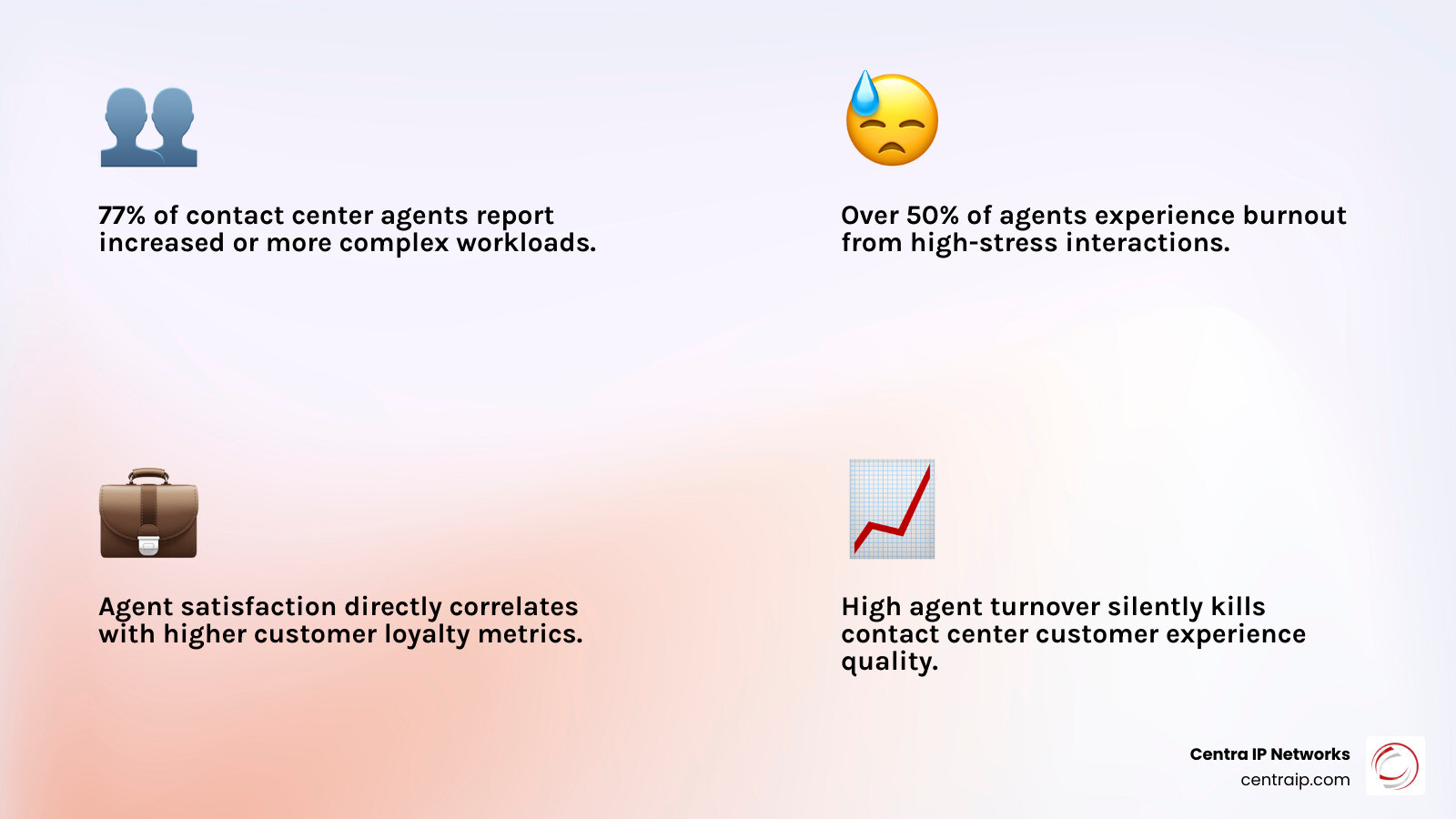
Currently, 77% of agents report increased or more complex workloads, and more than half report experiencing burnout. When agents are stressed, they are less empathetic, more prone to mistakes, and more likely to quit. High turnover is the “silent killer” of contact center customer experience.
To fix this, we recommend:
- Real-time Assistance: AI that “listens” to the call and pops up helpful knowledge base articles or “next-best-action” suggestions.
- Gamification: Turning metrics into friendly competition with rewards for high CSAT scores.
- Ongoing Training: Not just a one-week “onboarding,” but continuous coaching based on real call recordings.
- Empowerment Tools: Giving agents a “single source of truth” so they never have to say, “I’m not sure, let me check with my supervisor.”
Overcoming Challenges: From Agent Burnout to Data Silos
The road to a perfect contact center customer experience is paved with hurdles. The two biggest? Burnout and Data Silos.
In our work across Dallas and Fort Worth, we often see companies struggling with “fragmented technology.” They have a great phone system, but it doesn’t talk to their email. They have a CRM, but it doesn’t show chat history. This creates a disjointed experience for the customer and a frustrating one for the agent.
The solution is a unified data platform. When every channel is integrated, you can implement Skills-Based Routing. This ensures that the most complex problems go to your most experienced agents, while routine questions are handled by AI or newer staff. This balances the workload and prevents your top performers from burning out.
Security and compliance are also paramount in 2026. With regulations like HIPAA and PCI DSS, your Contact Center Services must include automatic PII (Personally Identifiable Information) redaction. This means if a customer says their credit card number or health info, the system automatically masks it in recordings and transcripts, keeping you compliant without extra effort from your team.
Frequently Asked Questions about Contact Center CX
What is the difference between call center and contact center customer experience?
The primary difference is channel variety and context. A call center experience is limited to voice, often requiring the customer to wait on hold and repeat their information. A contact center experience is omnichannel, allowing the customer to switch between text, email, and voice while the agent maintains a full view of the conversation history.
How can AI improve the contact center experience without losing the human touch?
AI handles the “heavy lifting”—routing calls, summarizing notes, and providing self-service for simple tasks. This actually saves the human touch for when it matters most. By removing routine tasks, agents have more time to spend on complex issues that require empathy and creative problem-solving.
What are the most important metrics for contact center success?
While every business is different, the “Big Three” are First Contact Resolution (FCR), Customer Satisfaction (CSAT), and Customer Effort Score (CES). If you make it easy for customers to fix their problems on the first try, your loyalty and revenue will follow.
Conclusion: Mastering the Experience with Centra IP
Mastering the contact center customer experience doesn’t have to be an uphill battle. In 2026, the businesses that win are the ones that simplify the journey—both for their customers and their agents.
At Centra IP Networks, we specialize in making this transition seamless for businesses in Dallas, Fort Worth, Orlando, Tampa, and throughout Florida. Our USP is simple: we provide all your Managed IT and Cloud Communications services on one platform. That means one bill, one provider, and one “single source of truth” for your entire communication strategy.
With over 35 partnerships, we don’t believe in “one size fits all.” We tailor cost-effective solutions that integrate your voice, data, and AI tools into a single, powerful engine for growth. Whether you’re looking to reduce agent burnout, break down data silos, or finally achieve that elusive 5-star CSAT score, we’re here to help.
Ready to transform your support from a cost center into a revenue driver? More info about contact center services is just a click away. Let’s build something great together.