Why a Mini PBX System Could Be the Smartest Phone Decision Your Small Business Makes
A mini PBX system is a compact, private telephone exchange designed for small businesses, home offices, and SOHO environments — giving you the core call-routing power of a full business phone system without the server room, high costs, or complexity.
Quick answer: What is a mini PBX system?
| Feature | Mini PBX System |
|---|---|
| What it does | Routes internal and external calls through one central system |
| Who it’s for | Small businesses, home offices, SOHO teams (typically 2–300 users) |
| Key types | Analog, On-Premise IP, Cloud/Hosted |
| Core features | Extensions, auto-attendant, call forwarding, voicemail, conferencing |
| Cost range | ~$200–$2,600+ upfront (on-premise) or $15–$40/user/month (cloud) |
| Top platforms | Asterisk, FreePBX, 3CX, proprietary appliances |
Managing business calls shouldn’t require a dedicated IT team or a five-figure hardware budget. Yet for years, that’s exactly what traditional PBX systems demanded. A conventional analog setup for just five employees could run at least $5,668 once you factor in hardware, installation, and labor. That’s a steep price for a small team trying to stay focused on growth — not telephony infrastructure.
Mini PBX systems change that equation. They bring professional call handling — think auto-attendants, call transfers, and multi-line management — down to a size and price point that actually works for small businesses. Whether it’s a physical appliance sitting quietly on a desk or a cloud-hosted solution running entirely over your internet connection, the goal is the same: keep your team connected and your customers well-served, without unnecessary overhead.
I’m Patrick Brangan, and over 20+ years of helping SMBs across Dallas, Tampa, and Orlando find the right unified communications fit, I’ve seen how the right mini PBX system can transform the way a small team communicates. In the sections below, I’ll walk you through everything you need to know to choose the best option for your business.
Mini pbx system word guide:
- best phone system for medium business
- best virtual phone system for small business 2026
- phone systems for small business
What is a Mini PBX System and How Does It Work?
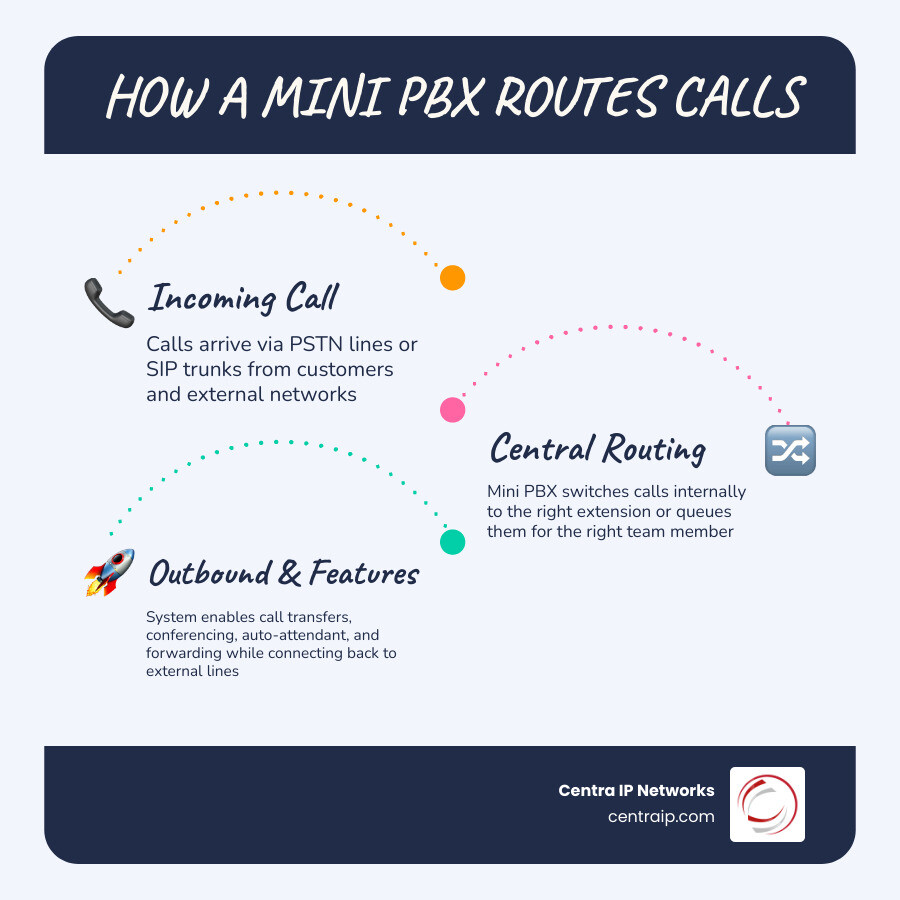
To understand a mini PBX system, we first have to look at what “PBX” actually means. PBX stands for Private Branch Exchange. In the old days, this was a massive cabinet of wires and switches located in a basement or server room. Its job was to act as a “mini telephone exchange” for a single building. It allowed employees to call each other via internal extensions and shared a limited number of external phone lines (the PSTN, or Public Switched Telephone Network) so the company didn’t have to pay for a separate line for every single desk.
A mini PBX system does exactly the same thing, but it’s been shrunk down by modern technology. Instead of a room-sized cabinet, it’s often a small appliance no larger than a Wi-Fi router, or even just a piece of software running on a small server.
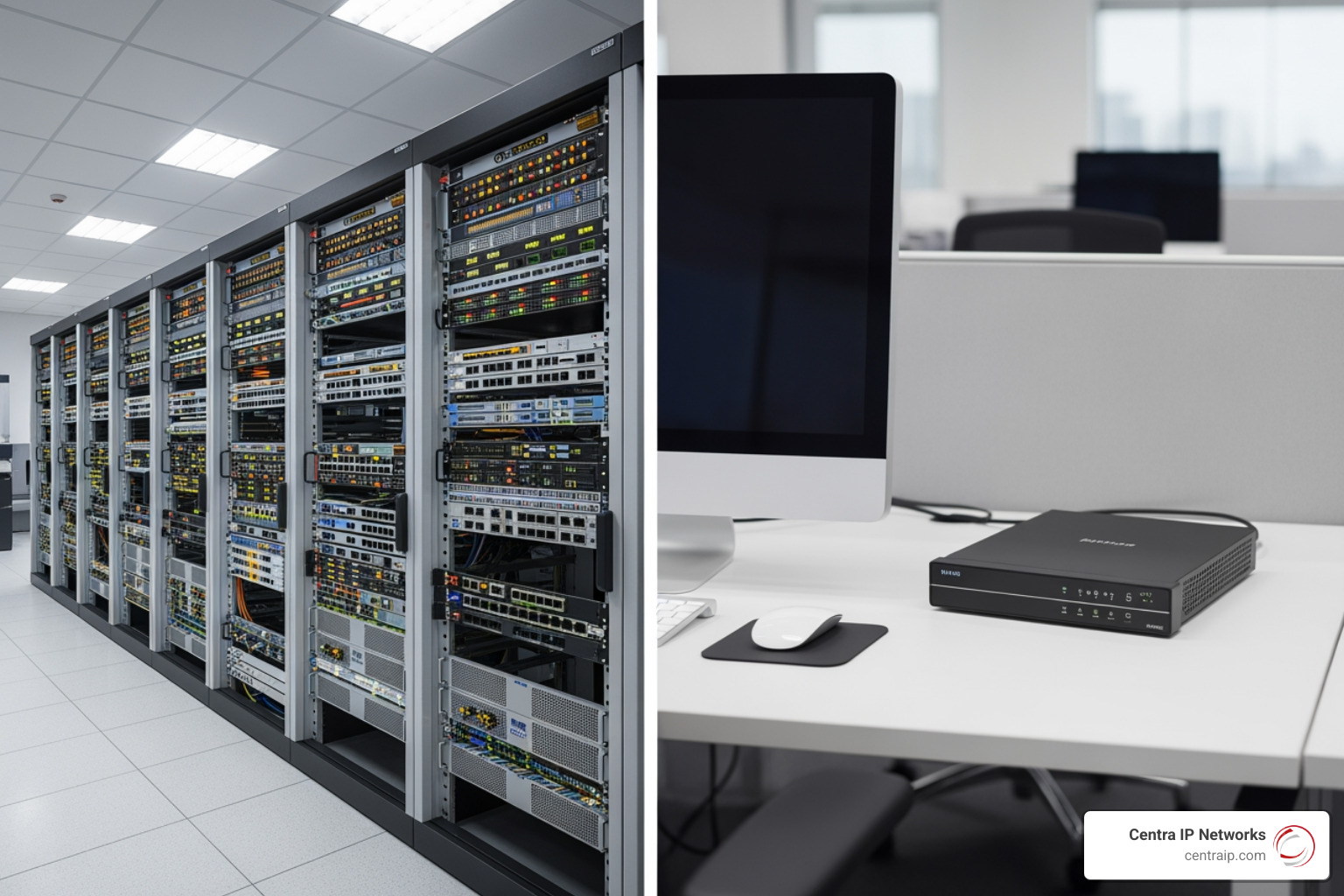
Today, most of these systems are IP-based. This means they use “Internet Protocol” to send voice data. Instead of traditional copper phone wires, your calls travel over the same network cables (or Wi-Fi) as your emails and web browsing. This shift from hardware-heavy switching to software-driven logic is why we can now fit 300 users into a box that weighs less than two pounds.
When choosing a system, you’ll need to decide between hardware and software. Some businesses prefer a physical “black box” on-site, while others opt for a virtualized version. Understanding the different types of business phone systems is the first step in identifying what you need in a business phone system to stay competitive in May 2026.
Mini PBX vs. Traditional PBX: Key Differences
The most obvious difference is the form factor. A traditional PBX requires a dedicated, cooled rack in a server room. A mini PBX, like the VoiSmart MINI or the OpenVox miniUCS, is often fanless and diskless, designed to sit on a shelf or desk without making a sound.
- Power Consumption: While a full-sized PBX can be a power hog, mini systems are incredibly efficient. For example, the miniUCS appliance consumes only about 14W of power.
- User Capacity: Traditional systems are built for thousands of users. Mini systems are right-sized for SOHO (Small Office/Home Office) environments, typically supporting anywhere from 8 to 300 users.
- Installation Simplicity: You don’t need a degree in telecom engineering to set these up. Many are “plug-and-play” or can be programmed using a standard telephone or a simple web interface.
- Scalability: If you need to expand with a PBX phone system, mini systems allow you to add licenses or SIP trunks digitally rather than running new physical copper lines through your walls.
Core Features of Modern Mini Systems
Don’t let the “mini” label fool you. These systems are packed with enterprise-grade features that used to be exclusive to Fortune 500 companies:
- DISA (Direct Inward System Access): This allows employees to call into the PBX from an outside line and then make outgoing calls as if they were sitting at their office desk.
- OGM Recording: You can record “Outgoing Messages” for your auto-attendant (e.g., “Press 1 for Sales, 2 for Support”).
- Advanced Call Handling: This includes Caller ID, call transfer, call forwarding (even to mobile phones), call pickup, and call barge-in for training purposes.
- Three-Party Conferencing: Easily bridge three callers together without needing a separate conference service.
- Door Phone Integration: Many mini systems can connect to your office’s front door intercom, allowing you to speak to visitors and even unlock the door from your desk phone.
Knowing these features helps when you’re looking for tips on how to know which business telephone system to choose.
Types of Mini PBX Solutions for Small Businesses
When we talk about a mini PBX system, we are usually referring to one of three architectures. Each has its own set of pros and cons depending on your technical comfort level and your office’s internet reliability.
| System Type | Best For | Connection | Pros | Cons |
|---|---|---|---|---|
| Analog Mini PBX | Very small teams (under 10) | Copper Landlines | Simple, works without internet | Limited features, hard to scale |
| On-Premise IP-PBX | Tech-savvy SMBs | VoIP / SIP Trunks | Total control, no monthly per-user fees | Higher upfront cost, requires maintenance |
| Hosted Cloud PBX | Remote/Hybrid teams | Internet | No hardware, easy setup, mobile apps | Monthly fees, requires stable internet |
At Centra IP Networks, we often help clients navigate these choices. For instance, some businesses in Dallas or Fort Worth prefer premise-based phone systems because they want to own their hardware outright, while others prefer the flexibility of Mitel VoIP phone systems.
On-Premise IP Mini PBX System Options
For businesses that want the reliability of local hardware, the “IP Mini PBX” is the gold standard. These systems use your local network to route calls but can still connect to the outside world via “SIP Trunks” (virtual phone lines) or traditional FXO ports (for analog lines).
- Open-Source Powerhouses: Platforms like Asterisk and FreePBX are the backbone of the industry. They offer “freedom” (as the FreePBX team likes to say) to build exactly what you need. Because they are open-source, you aren’t locked into a single vendor’s expensive licensing.
- 3CX: Trusted by over 350,000 businesses, 3CX is a favorite for IT admins because it’s easy to manage and offers a full “Unified Communications” suite, including video calls and chat.
- Hardware Appliances:
- miniUCS: A tiny beast that supports 50 extensions and 32 concurrent calls in a 1.85 lb package.
- UC501: A modular system supporting up to 300 users and 60 concurrent calls, featuring a built-in UPS (Uninterruptible Power Supply) to keep you online during brief power flickers.
- VoiSmart MINI: A fanless, aluminum-cased system designed for up to 16 users, perfect for quiet office environments.
If you are looking for IP PBX solutions in Fort Worth, TX, these hardware options provide a “set it and forget it” reliability that many local businesses value.
The Rise of the Cloud-Hosted Mini PBX System
In 2026, the trend is moving heavily toward the cloud. A cloud-hosted mini PBX system doesn’t require a box in your office. Instead, your phones (or mobile apps) connect directly to a provider’s server over the internet.
This is the ultimate solution for remote work. Your “office phone” can be an app on your smartphone, allowing you to take business calls from a coffee shop in St. Petersburg or a home office in Clearwater while showing your professional business caller ID.
When considering on-premise vs cloud PBX, the cloud offers unparalleled mobility. Providers offering business phone systems in St. Petersburg, FL highlight how cloud systems eliminate the need for on-site maintenance and bulky hardware.
Cost Analysis: Hardware, Installation, and Maintenance
Budget is usually the deciding factor for small businesses. Let’s look at the real-world numbers for a typical 5-person team as of May 2026.

The On-Premise Investment
If you choose to own your mini PBX system, expect an upfront cost of at least $2,605. This typically includes:
- The PBX appliance (like a UC501 or miniUCS).
- Five IP desk phones.
- Professional installation and configuration.
- Initial training for your staff.
While the upfront cost is higher, your ongoing monthly fees are much lower—you only pay for your SIP trunks (the actual phone lines), which can be as low as $20–$50 for the whole office. Over three to five years, this is often the most cost-effective path for the small business phone system.
The Cloud-Hosted Model
Hosted VoIP systems typically cost between $15 and $40 per user, per month. For a 5-person team, you’re looking at roughly $90–$200 per month.
- Pros: Low upfront cost (just the price of the phones, or $0 if you use mobile apps), and the provider handles all security updates and maintenance.
- Cons: You never stop paying the monthly “rent,” and costs can scale quickly as you add more employees.
For many businesses in Tampa or Lakeland, the savings on maintenance and labor make the cloud a very attractive option. It’s a predictable, monthly operating expense rather than a large capital outlay. For more details, check out our phone systems for small business guide.
Technical Implementation and Scalability
One of the biggest myths about a mini PBX system is that you need to be a computer scientist to run one. In reality, modern systems are designed with user-friendly Web GUIs (Graphical User Interfaces).
- Installation: Many systems feature “Zero-Touch Provisioning.” You simply plug a supported IP phone into your network, and it automatically “checks in” with the PBX to get its extension number and settings.
- Programming: For basic systems, you can even program features like call forwarding or voicemail passwords using the keypad on a standard telephone. For more advanced setups, PBX phone systems in Orlando are usually managed via a web browser.
- Scalability: This is where mini systems shine. If you start with 5 users and grow to 20, you don’t need a new box. You simply add more SIP endpoints (phones) or register more users in the software. Most mini appliances have a “concurrent call limit” (e.g., 32 or 60 calls at once). As long as you don’t have 60 people all talking at the exact same second, the system will handle your growth with ease.
If you’re looking for business phone systems in Clearwater, ensure you ask about the “ceiling” of the hardware—how many users it can really support before performance dips.
Frequently Asked Questions about Mini PBX Systems
How many users can a mini PBX typically support?
It depends on the specific hardware or software license.
- Entry-level analog systems often support 8 to 16 users.
- Compact IP appliances like the miniUCS support up to 50 extensions.
- Mid-range mini systems like the UC501 can scale up to 300 extension registrations.
- The VoiSmart MINI is optimized for smaller teams of up to 16 users.
Always look at “concurrent calls” too. A system might support 100 extensions but only 10 concurrent calls. If you run a call center, that’s a problem. If you run a law firm, it’s likely plenty.
Is a mini PBX system difficult to install and maintain?
Not anymore. Most modern systems are designed for IT generalists, not specialized telecom technicians. With web-based management, you can add a new employee or change an auto-attendant greeting in minutes. However, for the initial physical wiring and firewall configuration, many businesses in Sarasota find that professional installation saves hours of frustration and ensures high call quality from day one.
Can I integrate a mini PBX with my existing CRM?
Yes! This is one of the best reasons to choose an IP-based mini PBX system. Most modern platforms (especially 3CX and FreePBX) offer API access or built-in integrations for:
- HubSpot & Salesforce: See a “screen pop” with the customer’s name and history before you even pick up the phone.
- Microsoft 365: Sync your contacts and use Single Sign-On (SSO) for security.
- Click-to-Call: Click a phone number on your computer screen to instantly dial it on your desk phone.
Conclusion: Choosing the Right Path for Your Business
Choosing between a mini PBX system that sits in your office and a cloud-hosted solution is a big decision, but it doesn’t have to be a stressful one. It really comes down to whether you want to own your infrastructure (on-premise) or rent it (cloud).
At Centra IP Networks, we believe in the power of choice. Whether you’re in Dallas, Tampa, or Orlando, our goal is to provide a tailored, cost-effective solution that puts all your services on one platform with a single bill.
If you’re still weighing a premise-based phone system or a cloud system, we can help you analyze your specific needs, internet reliability, and growth plans. The right mini PBX system isn’t just a way to make calls—it’s a tool to unlock your business’s potential.
Ready to find the perfect fit? Explore our office phone systems for your business or learn more about unlocking efficiency with a tailored phone system today.