

The Best Virtual Phone Number Providers for Businesses in 2026
If you need a quick answer, here are the top virtual phone number providers worth considering in 2026:
| Provider | Starting Price | Best For |
|---|---|---|
| RingCentral RingEX | $20/user/month | Scaling businesses |
| Dialpad Connect | $15/user/month | AI-powered call management |
| Grasshopper | $14/month | Entrepreneurs and small teams |
| Google Voice | $10/user/month | Google Workspace users |
| Zoom Metered | $10/user/month | High inbound call volume |
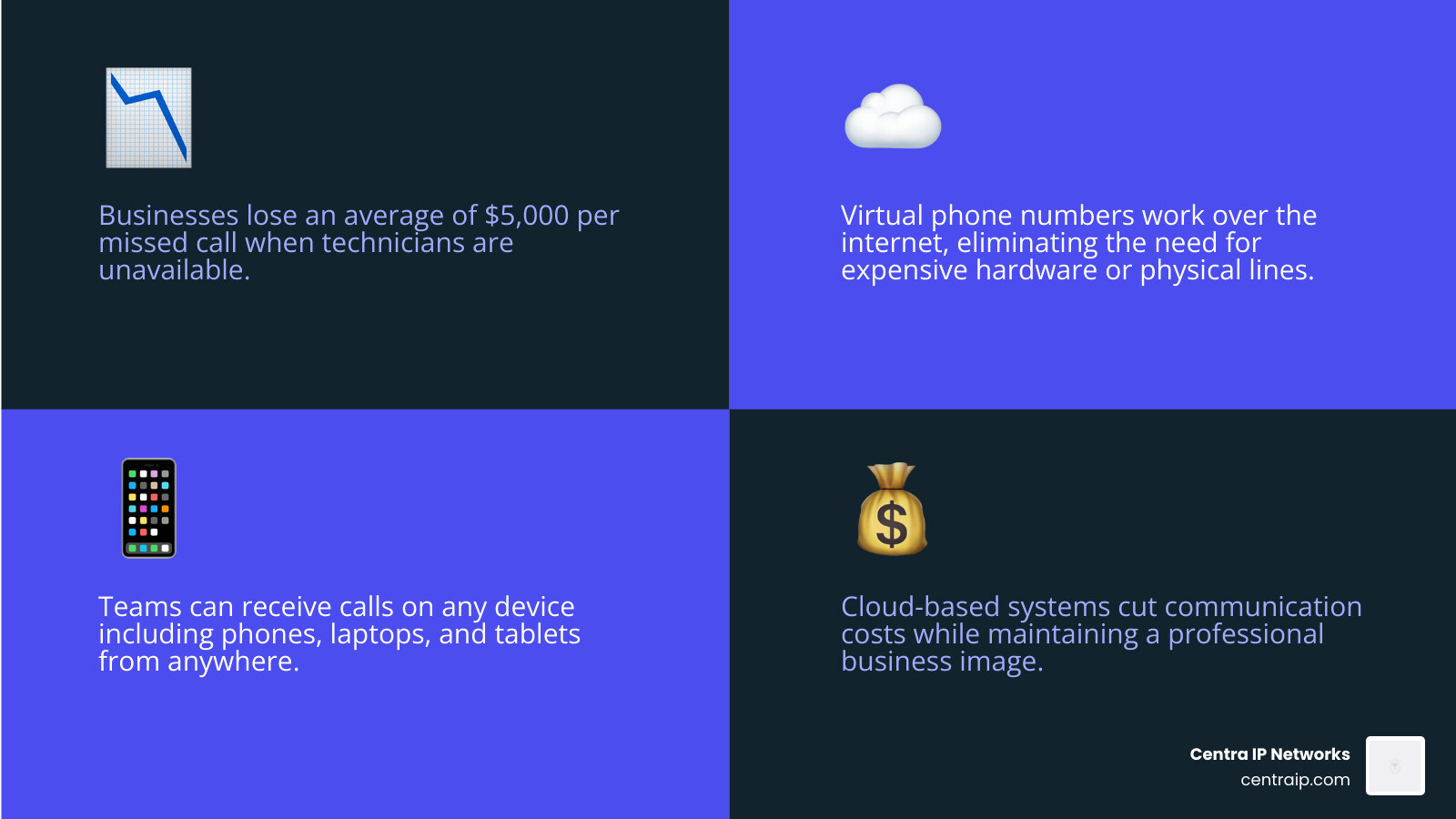
Think about how many calls your business misses every week — and what each one costs you. One HVAC business calculated it was losing $5,000 per missed call while their technicians were out in the field. That kind of problem is exactly what virtual phone number providers are built to solve.
A virtual phone number lets your team make and receive business calls from any device — phone, laptop, or tablet — without being tied to a desk or a physical phone line. No expensive hardware. No complicated installation. Just a professional business number that works wherever you are.
For businesses juggling multiple IT vendors and rising overhead, switching to a virtual phone system is often one of the fastest wins available. It cuts costs, simplifies communication, and helps small teams look polished and professional from day one.
I’m Patrick Brangan, and with over 20 years of experience in unified communications and technology solutions for SMBs, I’ve helped hundreds of businesses navigate the crowded landscape of virtual phone number providers to find the right fit. In this guide, I’ll break down exactly what to look for — and which providers stand out in 2026.
Virtual phone number providers word list:
What is a Virtual Phone Number and How Does it Work?
A virtual phone number is a business phone number that lives in the cloud instead of being tied to one desk phone, one SIM card, or one building.
In practice, that means when someone calls your business number, the call is routed through your provider over VoIP technology rather than a traditional copper landline network. The system can then send that call to:
- A mobile app
- A desktop app
- An IP phone
- A browser
- Multiple users at once
- A call queue or auto-attendant
That flexibility is the big difference. A traditional landline is tied to a place. A virtual number is tied to your business account and call rules.
If you want the full basics first, our guides on Virtual Phone Number 101, Maintaining Privacy While Using a Mobile Number, and Everything You Need to Know About Buying Phone Numbers Online break down the fundamentals.
Here is the simple version of how it works:
- You choose a virtual number from a provider.
- The provider hosts that number in the cloud.
- Incoming calls are routed using rules you set up.
- Your team answers from any approved device with internet access.
- Features like voicemail, texting, recording, and routing happen inside the software.
Compared with traditional phone service, virtual numbers usually offer:
- Faster setup
- Lower upfront cost
- Easier remote access
- More advanced call handling
- Better separation between personal and business calls

Types of Virtual Numbers for Business
Not every business needs the same type of number. The main options are:
- Local numbers
- Toll-free numbers
- Vanity numbers
- International or out-of-area local numbers
A local number is tied to a geographic area code, which can help your business feel familiar and nearby. For example, a business serving North Texas may want a local number tied to Dallas or Fort Worth.
An Orlando-based business may prefer a 407 number to strengthen local trust in Central Florida.
Toll-free numbers use prefixes such as 800, 888, 877, 866, 855, and 844. They are useful when you want a broader business image or national reach.
Vanity numbers spell a word or phrase, making them easier to remember. Think branding with fewer headaches and fewer “wait, what was that number again?” moments.
Some businesses also need international virtual numbers for expansion, customer service, or specific regional presence. If that applies to your team, our article on The NRIs Secret: How to Score a Virtual Indian Phone Number covers one common use case.
Top Virtual Phone Number Providers for Businesses in 2026
There is no single best provider for everyone. The right fit depends on your size, budget, call volume, remote-work needs, and whether you want a simple business line or a more complete unified communications platform.
Below are the providers we see most often in buyer comparisons in 2026.
| Provider | Starting Price | Standout Strength | Potential Drawback |
|---|---|---|---|
| RingCentral RingEX | $20/user/month | Best for scaling and broad feature depth | Can feel more complex than basic options |
| Dialpad Connect | $15/user/month | Strong AI tools and coaching features | Some advanced features require higher tiers |
| Grasshopper | $14/month | Simple setup for entrepreneurs | Less robust for larger teams |
| Google Voice | $10/user/month | Great for Google Workspace environments | International availability is more limited |
| Zoom Metered | $10/user/month | Low-cost inbound-heavy usage | Outbound calling is metered |
RingCentral RingEX
RingCentral remains one of the strongest all-around choices for businesses that expect to grow. Research we reviewed shows pricing starting at $20 per month, and the platform is commonly positioned as a strong fit for businesses of all sizes.
Why it stands out:
- Strong call routing and IVR options
- Reliable mobile and desktop apps
- Good support for remote and hybrid teams
- Broad feature set beyond basic calling
- Large market presence with more than 13k 5-star ratings across review platforms
RingCentral is especially appealing if you need more than “just a number.” It is better thought of as a full communications stack with calling, routing, voicemail, and business-grade admin controls.
Best for:
- Growing companies
- Multi-user teams
- Businesses that need robust call management
- Companies planning to scale beyond a simple startup setup
Dialpad Connect
Dialpad Connect starts at $15 per user per month and is one of the more interesting options for teams that want AI features built into day-to-day call handling.
Its strengths include:
- AI-powered call transcription
- Real-time coaching tools
- Helpful analytics for sales and support teams
- Easy use across phones, laptops, and other devices
Dialpad is particularly attractive for businesses with active customer-facing teams. If your staff makes or takes a lot of calls, the AI summaries and coaching tools can save time after each conversation.
Best for:
- Sales teams
- Support teams
- Hybrid workforces
- Businesses that want AI without building a custom stack
Grasshopper
Grasshopper is one of the simplest virtual phone systems for entrepreneurs and very small teams. It starts at $14 per month, is trusted by over 150,000 small businesses, and has served more than 400,000 customers according to the research.
It is built for businesses that want to look professional fast without turning phone setup into a side quest.
Common highlights include:
- Local, toll-free, and vanity numbers
- Call forwarding
- Voicemail transcription
- Call recording
- Unlimited calling on monthly plans
- Apps for mobile and desktop
Best for:
- Solo operators
- Startups
- Small service businesses
- Owners who want to separate personal and business calls
How to Evaluate Virtual Phone Number Providers
Choosing among virtual phone number providers gets easier when you compare the same core categories side by side.
We recommend scoring providers on these factors:
1. Number options
Check whether the provider offers:
- Local numbers in your service area
- Toll-free numbers
- Vanity numbers
- Number porting
- International numbers if needed
2. Call management features
Look for essentials like:
- Auto-attendant
- IVR menus
- Ring groups
- Call queues
- Simultaneous ring
- Business hours routing
- Voicemail to email
3. Ease of setup
Good providers let you:
- Pick a number quickly
- Download apps
- Add users fast
- Configure routing without needing a telecom engineer and three cups of coffee
If you need a walkthrough, see How Do I Get a Virtual Phone Number?.
4. Pricing model
Compare whether pricing is:
- Per user per month
- Per number per month
- Metered by minutes
- Bundled with advanced features
- Subject to add-on fees for extra numbers or compliance setup
5. Reliability and support
You want:
- Solid uptime
- Good mobile app performance
- Responsive support
- Clear admin tools
- A provider that can grow with your business
At Centra IP Networks, we also advise clients to look beyond the phone system alone. If your phones, internet, and cloud tools all affect each other, it can be smarter to work with one partner that can align the entire setup instead of splitting everything across unrelated vendors.
Strategic Benefits of Cloud-Based Communication
The biggest reason businesses switch is not that virtual numbers are trendy. It is that they solve real problems.
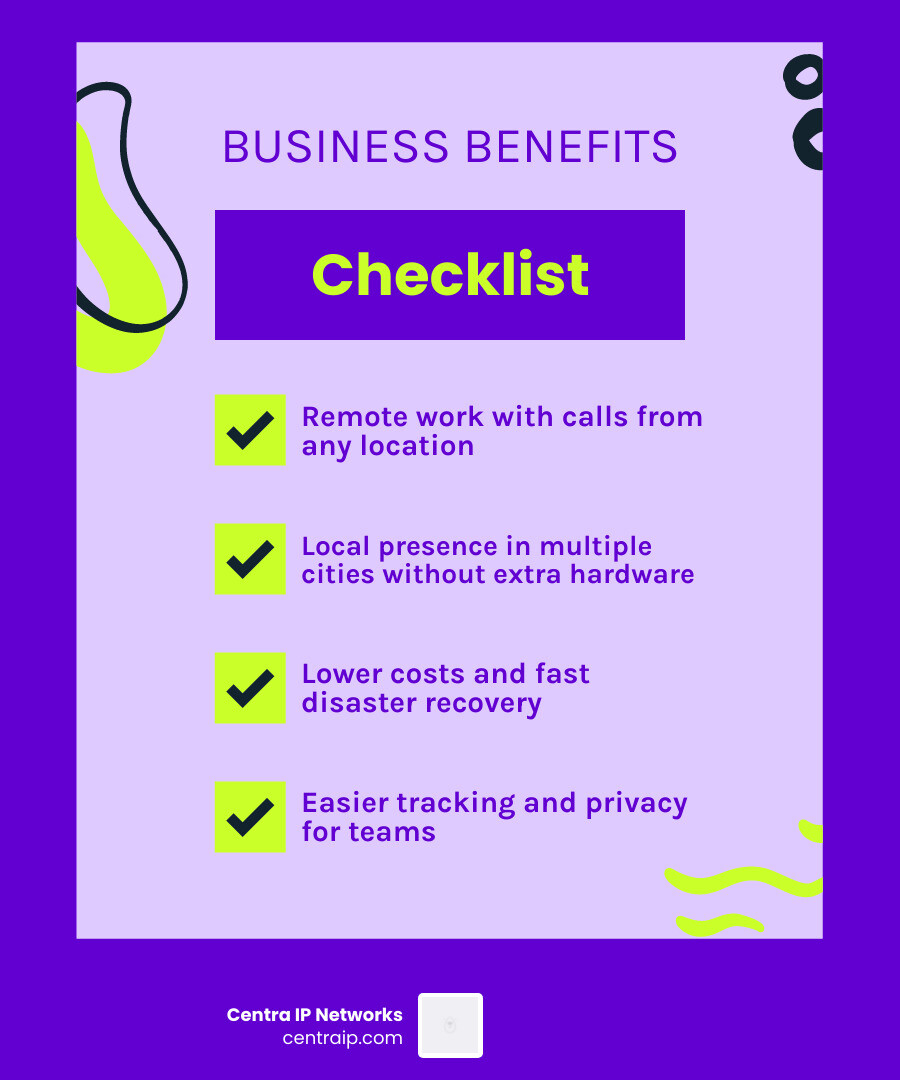
A virtual phone system supports:
- Remote work
- Multi-location teams
- Field staff
- Better customer response times
- Lower hardware costs
- Easier business continuity
Because calls are cloud-based, your team does not have to sit at one desk to stay reachable. A business in Dallas can answer calls on the road. A Fort Worth office can route overflow calls to Orlando. A technician in Tampa can answer from a mobile app. A manager in Sarasota can review voicemail transcripts from a laptop.
That is a practical upgrade, not just a technical one.
Virtual numbers are also useful for establishing presence in the markets you serve. A local number can help businesses connect more naturally with customers in Dallas, Fort Worth, Orlando, Tampa, St. Petersburg, Clearwater, and Sarasota without needing separate legacy phone systems in each location.
For more on forwarding and flexible routing, see Unlock Business Freedom: How Virtual Number Call Forwarding Works for You.
Other major benefits include:
- Better privacy for employees using personal phones
- Fast setup for new users and locations
- Easier disaster recovery if a site loses power or internet
- Ability to assign multiple numbers to different departments or campaigns
- Cleaner tracking of inbound calls and customer touchpoints
Professional Image and Call Management
A virtual number can make a small business sound far more established than a basic mobile line.
Features that help build that professional image include:
- Custom greetings
- Auto-attendants
- Department extensions
- Hold music
- Shared inboxes or message threads
- Call recording
- Business texting
- Scheduled routing
This means callers hear a polished front door instead of “Hey, I’m driving, can you text me?”
Even a two-person business can sound organized with the right setup. That matters for customer trust, especially in service industries where speed and professionalism win work.
If branding matters, vanity or memorable numbers can help too. Our guide From Basic to Boss: The Ultimate Guide to Online VIP Mobile Number Purchase explains how memorable number choices support branding.
Essential Features Offered by Virtual Phone Number Providers
The best providers offer far more than simple call forwarding. When comparing options, these are the features most businesses should prioritize.
- Mobile and desktop apps
- Call forwarding
- Auto-attendant or IVR
- Voicemail transcription
- Call recording
- SMS or business texting
- Number porting
- Multi-device access
- Ring groups and call queues
- Business hours and after-hours routing
- Caller ID controls
- Reporting and analytics
IVR menus and auto-attendants are especially helpful once your team grows. They route callers to the right person or department without making one employee act like a full-time switchboard.
Voicemail transcription is another underrated time-saver. Instead of listening to every voicemail in order, your team can skim messages quickly and respond faster.
Call recording helps with:
- Staff training
- Quality control
- Dispute resolution
- Documentation of customer conversations
Business texting is becoming more important too. Research we reviewed noted that many businesses still underuse SMS, even though customers increasingly prefer quick messages over voicemail ping-pong.
If SMS verification or OTP use cases matter to your business, our article Need an Indian Number for OTP? Here’s How to Get One for SMS covers a related scenario.
Advanced Integrations and AI
This is where providers start to separate themselves.
More advanced systems may include:
- CRM integrations
- Helpdesk integrations
- Team messaging
- Video meetings
- AI call summaries
- AI coaching
- Sentiment analysis
- Workflow automation
Dialpad is a good example of the AI trend, with real-time coaching and post-call summaries. RingCentral tends to stand out on broader integrations and scalability. Google Voice can be a smart fit if your business already lives inside Google Workspace.
If your business needs calling, internet, cloud apps, and support to work together, this is where our approach at Centra IP Networks can help. We bring managed IT, cloud communications, internet connectivity, and cloud services together on one platform with one provider and one bill. For many SMBs, that reduces finger-pointing between vendors and makes troubleshooting much less painful.
Frequently Asked Questions about Virtual Phone Number Providers
How do virtual phone numbers differ from traditional landlines?
Traditional landlines use the public switched telephone network, or PSTN, and are tied to a fixed location and physical wiring.
Virtual phone numbers use VoIP and cloud infrastructure. That means they can work through internet-connected devices rather than one hardwired phone jack.
Key differences:
- Landlines are location-bound; virtual numbers are location-flexible
- Landlines usually require hardware and installation; virtual systems are faster to deploy
- Virtual systems typically offer better software features like apps, transcription, routing, and analytics
- Virtual numbers support remote and hybrid work much more easily
In short, landlines connect to a place. Virtual numbers connect to your business.
Can I port my existing business number to a virtual provider?
Yes, in most cases you can port your existing number.
The usual process looks like this:
- Choose your provider and plan
- Submit a port request
- Provide proof of ownership or a recent bill
- Keep current service active during the transfer
- Test routing once the number moves
Porting is important because it lets you modernize without losing the number customers already know. Good providers are built to handle this with minimal disruption.
Are virtual phone numbers safe for receiving sensitive SMS?
Generally, yes, but you should choose the use case carefully.
For standard business communication, virtual numbers are widely used for calls and SMS. Many providers support two-factor authentication and text delivery features. Security depends on:
- The provider’s infrastructure
- Admin controls
- User permissions
- App security
- Whether the number supports the kind of SMS traffic you need
For highly sensitive workflows, verify that the provider supports your specific needs, including compliance requirements, logging, and access controls.
Virtual numbers can also improve privacy because employees do not need to give out personal mobile numbers to customers. That alone reduces a lot of avoidable chaos.
Conclusion
The best virtual phone number providers make business communication easier, more flexible, and more professional. They help you answer calls from anywhere, support remote teams, create a stronger local presence, and replace clunky hardware with cloud-based tools that are simpler to manage.
If you are comparing options in 2026, start with your real-world needs:
- Do you need a simple business number or a full phone system?
- Will your team work remotely or across multiple locations?
- Do you need texting, call recording, or AI summaries?
- Are you trying to protect personal numbers, improve response times, or scale fast?
RingCentral, Dialpad, Grasshopper, Google Voice, and Zoom all have strengths. But the best solution is the one that fits your workflows, budget, and growth plans.
At Centra IP Networks, we help businesses simplify more than just phones. We combine cloud communications, managed IT, internet connectivity, and cloud services into one platform with one bill and one provider. That means fewer vendors, fewer support gaps, and a more cost-effective setup tailored to how your business actually operates.
If you are ready to modernize your phone system, explore Unlock Business Freedom with Cloud-Based Phone Systems and see how we can help you build a smarter communications setup for your team.