
Why Finding the Right Cloud Communications Provider in Clearwater Matters
Choosing the right cloud communications provider Clearwater businesses can depend on is one of the most important decisions you’ll make for your company’s productivity and bottom line. With so many options on the market — from open-source IMS platforms to fully managed UCaaS solutions — it’s easy to feel overwhelmed.
Here are the top cloud communications providers serving Clearwater businesses to consider in 2026:
| Provider | Best For | Key Strength |
|---|---|---|
| Centra IP Networks | SMBs wanting one vendor | Unified IT, voice, and security |
| Clearspan | Large-scale enterprise | Carrier-grade reliability, 99.999% uptime |
| Centratel | Local Tampa Bay businesses | 45+ years local service, VoIP and UCaaS |
| CSM South | On-site installation | Hybrid and structured cabling solutions |
| Project Clearwater (Alianza) | Service providers and carriers | Cloud-native IMS, VoLTE, VoNR support |
The good news? You don’t need to be a telecom engineer to make a smart choice. You just need to know what to look for — and what each provider actually delivers.
Cloud communications have come a long way. Legacy phone systems tied to physical hardware are rapidly being replaced by software-defined, cloud-native platforms that scale on demand, cost less to maintain, and work from anywhere. For Clearwater businesses managing multiple vendors and rising IT costs, this shift is a real opportunity to simplify and save.
I’m Patrick Brangan, and with over 20 years of experience helping SMBs in Tampa, Dallas, and Orlando find the right cloud communications provider Clearwater and surrounding areas can count on, I’ve seen what works — and what doesn’t. Let’s break down your best options so you can make a confident, informed decision.
Understanding Project Clearwater in Cloud Communications
To truly understand how modern cloud communications platforms function under the hood, we have to look at the architectural revolution that made them possible. At the center of this transformation is Project Clearwater, an open-source IP Multimedia Subsystem (IMS) core designed specifically for virtualized cloud environments.
Developed originally by Metaswitch Networks and now integrated into Alianza’s carrier-grade cloud communication portfolio, Project Clearwater represents a massive departure from traditional telecommunications infrastructure. In the legacy world, an IMS core required proprietary, expensive hardware appliances that sat in a dedicated data center. Project Clearwater flipped this model on its head by applying web-scale design principles to telecom routing.
By utilizing open-source protocols and releasing the codebase under the GNU GPLv3 license, Project Clearwater allowed network operators to run voice, video, and messaging services on standard cloud servers. For a deeper look into how these platforms connect businesses globally, explore our guide on Connecting in the Clouds: Understanding Cloud Communications Platforms.
Whether a service provider is building an over-the-top (OTT) app or an enterprise is looking for highly scalable Session Initiation Protocol (SIP) routing, the foundation laid by Welcome to Clearwater — Project Clearwater 1.0 documentation remains a cornerstone of modern voice-over-IP (VoIP) technology.
The Intelligent Communications Fabric: Core Components and Architecture
At the heart of modern, carrier-grade communication lies what industry leaders call an “Intelligent Communications Fabric.” This approach relies on a microservices-based, stateless architecture where different nodes handle highly specialized tasks. Unlike older systems where a single server handled everything (and became a single point of failure), the Clearwater architecture splits signaling, state management, and media handling into distinct layers.
Let’s look at the core components that make this system work seamlessly:
- Bono (Edge Proxy): This is the entry point for all client connections. Bono acts as the Session Border Controller (SBC) or P-CSCF in IMS terminology. It handles client registration, anchors the connection for NAT traversal, and supports standard SIP over UDP/TCP as well as WebRTC via SIP over WebSockets.
- Sprout (SIP Router): Sprout is the brain of the routing engine. It acts as the I/S-CSCF and processes registration and call routing requests. Crucially, Sprout also includes a built-in Multimedia Telephony (MMTEL) application server to deliver standard calling features like call forwarding and call barring without needing external hardware.
- Vellum (State Store): To keep Sprout and Bono completely stateless, all long-lived registration and session data is offloaded to Vellum. Vellum utilizes cloud-optimized NoSQL technology, including Cassandra, Memcached, and etcd clusters, to store subscriber state securely and redundantly.
- Dime (Diameter Gateway): Dime manages authentication, authorization, and accounting (AAA) by translating internal requests into standard Diameter protocol messages, allowing easy connection to billing systems and subscription databases.
- Perimeta SBC: Often deployed alongside the Clearwater core, the Perimeta Session Border Controller is a highly advanced, cloud-native SBC designed to secure and distribute massive volumes of rich communication sessions.
This distributed design means that if a Sprout router node experiences an issue, another node can instantly take over its traffic without dropping active calls, because the call state is safely stored in Vellum. To see how these components enable seamless business calling, read our resource on how to Unlock Seamless Communication: A Deep Dive into Cloud PBX Platforms. For service providers deploying these architectures, the Clearwater Core IMS platform represents the gold standard of cloud-native network design.
Key Benefits of a Cloud-Native IMS for Service Providers
For telecommunications companies and service providers operating across the Tampa Bay area, Dallas, and beyond, migrating to a cloud-native IMS core is not just about keeping up with technology—it is about survival. Legacy systems are incredibly rigid, expensive to maintain, and slow to scale.
By contrast, a cloud-native architecture offers several massive advantages:
- 99.999% Reliability: Thanks to its stateless design and redundant clustering, cloud-native systems achieve five-nines uptime in production environments. If a virtual machine fails, the traffic automatically routes to an active node without any interruption to the end user.
- Rapid, Elastic Scalability: Traditional telecom systems require providers to purchase hardware based on peak capacity. Cloud-native systems allow operators to scale up or down automatically based on real-time traffic demands, saving thousands of dollars in unused compute power.
- Flexible Deployment Options: Whether deployed in a public cloud (like AWS), a private cloud, or as simplified all-in-one virtual machines for testing, the deployment flexibility is unmatched.
- Massive Cost Efficiency: Removing proprietary hardware dependencies drastically lowers capital expenses (CapEx) and operational expenses (OpEx).
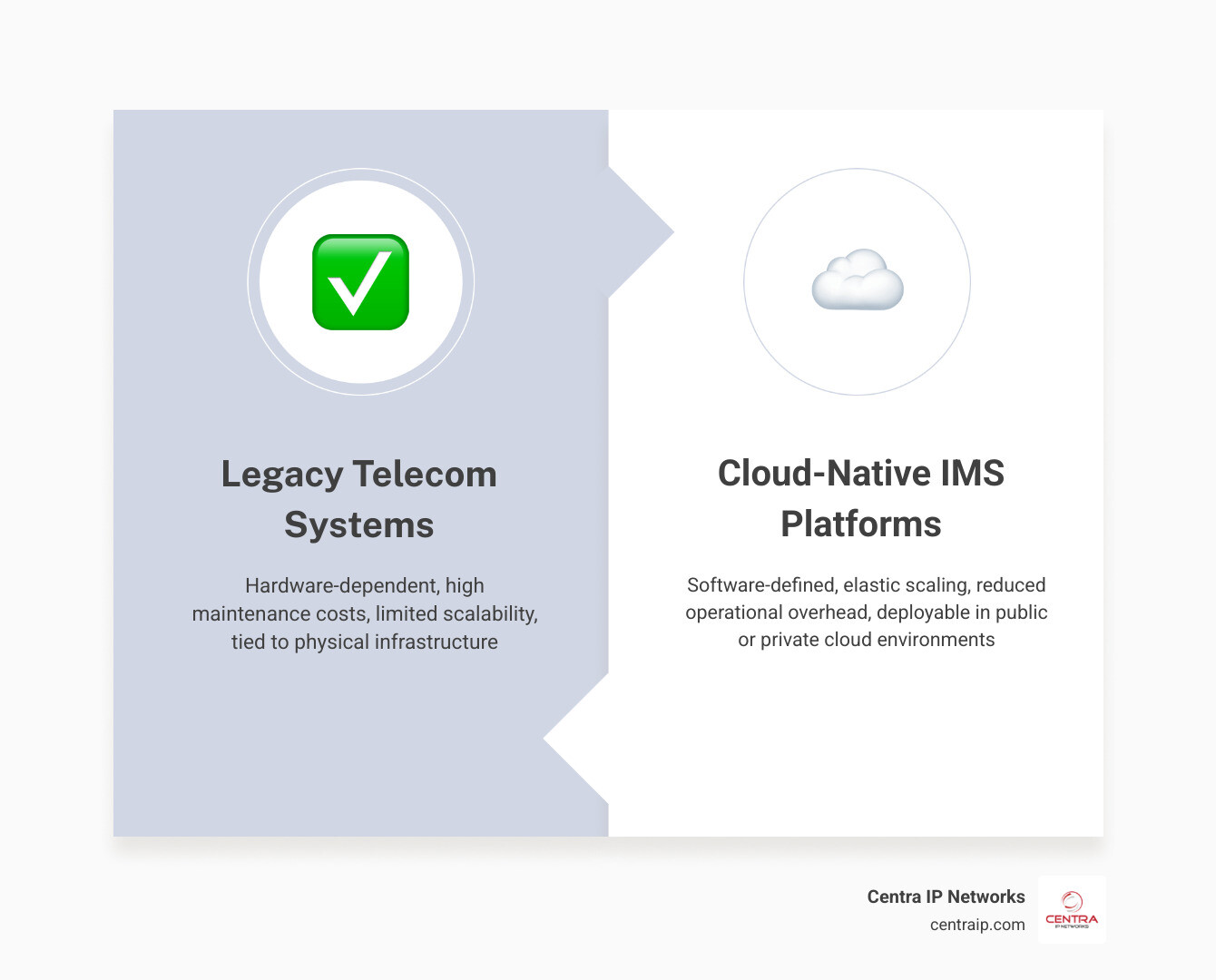
| Feature | Legacy Telecom Systems | Cloud-Native IMS (Clearwater) |
|---|---|---|
| Hardware | Proprietary, expensive appliances | Standard cloud servers / Virtual machines |
| Scalability | Manual upgrades, slow provisioning | Automated, elastic, machine-speed scaling |
| Architecture | Stateful, single point of failure | Stateless microservices, distributed data |
| Maintenance | High on-site maintenance costs | Centralized cloud management and automation |
| Uptime | Dependent on hardware redundancy | Built-in geographic redundancy (99.999%) |
Transitioning to this modern framework helps providers deliver high-quality, cost-effective solutions to their business clients. You can learn more about how these cloud benefits directly impact your business operations by reading about the Benefits of a Cloud-Based Phone System for Your Business.
Choosing a Cloud Communications Provider Clearwater Businesses Trust
Clearwater is a thriving business hub, and local companies need communication tools that match their modern, workflows. When searching for a cloud communications provider Clearwater businesses can trust, you must look beyond basic dial tones. You need a partner capable of supporting advanced communication use cases that keep your workforce connected and secure.

Modern providers must support cutting-edge capabilities, including:
- VoLTE & VoNR: Voice over LTE and Voice over New Radio (5G) ensure your team experiences crystal-clear mobile calling on the latest cellular networks.
- WebRTC Integration: Web Real-Time Communication allows your employees and customers to launch voice and video calls directly from a web browser without downloading external apps.
- Robocall Mitigation: With the rise of spam calls, having integrated STIR/SHAKEN compliance and automated robocall blocking is essential to protect your employees’ productivity.
At Centra IP Networks, we understand that local businesses don’t want to manage multiple vendors, confusing bills, or complicated network integrations. That’s why we deliver comprehensive Cloud Services Clearwater businesses rely on, combining voice, data, and managed IT services into a single, unified platform with one clear bill.
Integrating Existing Infrastructure with a Cloud Communications Provider Clearwater
One of the biggest concerns businesses have when upgrading their phone system is how it will integrate with their current infrastructure. Fortunately, cloud-native communication platforms are designed with open integration in mind.
Instead of forcing you to throw away your existing databases, a modern cloud provider can connect directly to your external Home Subscriber Server (HSS), Charging Data Function (CDF), or third-party application servers.
For technical teams looking to link external tools, the system uses standardized interfaces. For instance, you can easily configure application servers to handle custom routing rules or integrate with your CRM via APIs.
To learn more about the technical steps required for these integrations, refer to the official guide on Configuring an Application Server — Project Clearwater 1.0 documentation . Understanding how these puzzle pieces fit together is a crucial part of building an agile business, as highlighted in The Definitive Guide to Cloud Solutions.
Testing and Deploying with a Cloud Communications Provider Clearwater
Before rolling out a communication platform to hundreds of users across Clearwater, Tampa, or St. Petersburg, testing is key. Cloud-native platforms make this incredibly easy by offering “All-in-One” virtual machine images. These images allow IT administrators to spin up a complete, self-contained communication network on a single laptop or local server in minutes.
Once the test environment is live, administrators can use the Ellis web interface to quickly provision phone numbers, configure SIP credentials, and assign them to softphone clients like Zoiper, Bria, or X-Lite.
By testing calls, verifying two-way media, and configuring network settings (like STUN/TURN servers for NAT traversal), you can ensure a flawless deployment before going live. For a step-by-step walkthrough on setting up your first test call, check out Making calls through Clearwater — Project Clearwater 1.0 documentation .
Frequently Asked Questions about Cloud Communications
How does Clearwater Core IMS differ from traditional hardware-based telecom systems?
Unlike traditional systems that require proprietary, specialized hardware, Clearwater Core IMS is entirely software-defined and built specifically for cloud environments. It uses a stateless architecture where processing nodes (like Sprout) are separated from the database storage nodes (like Vellum). This allows the system to scale elastically on standard virtual machines, reducing costs and eliminating single points of failure.
What security and compliance features does Clearwater support?
Clearwater architectures prioritize security by dividing networks into trusted and untrusted zones. External traffic from users enters through the Bono edge proxy, which acts as a firewall and Session Border Controller (SBC).
Additionally, the system supports robust SIP encryption, STIR/SHAKEN standards to mitigate spam/robocalls, and fully compliant emergency 911 routing to ensure your business meets all local and federal safety regulations.
How does the total cost of ownership of cloud-native IMS compare to legacy systems?
The total cost of ownership (TCO) of a cloud-native IMS is significantly lower than legacy systems—often saving businesses up to 50% on monthly communication expenses. By eliminating the need for on-site physical hardware, companies save on maintenance, electricity, and cooling.
Furthermore, the elastic nature of the cloud means you only pay for the active user seats you actually need, rather than over-provisioning hardware to handle rare traffic spikes.
Conclusion
Navigating cloud communications doesn’t have to be a stressful journey. Whether you are a local SMB looking to upgrade your office phones or an enterprise seeking a highly secure, carrier-grade communication platform, finding the right partner is the key to success.
At Centra IP Networks, we make communication simple. We offer comprehensive Managed IT, cloud hosting, and Cloud-Based Phone Systems across Clearwater, Tampa, St. Petersburg, Sarasota, Orlando, Dallas, and Fort Worth. Our unique strength is our ability to deliver your phone systems, internet connectivity, and cloud security on a single, unified platform with one provider and one clear bill. By leveraging our 35+ industry partnerships, we design custom, cost-effective communication solutions tailored perfectly to your business goals.

Ready to elevate your business communications and stop juggling multiple tech vendors? We are here to help. Get in touch with the experts at Centra IP Networks today to schedule a free consultation and customized demo!