
Why Managing Multiple Business Phone Numbers Is Harder Than It Looks
Multiple business phone numbers are something most growing companies need — but few manage well.
Here’s a quick breakdown of what they are and why they matter:
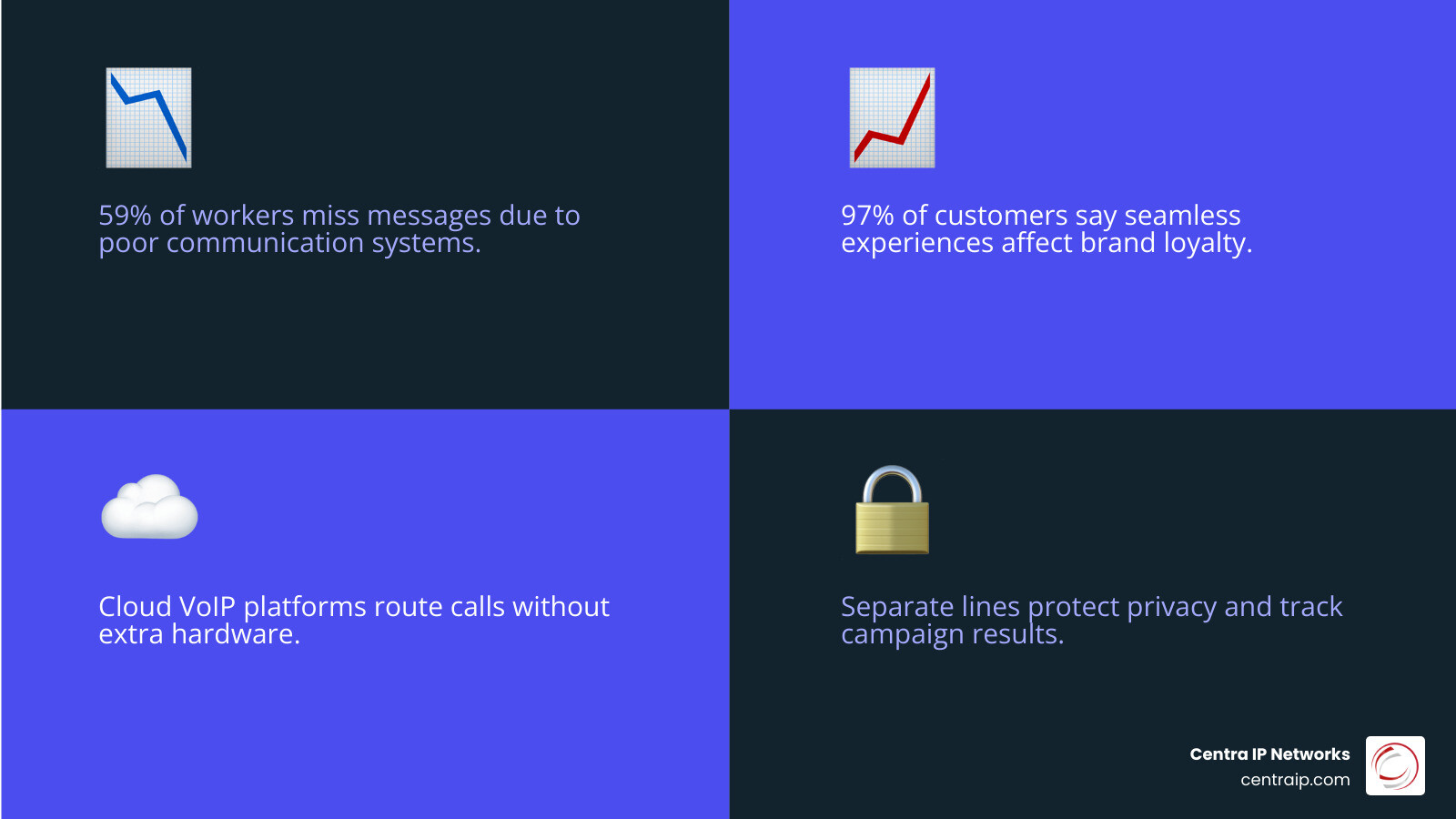
- What they are: Separate phone lines assigned to different departments, locations, campaigns, or team members — all managed from one system
- Why businesses use them: To look professional, track marketing, serve customers faster, and protect personal numbers
- How they work: Through cloud-based VoIP platforms that route calls without extra hardware
- Who needs them: Any business handling more than one type of call — sales, support, billing, or multiple locations
The numbers tell a real story here. According to industry research, 59% of workers have missed messages because of communication breakdowns. And when communication fails, customers notice — 97% of customers say a seamless communication experience directly affects whether they stay loyal to a brand.
Put simply: a messy phone setup doesn’t just frustrate your team. It costs you customers.
Managing multiple numbers used to mean expensive PBX hardware and IT headaches. Today, cloud-based systems make it far simpler — but only if you know what to set up and how.
I’m Patrick Brangan, founder of Centra IP Networks, with over 20 years of experience helping SMBs in Dallas, Tampa, and Orlando consolidate their communications — including deploying multiple business phone numbers across unified, cost-effective systems. In the sections below, I’ll walk you through exactly how to get, organize, and scale your phone numbers the right way.
Multiple business phone numbers definitions:
Why Your Growing Company Needs Multiple Business Phone Numbers
As your business grows, that single cell phone number you used to launch your “side hustle” becomes a liability. We’ve seen it time and again: a business owner in Dallas or Tampa tries to juggle client calls, family texts, and marketing inquiries on one device, and eventually, things start to slip through the cracks.

Professionalism and Brand Identity
First impressions are everything. When a customer calls your business, they expect a professional greeting, not a distracted “Hello?” from someone at the grocery store. Having multiple business phone numbers allows you to set up specific greetings for different departments. It gives the impression that your company is established and organized, regardless of whether you have five employees or fifty.
Privacy and Work-Life Balance
One of the most significant benefits is maintaining privacy while using a mobile number. By using virtual numbers, you keep your personal digits off public directories and marketing materials. This also allows you to set “Business Hours” for your professional lines. When it’s 7:00 PM on a Friday in Fort Worth, you can let your business calls go to a professional voicemail while still being available for personal calls from friends and family.
Customer Retention
The stakes are high. Research shows that for 50% of consumers, it only takes one bad experience to switch to a competitor. If a customer gets a busy signal or a messy voicemail experience, they are halfway out the door. Conversely, 98% of contact center leaders agree that a seamless communication experience is the primary driver of brand loyalty. By using multiple lines, you ensure that even if one line is busy, others are available to catch the next lead.
Strategic Ways to Use Multiple Business Phone Numbers for Growth
Smart scaling isn’t just about having more numbers; it’s about using them strategically. We help our clients at Centra IP Networks use their communication stacks to actually drive revenue, not just answer calls.

Segmenting Departments and Locations with Multiple Business Phone Numbers
One of the fastest ways to build trust is to look like a local. If you are targeting customers in North Texas, having Dallas Phone Numbers (214, 972, & 469) or Fort Worth Phone Numbers (817 & 682) makes you a neighbor, not a stranger.
Even if your main office is in St. Petersburg, you can easily get an Orlando number for your small business or get virtual numbers in Sarasota to establish a presence in those markets. This “geographic flexibility” is a core concept we cover in our Virtual Phone Number 101 guide. It allows you to expand your reach without the overhead of physical office space in every city.
Tracking Marketing Effectiveness with Multiple Business Phone Numbers
Are your Google Ads actually working? Is that billboard on I-35 in Dallas worth the investment? You don’t have to guess. By assigning unique numbers to different marketing channels, you can track exactly where your leads are coming from.
This is often done using DNIS (Dialed Number Identification Service) numbers. For example:
- Number A goes on your website.
- Number B goes on your Google Business Profile.
- Number C goes on a direct mail flyer.
When the phone rings, your system tells you which number was dialed, allowing you to calculate your ROI with surgical precision. Before you start, it’s worth learning everything you need to know about buying phone numbers online to ensure you own the numbers you’re using for these campaigns.
Choosing the Right Types of Business Numbers
Not all numbers are created equal. Depending on your goals—whether it’s looking like a national powerhouse or a local boutique—you’ll want to mix and match these types.
| Number Type | Best For… | Key Advantage |
|---|---|---|
| Local Numbers | Local trust in cities like Tampa or Dallas | Higher answer rates from local residents |
| Toll-Free Numbers | National brands (800, 888, 877) | Professional image; free for the caller |
| Vanity Numbers | Marketing and Brand Recall | Easy to remember (e.g., 1-800-FLOWERS) |
| Virtual Numbers | Remote teams and privacy | No hardware needed; works on any device |
If you’re operating in Florida, you might want Tampa phone numbers (727 and 813) to appeal to the local community. For those who want a truly standout identity, you might even consider a VIP mobile number purchase to get a highly memorable sequence.
How to Manage and Scale Your Multi-Line System
Once you have multiple business phone numbers, the challenge shifts to management. You don’t want to carry five different phones. Modern cloud systems allow you to manage everything through a single interface on your existing smartphone or computer.
Shared Numbers and Team Collaboration
One of the coolest features of modern systems is the “Shared Number.” This allows a team—say, your support staff in Clearwater—to all have access to the same business line.
- Concurrent Calls: Multiple people can be on the phone at once using the same number. No more busy signals.
- Ring Groups: You can set the system to ring everyone at once, or in a specific order.
- Internal Threads: Team members can chat with each other “behind the scenes” on a call or text thread before responding to the customer.
- Typing Indicators: See when a teammate is already replying to a text so you don’t send duplicate answers.
This level of transparency is a game-changer for collaboration. If you’re curious about the mechanics, we’ve detailed how virtual number call forwarding works for you in our dedicated blog post.
Number Porting and Technical Setup
If you already have a number you love, don’t worry—you can usually keep it. The process is called “porting.” Whether you’re looking at the City of Clearwater phone directory for inspiration or switching from a local St. Petersburg business phone service, porting allows you to move your number to a better platform without losing your established identity.
For those wondering “How do I get a virtual phone number?“, the process is typically fast. You pick your numbers, verify your account, and you’re up and running in minutes. We even help clients with more complex needs, like scoring a virtual Indian phone number for international operations or getting an Indian number for OTP and SMS.
Frequently Asked Questions about Multiple Business Phone Numbers
What is the difference between a second number app and a virtual phone system?
A “second number app” is usually a basic tool designed for individuals or very small startups to add one extra line to their cell phone. A “virtual phone system” (like what we provide at Centra IP) is a full-scale business solution. It includes advanced features like auto-attendants (the “Press 1 for Sales” menus), call recording, detailed analytics, and the ability to scale to hundreds of users.
How much does it cost to add additional business numbers to my plan?
Pricing varies, but most cloud providers charge between $5 and $30 per month per additional number. At Centra IP Networks, we focus on cost-effective solutions that bundle these costs into a single, predictable bill. Remember to factor in potential one-time porting fees (often around $5) and any additional user licenses you might need.
Can I manage multiple business brands under one single account?
Yes! This is a common request for entrepreneurs who run several different companies. You can assign different numbers to different brands, set up unique “whisper prompts” (a short audio clip that tells you which brand is being called before you answer), and ensure the correct caller ID is shown when you call back.
Conclusion
In May 2026, the “standard” for business communication is higher than ever. Customers expect you to be reachable, professional, and local, regardless of where your team actually sits. Managing multiple business phone numbers shouldn’t be a source of stress—it should be a strategic advantage that helps you grow.
At Centra IP Networks, we specialize in taking the complexity out of these systems. We offer a single platform where you can manage your phone systems, internet connectivity, and cloud solutions all in one place. With over 35 partnerships, we don’t just give you a “one size fits all” box; we tailor a solution that fits your specific needs in Dallas, Fort Worth, or anywhere across Florida.
Ready to professionalize your communication and stop missing those critical messages? Explore our Cloud-Based Phone Systems and let’s build a system that grows with you.