Why Surveillance Integration Phone Systems Matter for Modern Businesses
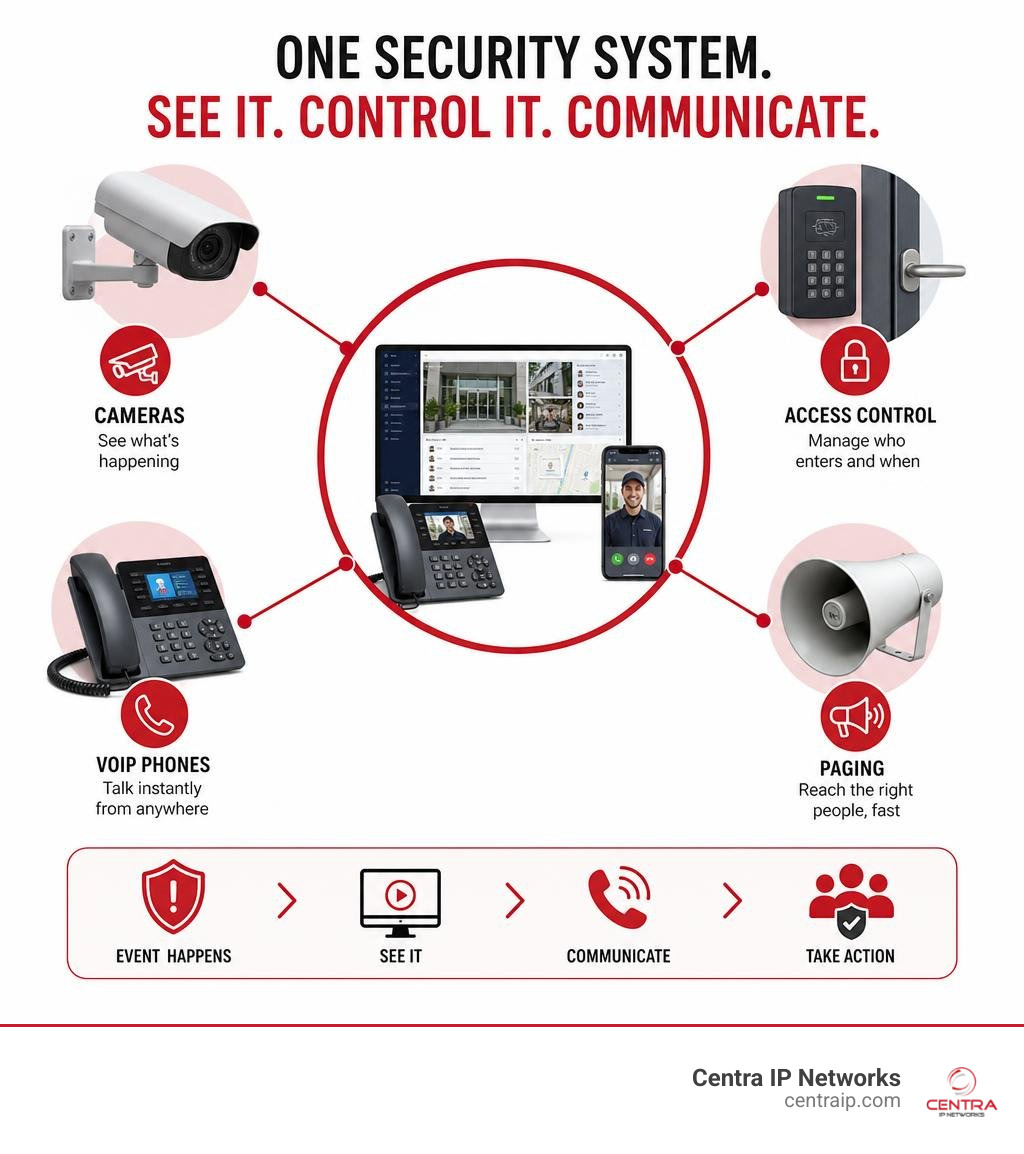
Surveillance integration phone systems connect security cameras, access control, video intercoms, paging, and VoIP calling so teams can see an event, communicate fast, and act from one connected platform.
| When this happens | An integrated system can help teams do this |
|---|---|
| A visitor presses a video door station | Send a live video call to a desk phone or mobile app |
| A camera or access event triggers an alert | Notify the right staff member with relevant video context |
| A safety issue needs an immediate response | Coordinate calls, paging, and security actions from one system |
| Someone calls 911 from the facility | Send on-site alerts and support accurate location reporting |
Instead of switching between camera apps, phone systems, door logs, and separate support vendors, a unified setup gives staff a clearer view of what is happening. It can also make investigations easier because video, access events, and communications are tied to the same incident timeline.
This matters most when seconds count. A security team can verify an alarm through live video, contact the right person through VoIP, and send a targeted page or emergency alert without relying on disconnected systems.
I am Patrick Brangan, a business technology specialist with more than 20 years of experience designing unified communications, managed IT, and surveillance integration phone systems for small and midsize organizations. My work includes fast-turnaround deployments that combine voice and data networks, access points, security cameras, and paging into one manageable environment.
Common surveillance integration phone systems vocab:
- business security camera integration
- surveillance integration with IT
- enterprise video surveillance systems
Unifying Security Ecosystems: Video Surveillance, Access Control, and Voice

When physical security tools operate in isolated silos, operational blind spots naturally emerge. A card reader might record an entry attempt, an IP camera might capture motion near a side entrance, and an administrative desk phone might sit completely silent—unaware that a security event is unfolding just yards away. Bringing voice, video, and access hardware together under a single IP backbone eliminates these operational gaps.
By converging these systems, businesses transition from passive recording to active, real-time security management. When an IP camera detects unusual activity or a visitor presses a video entry button, the system can instantly push video feeds directly to a desk phone’s display screen or a staff member’s mobile softphone app.
At Centra IP Networks, we focus on building unified low-voltage architectures that tie these disparate systems together seamlessly. To better understand how integrated physical security compares to traditional, siloed deployments, consider the core differences:
| Operational Feature | Isolated Legacy Security Systems | Integrated Unified Security Architecture |
|---|---|---|
| Visitor Entry Management | Separate audio intercom, physical door latch, manual front-desk lookup | Live video preview on desk phone, one-touch remote door release |
| Event Verification | Manual cross-referencing between door logs and camera timestamps | Automatic correlation of badge activity with live visual camera feeds |
| Emergency Alerts | Standalone fire/security alarms requiring manual phone calls | Automated multi-channel notification via VoIP, SMS, and overhead paging |
| Network Infrastructure | Disjointed cabling, multiple hardware closets, separate service vendor contracts | Single Cat6/6A IP backbone, centralized UPS backup, unified IT support |
| Investigative Speed | Hours spent scrubbing disconnected video feeds and entry logs | Instant forensic search indexing video directly to security events |
Integrating these technologies requires a deep understanding of network engineering and structured cabling. To dive deeper into network preparation, check out our resource on Surveillance Technology Integration: Making Your Cameras and IT Network Best Friends. Additionally, businesses evaluating physical entry upgrades can explore professional Access Control Installations in Dallas/Fort Worth – $0 Upfront to complement their voice and camera infrastructure.
Unifying Video and Access Control Credentials
One of the biggest vulnerabilities in facility physical security is tailgating—where an unauthorized individual slips through an open door right behind an authorized employee. In a traditional standalone access control system, the keycard reader only knows that a valid card was swiped. It has no way of verifying whether one person or five people walked through the door frame.
By unifying video cameras with access control credentials, software platforms perform automatic event correlation. The instant a keycard is swiped, the linked IP camera captures a high-definition video clip tagged directly to that specific user ID. If a credential badge event occurs without matching visual confirmation, or if a door is propped open beyond a set timer, the system triggers an immediate alarm.
Modern systems can leverage SIP Intercom Integration | Integrations | Products | Products | Gallagher Security AU protocols to route video door calls straight to receptionist workstations or mobile units. If a door-prop alarm sounds, the PBX system can initiate an automated voice call to security personnel, displaying the live camera feed of the open door directly on their screen.
Designing Surveillance Integration Phone Systems for Commercial Facilities
Engineering a unified physical security platform requires standardized communication protocols. The core standard making video-to-phone interoperability possible is SIP (Session Initiation Protocol), combined with ONVIF (Open Network Video Interface Forum) standards for IP video streaming.
When standard IP cameras and video door stations register as standard SIP endpoints on an IP PBX, they behave just like internal phone extensions. This setup allows for advanced workflow configurations:
- Extension Direct Dialing: A video door station at an employee entrance can dial extension
100(Reception) or a hunt group spanning multiple security officers. - H.264/H.265 Video Codecs: The phone system uses standard video compression protocols to deliver low-latency video directly to color touchscreen IP desk phones or desktop softphone clients.
- Relay Control via DTMF: During an active call with an entry door station, a receptionist can press
*6or a dedicated screen button to send a DTMF signal that activates an electronic door strike and grants access.
For a comprehensive look at designing scalable video infrastructures, read The Ultimate Guide to Business Surveillance Systems.
Key Advantages of Surveillance Integration Phone Systems
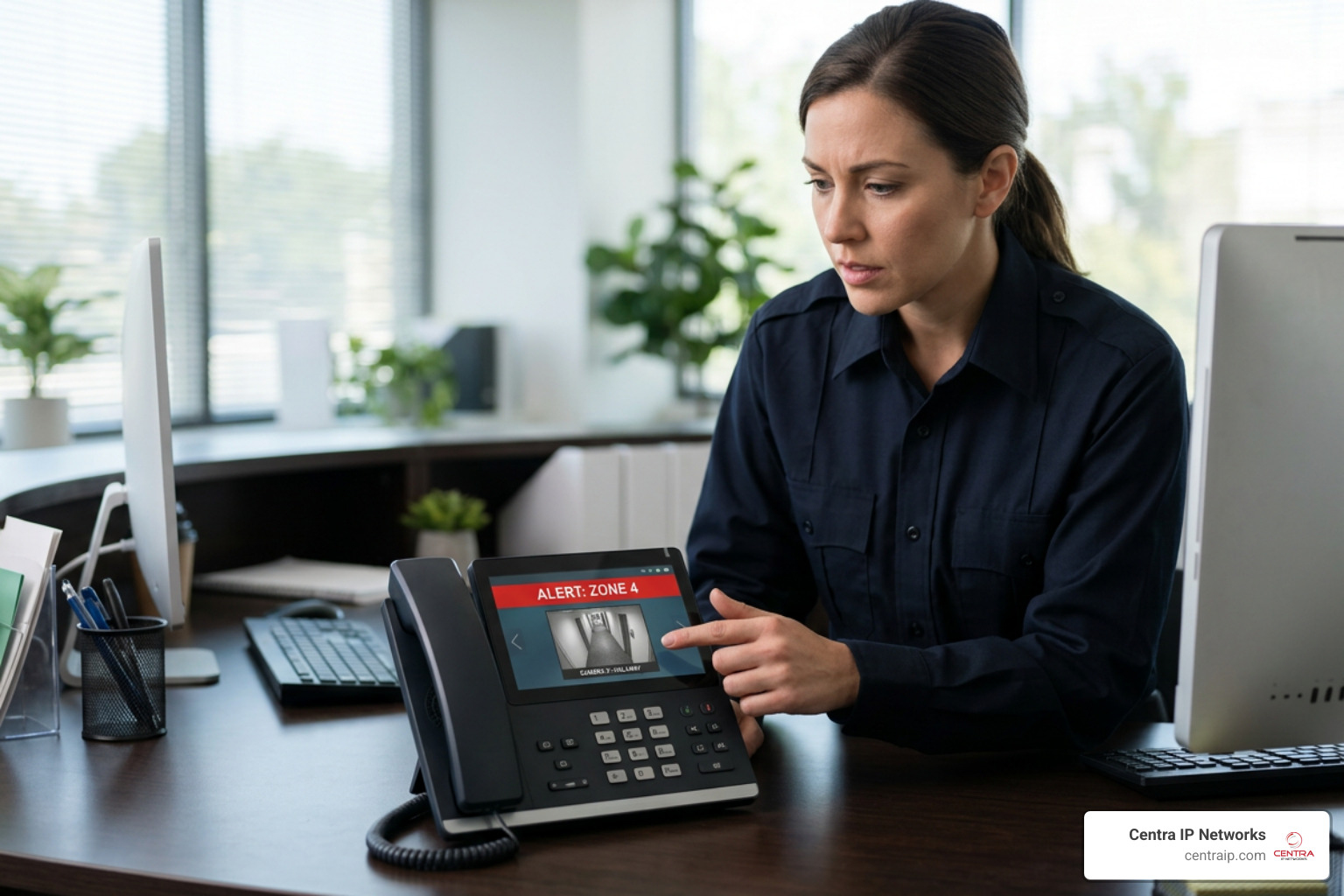
Integrating surveillance cameras into IP phone platforms changes how organizations handle daily operations and emergency events. Instead of relying on a staff member to sit in a dedicated security booth staring at wall-mounted monitors, intelligent triggers bring relevant visual data directly to key personnel wherever they are located.
Automating these workflows dramatically lowers administrative friction. Front desk staff can answer delivery driver inquiries without leaving their desks, property managers can verify maintenance calls remotely, and security officers receive immediate notification the instant a perimeter line is breached. Learn more about smart camera capabilities in our guide to Smart Business Security Camera Integration: A Complete Guide.
How Modern Surveillance Integration Phone Systems Streamline Emergency Response
During a critical incident, panic and chaos often slow down reaction times. Surveillance integration phone systems remove manual operational steps by executing pre-programmed emergency response plans instantly.
Consider a real-world scenario where a side exit door is opened improperly after hours:
- Detection: The door contact sensor and linked IP camera detect a breach.
- Automated Dialing: The IP PBX automatically dials a pre-set emergency ring group, contacting on-site security guards, site managers, and local administrators simultaneously.
- Real-Time Visual Verification: An interactive popup window opens on phone touchscreens and mobile softphones, delivering a live video feed of the breach zone.
- Active Interventions: The operator can press a softkey to broadcast a voice warning over the door’s localized IP speaker, activate strobe lights, or initiate a localized facility lockdown.
Because response teams verify incidents visually before calling public emergency dispatchers, response times are drastically reduced, and expensive false alarm fines are virtually eliminated.
AI-Powered Video Analytics and Smart Phone Alerts
Modern security cameras are no longer passive lenses recording video to a local drive. Equipped with edge-based artificial intelligence (AI), today’s cameras act as intelligent visual sensors capable of detecting specific behavioral patterns and physical objects in real time.
When combined with VoIP phone networks, AI analytics unlock automated threat mitigation:
- Active Gun Detection: Deploying AI active gun detection across a typical 100-camera campus footprint allows software to identify a brandished weapon in seconds. The system immediately alerts security desk phones, triggers automated lockdown protocols, and sends video alerts to staff before an armed intruder enters the building.
- Loitering and Perimeter Intrusion: AI analytics can differentiate between a passing vehicle and a person lingering near a sensitive loading dock or server room perimeter after hours, placing an automated call to security with live video context.
- Facial and License Plate Recognition (LPR): Known unauthorized vehicles or individuals flagged on blocklists trigger instant notifications to administrative phone extensions upon entering parking structures.
FCC Emergency Compliance: Kari’s Law and Ray Baum’s Act
For modern organizations, integrating VoIP communications with physical facility infrastructure is not only a best practice—it is a federal legal requirement. Federal Communications Commission (FCC) rules strictly govern how multi-line telephone systems (MLTS) handle emergency 911 calls.
When designing unified voice and surveillance networks, full compliance with Kari’s Law and Ray Baum’s Act must be built directly into the network architecture. Seamless integrations, such as the Yeastar+Hikvision Intercom Telephony Integration, highlight how voice platforms handle complex signaling requirements across connected security devices.
Meeting Kari’s Law Requirements
Enacted to eliminate barriers during emergency situations, Kari’s Law establishes two fundamental requirements for multi-line telephone systems:
- Direct 911 Dialing: Callers must be able to dial
911directly without first dialing an access prefix (such as dialing9or8for an outside line). - Mandatory On-Site Notification: When a 911 call is placed, the phone system must automatically trigger a contemporaneous notification to a designated on-site point of contact or security team.
When tied into a surveillance integration phone system, an outgoing 911 call instantly triggers on-site phone alerts, sends SMS/email broadcasts to staff, and automatically pops up live video feeds of the caller’s specific building quadrant on central security monitors.
Ray Baum’s Act and Granular Dispatchable Geolocation
Section 506 of Ray Baum’s Act focuses on ensuring emergency first responders receive a validated “dispatchable location” when a 911 call is made. A dispatchable location includes the civic street address plus granular details—such as the building number, floor, suite, or specific room quadrant—necessary to locate the caller quickly.
To achieve compliance across complex commercial buildings and multi-story campuses, IP phone systems use advanced location tracking frameworks:
- CESID Mapping: Caller Emergency Service Identification (CESID) numbers map specific phone extensions or physical network jacks directly to pinpoint building locations.
- HELD Protocol: The HTTP-Enabled Location Discovery (HELD) protocol allows softphone applications on laptops and mobile devices to report precise geolocation data dynamically to Next Generation 911 (NG911) routing providers.
- Layer 2 / Layer 3 Wiremapping: The PBX maps IP address ranges and network switch port MAC addresses so that as an employee moves their IP phone from floor 2 to floor 4, their emergency dispatchable location updates automatically in the background.
When emergency calls occur, security personnel receive both the exact caller location and immediate video feeds from nearby IP cameras, ensuring complete situational awareness when guiding first responders into the facility.
Specialized Deployment: Property Management and Multi-Tenant Facilities
Condominiums, high-rise apartment complexes, and commercial mixed-use developments present unique physical security challenges. These properties function simultaneously as private residential communities and public spaces with high visitor traffic, frequent package deliveries, and shared resident amenities.
Property managers face constant pressure to maintain tight security, minimize liability risks, and control operational costs. Deploying integrated voice, video, and access systems addresses these challenges directly. Property teams interested in evaluating comprehensive deployments can review our Surveillance Systems Complete Guide 2026.
Monitoring Critical Zones in Condominiums and Mixed-Use Properties
Comprehensive security design requires placing integrated video and voice endpoints strategically across a property’s most vulnerable areas:
- Parking Structures and Garages: Low-visibility underground garages benefit from AI-powered surveillance linked to call-box emergency phones. Bright emergency pull-stations tied into IP cameras allow residents to call front-desk staff instantly while triggering immediate video popups.
- Stairwells and Storage Rooms: Isolated areas often lack cellular coverage. Installing SIP-enabled intercom stations backed by motion-triggered cameras ensures residents can call for help while giving staff visual verification of secondary egress routes.
- Lobbies and Package Mailrooms: Package theft is one of the top resident complaints in multi-tenant communities. Integrated video entry phones manage delivery drivers seamlessly, capturing high-resolution video of every individual entering package rooms.
- Elevators and Rooftop Amenities: Elevator cabs equipped with IP video door stations route emergency calls straight to on-call management phones while providing live video proof during elevator cab stalls.
Risk Reduction and Property Value Enhancement
Installing integrated surveillance and voice systems delivers direct financial and operational dividends for property management groups and homeowners associations (HOAs):
- Reduced Liability and Lower Insurance Premiums: Insurance underwriters heavily favor properties with active risk mitigation systems. High-definition video logs linked with entry records supply indisputable evidence during slip-and-fall claims or property damage disputes, leading to lower liability premiums.
- Enhanced Resident Trust and Occupancy Rates: Safety is a primary factor for prospective tenants. Features like mobile app entry controls, visible video entry stations, and fast emergency response boost property prestige and retain resident loyalty.
- Streamlined Visitor Management: Management staff can handle gatekeeping duties remotely across multiple properties. When a guest arrives, the system forwards the video call to a centralized leasing office or the resident’s smartphone, allowing one-button remote door opening.
Coordinated Emergency Paging and Remote Mass Notifications
Broadcasting critical information quickly across large physical environments requires a reliable paging setup. Traditional analog horn speakers wired to standalone amplifier boxes in electrical closets are difficult to maintain and completely disconnected from modern IT networks.
Replacing outdated systems with IP-based overhead paging systems unifies audio broadcasting directly with VoIP phones and security cameras. Organizations looking to expand coverage can read about the overall Benefits of Remote Video Surveillance.
Synchronizing IP Overhead Speakers with Video Surveillance
IP overhead speakers operate as active native endpoints on the network, receiving Power over Ethernet (PoE) and communicating via standard SIP routing protocols. This architecture enables powerful operational synergies across commercial facilities and large industrial footprints:
- Broad Coverage for Large Facilities: IP-based paging platforms can easily cover expansive single-building footprints—such as a 120,000-square-foot refrigerated warehouse with 45-to-60-foot ceilings—ensuring clear, intelligible audio distribution across noisy environments.
- Audio Talk-Down Capabilities: When a security officer observes an unauthorized person loitering near a high-security area via live camera feed, they can dial an extension from their phone or mobile softphone to talk down directly through the nearby IP speaker, warning the trespasser that police are en route.
- Visual Event Triggers: IP cameras detecting line crossings or thermal anomalies can automatically initiate localized audio warnings (“Attention: You have entered a restricted area”) over connected IP horn speakers without requiring human intervention.
- Zonal Broadcasting: Administrators can group speakers logically into specific broadcast zones (e.g., Exterior Parking, Floor 2 Office, Warehouse Bay A), directing emergency announcements strictly where needed.
Mobile Access and Centralized Command Controls
Modern security management no longer keeps administrators tethered to a physical desk workstation. Centralized cloud platforms allow authorized personnel to monitor, manage, and control facility communications from anywhere in the world.
Through encrypted mobile applications and web-based command portals, operators can perform complete system administration remotely:
- Live Multi-Camera Viewing: Access real-time HD camera streams from smartphones, tablets, or remote laptops.
- Remote Door Release: Receive incoming video calls from front gate intercoms on mobile softphones and release door latches remotely for emergency personnel or trusted vendors.
- Mass Notification Push: Initiate pre-recorded emergency voice broadcasts or text alerts across all facility desk phones, mobile devices, and IP overhead speakers with a single tap.
Real-World Applications, Vendor Consolidation, and Best Practices
To get the best return on investment when deploying surveillance integration phone systems, organizations should follow proven industry guidelines:
- Run Voice and Security on Converged Structured Cabling: Standardize on high-performance Cat6 or Cat6A Ethernet cabling tested strictly to TIA/EIA standards. A unified IP backbone eliminates redundant wiring runs and simplifies IT maintenance.
- Prioritize Quality of Service (QoS): Configure managed network switches with strict QoS rules to prioritize real-time voice and video packets, preventing call dropping or video lag during high network traffic periods.
- Ensure Power Redundancy: Connect all PoE network switches, IP PBXs, and video recorders to Uninterruptible Power Supply (UPS) battery systems paired with emergency generators to maintain full security and 911 capability during power outages.
- Implement Strict Cyber Protection: Restrict Asterisk Management Interface (AMI) ports, use Session Border Controllers (SBCs) for external SIP trunking, and enforce encryption protocols (TLS/SRTP) across voice and video streams.
For budget planning and system sizing, use our interactive Video Surveillance Pricing Calculator to estimate installation scope.
Operational Advantages of Single-Vendor Infrastructure
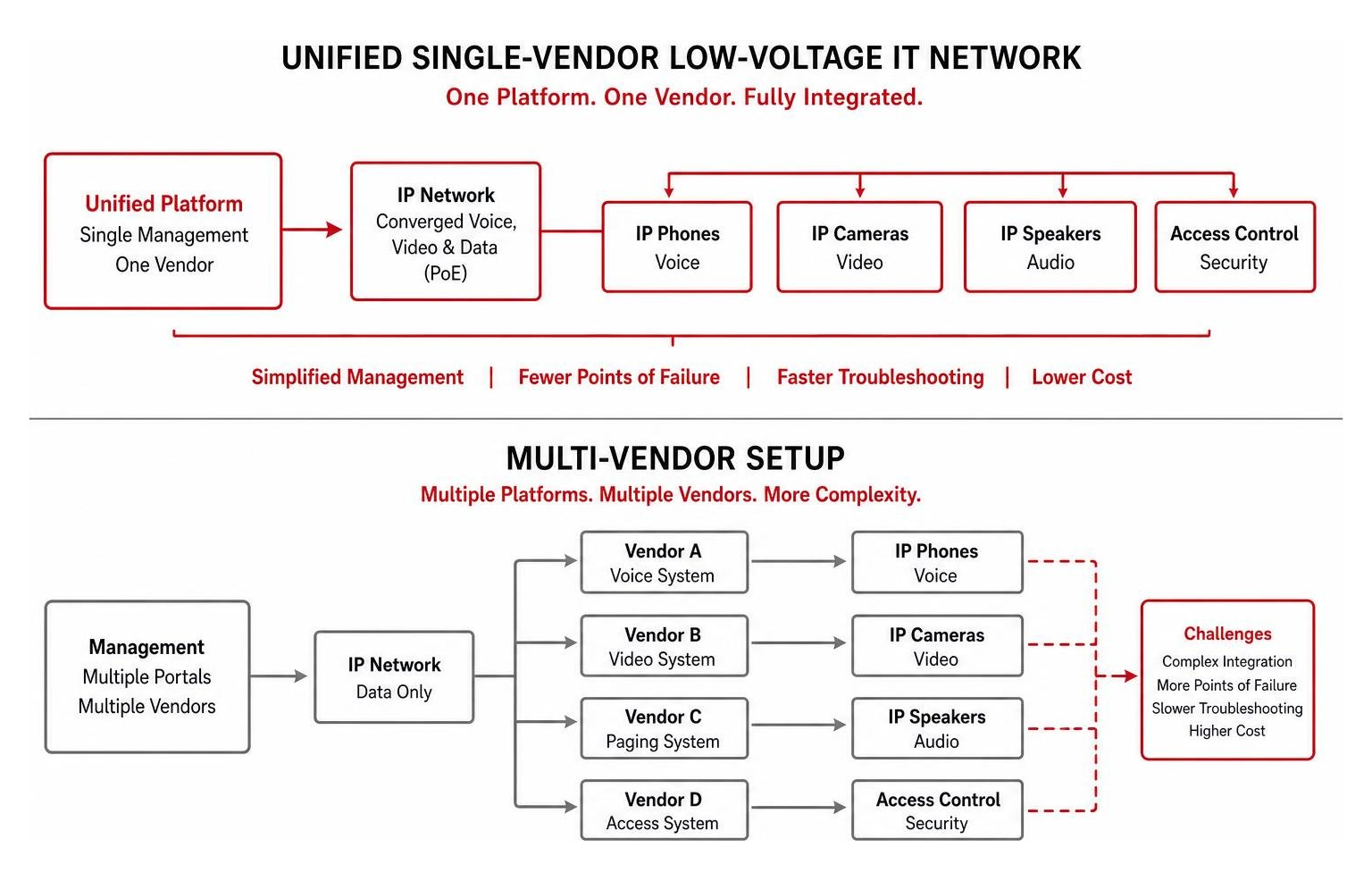
Historically, businesses managed separate vendor contracts for their telephone services, security camera installers, access control providers, and network cabling technicians. This fragmented approach frequently led to finger-pointing when technical issues arose, with each vendor blaming the other’s hardware for network slowdowns or service interruptions.
Partnering with a single provider like Centra IP Networks for cloud communications, managed IT, and low-voltage security eliminates operational friction completely:
- Single Point of Accountability: One phone call resolves any issue—whether it involves a desk phone extension, an IP camera feed, or an access control door lock.
- Unified Monthly Billing: Consolidate telecom lines, cloud PBX hosting, video storage subscriptions, and IT management into one transparent bill.
- Reduced Installation and Upkeep Costs: Installing one converged low-voltage cabling network drops labor costs significantly compared to running separate cabling networks for voice, security, and paging.
Case Studies: Education, Warehousing, and Commercial Success
The practical impact of surveillance integration phone systems is best understood through real-world operational deployments:
- School Campus Emergency Lockdown: A K-12 educational facility deployed an integrated security environment covering 100 IP cameras, door access control, and a modern VoIP network. When an exterior camera equipped with AI gun detection flagged a potential armed threat in the parking lot, the system automatically initiated an active lockdown, placed the phone system into emergency mode, broadcasted spoken warnings over all classroom IP speakers, and pushed immediate location maps to local police.
- Logistics Warehouse Operations: A 120,000-square-foot commercial logistics hub struggled with missed driver deliveries and property vandalism after hours. By integrating IP video door stations with their VoIP phone network, delivery drivers press a call button at the entry gate that rings directly to warehouse softphones. Staff visually verify drivers on desk phone screens, grant gate access remotely, and utilize IP talk-down speakers to guide vehicles safely to assigned loading bays.
- Commercial Property Entry Gatekeeping: An enterprise office building in Dallas replaced its traditional reception desk setup with an integrated video entry station tied directly to off-site administrative phone lines. The single-vendor deployment reduced front-desk staffing costs while maintaining 24/7 visual access verification and remote door release capability.
Frequently Asked Questions about Surveillance Integration Phone Systems
How does video surveillance integrate directly into business VoIP phone systems?
Video surveillance cameras and intercoms integrate into VoIP phone systems by leveraging standard Session Initiation Protocol (SIP) communication standards alongside standardized H.264 or H.265 video codecs. Hardware endpoints—such as video door stations, emergency call boxes, or IP cameras—register directly with the IP PBX as standard internal extensions.
When a user dials the camera’s extension or an alert is triggered, the PBX establishes a standard SIP call session, streaming live video directly to compatible touchscreen IP desk phones, desktop softphone clients, or mobile apps.
What are the main benefits of using a single vendor for voice and surveillance?
Using a single provider for voice, data, and video surveillance provides significant financial and operational advantages:
- No Vendor Finger-Pointing: A single support team manages the entire technology stack, eliminating communication delays during troubleshooting.
- Streamlined Infrastructure: Voice, video, and access control run across a single converged Cat6/6A network infrastructure, dramatically reducing cabling and labor costs.
- Simplified Billing: All telecommunications, cloud hosting, and hardware maintenance fees are consolidated into a single predictable monthly bill.
- Guaranteed Compatibility: Hardware, switch configurations, QoS settings, and software protocols are engineered to work together seamlessly from day one.
Can integrated phone and camera systems lower business insurance premiums?
Yes. Commercial property and casualty insurance providers frequently offer premium discounts to organizations that install integrated physical security platforms.
By unifying video surveillance, access control credential logging, and immediate emergency voice alerts, businesses significantly reduce their risk profile regarding property theft, vandalism, and fraudulent worker compensation or slip-and-fall claims. High-definition video recordings linked directly to entry logs provide clear legal evidence, allowing insurance carriers to defend against false claims effectively.
Conclusion
Modern physical security demands fast communication, complete visibility, and reliable network infrastructure. Operating standalone security cameras, disconnected door locks, and isolated telephone hardware leaves organizations exposed to operational delays, compliance risks, and security gaps.
By choosing surveillance integration phone systems, businesses bring voice, video, access control, and emergency paging into a single intelligent platform. Whether you are aiming to meet strict FCC 911 regulatory mandates, streamline visitor management in multi-tenant commercial properties, or protect staff across expansive industrial facilities, unifying your communications and physical security delivers total peace of mind.
At Centra IP Networks, we eliminate technical complexity by delivering managed IT, cloud communications, and integrated low-voltage security solutions under one roof—supported by 35+ strategic technology partnerships, custom engineering, a single bill, and local service across Dallas, Fort Worth, Orlando, Tampa, St. Petersburg, Clearwater, and Sarasota.
Ready to eliminate security blind spots and upgrade your facility communications? Explore our flexible Cloud Surveillance Services or contact our engineering team today to schedule a comprehensive physical security and smart infrastructure assessment.