
What is Business Security Camera Integration and Why Does It Matter?
At its core, business security camera integration is about breaking down software and hardware silos. Historically, physical security systems functioned like isolated islands. Your CCTV cameras recorded footage to a local drive, your access control system logged keycard swipes on a separate server, and your burglar alarm operated on a standalone dialer panel. If someone pulled a fire alarm or forced a rear door, someone had to manually check five different software interfaces or jog across the building just to see what happened.
When we integrate your surveillance cameras into your broader IT and physical security stack, these isolated tools transform into an intelligent network. Instead of passively recording events for post-incident finger-pointing, an integrated system communicates bi-directionally in real time. For example, when an employee scans their keycard at an entrance, the system automatically pulls up the live camera feed for that specific door and cross-references the user’s registered photo against the person entering.
This level of cohesion dramatically boosts situational awareness and operational control. Rather than assigning staff members to sit in a room staring at dozens of wall-mounted monitors—a task proven to lead to visual fatigue within 20 minutes—integrated networks bring critical events directly to your security operators or mobile devices. By combining video surveillance with your network infrastructure, you transform static cameras into proactive operational tools. To explore how your surveillance hardware and local network interact, check out our guide on Surveillance Technology Integration Making Your Cameras and IT Network Best Friends.
Core Systems Linked to Video Surveillance
Modern commercial security integration brings several vital facility management platforms together under a single pane of glass:
- Access Control Systems: Linking video management software (VMS) with door access readers allows security teams to correlate badge events with video recordings instantly. When an unapproved keycard is presented, or a door is forced open, the system tags the exact video clip and presents it to administrators. Leading industry developments, such as the honeywell-and-rhombus-introduce-ai-driven-cloud-video-and-access-solution-to-modernize-building-security, demonstrate how cloud-native access control and video surveillance work hand-in-hand to modernize physical site safety.
- Intrusion Alarms and Sensors: Standalone glass-break detectors and motion sensors often generate costly false alarms triggered by bad weather or stray animals. By integrating cameras with intrusion detection panels, monitoring agents receive an immediate video clip whenever a sensor trips, permitting rapid visual confirmation before emergency services are dispatched.
- Mass Notification and Emergency PA: During critical security incidents, timing is everything. Integrated camera systems can trigger automated, targeted public address announcements, audio alerts, or mass notifications via mobile messaging services the second an perimeter breach or unauthorized access attempt is detected.
- Fire Safety and Life-Safety Systems: When a fire alarm panel activates in a large office complex, facility managers need immediate visibility into the affected zone. Integrated surveillance feeds automatically display live video of the triggered zone on command center monitors, helping teams evaluate smoke conditions and clear evacuation routes safely.
- Emergency Dispatch Systems: Integrated AI software can push verified event metadata and location coordinates directly to 911 dispatch frameworks, short-circuiting traditional multi-minute emergency call procedures down to mere seconds.
Technical Protocols Driving Business Security Camera Integration
Achieving seamless integration across different hardware brands requires standard technical protocols and software hooks. In the past, proprietary lock-in forced businesses to buy all hardware from a single manufacturer. Today, open standards and open APIs give us the flexibility to connect legacy devices with state-of-the-art platforms:
- ONVIF (Open Network Video Interface Forum): ONVIF profiles (such as Profile S for IP video streaming, Profile G for edge storage, and Profile T for advanced video streaming) establish a universal communication language between network cameras, video recorders, and management software regardless of manufacturer.
- RTSP (Real-Time Streaming Protocol): RTSP serves as the standard network protocol used to deliver real-time multi-media video streams across IP networks to analytics engines and third-party dashboards.
- REST APIs and Webhooks: Representational State Transfer (REST) APIs allow cloud platforms and security management platforms to request and manipulate system data programmatically. Webhooks act as automated push notifications, sending instant event payloads (such as a door forced open alert) from one system to another without latency.
- Software Development Kits (SDKs): Deep, bi-directional hardware integration—such as controlling pan-tilt-zoom (PTZ) camera presets from within an access control client—is achieved through custom vendor SDK modules. Standard platforms like the Supported Integrations – IRIS+ platform demonstrate how core VMS platforms use native SDK connections and generic webhooks to synchronize streaming video and object metadata simultaneously.
Key Applications, Analytics, and Real-World Use Cases
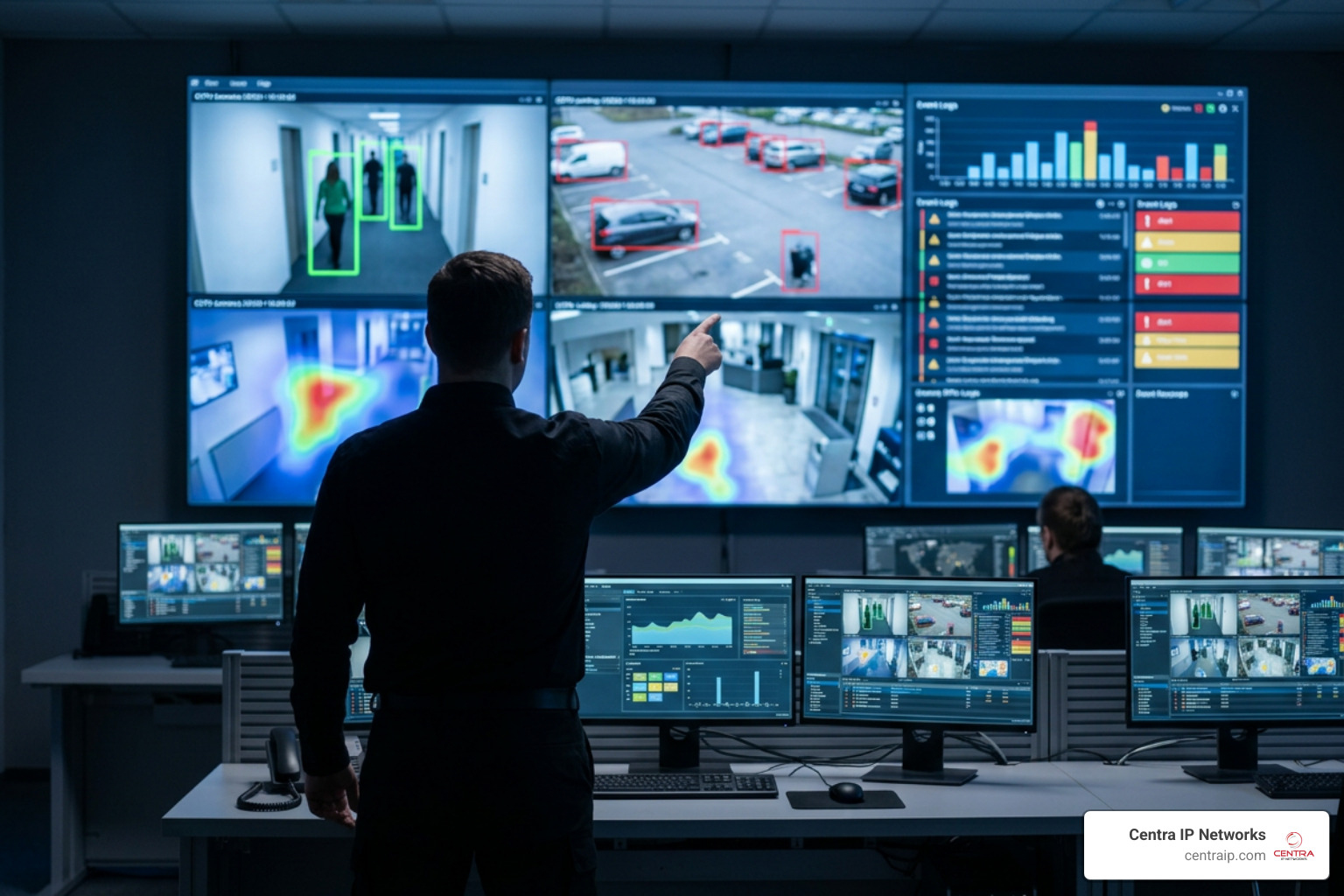
Modern IP surveillance cameras do much more than simply store thousands of hours of passive footage on hard drives. Equipped with modern artificial intelligence (AI) and machine learning engines, camera systems analyze environmental activity in real time, serving as smart digital guards across your commercial facilities.
Integrating AI video analytics into your network unlocks proactive security features that protect both your assets and bottom line:
- License Plate Recognition (LPR): LPR cameras automatically log vehicle license plates entering parking structures or commercial yards. When integrated with barrier gates or access systems, recognized vehicles for delivery drivers or authorized staff are granted immediate entry, while unknown or flagged vehicles trigger instant security notifications.
- Tailgating Detection: Tailgating occurs when an unauthorized individual follows an employee through a card-access door without swiping their own badge. By integrating camera streams directly above entryways with credential logs, AI software counts human bodies walking through the threshold and instantly flags credential mismatches.
- Occupancy & Heat Mapping: Retail stores and commercial venues utilize camera heat mapping to visualize foot traffic density. This provides double value: security teams identify crowded bottleneck areas vulnerable to safety hazards, while operations teams optimize product placement and staffing levels.
- Safety & Regulatory Compliance: Industrial facilities and distribution warehouses deploy analytics to ensure safety compliance. AI engines scan workplace zones for personal protective equipment (PPE)—such as hard hats, high-visibility vests, and safety glasses—and alert safety officers if an unequipped worker enters a hazardous area.
Beyond threat response, learning how advanced video surveillance protects your business assets can yield immense financial return. To learn more about maximizing hardware returns, review our detailed guide on the Benefits of Security Cameras for Businesses.
Industry-Specific Real-World Examples
To understand how business security camera integration creates day-to-day value, consider these practical applications across key commercial sectors:
Retail Loss Prevention
A multi-location retail chain in Tampa frequently suffered severe shoplifting losses near high-value electronics display counters. By deploying integrated AI cameras connected to staff smartwatches and mass notification systems, the moment a subject loiters near a high-risk cabinet for longer than 45 seconds, nearby staff receive an alert with a live video preview. This proactive alert allows staff to offer immediate assistance, quietly deterring theft before it happens.
Logistics and Warehouse Operations
At a busy freight depot in Dallas-Fort Worth, truck dock doors were frequently left propped open, creating security vulnerabilities and climate control energy loss. By connecting overhead IP cameras to door contact sensors and overhead PA systems, any loading bay door remaining open without an active truck present triggers a visual pop-up in the shipping manager’s dashboard and a clear, automated voice prompt on the warehouse floor.
Commercial Office Buildings
A corporate office building in Orlando streamlined its visitor management by integrating video surveillance, parking barrier gates, and tenant access control. Visitors receive a temporary QR code on their smartphone. When scanned at the gate, linked PTZ cameras automatically zoom in on the driver and vehicle, logging entry while notifying the host employee via web chat that their guest has arrived.
Healthcare Facilities
In a multi-building medical campus in St. Petersburg, securing restricted pharmacy stockrooms requires rigorous verification. Integrating biometrics, door readers, and wide-angle IP cameras ensures that every access attempt logs credential data paired alongside a high-definition video snapshot of the person entering, helping the facility comfortably fulfill strict regulatory audit requirements.
Retrofitting Legacy Systems vs. Hardware Upgrades
One of the most common myths surrounding business security camera integration is that you must rip out every piece of existing hardware and start from scratch. In reality, modern security engineering focuses heavily on preserving existing infrastructure wherever possible.
If your facility operates legacy analog cameras or older IP units, you can easily retrofit these devices into a unified, modern software stack:
- Cloud Connectors and Edge Appliances: Plug-and-play local gateway devices can ingest video streams from legacy ONVIF or RTSP cameras and route them to modern cloud platforms. This instantly upgrades older cameras with AI detection, smart search, and cloud backup capabilities without pulling a single new network cable.
- Video Encoders: If your facility relies on coaxial analog infrastructure, multi-channel video encoders convert analog signals into encrypted digital IP streams, integrating legacy cameras seamlessly into modern IP Video Management Systems (VMS).
- Hybrid NVRs: Hybrid Network Video Recorders feature both BNC coaxial inputs and IP network ports, allowing you to retain functioning legacy cameras while systematically adding high-resolution 4K IP cameras over time as your budget allows.
Platform software such as Security Integrations demonstrates how privacy-focused, on-premises AI layers can connect natively to existing camera feeds and VMS frameworks, enabling response automation without requiring costly hardware overhauls.
Deployment Architectural Models: Cloud vs. On-Premises
Choosing the right deployment architecture is a critical step when evaluating business security camera integration. Every business model presents unique tradeoffs regarding upfront hardware expenses, network bandwidth demand, operational flexibility, and long-term maintenance costs.
| Architecture Model | Primary Strengths | Key Considerations | Best Suited For |
|---|---|---|---|
| Cloud-Native Integration | Rapid multi-site deployment; remote access from anywhere; zero local server upkeep; automatic firmware updates. | Requires stable Internet connection; ongoing subscription fees; bandwidth usage management. | Multi-location retail, distributed office spaces, growing SMBs. |
| On-Premises VMS Integration | Complete local control over data; zero Internet bandwidth consumption for local viewing; no monthly SaaS fees. | High upfront server hardware costs; manual software patching; complex remote access configuration (VPNs). | Highly regulated environments, high-density industrial sites, government facilities. |
| Hybrid Cloud Integration | Combines local storage reliability during internet outages with centralized cloud management and remote accessibility. | Requires balancing local NVR maintenance with cloud software licensing. | Enterprise campuses, commercial facilities, multi-building sites. |
Cloud architectures have transformed how modern businesses scale security operations across multiple locations in Dallas, Fort Worth, Orlando, Tampa, St. Petersburg, Clearwater, and Sarasota. To dive deeper into modern cloud deployment models, explore our comprehensive breakdown on Cloud Surveillance Solutions Transforming physical site protection, or read how cloud platforms simplify remote management in How Cloud-Based Video Surveillance Adds Security.
Key Challenges in Business Security Camera Integration
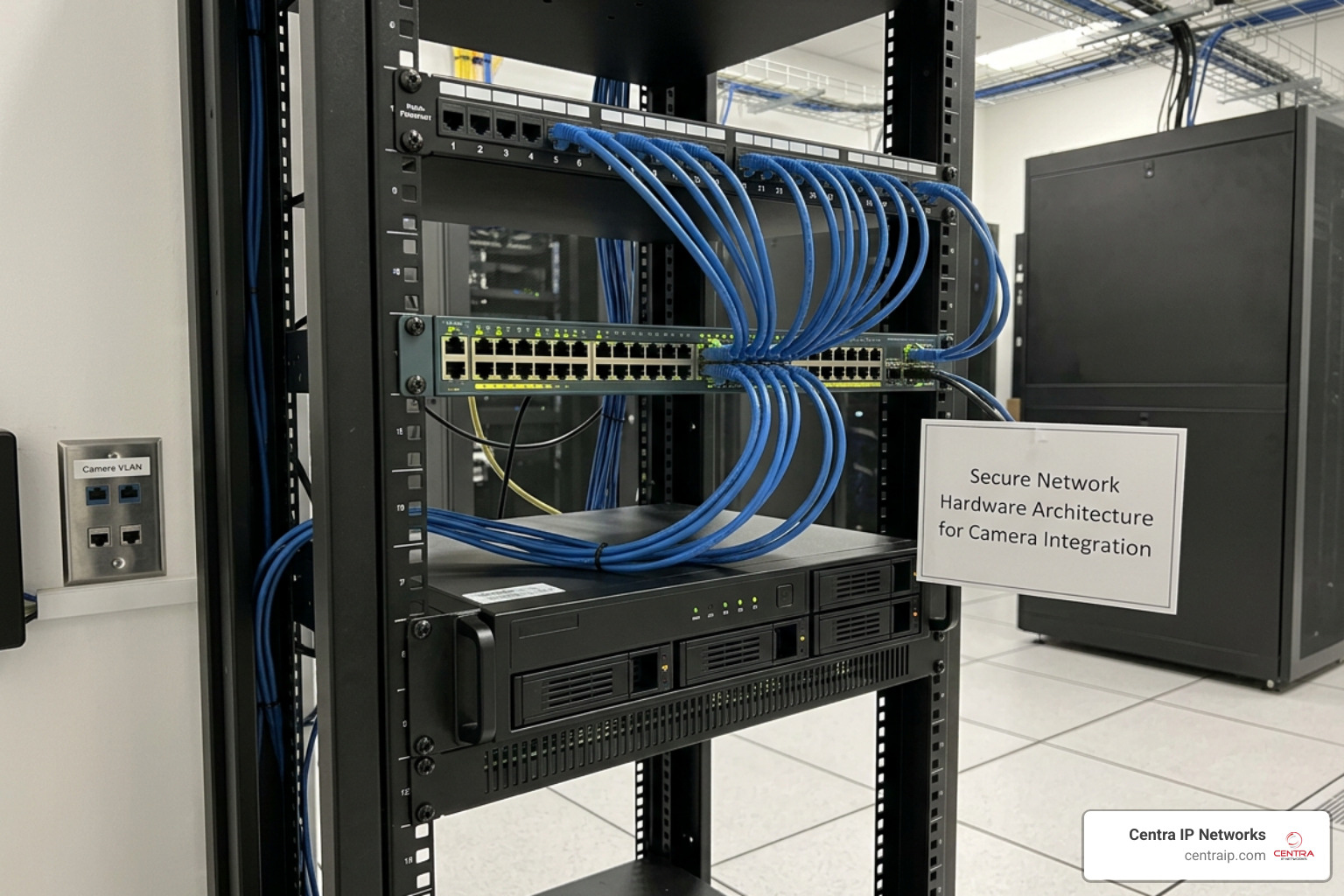
While integrating your business security cameras unlocks immense operational value, doing so improperly can introduce serious network vulnerabilities or compliance headaches. Partnering with experienced IT and low-voltage integration experts ensures your network stays secure:
Cybersecurity Protections
Every network-connected IP camera is essentially a small computer attached to your network. Unsecured IoT devices present entry points for network intrusion. A robust security strategy requires isolating security devices on dedicated Virtual Local Area Networks (VLANs), disabling default factory passwords, implementing strict 802.1X port authentication, enforcing TLS 1.2+ encryption for data in transit, and applying AES-256 encryption for video at rest.
Data Privacy and Compliance Regulations
Collecting video footage across customer-facing or workplace environments carries clear legal responsibilities. In Florida and Texas, strict compliance regulations govern video retention and audio recording. Standard commercial surveillance systems typically store footage for 30 to 90 days. Additionally, because built-in camera microphones can inadvertently breach local wiretapping regulations, audio monitoring features must be carefully configured to comply with employee and customer privacy guidelines.
NDAA Compliance
For businesses that interact with federal entities, high-security infrastructure, or receive federal grants, National Defense Authorization Act (NDAA) Section 889 compliance is mandatory. System design must strictly exclude telecommunications and video surveillance hardware manufactured by banned vendor entities.
Local Network Bandwidth Optimization
Streaming multiple 4K security streams across your local network can easily saturate corporate bandwidth if engineered incorrectly. Utilizing dynamic stream switching (sub-streaming for multi-camera wall grids and primary streams for full-screen playback), smart video compression standards like H.265+, and edge-based storage caching ensures your critical business apps always have plenty of bandwidth headroom.
To ensure your infrastructure adheres to modern performance standards, review our complete guide on Surveillance Systems Complete Guide 2026.
Frequently Asked Questions About Video Surveillance Integration
Can existing cameras be integrated without replacing hardware?
Yes! In almost all cases, existing IP and analog security cameras can be integrated into modern video management and access control systems without full hardware replacement. Standard ONVIF-compliant IP cameras and RTSP video streams connect natively into new VMS software or cloud gateway appliances.
Even legacy BNC analog cameras can be preserved by installing multi-channel video encoders or hybrid NVRs, which convert analog signals into digital network streams. This lets you layer modern AI analytics, cloud access, and system integration over your legacy hardware while systematically upgrading hardware over time.
How does integration improve incident response times?
Traditional, unintegrated security systems operate in isolated silos, requiring personnel to manually notice an alert, cross-reference camera locations, pull up footage, and make phone calls to dispatch team members. This manual chain usually takes between 3 to 7 minutes.
Integrated security camera networks automate event handling. The moment a sensor, door forced open event, or AI rule triggers, the system automatically correlates the event, pops up live camera feeds on operator monitors, attaches video clips to mobile alerts, and can instantly dispatch notification payloads to emergency services or site lockdown systems—cutting total response times down to under 10 seconds.
What technical protocols are required for third-party system interoperability?
Third-party physical security integration primarily relies on four standard protocols:
- ONVIF (Profiles S, G, T, M): Ensures core video streaming, PTZ control, edge storage, and metadata communication work across different hardware manufacturers.
- RTSP (Real-Time Streaming Protocol): The standard IP network protocol used to route live video feeds to analytics engines and third-party dashboards.
- REST APIs and Webhooks: Lightweight web service interfaces that allow independent cloud platforms and local servers to exchange event data and send instant push triggers programmatically.
- Vendor SDKs: Specialized software development kits used to enable deep feature compatibility (like cardholder photo pop-ups inside a VMS client) between specific vendor platforms.
Conclusion
Modern physical security is no longer about hanging a few standalone cameras on corners and hoping for the best. Business security camera integration turns passive recording hardware into an active, intelligent response ecosystem—connecting access control, intrusion sensors, mass notification platforms, and AI video analytics into a unified command dashboard.
By replacing disconnected systems with a coordinated security architecture, your business gains faster incident response times, eliminates investigative blind spots, protects critical assets, and streamlines everyday operational efficiency.
At Centra IP Networks, we specialize in helping commercial organizations across Dallas, Fort Worth, Orlando, Tampa, St. Petersburg, Clearwater, and Sarasota simplify their technology stack. By delivering comprehensive Managed IT, Cloud Communications, structured cabling, and advanced surveillance integration on one platform with a single provider and bill, we take the complexity out of securing your operations.
Ready to transform your physical security setup into an intelligent, connected network? Explore our Cloud Surveillance Services or contact our integration team today to schedule your comprehensive facility security assessment.