

Why a Cloud Ecommerce Platform Is a Revenue System
A cloud ecommerce platform is an internet-hosted system that runs an online store while connecting the work behind every sale: products, payments, inventory, orders, customer data, marketing, and support. Unlike a basic website, it helps a business manage the full customer journey and can scale computing resources when traffic rises.
- Cloud-hosted: The provider runs the servers, updates, backups, and much of the infrastructure.
- Built for growth: Capacity can expand during busy periods without buying permanent hardware.
- Connected operations: APIs and integrations can sync the storefront with ERP, CRM, inventory, shipping, and payment tools.
- Revenue-focused: It turns customer activity into orders, fulfillment tasks, support requests, and usable business data.
For businesses managing too many systems and vendors, the real value is not simply putting a catalog online. It is creating a reliable, secure commerce operation where customer-facing sales and back-office work stay connected.
I am Patrick Brangan, and I have more than 20 years of experience helping small and midsize businesses simplify technology through communications, managed IT, networks, and security solutions. That practical background matters when evaluating a cloud ecommerce platform, because dependable connectivity, scalable systems, and proactive support all affect how well a revenue system serves customers.
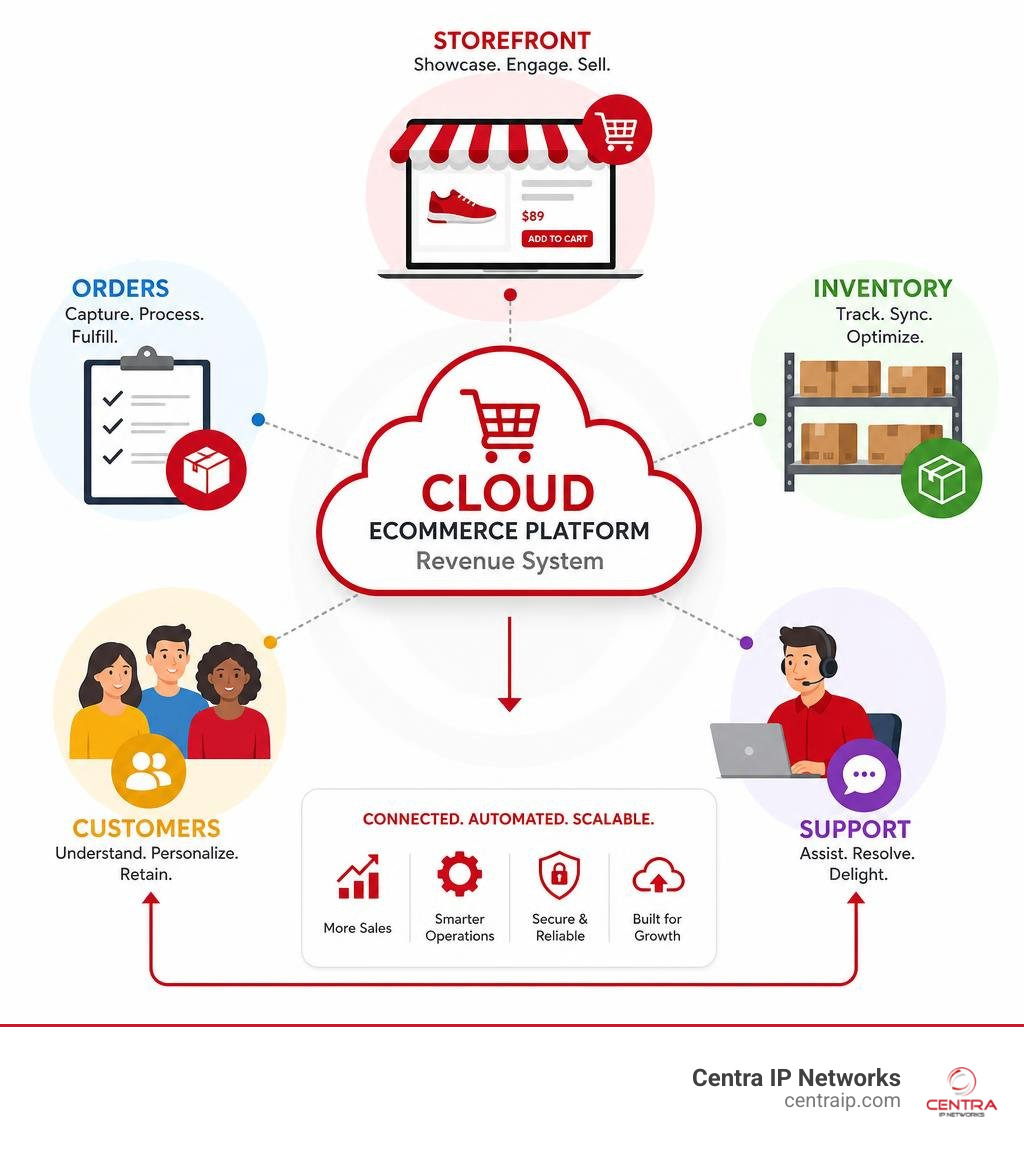
Cloud ecommerce platform terms at a glance:
What Is a Cloud Ecommerce Platform vs. Legacy Systems?
A modern cloud ecommerce platform is far more than an electronic product catalog. It is the core data infrastructure that drives the end-to-end buying journey, processing transactions, tracking stock levels across multi-site warehouses, and orchestrating customer interactions in real time.
In a traditional setup, businesses ran monolithic software installed on local physical servers located in an on-premises server room or colocation facility. Modern cloud commerce platforms, by contrast, operate on distributed virtual networks hosted in public or managed cloud environments. They leverage multi-tenant or multi-instance cloud architectures where server resources, automatic software updates, and maintenance are handled seamlessly in the background.
Choosing an adaptable platform solution such as Litium Commerce Cloud – Fast and flexible for growth allows merchants to focus on customer acquisition and operations rather than managing hardware health and network uptime.
Defining Cloud-Based Digital Commerce Infrastructure
At its foundational level, cloud-based digital commerce infrastructure relies on disaggregated software-defined compute and storage resources. Databases running behind high-volume online shopping carts demand sub-millisecond latency for “Add to Cart” and checkout operations to prevent catalog jitter and cart abandonment.
To achieve this performance, modern cloud hosting leverages high-speed block storage protocols (such as NVMe-over-TCP) paired with edge content delivery networks (CDNs). This ensures that no matter where a customer opens your app or website globally, product images load instantly and backend inventory databases respond without delay. Managed cloud infrastructure provides concrete SLA-backed performance—frequently offering guaranteed uptime availability ranging from 99.9% to 99.95%—with built-in failover capabilities.
Why On-Premise E-Commerce Infrastructure Is Becoming Obsolete
For decades, running on-premises e-commerce meant purchasing expensive physical servers, configuring localized SAN/NAS arrays, paying for redundant cooling and power, and maintaining in-house IT staff for routine patching. Today, that capital-intensive approach is obsolete for all but a few tightly restricted edge cases.
- High Capital Expenditure (CapEx): On-premise deployments require massive upfront capital outlays for hardware designed to sustain peak yearly traffic loads, leaving up to 70% of server capacity sitting idle during normal business months.
- Update Friction and Broken Customizations: Deploying software patches or major upgrades to legacy on-premises platforms frequently overwrites custom code and API integrations. IT teams end up delaying updates, leaving systems exposed to security flaws.
- Severe Scaling Bottlenecks: When unexpected traffic bursts hit an on-premises setup, physical hardware cannot provision extra CPU cores or RAM instantly. The result is server crashes, spinning checkout wheels, and lost revenue.
SaaS, PaaS, IaaS, and Headless E-Commerce Architectures
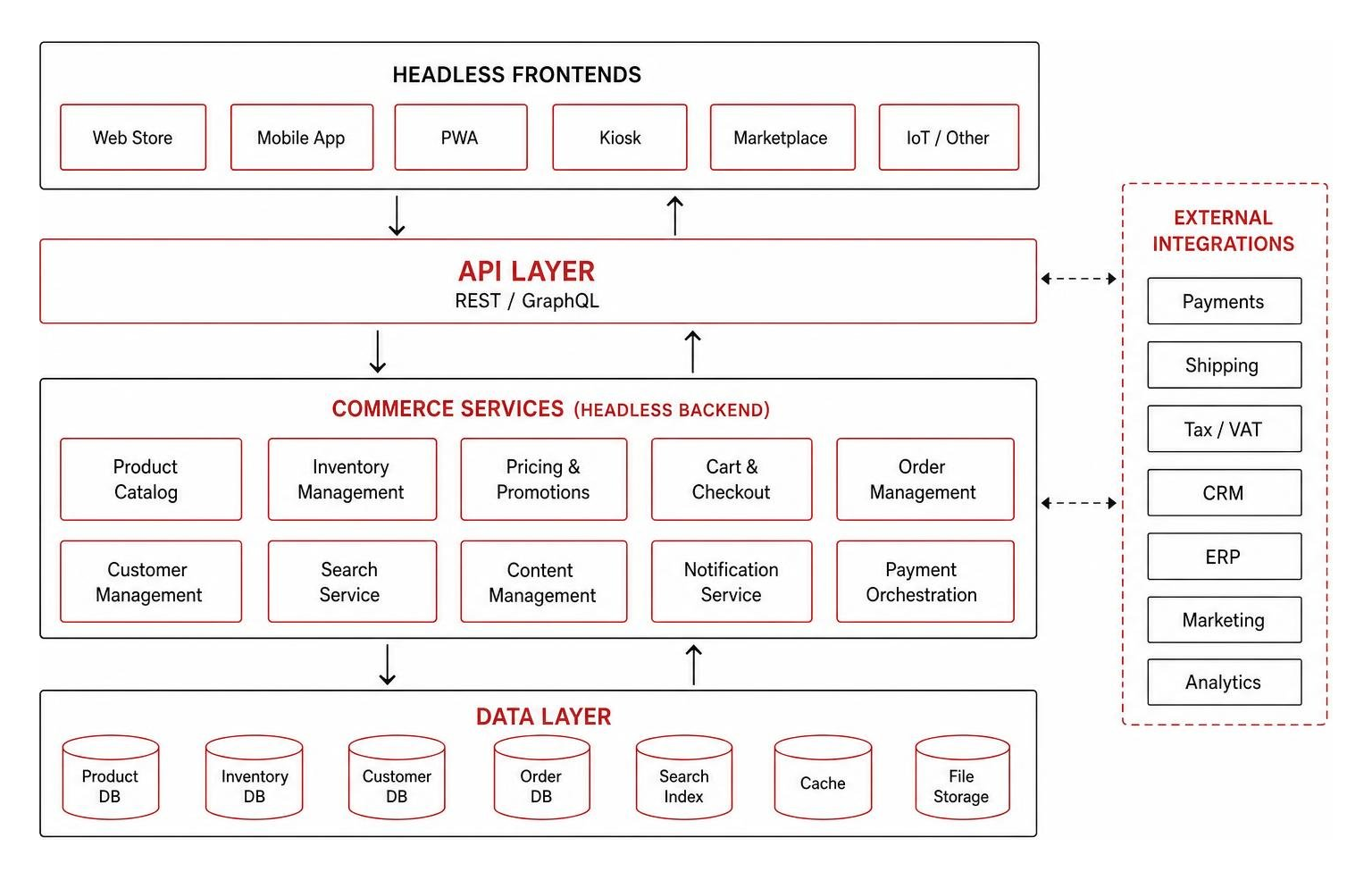
Understanding the technical delivery models of cloud e-commerce helps leadership teams balance trade-offs between speed-to-market, long-term costs, and customization freedom.
As digital retail has matured into an interconnected revenue engine, API-first architectural frameworks like MACH (Microservices, API-first, Cloud-native, Headless) have replaced static, single-piece software. Modular platforms like commerce-platform empower enterprises to decouple their frontend shopping experiences from backend transaction logic.
Evaluating SaaS, PaaS, and Custom Cloud Options
Selecting the right cloud delivery model determines how much operational management remains with your internal tech team versus your cloud provider.
- Software-as-a-Service (SaaS): A completely turnkey subscription model where the vendor manages hosting, core application code, platform security, and upgrades. It delivers the fastest deployment timeline (typically 2 to 8 weeks) and predictable operating expenses, though customization is subject to platform boundaries.
- Platform-as-a-Service (PaaS): Provides an open development framework hosted in a fully managed cloud environment. Developers gain deep control over custom application logic and database structures without having to manage raw virtual server OS patches or hardware infrastructure.
- Infrastructure-as-a-Service (IaaS): Offers raw virtualized computing resources, block storage, and networking (e.g., AWS, Azure, Google Cloud). The merchant retains maximum control and can write completely custom cloud code, but must manage operating systems, database tuning, network firewalls, and security monitoring.
Key Advantages of a Modern Cloud Ecommerce Platform
The shift to cloud digital commerce yields measurable operational and financial benefits:
- Elastic Auto-Scaling: Cloud environments automatically monitor inbound HTTP requests and database transaction queues. During high-volume flash sales or peak holiday shopping events like Black Friday, additional server instances spin up in seconds to absorb thousands of orders per minute without manual intervention.
- 70% Cost Reduction on Idle Hardware: Industry data confirms that cloud hosting solutions save up to 70% of infrastructure costs compared to building static on-premises environments sized for peak loads.
- AI-Native Optimization: Enterprise cloud suites, such as DeepCommerce Cloud | First AI Native Composable Commerce Suite, integrate artificial intelligence directly into the core engine for automated localized content, dynamic real-time price optimization, and conversational smart search.
- High Availability & Global Footprint: Multi-region synchronous database replication combined with edge caching ensures 99.95%+ platform availability, protecting revenue against regional network failures.
System Integrations and Core Features of a Revenue System
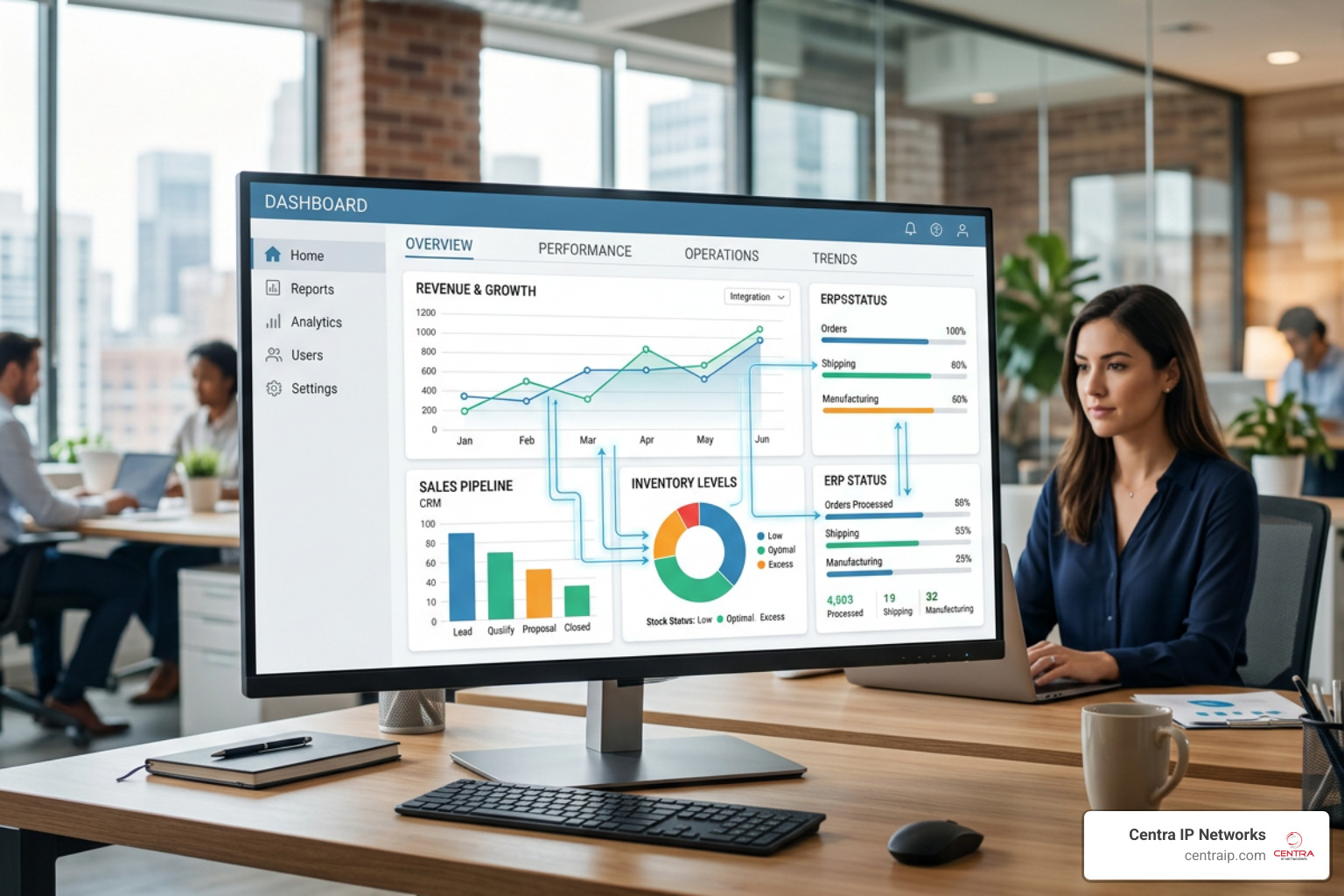
Treating e-commerce as an integrated revenue engine requires seamless bidirectional data flow across every department in your organization.
A standalone web storefront creates data silos that cause stockouts, billing errors, and shipping delays. A true revenue system unifies front-of-house sales tools directly with back-office administration systems. Unified platforms like VTEX Commerce Platform – The AI-Native Commerce Suite for CIOs and CEOs connect order management, omnichannel logistics, and supplier networks into a single dashboard.
Critical Capabilities for Enterprise and B2B Commerce
Modern digital commerce platforms must handle multi-faceted B2B and B2C operational demands simultaneously:
- ERP and Inventory Synchronization: Real-time API integrations with Enterprise Resource Planning (ERP) software guarantee accurate stock counts across multiple fulfillment centers, preventing overselling.
- Product Information Management (PIM): Centralized PIM capabilities aggregate product data, technical specifications, localized translations, and media assets for distribution across storefronts, mobile apps, and third-party marketplaces.
- Customized B2B Workflow Tools: B2B e-commerce requires advanced functionalities, including tier-based volume pricing, contract-specific custom assortments, automated purchase order credit terms, draft order quotes, and multi-tier corporate account approval hierarchies.
- Automated Customer Operations: Integrating Commerce Cloud systems with CRM and customer service ticketing modules allows support agents to process refunds, update shipping destinations, and reorder items directly within customer conversation portals.
Security, PCI DSS, and Global Regulatory Compliance
Online merchants are primary targets for cyber threats, credentials stuffing, and credit card fraud. Choosing a compliance-first cloud platform drastically reduces business liability and security auditing overhead.
- PCI DSS Compliance: Payment Card Industry Data Security Standard (PCI DSS) compliance is mandatory for accepting payment cards online. Cloud SaaS platforms handle PCI requirements by tokenizing payment details directly at checkout, ensuring sensitive primary account numbers (PAN) never touch your web servers.
- Data Privacy Laws (GDPR, CCPA): Global privacy regulations mandate strict controls over customer data collection, storage, and processing. Leading cloud e-commerce suites provide localized isolated data vaults, cookie consent banners, and automated “right-to-be-forgotten” data deletion tools.
- Infrastructure Security: Advanced cloud platforms maintain enterprise certifications including SOC 1, SOC 2, SOC 3, and ISO 27001, providing continuous web application firewall (WAF) filtering, automated DDoS mitigation, and encrypted SSL/TLS data pipelines.
Total Cost of Ownership, Hidden Fees, and Migration Strategy
Evaluating the financial reality of a cloud ecommerce platform requires looking far past the baseline software subscription rate. A platform advertised at $50,000 per year in licensing can easily total $500,000 in annual total cost of ownership (TCO) once custom implementation, middleware hosting, third-party plugin subscriptions, and developer maintenance are calculated.
The global e-commerce market reached $23.2 billion in 2024 and is projected to expand to $44.8 billion by 2029. Capturing market growth requires maintaining control over platform TCO so margins remain healthy.
| Cost Component | SaaS Platform | PaaS Platform | Custom / IaaS Cloud |
|---|---|---|---|
| Upfront Implementation | $15,000 – $60,000 | $50,000 – $200,000 | $150,000 – $500,000+ |
| Annual Software / License | $3,600 – $40,000 (Subscription) | $20,000 – $100,000 | $0 (Open-source base) |
| Cloud Infrastructure & Hosting | Included in platform fee | $5,000 – $30,000 / year | $20,000 – $120,000 / year |
| Payment Gateway Processing | 2.2% – 3.5% + $0.30 / transaction | 2.2% – 3.5% + $0.30 / transaction | 2.2% – 3.5% + $0.30 / transaction |
| Third-Party Apps & Middleware | $500 – $3,000 / month | $200 – $1,500 / month | Built in-house or integrated via API |
| Ongoing Dev & IT Maintenance | Low (Vendor managed) | Moderate (Internal / Agency) | High (Dedicated IT staff) |
Customized enterprise solutions tailored specifically for distributors and B2B manufacturers, such as eCommerce platform for wholesalers and (brand) manufacturers – CloudSuite, mitigate unexpected integration expenses by offering native out-of-the-box ERP integrations and continuous automated software updates.
Selecting the Right Cloud Ecommerce Platform for Your Business Size
To select the right architecture, align your annual Gross Merchandise Value (GMV) and catalog complexity against platform capabilities:
- Emerging Businesses & Startups (GMV under $2M): Standard turnkey SaaS setups provide the lowest TCO. Focus capital on product development and marketing rather than custom software builds.
- Mid-Market Merchants (GMV $2M – $20M): Advanced SaaS or composable hybrid platforms offering rich native functionality (such as integrated PIM, rules-based promotions, and multi-warehouse sync) eliminate app sprawl while managing costs.
- Enterprise Organizations (GMV $20M – $200M+): Headless PaaS, MACH composable suites, or custom microservices architecture deliver full operational flexibility, supporting specialized customer journeys across international markets.
Navigating Data Migration and Replatforming Pitfalls
Moving from an aging on-premises system or outdated e-commerce software to a high-performance cloud platform is a major operational project. Following a disciplined 5-step replatforming framework prevents data loss and downtime:
- Audit & Data Scrubbing: Clean legacy database records. Standardize product categories, remove outdated SKUs, and reformat customer records prior to export.
- Catalog & Data Schema Mapping: Map legacy database fields to your new cloud platform’s schema, ensuring historical order data, customer passwords, and custom product attributes transfer cleanly.
- Integration Middleware Setup: Build and test API connections between your cloud e-commerce core and existing ERP, CRM, warehouse management systems (WMS), and accounting software in a staging environment.
- Parallel Testing & Performance Audits: Perform stress testing on checkout workflows, payment gateway callbacks, mobile UX performance, and automated tax calculation rules.
- DNS Cutover & Post-Launch Monitoring: Execute the domain name system (DNS) cutover during low-traffic hours, maintaining live system monitoring to address any unexpected API synchronization bottlenecks immediately.
Frequently Asked Questions
How does a cloud e-commerce platform handle massive holiday traffic spikes?
Cloud platforms handle intense traffic bursts through dynamic infrastructure auto-scaling, serverless compute functions, and edge CDN distribution. When incoming user requests spike during major shopping sales, the underlying orchestration system automatically provisions additional virtual compute nodes and scales database read-replicas. Software-defined storage architectures decouple compute from storage capacity, allowing the platform to absorb thousands of concurrent order checkout requests per minute without site slowdowns or hardware crashes.
What is the difference between a SaaS platform and custom cloud development?
A SaaS platform is a fully managed, subscription-based cloud software solution where the software vendor hosts the application, manages security patches, and maintains underlying cloud infrastructure. Custom cloud development involves writing tailored commerce software deployed directly onto cloud infrastructure (such as AWS or Azure) using IaaS or PaaS architectures. SaaS offers rapid deployment, predictable subscription costs, and minimal IT overhead, whereas custom cloud development offers unlimited customization and backend control at the trade-off of higher development costs, longer implementation timelines, and ongoing maintenance responsibilities.
How do cloud platforms lower PCI DSS and security compliance burdens?
Cloud platforms lower PCI DSS compliance burdens by removing sensitive payment card data from your local servers and application databases. Through hosted checkout fields and tokenization APIs, credit card details entered by customers are transmitted directly to certified third-party payment gateways. The gateway returns a secure, randomized token back to your cloud platform to finalize the order. Because your store platform never sees, processes, or stores raw credit card account numbers (PAN), your business qualifies for simplified PCI DSS self-assessment questionnaires (SAQ-A), avoiding costly manual infrastructure compliance audits.
Conclusion
Viewing an e-commerce platform merely as a digital storefront is an outdated operational approach. In 2026 and beyond, a modern cloud ecommerce platform serves as an integrated, enterprise-wide revenue system—a central engine orchestrating storefront sales, customer relationships, real-time inventory tracking, multi-site fulfillment, and secure transaction processing. Modernizing your digital infrastructure onto a scalable cloud foundation eliminates maintenance friction, ensures high availability during peak traffic spikes, and grants your business the agility needed to react instantly to changing market demands.
Building a truly seamless revenue engine requires more than powerful storefront software; it relies on dependable cloud infrastructure, resilient connectivity, unified business communications, and robust IT security. At Centra IP Networks, we specialize in helping businesses simplify complex technology environments. We deliver managed IT, cloud communications systems, high-speed Internet connectivity, and cloud security services under a unified umbrella—giving your organization a reliable operational backbone with a single bill, one platform, and dedicated partner support.
Learn more about Centra IP Cloud Services today to discover how our tailored cloud, connectivity, and managed IT solutions can power your digital commerce infrastructure and support your ongoing business growth.