

What is a Cloud PBX Platform?
A cloud PBX platform is a modern phone system that uses the internet to handle your business calls. It’s a virtual version of a traditional office phone system, hosted entirely in the cloud. This means you don’t need clunky physical equipment in your office.
Here’s a quick look at what a Cloud PBX is:
- Internet-based: Your phone system lives on the internet, not in a server closet.
- Virtual: It’s software, not hardware.
- VoIP technology: It uses Voice over Internet Protocol (VoIP) to make calls over your internet connection.
- No on-premise equipment: You don’t need to buy or maintain bulky traditional PBX hardware.
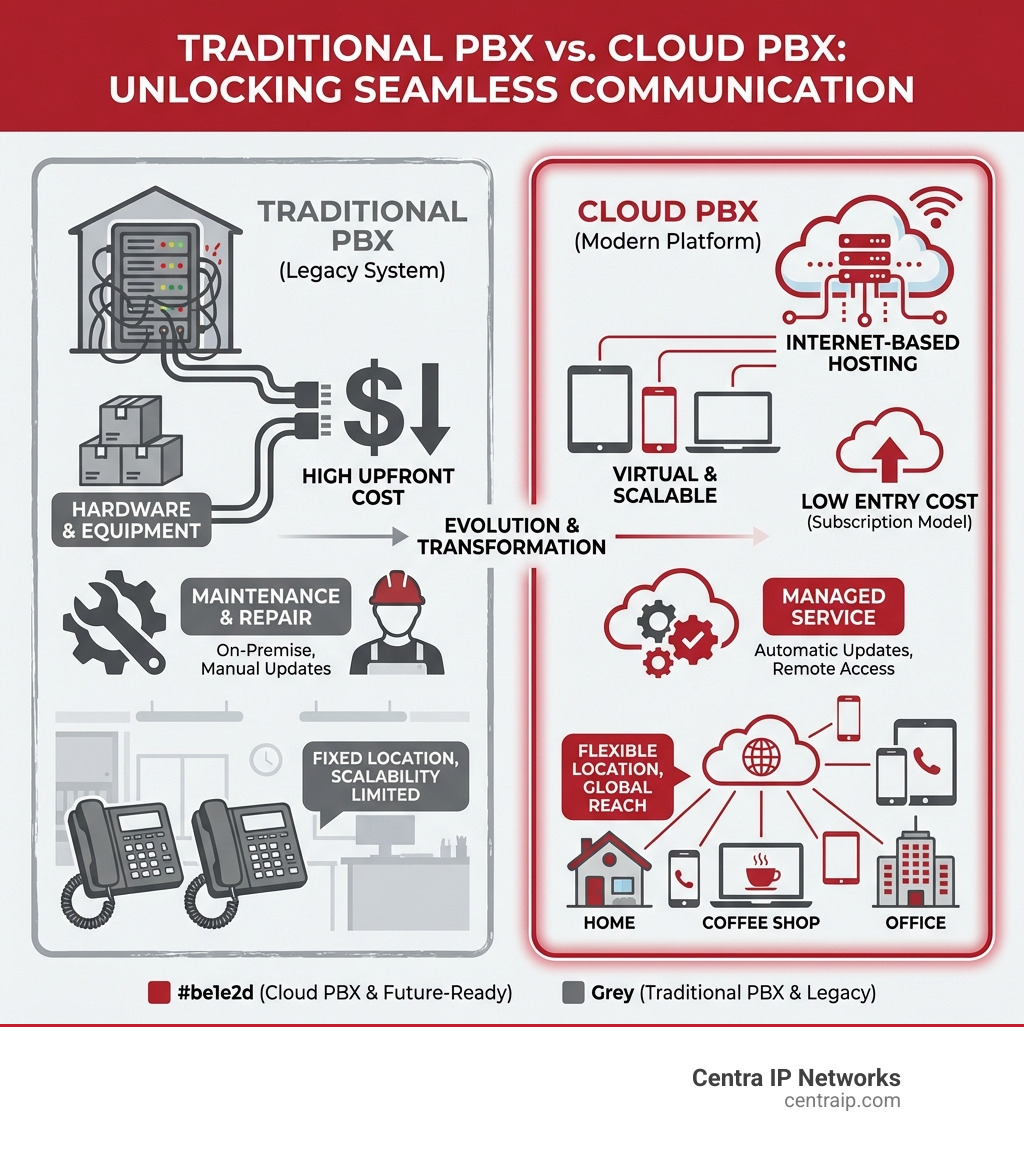
Think of it as moving your entire office phone system online. Instead of owning and maintaining complex hardware, you access your phone system as a service over the internet. This brings new flexibility and ease compared to older, traditional PBX systems. These legacy systems required significant upfront costs and ongoing maintenance for physical equipment.
To learn more about how these systems work, read our Introduction to Cloud-Based Phone Systems.
I’m Patrick Brangan, and with over 20 years of experience, I’ve seen how a well-implemented cloud PBX platform can transform communication for SMBs. My focus at Centra IP Networks is curating simple, reliable, and scalable unified communication solutions for businesses like yours.
Core Features and Business Benefits of Cloud Telephony
Moving to a cloud PBX platform isn’t just about upgrading your phone system; it’s about changing how your business communicates and operates. We’ve seen how businesses in Dallas, Fort Worth, Orlando, Tampa, Plano, and Myrtle Beach have leveraged these systems to gain a competitive edge. The benefits extend far beyond just making and receiving calls.

One of the most immediate advantages we highlight for our clients is cost savings. With traditional PBX, you’re looking at significant upfront investments in hardware, installation, and ongoing maintenance. A cloud PBX, however, shifts this to a predictable, often lower, monthly subscription model. This means less capital expenditure (CapEx) and more operational expenditure (OpEx), which is often preferred for budgeting. Many providers offer unlimited calling plans within local countries, the US, and Canada, further reducing variable costs.
Beyond cost, the scalability of a cloud PBX platform is a game-changer. Imagine your business growing rapidly, or perhaps seasonal fluctuations requiring more (or fewer) staff. With a cloud system, adding or removing users is typically a few clicks away, without needing a technician to install new lines or equipment. This agility is something traditional systems simply can’t match.
For businesses embracing remote or hybrid work models, remote flexibility is paramount. A cloud PBX allows your team to connect from anywhere with an internet connection, using their desk phone, computer, or even their smartphone. This means your sales team in Dallas can be just as connected as your customer support in Orlando, fostering seamless collaboration.
These factors contribute to improved productivity. When communication tools are easy to use, reliable, and accessible from anywhere, your team spends less time troubleshooting and more time focusing on their core tasks.
For a deeper dive into these advantages, explore our insights on Cloud-Based Phone Systems for Your Business.
To understand the underlying technology that makes internet-based calling possible, you can also review this overview of Voice over IP, which explains how voice traffic is transmitted over data networks.
Key Features That Drive Efficiency
A modern cloud PBX platform is packed with features designed to streamline communication and improve customer experience. These aren’t just bells and whistles; they’re essential tools for today’s dynamic business environment.
- Auto-attendant: This virtual receptionist greets callers and directs them to the right department or individual. It can handle calls based on time zones, operating hours, and other conditions, providing faster response times and self-service options.
- Call routing: Advanced routing capabilities ensure calls reach the most appropriate person or team, improving efficiency and customer satisfaction. This includes intelligent routing based on agent availability, skill sets, or even customer history.
- Ring groups: Distribute incoming calls among a group of extensions, helping balance workloads and ensuring no call goes unanswered. This is particularly useful for sales or support teams.
- Call recording: Essential for quality assurance, training, and compliance, call recording captures conversations for future reference. Many platforms offer cloud-based storage and easy access to these recordings.
- Visual voicemail: Instead of dialing in, access your voicemails as text transcripts or audio files directly from your email, mobile app, or desktop application. This feature is a huge time-saver.
- Voicemail-to-email: Get voicemail messages delivered straight to your email inbox, often with a transcription, so you can read or listen at your convenience.
- Video conferencing: Integrated video conferencing allows for face-to-face meetings with colleagues, clients, and partners, regardless of location. Some platforms even allow you to convert a 3-way call into a video meeting with a single click.
- Mobile apps: Turn your smartphone into a full-featured business phone. Make and receive calls, access voicemails, and manage settings directly from your mobile device, ensuring you’re always connected.
These features, combined with capabilities like call parking (placing a call in a virtual waiting room for any extension to pick up) and advanced call queues, contribute to a seamless communication flow. For more on the importance of recording, check out Cloud-Based Call Recording: Why It’s Essential for Modern Businesses.
How Cloud PBX Delivers Significant Cost Savings
Let’s talk numbers, because who doesn’t love saving money? One of the most compelling arguments for adopting a cloud PBX platform is the substantial cost savings it offers.
- Reduced hardware costs: This is a big one. With a cloud PBX, you eliminate the need for expensive, specialized PBX hardware. No large upfront capital investment in equipment that quickly becomes outdated. We’ve seen businesses save thousands by making this switch.
- Lower maintenance: Traditional PBX systems require dedicated IT staff or external contractors for installation, maintenance, and repairs. A cloud PBX provider handles all the technical upkeep, software updates, and infrastructure management. This translates to fewer headaches and significant savings on IT personnel and service contracts.
- Predictable subscription models: Cloud PBX operates on a subscription basis, typically per user per month. This predictable operational expenditure (OpEx) makes budgeting much simpler, avoiding unexpected large expenses. Some innovative models even offer a single annual license cost, which can cut licensing costs significantly compared to traditional per-user pricing, especially for businesses with 25+ users.
- Unlimited calling plans: Many providers include unlimited domestic calling within the US and Canada in their basic plans. Some even offer unlimited calling to dozens of countries, drastically reducing long-distance charges that can quickly add up with traditional phone systems.
- No need for dedicated IT staff: While you’ll still need IT support for your network, the specialized knowledge required to manage a complex on-premise PBX is no longer necessary. This frees up your existing IT team to focus on other strategic initiatives or reduces the need for additional hires.
A cloud PBX platform transforms your communication costs from a heavy, unpredictable capital expense into a lighter, predictable operational one, delivering an immediate return on investment for many businesses.
Choosing the Right Cloud PBX Platform for Your Business
Selecting the perfect cloud PBX platform for your business in Orlando, Tampa, or any of our service areas can feel like a big decision. It’s not just about picking a phone system; it’s about investing in a communication backbone that will support your growth and efficiency. To simplify this, let’s compare it to its predecessor:
| Feature | Cloud PBX Platform | On-Premise PBX System |
|---|---|---|
| Cost | Predictable monthly OpEx, lower upfront costs | High upfront CapEx, ongoing maintenance costs |
| Scalability | Highly scalable, easy to add/remove users | Limited scalability, hardware upgrades needed |
| Maintenance | Managed by provider, automatic updates | Requires dedicated IT staff, manual updates |
| Features | Advanced UC features, AI, integrations, mobile apps | Basic call features, limited advanced capabilities |
| Flexibility | Access from anywhere, supports remote/hybrid work | Tied to office location, less flexible |
| Deployment | Quick, software-based | Lengthy installation, hardware dependent |
| Reliability | High uptime SLAs, geographically redundant | Dependent on local power/internet, single point of failure |
For a more detailed comparison, check out our article: PBX vs. The Cloud: Which Is the Right Office Phone System for Business?
Key Evaluation Criteria
When we help our clients choose a cloud PBX platform, we focus on several critical factors to ensure they get the best fit:
- Security: As internet-based systems, cloud PBX platforms can be targets for cyber threats. We prioritize providers with robust, multi-layered security strategies. Look for enterprise-grade encryption (like TLS/SRTP), secure access management (integrating with identity management tools), and strong network security. Your data’s integrity and confidentiality should be paramount.
- Compliance (HIPAA, GDPR): For industries like healthcare or those dealing with sensitive customer data, compliance is non-negotiable. We ensure the chosen platform adheres to relevant regulatory standards such as HIPAA (critical for our healthcare clients in Tampa and Plano) and GDPR. Some providers offer features like data retention controls and automated deletion policies to aid compliance.
- Scalability: Will the system grow with you? A good cloud PBX should effortlessly accommodate more users, lines, and features as your business expands, without requiring major overhauls.
- Reliability (Uptime SLA): “Zero tolerance on downtime” is a phrase we live by. Look for providers that offer high uptime Service Level Agreements (SLAs), ideally 99.999%. This indicates a commitment to consistent service, often backed by globally redundant infrastructure across multiple geographical locations and availability zones.
- Feature set: Evaluate the core features against your business needs. Do you need advanced call center capabilities? CRM integrations? Video conferencing for large teams? A virtual AI receptionist? Ensure the platform offers the specific tools that will genuinely improve your operations.
- Customer support: Even the best systems need support sometimes. Look for providers with award-winning, responsive customer service, preferably with 24/7 availability. Good support can make all the difference in a smooth transition and ongoing operation.
- Cost models: Understand the pricing structure. Is it per user, per line, or a flat annual fee? Are there hidden costs for advanced features or international calling? We help our clients find transparent and cost-effective solutions.
Understanding Deployment Options for a Cloud PBX Platform
While the term “cloud” generally implies off-site hosting, there are nuances in how a cloud PBX platform can be deployed:
- Hosted PBX: This is the most common model. The provider fully manages the PBX software and hardware in their data centers. You simply pay a subscription fee to access the service over the internet. This is a hassle-free option, as all maintenance, updates, and security are handled by the provider. Many hosted VoIP services are trusted by thousands of businesses and emphasize their cloud-based, high-redundancy infrastructure.
- On-premise software: In some cases, businesses might choose to host the PBX software on their own servers, but still leverage cloud-based VoIP technology for calls. This offers more control over the system but requires internal IT expertise and infrastructure. Some open-source IP PBX software allows for this type of deployment, giving users the tools to build a phone system custom to their needs.
- Hybrid solutions: A blend of on-premise and cloud elements. For instance, a business might keep some legacy hardware for specific functions while routing most calls through a cloud PBX. This can be a transitional step for larger organizations.
- Private cloud: For businesses with stringent security or customization needs, a private cloud deployment means the PBX runs on dedicated cloud infrastructure, either managed by the business or a third party, but not shared with other customers. Some platforms offer flexibility for hosting in your own private cloud.
- Public cloud: This is where the PBX runs on shared cloud infrastructure (like AWS or Azure), managed by the provider. It’s cost-effective and highly scalable.
It’s worth noting that while some solutions might offer on-premise components, the trend is overwhelmingly towards fully hosted or private cloud solutions for their flexibility and reduced maintenance burden. For more on traditional systems, see our page on Premise-Based Phone Systems.
The Role of UCaaS and Integrations
When we talk about a cloud PBX platform today, we often find ourselves discussing its relationship with Unified Communications as a Service (UCaaS). Think of it this way: a cloud PBX is the powerful engine that handles your voice communications, but UCaaS is the entire, sleek vehicle that integrates all your communication and collaboration tools.
- Cloud PBX as a component of UCaaS: A cloud PBX provides the core telephony capabilities – making and receiving calls, call routing, voicemail, etc. UCaaS takes this a step further by integrating these voice features with messaging, video conferencing, presence, and other collaboration tools into a single, cohesive platform. As research notes, UCaaS is a complete platform that integrates calling, messaging, video conferencing, and often AI-powered features—all in one app.
- Unified Communications as a Service (UCaaS): This isn’t just about having all tools in one place; it’s about making them work together seamlessly. Your team can move from a chat message to a phone call, then to a video conference, all within the same application, enhancing productivity and reducing context switching. Many platforms consolidate all business communication and collaboration into a single system, creating an all-in-one collaboration hub for phone, video, and messaging.
- Integrating voice, video, messaging: This integration is crucial for modern workflows. Whether it’s a quick chat, a scheduled video call, or a traditional phone conversation, your team has all options at their fingertips.
- CRM integration (Salesforce, HubSpot): A key benefit of cloud PBX and UCaaS platforms is their ability to integrate with other business applications, especially Customer Relationship Management (CRM) systems. When your phone system connects with Salesforce, HubSpot, Zoho, or Zendesk, your team gains immediate access to customer information during calls, automates logging, and streamlines workflows. This means better customer service and more efficient sales processes. For example, many platforms offer VoIP CRM integrations with leading systems like Salesforce and HubSpot.
- Collaboration tools: Beyond voice and video, many platforms offer shared workspaces, file sharing, and project management integrations, turning your communication system into a full-fledged collaboration hub.
This seamless integration, especially with CRMs, is a powerful differentiator. Learn more about it in our article on Cloud Phone System CRM Integration.
Implementation: Security, Adoption, and Use Cases
Bringing a new cloud PBX platform into your business in Fort Worth, Plano, or Myrtle Beach is an exciting step, but it requires careful consideration of security, user adoption, and how it will best serve your specific needs.

Mitigating Security Risks on Your Cloud PBX Platform
While the cloud offers immense benefits, it also introduces new security considerations. Since cloud PBX platforms are internet-based, they can be targets for cyber threats. We emphasize a proactive approach to security:
- Cyber threats: Your communication data is valuable. Protecting it from unauthorized access, eavesdropping, and denial-of-service attacks is paramount.
- Data encryption (TLS/SRTP): Ensure your provider uses enterprise-grade encryption for voice traffic (SRTP) and signaling (TLS). This encrypts your conversations, keeping them private and secure. Many providers offer secure end-to-end encryption for softphone apps and can enable it for desk phones.
- Access management: Robust identity and access management tools are critical. This means strong passwords, multi-factor authentication, and role-based access controls to ensure only authorized personnel can access sensitive settings or data. Some platforms have introduced SAML modules for improved login security.
- Firewalls: A properly configured firewall acts as the first line of defense, monitoring and controlling incoming and outgoing network traffic.
- Network security: The underlying network infrastructure must be secure. Leading providers focus on carrier-grade services on private, cloud-agnostic IP networks. For improved security, especially for remote workers, Session Border Controllers (SBCs) are vital. We highly recommend upgrading your security with SBCs to protect your VoIP network.
Many providers build in security with TLS/SRTP encryption and regulation compliance, focusing on top security and compliance standards, including HIPAA and GDPR.
Ensuring Successful Adoption and Change Management
Even the most technologically advanced cloud PBX platform won’t be effective if your team doesn’t use it. Adoption challenges are often human-centric, so we focus on making the transition as smooth as possible:
- Human-centric challenges: People naturally resist change. Employees might be comfortable with their old system, or fear learning new technology. Acknowledge this and address concerns head-on.
- Employee training: Comprehensive, hands-on training is essential. Don’t just show them how to use it; explain why it benefits them. Some providers offer multiple one-hour training sessions with an expert to ease the transition.
- Onboarding process: A well-structured onboarding process ensures everyone gets up to speed quickly. This includes clear documentation, quick-start guides, and dedicated support.
- User-friendly interfaces: Choose a platform with an intuitive design. The easier it is to steer, the faster your team will adopt it. Look for platforms that are known for being a breeze to set up.
- Communication strategy: Clearly communicate the benefits of the new system, how it will improve their daily work, and where they can find support. Highlight features like mobile apps and integrations that simplify their tasks.
Industries and Use Cases Benefiting from Cloud PBX
The versatility of a cloud PBX platform makes it suitable for a wide array of businesses and industries. We’ve seen changes across the board for clients in Dallas, Fort Worth, Orlando, Tampa, Plano, and Myrtle Beach:
- Remote & hybrid workforces: This is perhaps the most obvious beneficiary. Cloud PBX enables employees to work from anywhere, maintaining full communication capabilities as if they were in the office. These systems explicitly enable comprehensive work-from-home and remote access programs.
- Multi-location businesses: Easily connect multiple offices under a single, unified communication system, allowing for seamless internal dialing and call transfers between locations.
- Call centers: Features like Automatic Call Distribution (ACD), Interactive Voice Response (IVR), call queues, call monitoring, and intelligent routing are critical for efficient call center operations. Some providers specifically cater to call centers.
- Small to medium businesses (SMBs): Cloud PBX offers enterprise-grade features at an affordable price point, leveling the playing field for smaller companies. Some virtual phone systems are custom-built for SMBs.
- Healthcare: With HIPAA compliance capabilities and robust security, cloud PBX supports efficient patient communication, appointment scheduling, and internal coordination for clinics and hospitals. These systems are used in healthcare for routing calls and managing faxes.
- Retail: Facilitates communication between stores, warehouses, and customers, often incorporating features like device sharing for in-store staff.
- Sales teams: AI-powered features (like AI concierges or revenue communication platforms) and CRM integrations improve sales outreach, improve connection rates, and provide valuable insights into customer interactions.
Frequently Asked Questions about Cloud PBX
We often get asked similar questions by businesses considering the switch. Let’s tackle some of the most common ones.
What is the difference between VoIP and a Cloud PBX?
This is a great question, and it’s where things can sometimes get a little fuzzy!
- VoIP as the underlying technology: Think of VoIP (Voice over Internet Protocol) as the method or technology for making voice calls over the internet. It’s the engine that powers internet-based calling. Every cloud PBX platform uses VoIP.
- Cloud PBX as the complete system: A cloud PBX is the entire system or service that uses VoIP technology to deliver a comprehensive business phone solution. It wraps VoIP technology with a host of features like auto-attendants, call routing, voicemail, extensions, video conferencing, and integrations. So, while all cloud PBX systems use VoIP, VoIP itself isn’t a complete phone system.
As we explain in our article, VoIP vs. Cloud-Based Phone System: What’s the Difference?, VoIP is the foundational technology, and a cloud PBX is the robust, feature-rich application built upon it.
Can I keep my existing business phone number?
Absolutely, yes! We understand how important it is to maintain your business identity and continuity.
- Number porting process: The process of transferring your existing business phone number(s) from your current carrier to a new cloud PBX platform provider is called “number porting.” It’s a standard procedure, and nearly all cloud PBX providers support it.
- Local Number Portability (LNP): This regulatory mandate ensures you have the right to keep your phone number when changing providers.
- Maintaining business identity: Keeping your established numbers means your customers can continue to reach you without disruption, preserving your brand recognition and trust.
- No disruption to customers: The porting process is designed to be seamless, with minimal to no downtime for your phone service. Your customers won’t even notice the switch.
Do I need special phones to use a Cloud PBX?
Not necessarily! This is one of the fantastic flexibilities of a cloud PBX platform.
- Softphones (desktop & mobile apps): Most cloud PBX systems offer “softphone” applications that you can install on your computer, tablet, or smartphone. These apps turn your device into a fully functional business phone, allowing you to make and receive calls, manage voicemails, and access features using your device’s microphone and speakers (or a headset).
- Using existing smartphones: With a mobile softphone app, your personal smartphone effectively becomes your business phone, allowing you to separate business and personal calls while using one device.
- Dedicated VoIP desk phones: If you prefer the traditional feel of a desk phone, there are many VoIP-compatible desk phones available. These connect to your internet network and often offer advanced features. Some providers even include best-in-class VoIP phones with their unlimited plans.
- Bring Your Own Device (BYOD): This flexibility means you can often choose the device that works best for you and your team, whether it’s a softphone, a dedicated VoIP phone, or a combination.
Conclusion: Future-Proof Your Business Communications
In today’s business world, effective communication is no longer a luxury—it’s a necessity. A cloud PBX platform isn’t just an upgrade; it’s a strategic investment that future-proofs your business communications. We’ve explored how these platforms deliver unparalleled flexibility for remote and multi-location teams, offer incredible scalability to adapt to your business growth, and provide significant cost-efficiency by reducing hardware and maintenance burdens.
The shift to unified communications, where voice, video, and messaging converge into a single, integrated experience, is undeniable. This integration, coupled with robust security features and seamless CRM connectivity, empowers your team to work smarter, serve customers better, and stay connected from anywhere.
At Centra IP Networks, we pride ourselves on offering comprehensive Managed IT and Cloud Communications services. Our unique selling proposition is providing all these services on one platform with a single bill and provider. By leveraging our 35+ partnerships, we curate custom, cost-effective solutions that meet the specific needs of businesses in Dallas, Fort Worth, Orlando, Tampa, Plano, and Myrtle Beach. We take the complexity out of choosing and implementing your next communication system, allowing you to focus on what you do best.
Ready to open up seamless communication for your business? Explore our Cloud-Based Phone Systems today and find how we can help you achieve more.