
Why Getting a Corporate Phone Number Is the First Step to a More Professional Business
How to get a corporate phone number is simpler than most business owners expect — and the payoff is immediate.
Here’s the quick version:
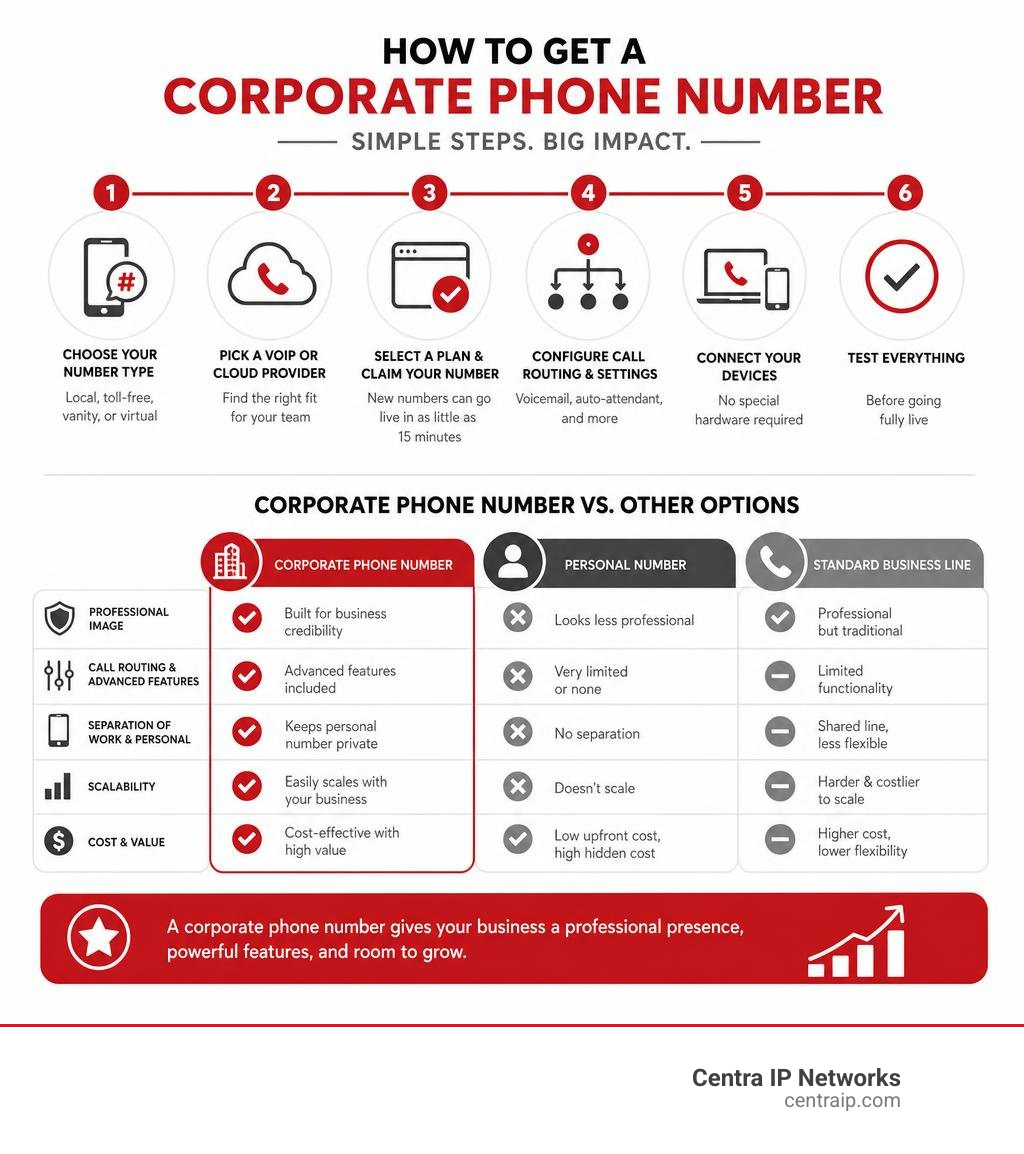
- Choose your number type — local, toll-free, vanity, or virtual
- Pick a VoIP or cloud phone provider that fits your team size and budget
- Select a plan and claim your number (new numbers can go live in as little as 15 minutes)
- Configure call routing, voicemail, and auto-attendant settings
- Connect your devices — no special hardware required
- Test everything before going fully live
That’s the core process. The rest of this guide explains how to do each step well.
Still using a personal cell phone to handle customer calls? You’re not alone. Many growing businesses start that way. But it creates real problems fast — missed calls, no call routing, zero separation between work and personal life, and a less-than-professional first impression.
The stakes are higher than they might seem. 78% of callers will abandon a business after a missed call. That’s not a minor inconvenience — that’s lost revenue, on repeat.
A dedicated corporate phone number solves this. It gives your business a professional presence, keeps personal numbers private, and unlocks features like auto-attendants, call analytics, and CRM integrations that a personal phone simply can’t offer.
I’m Patrick Brangan, and with over 20 years of experience helping SMBs navigate unified communications and managed IT, I’ve guided hundreds of companies through exactly how to get a corporate phone number that scales with their growth. In this guide, I’ll walk you through everything you need to know — from choosing the right number type to porting your existing number without losing a single call.
Learn more about how to get a corporate phone number:
What is a Corporate Phone Number? (And Why Your Business Needs One)
At its core, a corporate phone number is a dedicated contact line used exclusively for professional communications. But it is much more than just a sequence of digits. Unlike a personal mobile number or a standard home landline, a corporate phone system operates on an enterprise-grade infrastructure. It acts as the front door to your business, routing callers to the right departments, recording voicemail-to-email transcriptions, and protecting your team’s personal privacy.

Let’s break down the differences:
- Corporate vs. Personal Numbers: When you use your personal cell phone for business, you are essentially on call 24/7. There is no way to distinguish a high-value client from a telemarketer, and you risk answering a critical business call with a casual “hello?” A corporate number allows you to establish strict business hours, route calls to multiple employees, and maintain a healthy work-life balance.
- Corporate vs. Standard Business Lines: A basic business line might just ring a single desk phone. A true corporate phone system is built for scalability. It supports multi-site management, advanced call queues, ring groups (where multiple phones ring simultaneously), and deep software integrations.
If you are still on the fence about whether to invest in a professional system, consider these industry realities:
- 78% of callers abandon a business after a missed call, often heading straight to a competitor.
- More than two-thirds of business professionals say voice calls are vital for resolving complex customer issues and closing sales.
- A dedicated line builds immediate trust. If customers can only reach you via a personal mobile number, they may question the legitimacy and stability of your operation.
Setting up a dedicated system is a foundational step in Dialing Up Your Dreams: A Fresh Start with a New Business Phone Line. It transitions your business from a scrappy passion project into a credible, scalable brand.
The Main Types of Corporate Phone Numbers
When learning how to get a corporate phone number, you must first decide which type of number fits your brand style and target audience. Modern cloud communication platforms allow us to provision multiple number types under a single account.
Here are the main options available:
1. Local Phone Numbers
Local numbers start with a specific regional area code. They are highly effective if your business relies on local community trust. Studies show that consumers are far more likely to answer calls from numbers matching their own local area codes.
- If you operate in North Texas, you might want to secure a Dallas number for your small business or establish a Fort Worth presence using a local phone line.
- For Florida businesses, establishing a local presence is easy. You can target central Florida with an Orlando 407 area code, tap into the Gulf Coast by getting a Tampa phone number, or align your local outreach with local municipal guidelines in cities like St. Petersburg, Clearwater, and Sarasota. In fact, aligning your local phone presence with regional registrations, such as looking into the Business – City of St. Petersburg portal, checking the official Contact Us – City of Clearwater directory, or registering for a Local Business Tax – City of Sarasota , cements your brand as a legitimate local entity.
2. Toll-Free Numbers
Toll-free numbers (beginning with 800, 888, 877, 866, 855, 844, or 833) allow callers to reach your business from anywhere in the country without incurring long-distance charges. This signals that your business is an established, national brand. Notably, US consumers are seven times more likely to call a toll-free number than a traditional local number when doing business with an out-of-state company.
3. Vanity Numbers
A vanity number is a custom toll-free or local number that spells out a memorable word or phrase (e.g., 1-800-FLOWERS or 1-888-555-BOOK). These are fantastic for print, radio, and digital marketing campaigns because they dramatically improve brand recall.
4. Virtual Phone Numbers
Unlike traditional analog lines tied to a copper wire in a wall, virtual numbers operate entirely over the internet using Voice over Internet Protocol (VoIP) technology. They can route incoming calls to any device—your laptop, tablet, desk phone, or cell phone app—regardless of where your team is physically located. To understand the underlying technology, check out our comprehensive guide on Virtual Phone Number 101.
5. International Numbers
If you are expanding your business globally, virtual international numbers allow you to establish a local presence in over 140 countries. Customers in London or Tokyo can call a local number, and your team in Dallas or Tampa can answer the call on their standard mobile app.
| Number Type | Best For | Key Advantage | Location Flexibility |
|---|---|---|---|
| Local | Regional service providers, local shops | Builds immediate community trust | Limited to specific area codes |
| Toll-Free | National e-commerce, nationwide support | Projects established corporate image | Nationwide reach |
| Vanity | Heavy marketing campaigns, billboard ads | Unmatched brand recall | Nationwide or local |
| Virtual | Remote teams, hybrid businesses | Extreme flexibility, device-agnostic | Global routing |
How to Get a Corporate Phone Number: A Step-by-Step Guide
Getting your new corporate line up and running doesn’t require a degree in telecom engineering. In fact, with modern cloud communication platforms, you can complete the basic setup in less than an hour.
If you are wondering about the speed of the process, you can learn How to Get a Phone Number in Minutes using self-service platforms. However, for a robust, enterprise-grade corporate setup, we recommend a more structured approach.
Step 1: Assess Your Needs and Learn How to Get a Corporate Phone Number
Before buying any plans, evaluate your current and future communication requirements. Ask yourself:
- What is our daily call volume? Do we need unlimited minutes, or will a metered plan suffice?
- How large is our team? Do we need individual extensions for every employee, or can we share a few primary lines?
- Do we support remote work? If our team is scattered across Orlando, Tampa, and Fort Worth, we need software-based apps (softphones) rather than physical desk hardware.
- What are our software integration needs? Do we need our phone system to automatically log call data inside our CRM (like Salesforce or HubSpot)?
Step 2: Choose Your Provider and Finalize How to Get a Corporate Phone Number
The provider you choose will serve as the backbone of your business communications. Avoid picking a provider based solely on the cheapest price. Look for:
- Reliability: Ensure they offer a 99.999% uptime guarantee.
- Support: Look for 24/7 live technical support.
- Scalability: Can you easily add new lines, offices, or advanced features as your business grows?
To weigh your options, read our analysis in Beyond the Landline: The Ultimate Guide to Virtual Phone Number Providers.
Key Features, Equipment, and Cost Factors to Evaluate
When shopping for a corporate phone system, you aren’t just buying a dial tone; you are investing in a suite of business tools.
Essential Features to Look For
- Auto-Attendant (IVR): This is the automated voice menu (“Press 1 for Sales, Press 2 for Support”) that guides callers. It prevents the common consumer “rage” associated with endless ringouts or disorganized routing. In fact, 64% of consumers report feeling rage due to lengthy, confusing automated messages and difficulty reaching a live human. A clean, simple IVR setup is critical.
- Voicemail-to-Email / Voicemail-to-Text: Modern systems automatically transcribe voicemails and send them to your email inbox or Slack channel, allowing you to scan and respond to urgent requests in seconds.
- Call Forwarding & Ring Groups: Ensure you can route calls dynamically based on who is available. Learn how this works in Unlock Business Freedom: How Virtual Number Call Forwarding Works for You.
- AI-Powered Summaries: Enterprise VoIP systems in 2026 now leverage built-in AI to summarize calls, extract action items, and log them directly into your project management tools.
Equipment Requirements
The beauty of modern cloud VoIP is that it is highly flexible:
- Softphones (Apps): Your team can make and receive calls on their existing computers, smartphones, and tablets via secure apps.
- IP Desk Phones: If your team prefers physical hardware, you can purchase VoIP-compatible desk phones that plug directly into an ethernet port. No complex on-site PBX server closets are required.
Cost Factors
Pricing typically ranges across three tiers:
- Basic Virtual Lines: $10 to $15 per user/month. Best for solo entrepreneurs or very small teams needing basic routing.
- Unified Communications (UCaaS): $20 to $30 per user/month. Includes advanced integrations, video conferencing, SMS marketing, and call analytics.
- Enterprise Solutions: $35 to $75+ per user/month. Designed for large call centers requiring custom APIs, advanced security compliance, and dedicated account managers.
Porting Existing Numbers and Avoiding Common Setup Mistakes
If you already have a business phone number printed on your business cards, website, and vehicle wraps, don’t worry—you don’t have to start over.
The Porting Process
Number porting is the legally protected process of moving your existing phone number from one carrier to another.
- Submit a Letter of Authorization (LOA): You will sign a document giving your new provider permission to request the transfer.
- Verify Your Account Details: Ensure your business name, billing address, and account number match your current carrier’s records exactly. A simple typo (like omitting “LLC” or “Inc.”) can cause the port request to be rejected.
- Do NOT Cancel Your Old Service: Keep your current phone service active during the transition. If you cancel early, your carrier may release your number back into the general public pool, making it nearly impossible to recover.
- Expect a 5 to 15 Business Day Window: Local number ports usually take 5 to 10 business days, while toll-free ports can take up to 15 business days.
To explore how to secure premium or specialized numbers online, check out Everything You Need to Know About Buying Phone Numbers Online.
Common Setup Mistakes to Avoid
- Overlooking Local Appeal: Opting exclusively for a toll-free number can alienate local customers who prefer supporting regional businesses in cities like Clearwater or Sarasota.
- Skipping the Voicemail & Routing Configuration: Many businesses buy a number but leave the default carrier voicemail active. Take the time to record professional, branded greetings.
- Using Personal Numbers for Cold Outreach: If you are building a sales team, scraping contacts or making cold calls on personal lines violates privacy standards and erodes trust. For details on professional sourcing, read 7 Best Ways to Get a Business Phone Number in 2026 .
Frequently Asked Questions About Corporate Phone Setup
Can I use my personal mobile number for corporate business?
While you can, it is highly discouraged as your business grows. Using a personal number compromises your privacy, prevents you from setting boundaries after hours, and limits your ability to scale. If you share a single personal number, you cannot have multiple employees answer calls or track performance analytics.
To learn more about keeping your personal life private, read our guide on Maintaining Privacy While Using a Mobile Number.
How long does it take to port an existing corporate number?
On average, porting a local number takes 5 to 10 business days, while toll-free numbers can take 5 to 15 business days. During this transition period, your service will remain completely active on your old system, ensuring zero downtime or missed customer calls.
Do I need special hardware to run a corporate phone system?
No. Modern corporate phone systems run on cloud-based VoIP technology. You can manage your entire system using softphone apps installed on your existing smartphones, laptops, and tablets. Physical IP desk phones are completely optional.
Conclusion
Getting a corporate phone number is one of the easiest and most impactful ways to elevate your business’s professional image, protect your team’s privacy, and streamline customer communication. Whether you need a local presence in Dallas, Fort Worth, Orlando, Tampa, St. Petersburg, Clearwater, or Sarasota, the transition to a modern cloud system is seamless.
At Centra IP Networks, we make this process entirely stress-free. We offer comprehensive Managed IT and Cloud Communications services, bringing your phone systems, high-speed internet connectivity, and cloud solutions onto one single platform with a single monthly bill.
By leveraging our 35+ strategic industry partnerships, we don’t force you into a one-size-fits-all plan. Instead, we design tailored, cost-effective communication solutions built specifically for your business’s unique workflow and growth goals.
Ready to upgrade your business communication? Let’s build a system that works for you. Learn more about How to Get a Business Phone Number with Centra IP Networks today!