

Why Every Business Needs to Understand Cloud Communications Platforms in 2026
A cloud communications platform is a system that delivers voice, video, messaging, and collaboration tools over the internet — replacing traditional phone hardware with software you access from any device, anywhere.
Quick answer for busy readers:
| Feature | Cloud Communications Platform |
|---|---|
| What it is | Internet-based voice, video, and messaging — hosted by a third party |
| How it works | Uses VoIP and APIs over broadband; no on-site PBX hardware needed |
| Who it’s for | Businesses of any size wanting flexible, scalable communications |
| Key types | UCaaS, CCaaS, CPaaS |
| Top benefits | Lower costs, remote work support, AI features, easy scaling |
| Common providers | Twilio, Plivo, SignalWire, Intermedia, Webex |
Think about the last time you picked up a phone and dialed a number. Simple, right? Behind that simple action is a mountain of hardware, wiring, and maintenance — unless your business has moved to the cloud.
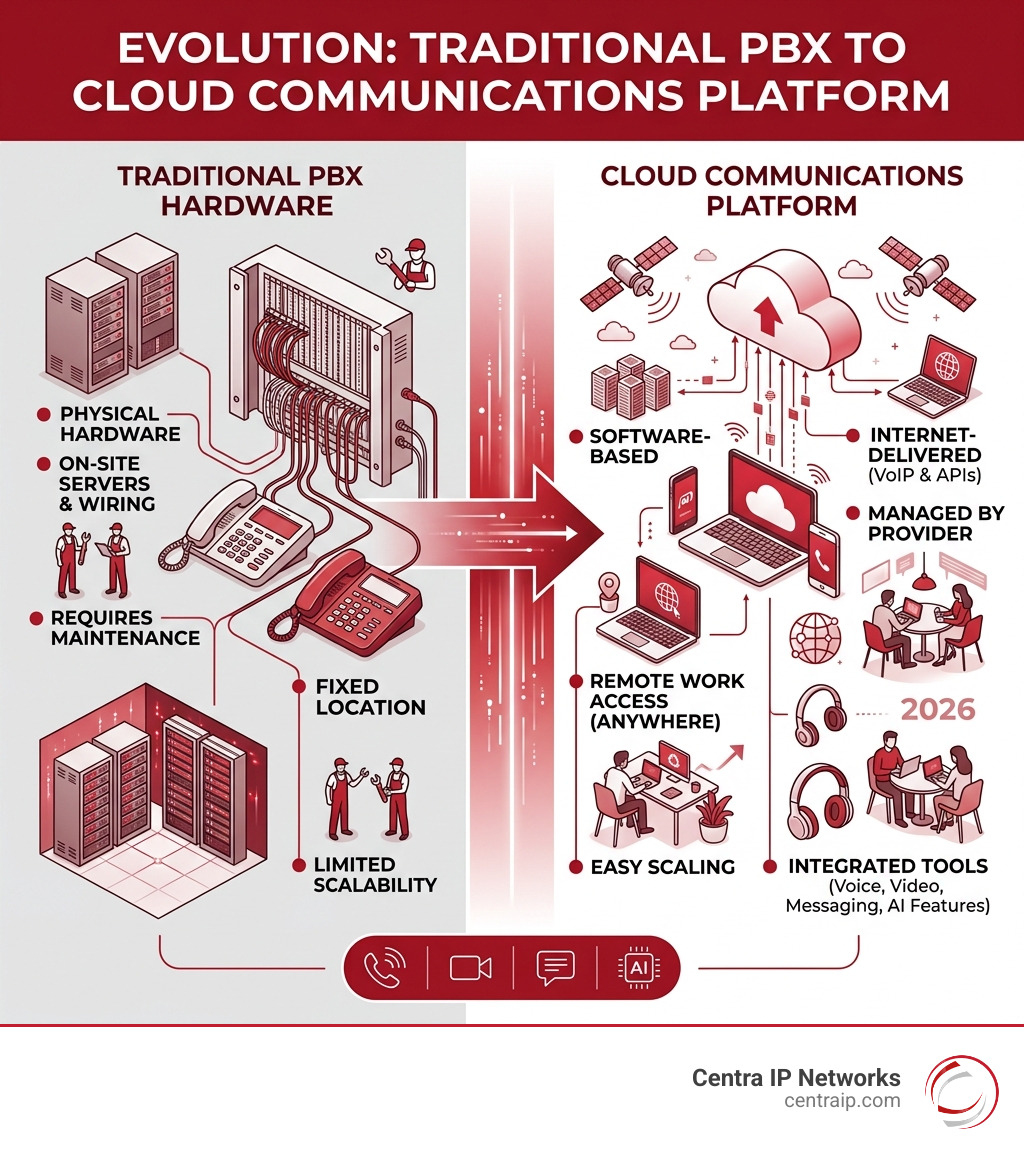
Traditional phone systems rely on physical equipment sitting in your office. If it breaks, you call a technician. If you grow, you buy more hardware. If your team goes remote, you scramble.
A cloud platform removes all of that. Your communications run over the internet, managed by a provider, accessible from a laptop, smartphone, or desk phone — from anywhere.
And in 2026, it goes even further. Modern platforms now layer in AI-powered tools like real-time transcription, sentiment analysis, and voice agents that can handle calls around the clock. What was once just a phone system has become a full business intelligence engine.
I’m Patrick Brangan, and with over 20 years in business technology — specializing in unified communications for SMBs under 200 users across Dallas, Tampa, and Orlando — I’ve helped hundreds of companies ditch their tangled multi-vendor setups and move to a single, streamlined cloud communications platform. In this guide, I’ll walk you through everything you need to know to make a confident, informed decision for your business.
Cloud communications platform word roundup:
What is a Cloud Communications Platform?

At its heart, a cloud communications platform is a virtualized environment where all your business interactions—voice, video, and data—live. Instead of having a bulky “brain” (the PBX) sitting in a closet in your Dallas or Tampa office, the brain lives in secure, geo-diverse data centers.
This shift is largely powered by VoIP (Voice over Internet Protocol), which converts your voice into data packets that travel over the internet. When you use a cloud-based phone system, you are essentially replacing the old copper-wire PSTN (Public Switched Telephone Network) with a digital highway.
For businesses, this means you no longer need to worry about “lines” in the traditional sense. You just need a solid internet connection. As noted by experts at the Cloud Communications Group: Technology Advisory & Expense … , moving to the cloud allows for a centralized management experience that traditional systems simply can’t match.
The choice often comes down to a cloud-based vs premise-based phone systems debate. On-premise systems are like owning an old car; you’re responsible for every oil change and engine failure. Cloud systems are more like a premium ride-sharing service: you get the latest features, the best security, and someone else handles the maintenance.
Key Components of a Cloud Communications Platform
What exactly are you getting when you sign up? Modern platforms are “unified,” meaning they combine several tools into one interface. If you’re looking for an introduction to cloud-based phone systems, start here:
- Voice Calling: HD quality calls that work on desk phones, laptops, or mobile apps.
- Video Conferencing: Built-in virtual meeting rooms for team huddles or client presentations.
- Instant Messaging: Secure chat for internal teams to reduce email clutter.
- File Sharing: The ability to drop a document into a chat or meeting in real-time.
- Unified Interface: One app to rule them all. No more switching between three different programs just to talk to a coworker.
How Cloud Systems Differ from Traditional Telephony
The biggest difference is the “death of hardware.” In a traditional setup, you have a physical Private Branch Exchange (PBX) box, miles of specialized wiring, and a heavy dependence on local carriers.
When comparing VoIP vs cloud-based phone system models, it’s important to understand that while VoIP is the technology that carries the voice, the “Cloud Platform” is the ecosystem that manages it.
- Maintenance Reduction: You don’t need an IT guy on-site to “punch down” wires. Updates happen automatically in the cloud.
- Capital Expenditure (CapEx) vs. OpEx: Instead of spending $10,000 upfront on hardware, you pay a manageable monthly subscription.
- Operational Agility: Need to add ten new employees in your Sarasota branch tomorrow? It takes five minutes in a web portal, not a week waiting for a technician.
Main Types of Cloud Communication Solutions
Not all cloud platforms are built for the same purpose. Depending on whether you’re focusing on internal teamwork or external customer support, you’ll choose between three main “as-a-Service” models.
| Solution Type | Full Name | Primary Focus | Best For |
|---|---|---|---|
| UCaaS | Unified Communications as a Service | Internal Collaboration | General business operations and remote teams |
| CCaaS | Contact Center as a Service | Customer Engagement | Support teams, sales floors, and help desks |
| CPaaS | Communications Platform as a Service | Programmable APIs | Developers building custom app features |
If you want to dive deeper into the most common business choice, check out our guide on what is UCaaS. These definitions are frequently discussed at major industry events like Cloud Connections 2024 | Connect With The Best In Cloud | CCA , where the focus is on how these technologies overlap to create a seamless “omnichannel” experience.
UCaaS vs. CCaaS: Choosing the Right Cloud Communications Platform
Most of our clients in Plano or Clearwater start with cloud-based business phone systems that fall under the UCaaS umbrella. It’s designed to help your staff talk to each other and handle standard business calls.
However, if your business lives and dies by high-volume customer interactions, you need CCaaS. CCaaS offers:
- Intelligent Routing: Making sure the customer gets to the right person based on their needs.
- Workforce Optimization: Tools to track how long agents are on calls and how happy customers are.
- Omnichannel Support: Letting a customer start a conversation on SMS and finish it on a voice call without losing their history.
The Rise of CPaaS and Programmable APIs
Then there’s CPaaS. This is the “Lego set” of the communications world. Instead of buying a finished app, you use APIs (Application Programming Interfaces) to build communication features into your own software.
Providers like Twilio and SignalWire are leaders here. For example, Twilio supports over 2.5 trillion communications annually! If you’ve ever received a text from an Uber driver or a verification code from your bank, you were likely using a CPaaS provider. Developers use these cloud PBX platforms to embed voice and SMS directly into their custom workflows.
Business Benefits and AI Integration in 2026

By April 2026, the conversation around the cloud communications platform has shifted from “can we save money?” to “how can AI help us grow?”
The benefits are still rooted in basics like scalability and cost-effectiveness. We’ve seen businesses in the Orlando area reduce their monthly communication bills by as much as 50% just by consolidating services. But the real “magic” now lies in the integration of Artificial Intelligence.
How AI Enhances the Cloud Communications Platform
AI isn’t just a buzzword anymore; it’s a productivity workhorse. In 2026, a top-tier platform uses Natural Language Processing (NLP) to act as a silent assistant in every meeting.
- Call Recaps & Summaries: No more frantic note-taking. AI generates a summary and action items immediately after a call.
- Sentiment Analysis: The system can flag if a customer is becoming frustrated, allowing a manager to step in and help.
- Voice AI Agents: Companies like Plivo now handle trillions of minutes of conversations via AI agents that sound remarkably human.
- CRM Integration: When a call comes in, your cloud phone system CRM integration automatically pulls up the client’s history, while AI suggests the best “next step” for the salesperson.
This is especially vital for cloud-based call recording, where AI can search through thousands of hours of audio to find specific compliance issues or training opportunities. Of course, all this data needs protection, which is why Cloud Security | Clearwater remains a top priority for local firms.
Reliability and Global Reach Statistics
If you’re worried about the internet “going down,” modern cloud providers have built massive safety nets.
- Uptime: Platforms like SignalWire and Plivo boast a 99.95% to 99.99% platform uptime.
- Scale: Twilio handles 193+ billion messages annually.
- Redundancy: By using geo-diverse data centers, if one server in Tampa has an issue, your calls are instantly rerouted to another location without you even noticing.
This “carrier-grade” redundancy is why 150,000 businesses trust providers like Intermedia to handle their daily operations.
Security, Compliance, and Implementation Best Practices
Security is the “make or break” factor. You shouldn’t just pick the cheapest provider; you need one that respects the laws of your industry. Whether you are a legal firm in Fort Worth or a doctor’s office in St. Petersburg, compliance is non-negotiable.
When evaluating a cloud communications platform, look for these gold standards:
- SOC 2 Type II: Ensures the provider manages your data securely.
- HIPAA Compliance: Essential for healthcare providers to protect patient privacy.
- GDPR: Critical if you do business with anyone in Europe.
- End-to-End Encryption: Your voice and data should be scrambled so that no one—not even the provider—can listen in.
Local experts at Cloud Services Orlando and kangascloud.com emphasize that security is a shared responsibility. While the platform provides the locks, you must ensure your team uses Multi-Factor Authentication (MFA) to keep the keys safe.
Selecting and Integrating Your Platform
Don’t rush the process. A “painless” deployment involves several key steps:
- Needs Analysis: How many people actually need a desk phone? How many just need a mobile app?
- CRM Integration: Ensure the platform talks to Salesforce, HubSpot, or Microsoft Teams.
- Technical Comfort: If your team isn’t tech-savvy, look for a platform with a simple interface.
- Pilot Testing: Roll it out to a small group in your Plano office first to iron out any kinks.
Frequently Asked Questions about Cloud Communications
How does a cloud platform support remote and hybrid work?
The cloud is the ultimate “work from anywhere” tool. Because the system is internet-based, your business phone number follows you. You can answer a call on your laptop in a coffee shop in Dallas, and to the customer, it looks like you’re sitting at your desk. Features like softphones (software-based phones) and mobile apps ensure a consistent experience regardless of physical location.
What are the cost differences between on-premise and cloud systems?
The difference is staggering. With an on-premise system, you have high upfront costs for servers and handsets. In the cloud, hardware costs are often zero if you use apps, and you move to a subscription model. When comparing on-premise vs cloud PBX, the cloud almost always wins on ROI because it reduces the need for expensive on-site IT maintenance.
What security standards should I look for in a provider?
Beyond HIPAA and SOC 2, look for ISO 27001 certification and PCI DSS (if you take payments over the phone). Modern providers also offer AI-driven fraud detection to prevent “toll fraud,” where hackers hijack your lines to make expensive international calls. For those with physical locations, integrating cloud surveillance services into your broader security stack is also a smart move.
Conclusion
Navigating cloud communications platforms can feel like learning a new language. Between UCaaS, CCaaS, and the endless list of AI features, it’s easy to get overwhelmed.
That’s where we come in. At Centra IP Networks, we believe your technology should serve you, not the other way around. Our USP is simple: we provide a single-platform solution. That means one bill, one provider, and one point of contact for your Managed IT, internet connectivity, and cloud phone systems.
By leveraging over 35 strategic partnerships, we don’t force you into a “one size fits all” box. We tailor a solution that fits your specific needs in Dallas, Tampa, Orlando, and beyond.
Ready to move your business to the intelligent cloud? Let’s talk about how we can consolidate your services and give you the competitive edge you need in 2026. Explore our full range of cloud services today.