
Choose a Business Camera System That Fits Your Risk and Growth
A reliable surveillance camera system for business should do more than record an incident. It should give your team clear evidence, fast alerts, and secure remote access without creating another hard-to-manage vendor or monthly bill.
For most businesses, start by comparing three things:
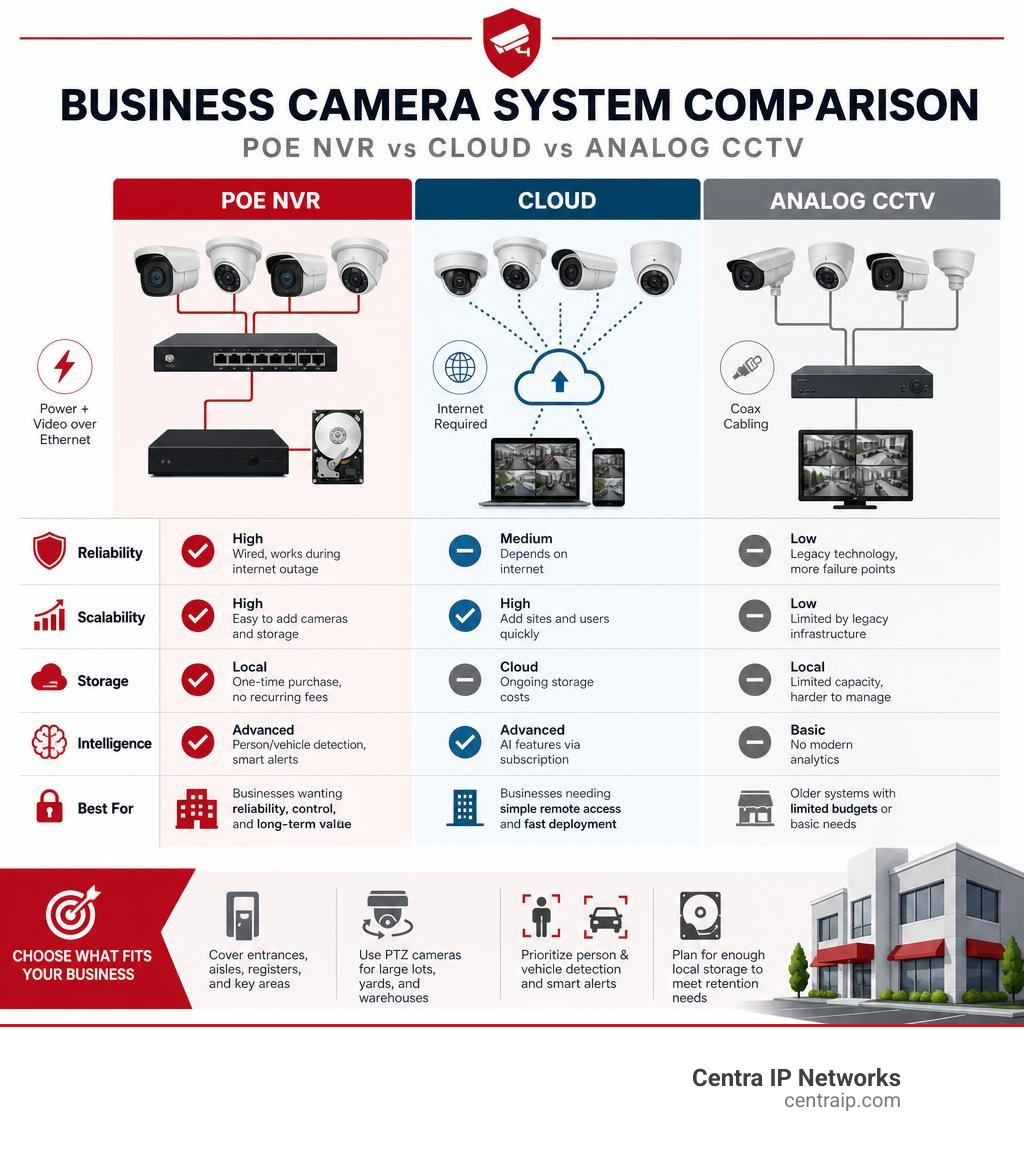
- Architecture: PoE NVR systems offer stable wired power and video, local recording, and operation during an internet outage. Cloud systems simplify remote management but usually add recurring storage costs. Legacy analog CCTV is often harder to scale and lacks modern analytics.
- Coverage: Use fixed bullet or turret cameras for entrances, aisles, and registers. Add PTZ cameras for large parking lots, yards, and warehouse floors where active tracking or zoom matters.
- Intelligence and storage: Prioritize person and vehicle detection, custom alert zones, and enough local storage to meet your retention needs. These tools reduce nuisance alerts and make it much faster to find footage for a dispute, claim, or investigation.
The right system connects video, network infrastructure, access control, sensors, and alerts into one practical security plan. That means better visibility across one site or many, while keeping ownership of the footage and costs clear.
I am Patrick Brangan, a business technology specialist with more than 20 years of experience helping SMBs select and deploy communications, managed IT, and surveillance camera system for business solutions. My work includes fast-turnaround deployments of cameras, networks, access points, speakers, and related security technology for multi-location organizations.
Related content about surveillance camera system for business:
- IT integrated surveillance systems
- surveillance integration with IT
- business security camera integration
System Architectures: PoE NVR vs. Cloud vs. Legacy CCTV
Choosing the foundation for your commercial video security dictates how your system performs during critical incidents, how it impacts your corporate bandwidth, and what it costs over its lifespan.
| Feature / Architecture | On-Premise PoE NVR | Cloud Video Surveillance (VSaaS) | Legacy Analog CCTV |
|---|---|---|---|
| Data Transmission | Cat5e/Cat6 Ethernet (Power + Video) | Ethernet / Wi-Fi to Cloud Gateway | Coaxial Cable (Separate Power Line) |
| Video Resolution | Up to 4K Ultra HD / 16MP Multi-Sensor | 1080p to 4K (Bandwidth Permitting) | Standard Definition / Analog HD |
| Storage Medium | On-site SATA Hard Drives (Expandable) | Remote Cloud Datacenters | DVR Local Hard Drives (Limited) |
| Ongoing Storage Fees | $0 (No mandatory subscription) | Monthly / Annual per-camera fee | $0 |
| Internet Outage Impact | Full 24/7 recording continues locally | May halt recording without edge storage | Full local recording continues |
| AI Analytics | On-device Neural Processing Units (NPUs) | Cloud-server processed / Edge hybrid | Basic pixel motion detection |
| Scalability | 8 to 64+ channels per NVR unit | Virtually unlimited camera licenses | Difficult (Requires manual rewiring) |
Power over Ethernet (PoE) Network Video Recorder (NVR) systems deliver significant advantages for commercial properties. By delivering electrical power and high-bandwidth digital data over a single network cable, PoE eliminates the need for dedicated electrical outlets at every camera mount point.
While learning how cloud-based video surveillance adds security shows the flexibility of off-site management, PoE NVR deployments give businesses uncompromised local network resilience. If an external fiber line gets cut or an internet service provider experiences downtime in Dallas or Tampa, on-site PoE NVR systems continue recording 4K streams uninterrupted.
Core Components of a Modern Surveillance Camera System for Business
A complete commercial security setup integrates several purpose-built network elements working in harmony:
- IP Cameras (Internet Protocol): Digital endpoints that capture, digitize, and preprocess visual data at the edge.
- Gigabit PoE Switches: Network hardware that pools bandwidth and distributes power across multiple camera channels.
- Structured Cat6 Cabling: High-speed twisted-pair cabling engineered to eliminate signal attenuation and electromagnetic interference over long commercial runs.
- Network Video Recorder (NVR): The centralized hardware appliance housing processors, video management software, and high-capacity storage drives.
- Standalone Local Area Network (LAN): An isolated network topology that keeps internal video streaming traffic segregated from your primary business data operations.
To explore the entire setup process from site assessments to structured cabling, check out our Surveillance Systems Complete Guide 2026.
Local Storage vs. Cloud Subscriptions and Data Privacy
For enterprise and small business environments alike, recurring software-as-a-service (SaaS) camera licensing can quietly drain capital budgets over time. A 32-camera cloud setup charging $15 to $25 per channel every month adds thousands of dollars to your annual operating overhead.
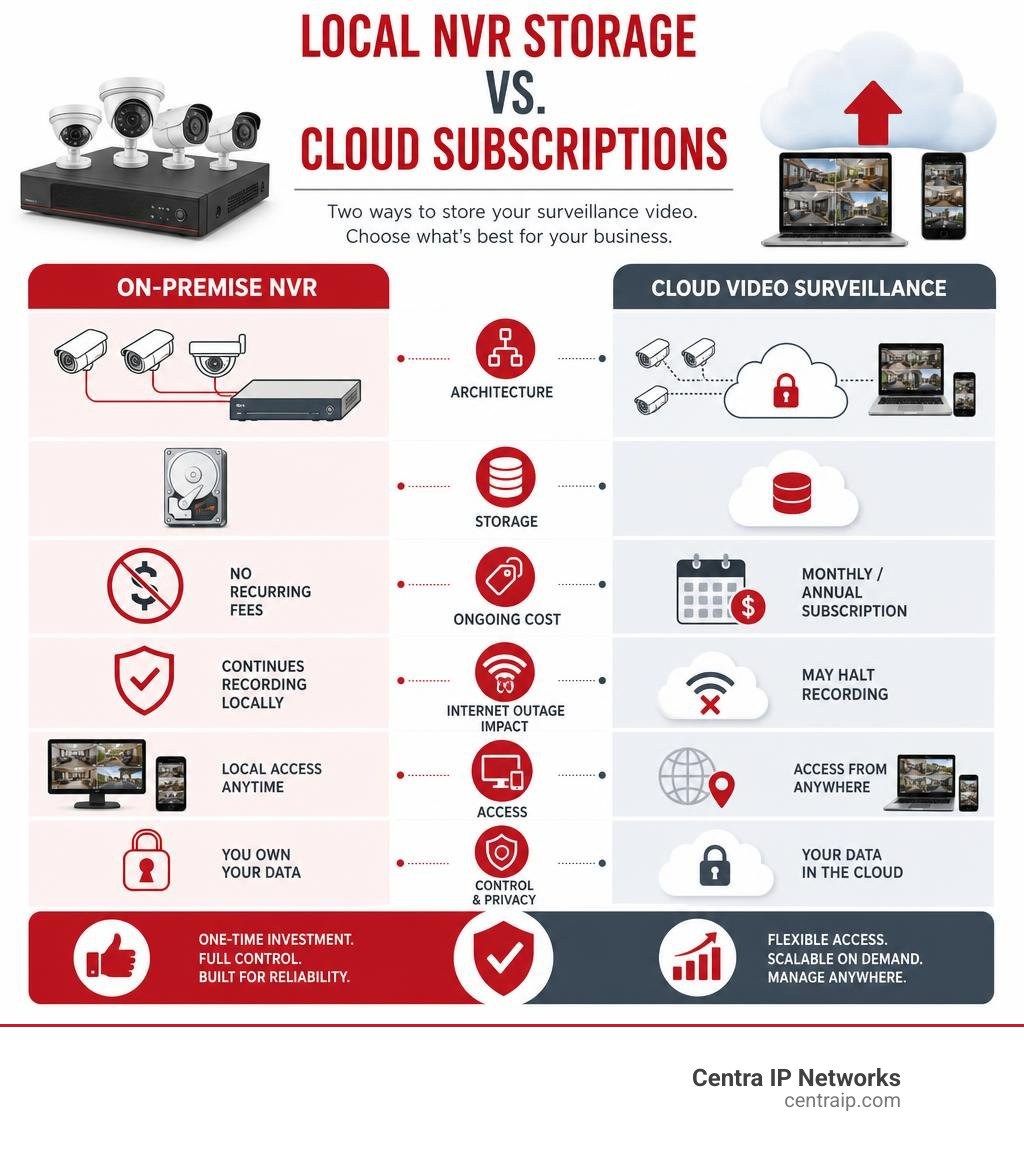
On-premise NVRs eliminate these recurring licensing expenses by storing footage locally across high-capacity SATA hard drive bays. Modern high-efficiency encoding standards like H.265+ compress video streams by up to 70% compared to legacy formats, letting you preserve weeks of continuous 4K footage without sacrificing visual clarity.
Deployments utilizing 64-channel 4K PoE commercial hardware can scale up to 128TB across an 8-bay drive array. This gives your business total control over data retention timelines, internal compliance rules, and video encryption at rest, keeping proprietary video assets safe on your own physical premises.
Choosing the Right Surveillance Camera System for Business Hardware
Selecting camera hardware requires matching optical specifications to your physical footprint. Commercial environments demand durable enclosures rated at IP65 or higher to withstand weather extremes, moisture, and dust across regions like Orlando and Fort Worth.
Clear 4K UHD video matters when investigating a disputed transaction, handling a workplace injury claim, or providing forensic evidence to local law enforcement. High-resolution sensors combined with true optical zoom ensure that details like facial features, currency denominations, and license plates remain sharp during post-incident review.
Form Factors: Bullet, Turret, and PTZ Cameras
Matching physical camera shapes to target locations eliminates blind spots while maximizing visual deterrence:
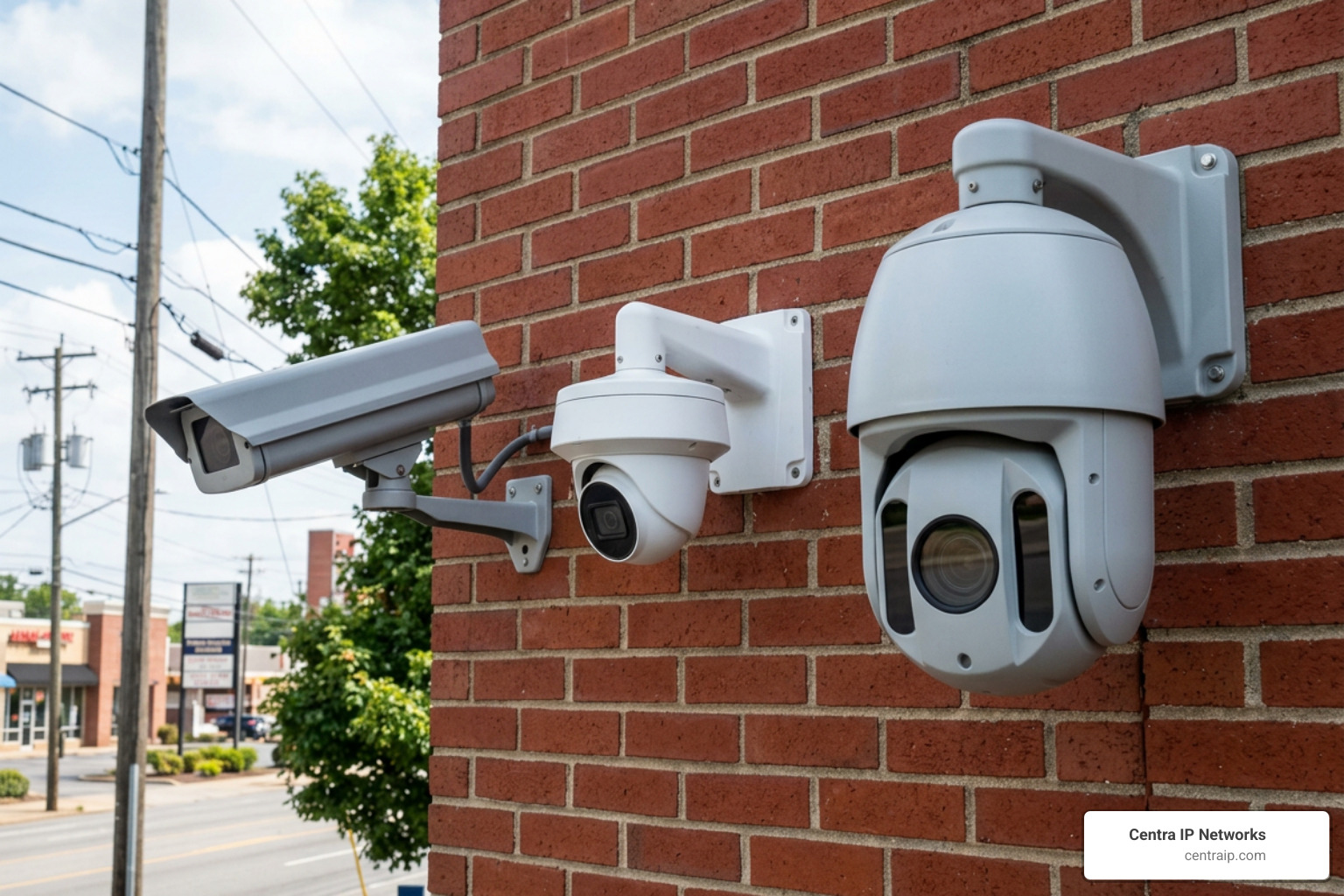
- Bullet Cameras: Feature a prominent, cylindrical profile that acts as an active visual deterrent. Their fixed directional lenses make them ideal for building perimeters, long hallways, and warehouse aisles.
- Turret and Dome Cameras: Provide a discreet, vandal-resistant housing that blends cleanly into office ceilings, hotel lobbies, and retail storefronts without revealing the exact lens direction.
- Pan-Tilt-Zoom (PTZ) Cameras: Equipped with motorized internal gears, PTZ cameras can rotate 360 degrees and tilt to dynamically track moving subjects across broad spaces like logistics yards and commercial parking facilities.
- Hybrid Multi-Lens Units: Advanced systems like the eufy PoE NVR Security System S4 Max combine a fixed wide-angle lens with an auto-tracking PTZ mechanism inside a single housing. The wide lens maintains complete situational context while the secondary lens zooms in up to 164 feet to capture subject details.
To review every commercial form factor and its ideal deployment zone, explore our breakdown of the 10 different types of security cameras for business.
Night Vision Capabilities: Infrared, Starlight, and Spotlight
Low-light performance is essential for around-the-clock commercial security. Modern commercial hardware balances three primary illumination technologies:
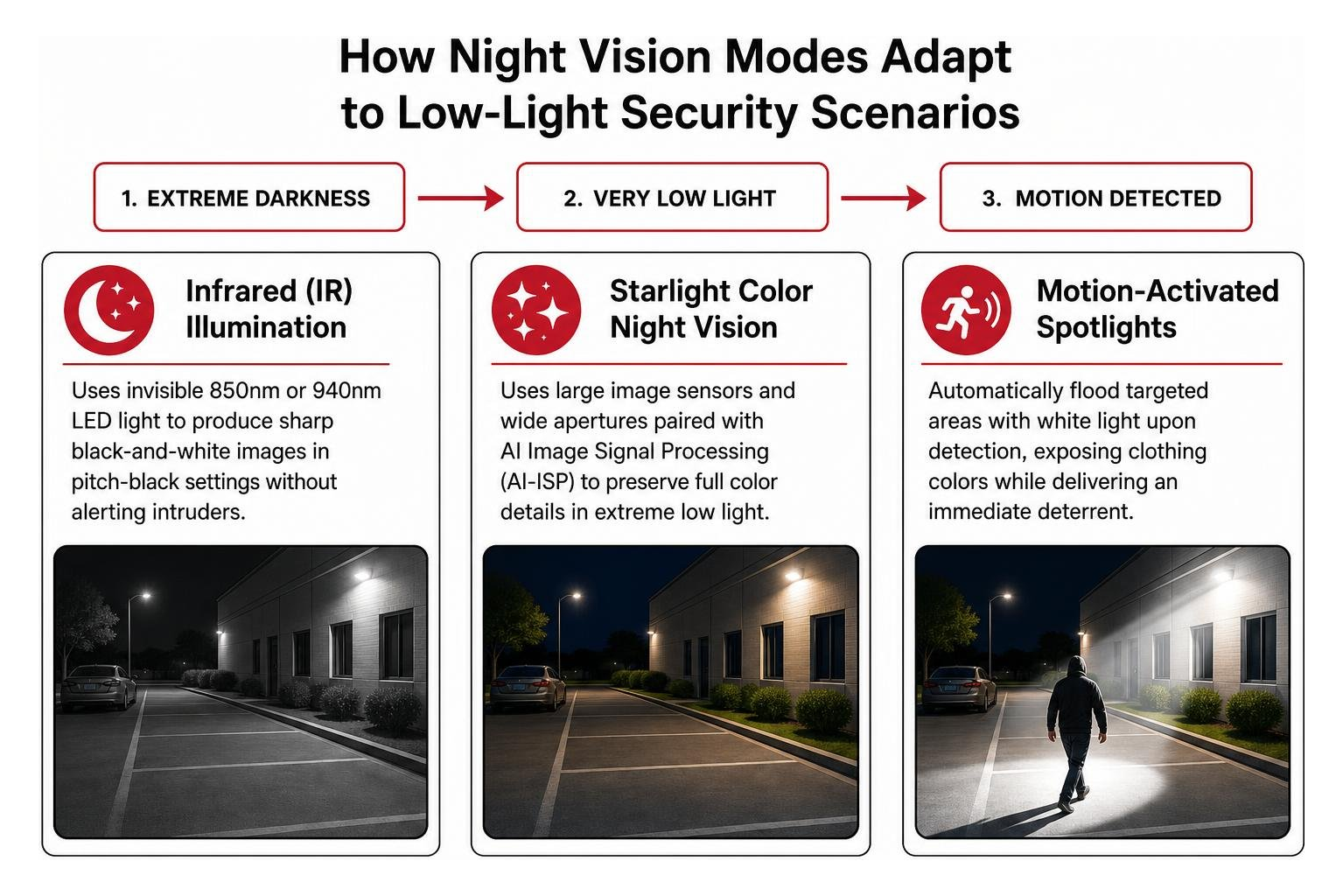
- Infrared (IR) Illumination: Uses invisible 850nm or 940nm LED light to produce sharp black-and-white images in pitch-black settings without alerting intruders.
- Starlight Color Night Vision: Uses large image sensors and wide apertures paired with AI Image Signal Processing (AI-ISP) to preserve full color details in extreme low light.
- Motion-Activated Spotlights: Automatically flood targeted areas with white light upon detection, exposing clothing colors while delivering an immediate deterrent to trespassers.
Equipping exterior cameras with High Dynamic Range (HDR) prevents bright headlights from blinding the sensor, ensuring clear capture of vehicle license plates at entry gates.
Advanced AI Analytics and Operational Threat Detection
Studies show that security personnel miss significant activity when monitoring live feeds manually, and less than 1% of traditional surveillance footage is ever reviewed live. Modern AI systems transform passive video archives into active security systems by using on-device Neural Processing Units (NPUs) that evaluate incoming visual frames in real time.
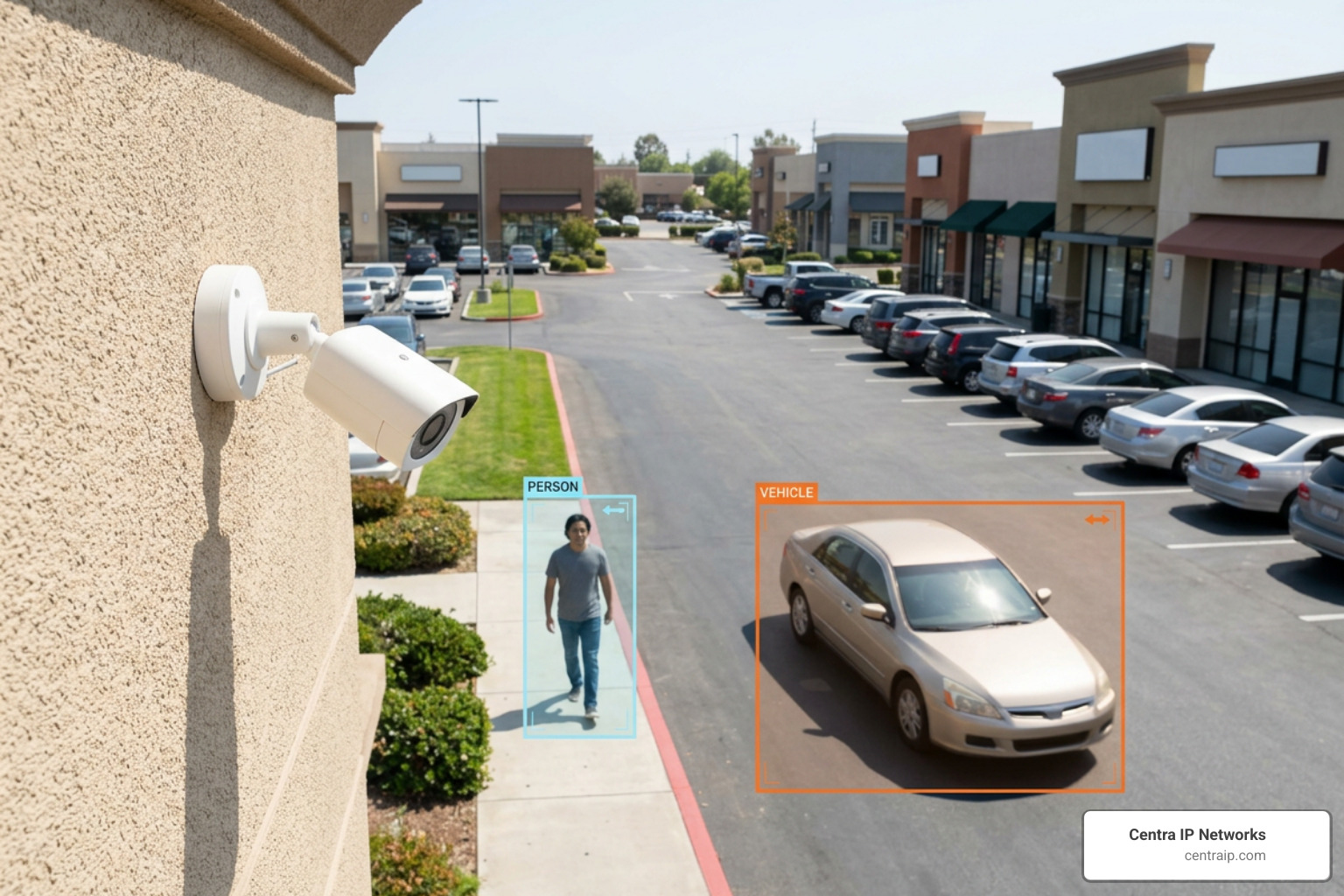
By filtering out irrelevant motion like swaying tree branches, shifting shadows, and rain, AI-driven systems reduce false alarms by 70% to 90%. Understanding the benefits of security cameras for businesses means recognizing how proactive edge analytics safeguard facilities while reducing operational fatigue for monitoring staff.
Cross-Camera Tracking and Smart Video Search
In complex environments like multi-story office buildings or large manufacturing centers, following an incident across multiple individual cameras used to require hours of manual timeline scrubbing.
Modern commercial surveillance systems solve this with coordinated edge computing:
- Cross-Camera Tracking: As a person or vehicle moves through your facility, networked cameras pass tracking data between feeds, building a continuous path of the subject across your entire property.
- Natural Language Video Search: Security teams can find incidents in seconds by typing plain-text queries—such as “person in yellow safety vest near loading dock”—instantly pulling up relevant clips.
- Behavioral Analytics: Edge algorithms automatically detect unauthorized loitering near dumpsters, perimeter fence crossings, and tailgating through secure access doors.
Perimeter Defense: Smart Alert Zones, Strobes, and Sirens
Active deterrence turns your surveillance cameras into a first line of defense. Rather than waiting for a break-in to occur, smart alert zones can trigger integrated countermeasures the moment a boundary is breached:
- Customized Tripwires: Virtual boundaries drawn along property lines that send real-time push alerts when crossed during off-hours.
- Flashing Warning Strobes: Integrated red and blue LED strobes that activate upon unauthorized entry to notify intruders they are on camera.
- Automated Audio Sirens and Two-Way Talk: Built-in speakers can sound audible warnings or let your security team speak directly to visitors and delivery drivers from a mobile app.
Implementation, Scalability, and IT Integration
Deploying a business surveillance camera system requires clean structured low-voltage cabling, dedicated bandwidth management, and strong physical cybersecurity.
As your operations expand across locations in Dallas, Fort Worth, Orlando, Tampa, St. Petersburg, Clearwater, or Sarasota, your video management architecture must scale without requiring a complete hardware redesign.
Scaling a Surveillance Camera System for Business Across Multiple Locations
A scalable surveillance infrastructure relies on modular expansion:
Starting with an 8-channel or 16-channel PoE NVR lets you add cameras by connecting Gigabit PoE distribution switches to your local network. For enterprise environments with multiple regional facilities, centralized Video Management Software (VMS) allows security teams to view feeds, review recorded events, and manage access permissions across every location from a single dashboard.
Unifying Video Surveillance with Access Control and IT Networks
Video surveillance delivers the most value when integrated directly with your broader business infrastructure. By making your cameras and IT network best friends, your security system communicates directly with badge readers, network firewalls, and unified communication systems.
Key integration points include:
- Access Control Event Linking: Video feeds automatically pair with door badge swipes, capturing video clips of every access event to verify identity and detect tailgating.
- Environmental Sensors: Temperature, freeze, flood, and smoke sensors can instruct nearby PTZ cameras to swivel automatically toward an alert area for immediate visual confirmation.
- Life Safety and Mass Notification: During an active emergency, automated systems can broadcast alerts across IP desk phones, smart display consoles, and two-way overhead speakers simultaneously.
Frequently Asked Questions About Business Security Cameras
Do commercial NVR security systems work during internet outages?
Yes. Commercial PoE NVR systems process and store video data entirely on your local area network (LAN). If your internet connection drops, the NVR continues to record, run local AI analytics, and save high-resolution video directly to its internal SATA hard drives without interruption. An active internet connection is only required when team members need to view live streams or receive push notifications remotely via mobile apps or web portals.
How much storage capacity is required for continuous 24/7 recording?
Storage requirements depend on your total camera count, sensor resolution, frame rate, and compression standard. For example, a system running four 4K cameras using H.265+ compression requires roughly 2TB of storage for 10 to 20 days of continuous recording. Larger commercial deployments using 16 to 64 channels typically require an 8-bay NVR configured with 16TB to 128TB of storage to maintain 30 to 90 days of continuous video retention for compliance and insurance needs.
What is the advantage of hybrid bullet-PTZ cameras over standalone models?
Hybrid bullet-PTZ cameras integrate two separate optical sensors into a single physical unit. The fixed wide-angle bullet lens continuously records a full 122-degree overview of the area, while the motorized PTZ lens automatically zooms in and tracks individuals or vehicles moving across the scene. This design eliminates the traditional blind spots created when a standard single-lens PTZ camera turns away from an area to track a target.
Conclusion
A well-designed business camera system protects your assets, supports daily operations, and keeps long-term hardware costs predictable. Balancing local PoE NVR reliability with smart AI detection ensures your facilities stay secure 24/7 without burdening your organization with heavy subscription fees.
At Centra IP Networks, we help businesses unify their physical security, managed IT, internet connectivity, and cloud communications under a single provider with one clear bill. Explore our comprehensive cloud surveillance services or connect with our team to design a secure, scalable surveillance solution tailored to your operational needs.