

Why IT Integrated Surveillance Systems Matter for Modern Businesses
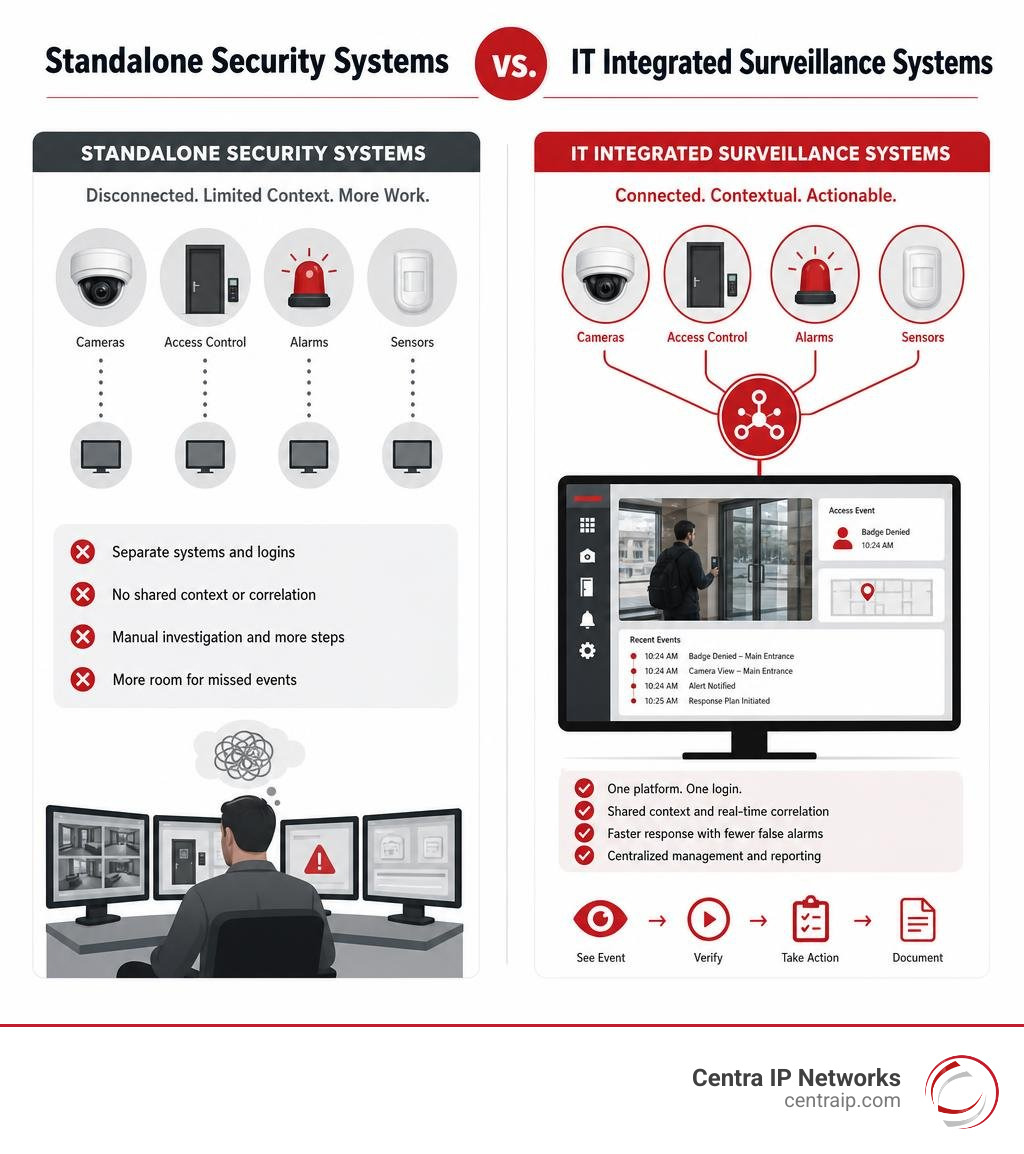
IT integrated surveillance systems connect cameras, door access, alarms, sensors, and alerts through one secure network and management view. Instead of signing into separate tools and manually matching timestamps, your team can see an event, verify it with video, follow a response plan, and document what happened in one workflow.
For a business managing several vendors or locations, that means fewer blind spots and less operational drag. A denied badge swipe, for example, can immediately open the matching camera feed, alert the right people, and preserve the related video and access record.
Standalone systems can still record video or sound an alarm. But they rarely share context. Integrated systems turn separate devices into a coordinated security and operations tool, helping teams respond faster, reduce false alarms, and manage security from a central dashboard.
I am Patrick Brangan, a business technology specialist with more than 20 years of experience helping small and midsize organizations simplify communications, managed IT, networks, access systems, and security cameras. My work with IT integrated surveillance systems includes deployments that combine voice and data networks, Wi-Fi, speakers, access points, and cameras into one dependable environment.
IT integrated surveillance systems terms to learn:
- surveillance integration with IT
- business security camera integration
- surveillance integration phone systems
What Are IT Integrated Surveillance Systems and How Do They Work?
To understand why modern security is changing, look at how conventional security was set up for decades. A business would buy analog security cameras from one vendor, an electronic door access system from a second, a burglar alarm from a third, and building intercoms from a fourth.
Each piece of equipment operated inside its own digital silo. If a back door alarm was triggered at 2:15 AM, the security manager received a generic ping. To figure out what happened, they had to log into the alarm portal, note the exact time, log into a completely separate camera interface, scrub through grainy footage across multiple cameras, and guess which angle captured the incident.
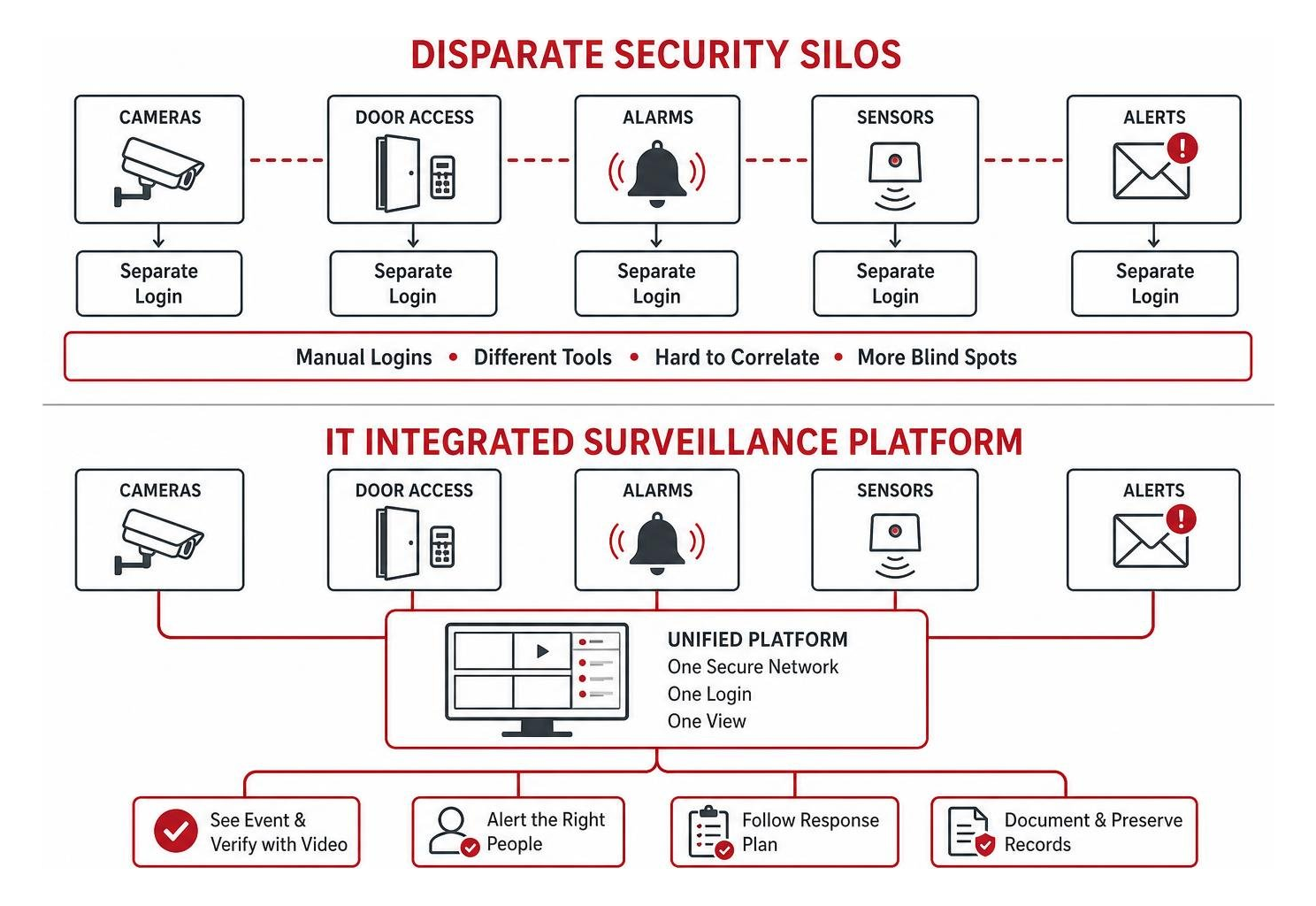
Integrated systems tear down these silos by uniting all physical security hardware onto your core IP network. Rather than treating security cameras as isolated appliances, modern setups treat them as intelligent endpoints on your corporate network. Everything communicates through a centralized platform, giving you a single pane of glass to view live video feeds, door activity, environmental alerts, and device health across every property you manage.
Understanding this balance starts with a clear view of your company’s network backbone, as detailed in our guide on The Non-Techie Guide to Business IT Infrastructure. When security feeds and network infrastructure communicate, you eliminate the hidden administrative drag of balancing multiple service contracts, outdated software, and mismatched event logs.
| Feature / Capability | Standalone Legacy Security | IT Integrated Surveillance Systems |
|---|---|---|
| System Visibility | Disconnected dashboards & separate logins | Single unified pane of glass |
| Incident Verification | Manual cross-referencing across tools | Automated instant video verification |
| Data Synchronization | Prone to clock drift and time mismatches | Microsecond-accurate timestamp alignment |
| Network Infrastructure | Dedicated proprietary coaxial cabling | Standardized Power over Ethernet (PoE) & IP |
| Scalability | High cost; manual hardware replacements | Modular; open-architecture software licenses |
| Response Capability | Slow, passive, post-event review | Automated, proactive, real-time threat response |
Core Architecture: How IT Integrated Surveillance Systems Bridge Disparate Hardware
The magic of modern system integration lies in open architectures and standardized data protocols. Instead of proprietary hardware locking you into a single brand forever, industry-leading deployments rely on open-architecture platforms that bring together high-definition IP cameras, smart sensors, and door controllers under one roof.
Here is how the core hardware pieces connect:
- IP Surveillance Cameras: Digital cameras capture high-definition video (from 1080p to 4K and multi-sensor panoramic views) and convert visual data into encrypted data packets sent across the local area network.
- Power over Ethernet (PoE) Switches: High-capacity PoE network switches provide electrical power and data connectivity through a single standard Ethernet cable, removing the need for dedicated electrical outlets at every camera location.
- Video Management Software (VMS) & Network Video Recorders (NVR): This software layer organizes incoming video streams, manages storage retention policies, applies analytics, and presents footage to operators.
- Environmental & IoT Sensors: Digital sensors detect smoke, glass breakage, sudden temperature spikes, water leaks, or unauthorized motion, instantly piping those alerts into the video management layer.
When you invest in smart business security camera integration, you turn passive recording devices into an active sensor grid that monitors operational health alongside physical security.
The Convergence of Access Control, Alarms, and Communications
A key advantage of network-driven integration is tying physical entry points directly to video surveillance and corporate communications.
In a disconnected setup, an employee swiping a badge at an exterior turnstile creates a line of text in an access log. If an unauthorized individual grabs the closing door right behind them—a security breach known as tailgating—the access log shows only that an authorized employee entered.
In a unified environment, AI-driven video analytics work with door frame sensors to instantly count how many people passed through the door during that single badge event. If two people walk in on one badge swipe, the system triggers an automated alert, flags the video clip, and displays the incident on the monitoring dashboard.
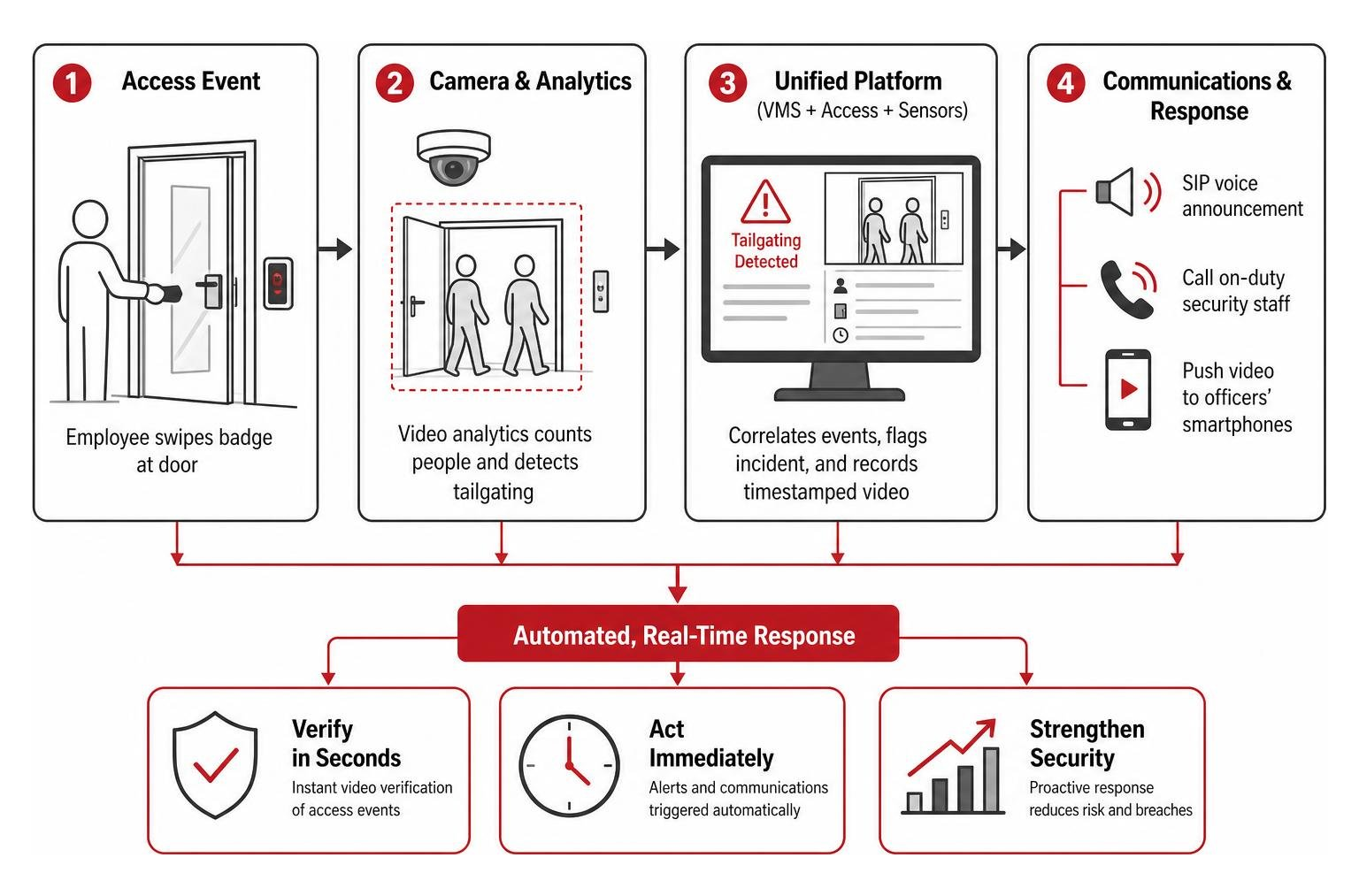
This integration extends to your daily communications. By linking your security infrastructure with surveillance integration with phone systems, an unauthorized door breach or perimeter tripwire can automatically trigger a targeted SIP voice announcement over overhead speakers, dial on-duty security staff via automated voice prompts, and push mobile video links straight to security officers’ smartphones.
Key Operational Benefits: From Rapid Incident Response to Threat Detection
The primary return on investment for integrated physical and network security is speed. In an emergency, seconds count, and toggling between four different browser tabs to confirm an alarm costs precious time.

Research shows that Integrated Security Systems (ISS) can reduce incident response times by up to 50%, as proven in large-scale deployments like the Jerusalem Old City security initiative that unified thousands of cameras and analytical channels into one operational view. When sensors and cameras operate in sync, false alarms drop significantly because operators can visually confirm a situation before dispatching first responders or private patrols.
Real-Time Verification and Incident Acceleration
Integrating video with alarm monitoring replaces guesswork with automated context. Using centralized command platforms, security teams no longer react to ambiguous alerts.
When a perimeter intrusion sensor trips along an outdoor storage yard, the system automatically:
- Pores over incoming data and pairs the sensor alert with the nearest pan-tilt-zoom (PTZ) camera.
- Instructs the PTZ camera to swing, zoom in, and lock focus on the exact breach coordinates.
- Pops up a live video feed on the operator’s screen alongside the facility’s standard operating procedure (SOP).
- Generates a one-click digital link that can be shared with law enforcement, showing live and recorded evidence of the intruder.
This coordinated response is why many enterprises adopt the benefits of remote video surveillance to manage multiple commercial properties across Texas and Florida from a central command room.
Edge AI and On-Device Processing in Modern Surveillance
Surveillance hardware is no longer just a passive lens. Modern cameras and on-premises recording units feature high-powered neural processing units (NPUs) that run advanced artificial intelligence directly on the device.
For instance, modern hardware like the on-device AI processing built into advanced NVR systems leverages 6 TOPS (Tera Operations Per Second) 8-core processors to evaluate video frames locally at the edge. Edge computing delivers three major operational advantages:
- Near-Zero Latency Threat Detection: Because the AI model runs on the local camera or recording box rather than sending raw video up to a remote cloud server for analysis, the system can detect an intruder, classify them as human, and sound an active deterrence siren within milliseconds.
- Intelligent Cross-Camera Tracking: As a person or vehicle moves through a large parking lot or multi-building campus, edge-enabled cameras work together. When a target moves out of one camera’s field of view, it hands off target coordinates to the adjacent camera in real time to maintain a continuous tracking loop.
- Smart Tamper Resistance: Modern systems feature anti-tamper computer vision. If an intruder attempts to spray-paint the lens, blind the sensor with a high-intensity flashlight, redirect the camera housing, or cut the cable, the system flags camera tampering within seconds and triggers secondary perimeter alarms.
Cross-Vendor Data Integration and Broad-Scale Applications
One fear businesses have when upgrading surveillance is the dreaded “rip and replace”—the assumption that modernization requires throwing away every existing camera, wire, and door lock. Fortunately, open-protocol IT integration makes that unnecessary.
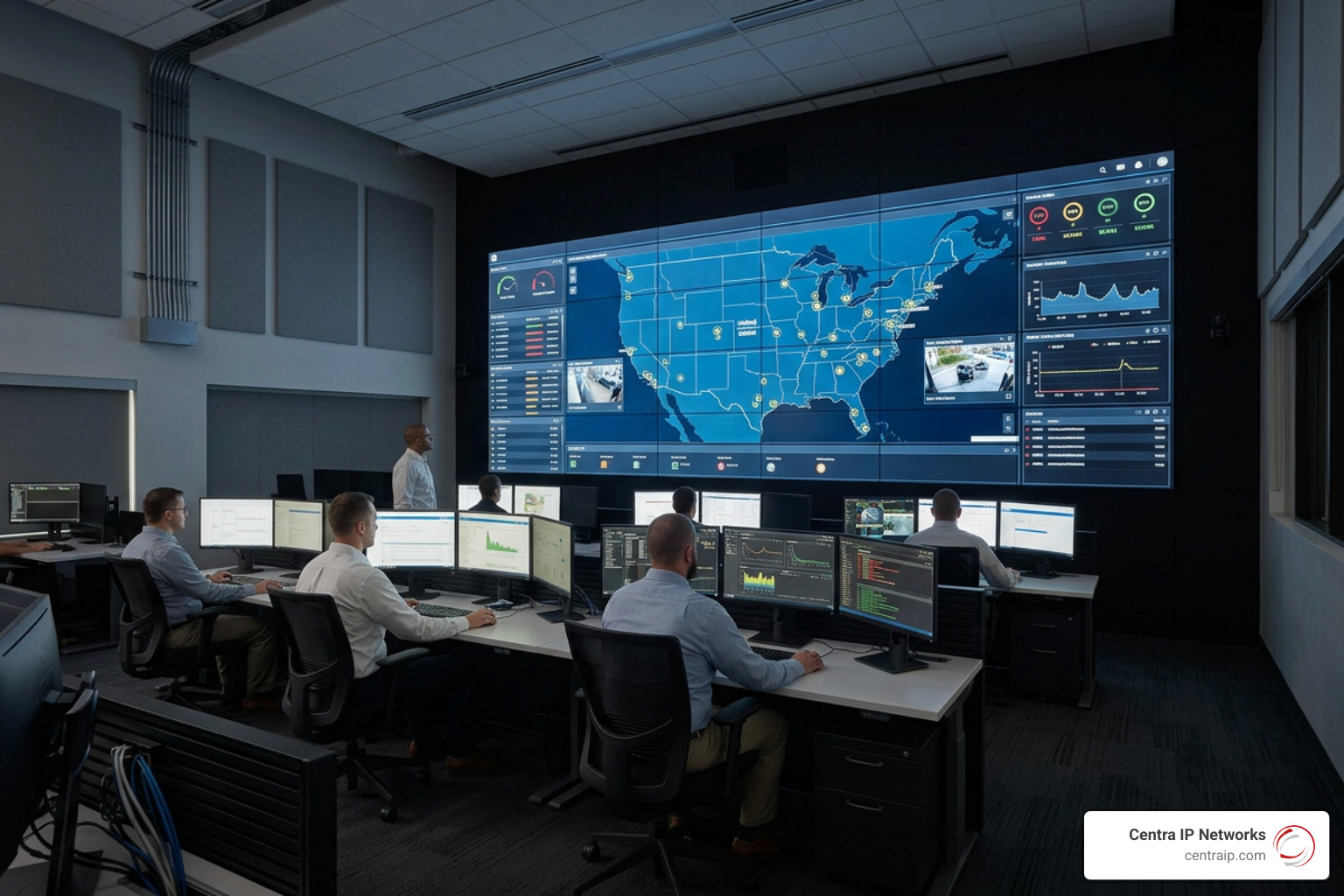
Through industry-standard communication profiles like ONVIF (Open Network Video Interface Forum) and RTSP (Real-Time Streaming Protocol), modern management platforms ingest, display, and manage camera feeds across varied manufacturers and hardware generations. This flexibility relies on a solid data networking foundation that provides the bandwidth and switching performance needed to move heavy video streams without packet loss.
Normalizing Multi-Vendor Feeds and Complex Event Processing
Enterprise-grade software uses unified data ingestion layers to translate diverse communication protocols into a single language. Solutions like multi-vendor central monitoring can manage 10,000+ live camera streams in a single deployment, seamlessly combining disparate analog DVR feeds, legacy IP cameras, and modern 4K AI units.
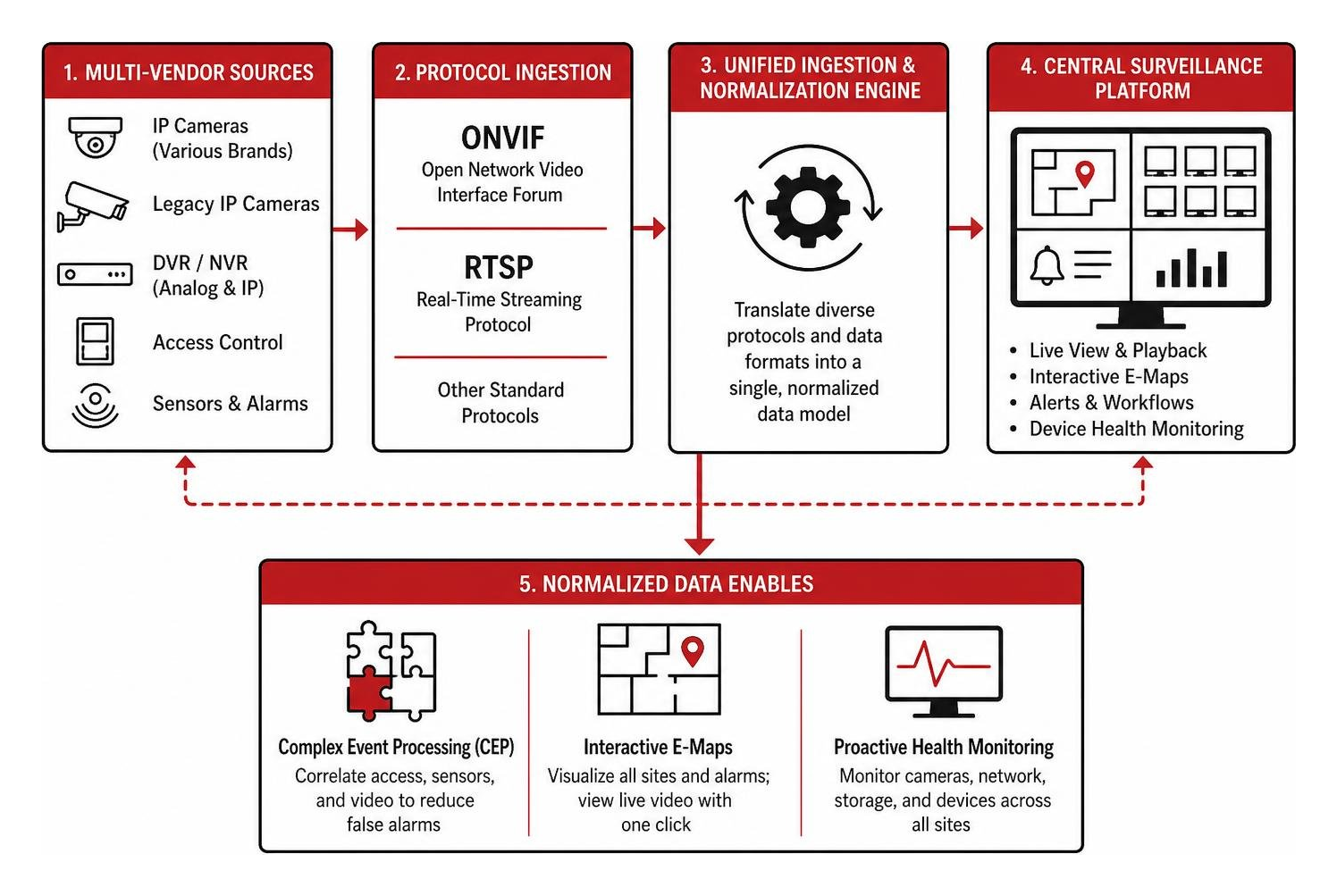
By deploying a vendor-agnostic ingestion engine, organizations achieve:
- Complex Event Processing (CEP): Correlating inputs from access cards, optical sensors, and computer vision to filter out false positives (such as windblown tree branches or stray animals).
- Interactive E-Maps: Visualizing all facilities on interactive floor plans and geographic maps, showing active alarm locations and live camera streams with a single click.
- Proactive Device Health Monitoring: Tracking camera uptime, network latency, switch port statuses, and hard drive wear across all sites so field technicians can resolve equipment issues before a critical security incident occurs.
To learn more about connecting physical security devices to your enterprise network, review our guide on surveillance technology integration.
Scaling Surveillance for Multi-Site Facilities and Public Health Monitoring
The benefits of normalized, network-connected surveillance extend far beyond catching warehouse trespassers. Unified surveillance platforms play an increasing role in enterprise operations, multi-tenant property management, and public health data aggregation.
In public health and environmental monitoring, integrated data repositories harmonize information across disparate health and environmental sensors. Under broader “One Health” initiatives, organizations pull together environmental sensor readings, building occupancy counts, thermal imaging data, and air quality metrics into centralized software.
Whether tracking airborne particulate spikes across industrial facilities or monitoring foot-traffic density across corporate office towers in Dallas, Fort Worth, Tampa, or Orlando, IT-managed surveillance bridges the gap between physical spaces and actionable digital insights.
Deploying IT Integrated Surveillance Systems: Cloud, On-Premises, and Security
When designing your surveillance deployment, choosing where your data lives and processes is one of the most critical decisions. Today’s architectures fall into three broad categories: on-premises recording servers, pure cloud video surveillance (VSaaS), and hybrid-cloud deployments.
Managing these technical environments across multiple commercial properties is simpler when partnering with experienced managed IT services teams who understand network bandwidth optimization, firewall configurations, and endpoint protection.
Evaluating Cloud vs. On-Premises IT Integrated Surveillance Systems
Every business has unique operational needs, compliance mandates, and network constraints. Deciding between cloud and on-premises infrastructure comes down to balancing bandwidth availability, capital expenses, and data retention requirements.
- On-Premises Surveillance: Traditional NVRs and video servers record video directly to local hard disk arrays over the local network. This setup requires minimal internet bandwidth during normal operations and avoids recurring cloud storage subscriptions, making it popular for high-camera-density facilities. However, it requires upfront hardware investments and on-site maintenance.
- Pure Cloud Surveillance: Cameras stream footage directly to off-site cloud data centers. This model eliminates on-premises recording servers, provides seamless browser-based remote access, and shifts infrastructure costs into predictable operating expenses. However, streaming dozens of continuous 4K camera channels can strain standard commercial internet connections.
- Hybrid Cloud Architecture: The ideal middle ground for many midsize businesses. Hybrid systems record high-resolution video locally to edge storage (microSD cards inside the cameras or compact local appliances) while pushing event metadata, low-bandwidth thumbnails, and critical incident clips up to cloud services. If your internet connection drops, the cameras keep recording locally without missing a frame.
Ensuring Cybersecurity, Network Hardening, and Regulatory Compliance
Every IP camera connected to your network is an IoT computer running an operating system. If left unmanaged with default passwords and open ports, security cameras can become vulnerabilities for cybercriminals seeking entry into your corporate network.
A comprehensive IT integrated surveillance deployment must enforce rigorous cybersecurity standards:
- Virtual Local Area Network (VLAN) Segmentation: Surveillance cameras and physical access hardware must reside on dedicated, isolated VLANs with strict firewall access-control lists (ACLs). An attacker who gains physical access to an exterior camera cable cannot pivot into your finance servers, corporate databases, or point-of-sale systems.
- End-to-End Data Encryption: Video streams and access records must be encrypted using strong protocols (such as TLS 1.3 for data in transit and AES-256 for video stored on local disks or cloud storage).
- Role-Based Access Control (RBAC) & Single Sign-On (SSO): Integrate your physical security platform with enterprise identity providers via LDAP, SAML 2.0, or Microsoft Entra ID. When an employee leaves the company, revoking their single corporate credential automatically cuts off their access to security cameras, door logs, and facility floor plans.
- Firmware Lifecycle Management: Regular, automated firmware patching closes newly discovered vulnerabilities in camera operating systems and network controllers.
- Supply Chain & Hardware Compliance: Ensure hardware meets industry and regional standards, including NDAA (National Defense Authorization Act) compliance, preventing the use of hardware from restricted manufacturers in sensitive commercial, financial, and government-adjacent environments.
Frequently Asked Questions About Integrated Security Systems
How do integrated surveillance systems handle cameras from multiple manufacturers?
Modern integrated platforms use open international communication standards, primarily ONVIF (Profiles S, G, T, and M) and RTSP streams. These open standards act as universal translation layers. When an enterprise software platform connects to an ONVIF-compliant camera—regardless of the brand—it automatically negotiates video resolution, audio channels, pan-tilt-zoom controls, and onboard motion analytics without requiring custom software for every camera make.
What is the difference between unified security software and standard integrated systems?
While people often use the terms interchangeably, there is a distinct difference between traditional integration and true platform unification:
- Standard Integrated Systems: Multiple independent software applications (one for video, one for badge access, one for alarms) joined together using software plugins or API bridges. While they can share basic data, updates to one application can break compatibility with another, and operators still manage separate databases and user accounts.
- Unified Security Platforms: A single, comprehensive software suite designed from the ground up to manage video surveillance, electronic access control, license plate recognition, and communications within one unified database and user interface. Unification eliminates database synchronization issues, simplifies maintenance, and slashes training time for your security operators.
How do integrated cameras improve emergency lockdown and evacuation procedures?
During an active threat or facility emergency, integrated systems automate coordinated actions across multiple building systems at once. A single emergency command entered from a computer dashboard or panic button can instantly:
- Initiate an automated perimeter lockdown by securing all exterior electromagnetic doors.
- Switch corridor cameras to high-framerate emergency recording modes.
- Broadcast targeted, pre-recorded evacuation instructions across overhead VoIP phone systems and PA speakers.
- Generate an encrypted, secure web portal link that automatically shares live building floor plans and real-time internal camera feeds with first responders before they arrive on-site.
Moving Forward with Smarter Enterprise Protection
Moving from isolated, reactive security hardware to a fully unified, network-driven surveillance ecosystem transforms how your organization protects its facilities, employees, and assets. By aligning your physical security hardware directly with proven IT engineering principles, you eliminate blind spots, protect your corporate network from vulnerabilities, and give your operations team the speed they need to act when every second counts.
At Centra IP Networks, we believe managing your business technology shouldn’t require balancing half a dozen different vendors, disjointed service agreements, and finger-pointing support desks. We deliver unified business communication, reliable network infrastructure, managed IT, and customized cloud surveillance services on one platform, with a single point of contact and one transparent monthly bill.
Whether you manage single corporate offices, multi-tenant commercial parks, or distributed enterprise facilities across Dallas, Fort Worth, Orlando, Tampa, St. Petersburg, Clearwater, or Sarasota, our team brings the network architecture and physical security expertise needed to keep your business connected, efficient, and protected.