
Understanding VoIP Call Center Pricing: Models and Tiers
When evaluating voip call center pricing, understanding how vendors bill for their platforms is critical. Telecom software is no longer a simple flat monthly service. Vendors calculate monthly invoices using distinct pricing frameworks designed around agent headcount, active phone calls, or trunking capacity. Finding the right fit prevents software waste, as shown in our guide on why VoIP One Size Fits All setups rarely work for growing teams.
Per-User, Concurrent Seat, and Pay-As-You-Go Models
The most common structure in cloud communication is the per-user (named seat) subscription. Every employee who logs into the system requires a paid license, whether they use the phone for ten minutes or eight hours a day.
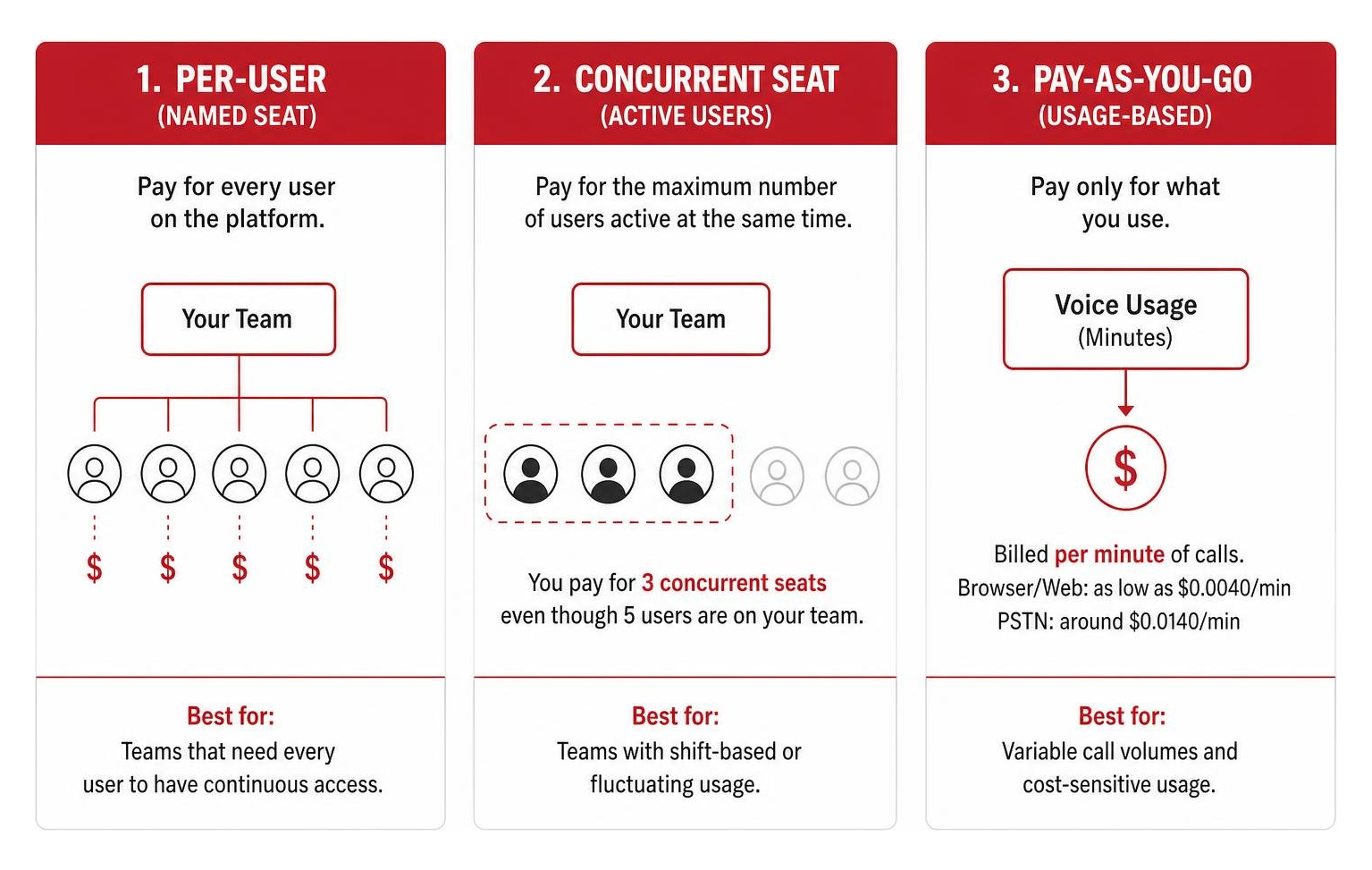
Alternative pricing structures offer greater efficiency depending on operational needs:
- Named User Billing: Standard SaaS pricing where every individual agent requires a dedicated monthly subscription.
- Concurrent Seat Billing: You pay for the maximum number of agents logged in simultaneously during peak shift windows. If you have 60 total agents working across three distinct shifts with only 20 active at any given time, you only pay for 20 concurrent licenses.
- Pay-As-You-Go & Usage-Based Rates: Platforms like Twilio or specialized browser-based systems bill per minute rather than charging fixed seat fees. Browser or web app-based voice routing can cost as little as $0.0040 per minute, whereas traditional local and toll-free PSTN terminations run around $0.0140 per minute.
- SIP Trunking & Channel Pricing: Businesses operating self-hosted or hybrid PBX systems often pay by static channel capacity (e.g., $20 to $25 per channel/month), where each channel allows one live active call regardless of agent count.
- Annual vs. Monthly Term Discounts: Committing to an annual agreement routinely drops per-user pricing by 10% to 25% compared to flexible month-to-month contracts.
Standard Business VoIP vs. Dedicated Call Center Plans
A frequent mistake small businesses make is attempting to run high-volume inbound or outbound support teams on basic Unified Communications as a Service (UCaaS) plans.
Standard business phone plans ($15 to $30 per user/month) explicitly restrict high-volume call center activities in their Acceptable Use Policy (AUP). Terms enforced by major carriers prohibit auto-dialing, predictive dialing, call center trunking, and continuous automated calling on standard seats. Violating these policy guidelines can result in immediate account termination.
Dedicated Contact Center as a Service (CCaaS) platforms ($50 to $150+ per agent/month) are architected specifically to handle concurrent queuing, continuous call distribution, and automated outbound campaigns. To understand what software core your team actually requires, review What You Need in a Business Phone System.
Provider Comparisons: Small Business to Enterprise
Selecting a provider requires matching your actual call volume and staffing needs against standard vendor tiers.
| Provider | Small Business / Base Tier Pricing | Dedicated Call Center Tier Pricing | Key Included Features | Minimum Seat Requirements |
|---|---|---|---|---|
| Dialpad | $15 / user / month | $25+ / user / month | SMS/MMS, AI transcription, custom greetings | 1 seat |
| Nextiva | $15 – $25 / user / month | $75 – $150 / agent / month | Advanced IVR, ACD queues, queue dashboards | 1 seat |
| Aircall | $30 / user / month | $50 / user / month | CRM integrations, whisper/barge, analytics | 3 seats minimum |
| Five9 | $119 / seat / month (Digital) | $159+ / seat / month (Core Voice + AI) | Omnichannel, Intelligent Virtual Agents | 50 seats minimum |
| OnSIP | $18.95 / user / month | $14.95 / user add-on (ACD queues) | Modular queue routing, pay-as-you-go options | 5 seats minimum |
Evaluating Provider VoIP Call Center Pricing for Small Business
Small businesses in Tampa or Orlando often need lightweight software capable of routing inbound customer calls without enterprise complexity.
- Dialpad: Entry-level seats start at $15 per user/month (billed annually), offering built-in real-time AI transcription, unlimited domestic calling, and SMS/MMS.
- Nextiva: Base UCaaS plans start around $15 to $25 per user/month, while dedicated contact center packages with Automatic Call Distribution (ACD) start at $75 per agent/month.
- Aircall: Offers simple pricing starting at $30 per user/month for Essentials and $50 per user/month for Professional tiers, enforcing a realistic 3-seat minimum.
- Global Tiers: Regional platforms, such as a specialized VoIP call center in Singapore, structure tiers from standard business seats (starting around SGD 12 to 19/month) up to high-volume outbound seats (SGD 25/month).
Enterprise CCaaS Tiers, Minimums, and Volume Discounts
Large organizations managing multi-site operations require high availability, enterprise-grade Security SLAs (99.999% uptime), and workforce optimization software.
Enterprise platforms like Five9 offer specialized solution bundles:
- Digital Bundle: $119 per seat/month for digital channels (chat, email, messaging).
- Core Bundle: $159 per seat/month covering complete voice channels along with essential AI capabilities and 3,000 bundled AI minutes per seat.
Enterprise providers enforce 50-seat minimum commitments. However, full-featured CCaaS systems yield impressive returns—independent market research shows cloud contact center migrations achieving a 212% ROI over three years by reducing hardware overhead and automating routine agent tasks.
Base Features vs. Expensive Add-Ons: What Do You Really Need?

Software vendors frequently separate core call handling from specialized agent features. Unpacking these bundles prevents paying extra for tools your team will never touch.
Core Call Center Functionality vs. Tiered Upgrades
Baseline subscriptions generally cover simple business phone needs, but advanced operations rely on specialized add-on tools:
- Included in Base Plans: Virtual auto-attendants, softphone application extensions, basic call forwarding, standard voicemail-to-email, and domestic peer-to-peer calling.
- Standard Contact Center Add-Ons: Basic queue routing ranges from $9.95 per user/month, while Enhanced ACD Queues (enabling live supervisor monitoring, call whisper, call barge, and live queue dashboards) usually add around $14.95 per user/month.
- Call Recording & Compliance: Basic call recording ranges from $4.95 per user/month to fully compliant storage packages integrated with PCI-DSS or HIPAA encryption layers.
AI Automation, Workforce Management, and Omnichannel Costs
AI tools and automated workflows are transforming modern contact center budgets:
- AI Transcription & Summaries: Advanced agent-assist tools can save up to 120 seconds per call by handling post-call administrative write-ups automatically.
- AI Voicebots and Chatbots: Platforms often bill conversational AI via usage tiers (e.g., $49/month for 500 voicebot minutes, with overage fees between $0.065 and $0.08 per minute).
- CRM Integrations: Connecting call popups to platforms like Salesforce, HubSpot, or Zendesk is typically included in professional tiers ($25 to $50/user) but may carry custom API integration fees on lower plans.
- Omnichannel Messaging: Supporting WhatsApp customer conversations involves pass-through pricing per 24-hour window (e.g., Meta conversation rates of $0.085 for marketing or $0.020 for utility interactions).
Uncovering Hidden Fees in VoIP Call Center Software
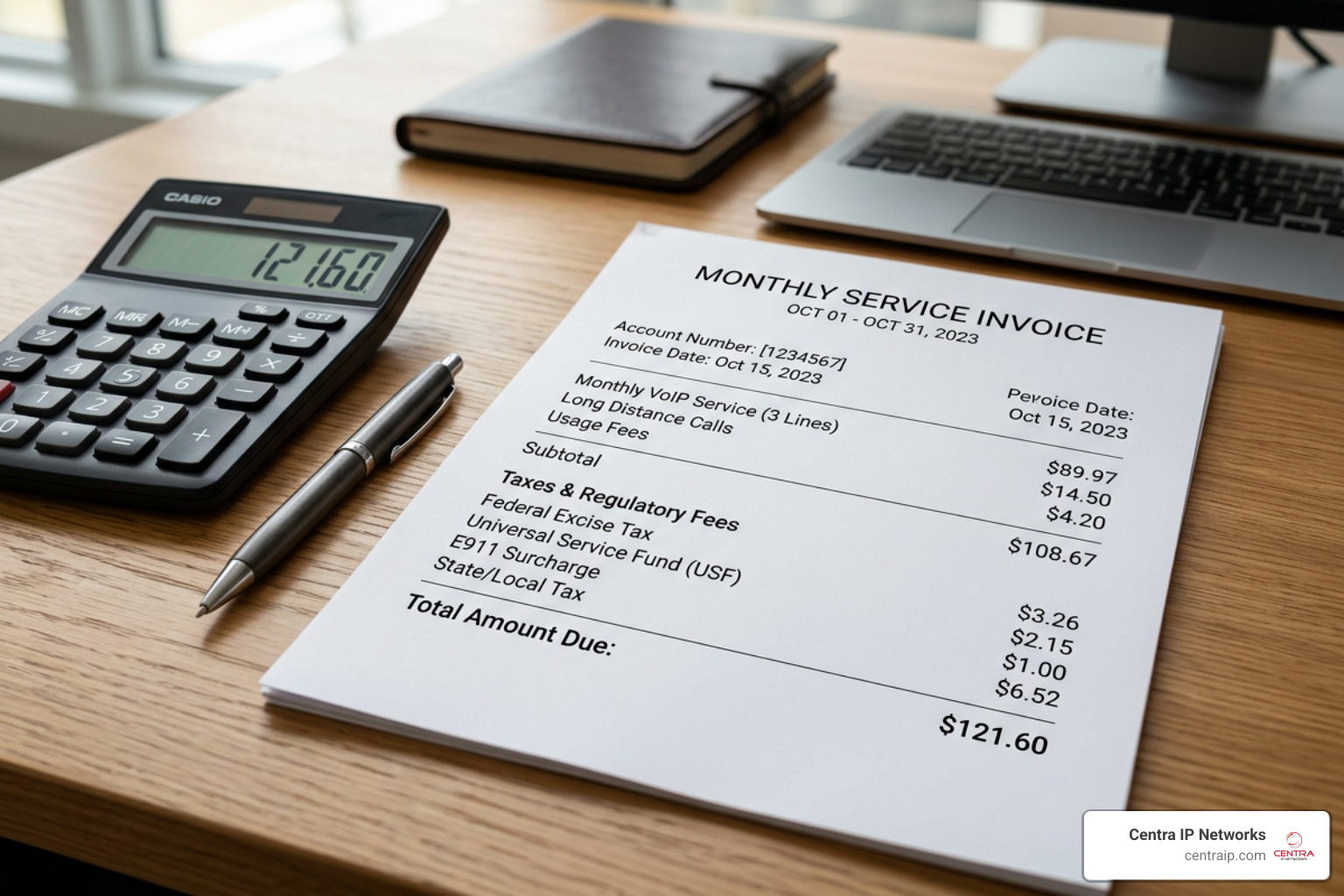
A quote for $25 per user can easily scale to $40 per user once mandatory fees, add-on features, and taxes are applied to your bill.
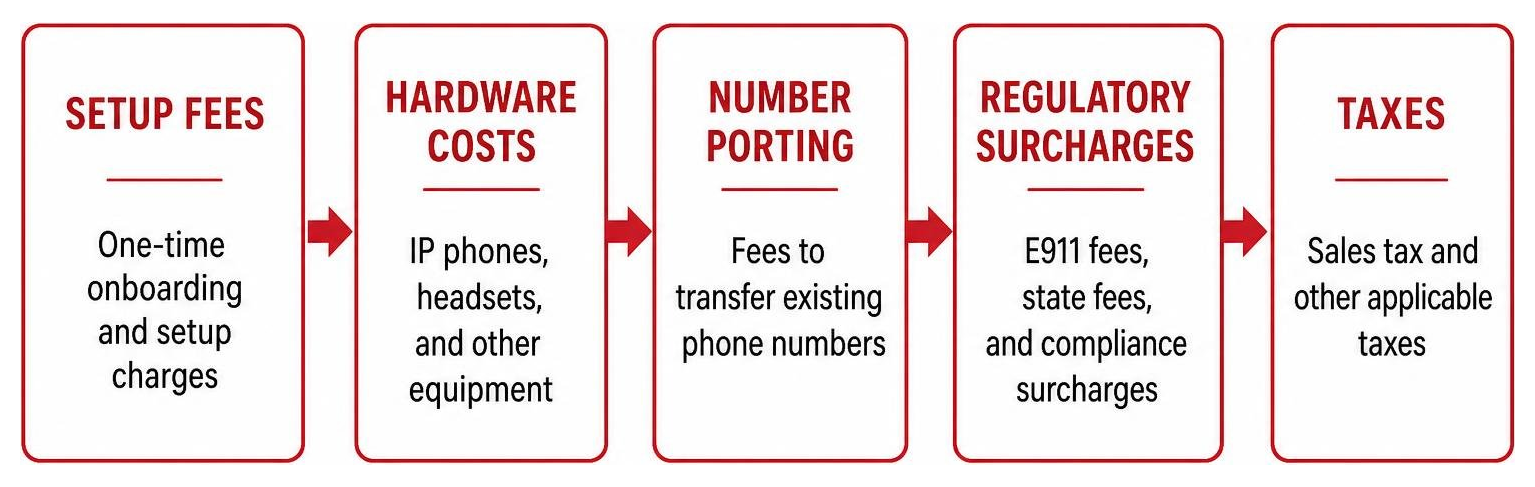
Setup Charges, Hardware, and Regulatory Surcharges
- Setup and Onboarding Charges: Professional setup charges range from $40 per user for cloud onboarding to $1,299+ for full custom server setups.
- Hardware vs. Softphones: Buying dedicated IP desk phones costs $60 to $150 per handset. You can eliminate this upfront expense entirely by deploying browser softphones or smartphone apps on existing hardware.
- Regulatory Surcharges & E911: Standard regulatory recovery fees, state sales tax, and E911 emergency services (averaging $1.80 per user/month) routinely add $75 to $150 per month to total company bills (roughly $10 per user). For residential or micro-office baseline comparisons, see Residential Landline Phone Service.
- eFax Adaptations: Adding paperless digital fax extensions generally costs $5 per user/month or $20/month for dedicated analog adapters. Learn more in our summary of the Best Digital Fax Service Top Picks for a Paperless Office.
International Calling and Toll-Free VoIP Call Center Pricing
Handling international or toll-free traffic requires budgeting beyond basic per-seat charges:
- Toll-Free Numbers & Minutes: Standalone toll-free lines average $2.00 to $10.00/month per DID. Monthly usage bundles cost around $10/month (including 100 minutes) to $45/month (including 1,000 minutes), with overage fees ranging from $0.035 to $0.05 per minute.
- International Rate Cards: Standard international rates range from $0.03 to $0.07 per minute for major global locations, but can reach $0.70+ per minute for mobile termination networks.
- International Toll-Free Trap: Receiving inbound toll-free calls from overseas customers often results in double-charging—you pay both the international carrier fee and your provider’s inbound toll-free rate.
- DID Number Porting: Transferring existing business phone numbers is often free, but some carriers charge one-time DID porting fees of $15.00 per number.
Cloud VoIP vs. On-Premise PBX Total Cost of Ownership
Transitioning from an legacy on-premise PBX system to a cloud VoIP platform drastically shifts capital expenses into predictable operating expenditures.
Legacy PBX setups require expensive Session Border Controllers ($1,000+), physical server rooms, dedicated copper wiring, and specialized on-site IT engineers. Upfront installation costs range from $5,000 to $15,000+.
In contrast, cloud VoIP runs over standard high-speed business internet (requiring a minimum of 100 kbps bandwidth per concurrent call). It eliminates hardware maintenance and lets remote agents connect instantly from Dallas, Fort Worth, or Clearwater using softphone apps. To evaluate modern system alternatives, see our guides on how to Expand with a PBX Phone System, Cut the Cord Not the Quality Comparing Top VoIP Service Providers, and finding the Best Business Voice System.
Frequently Asked Questions About Call Center Costs
Can standard business VoIP plans be used for automated outbound call centers?
No. Standard UCaaS plans strictly prohibit high-volume auto-dialing, predictive dialers, and continuous outbound campaigns under their Acceptable Use Policies. Attempting to run call center dialing on basic seats will lead to service suspension. You must purchase a dedicated CCaaS tier.
What is the average monthly cost per user for a VoIP call center?
Basic VoIP business phone plans cost $20 to $60 per user/month. Dedicated inbound/outbound call center plans average $50 to $150 per agent/month, depending on whether you require advanced ACD queue routing, supervisor monitoring, or AI-driven analytics.
What happens if I cancel a VoIP contract early?
Most cloud VoIP contracts offer a 30-day window from service activation where you can cancel with written notice to receive a pro-rata refund for unused prepaid fees. Canceling annual contracts past this initial window without cause may incur early termination penalties equal to the remaining balance of the contract term.
Conclusion: How to Optimize Your Contact Center ROI
Navigating voip call center pricing does not have to involve confusing add-on charges, unneeded AI upsells, or restrictive contract terms. By auditing your agent headcount, peak concurrent calls, and actual call distribution needs, you can build a cloud phone system tailored precisely to your budget.
At Centra IP Networks, we eliminate carrier confusion for businesses across Dallas, Fort Worth, Orlando, Tampa, St. Petersburg, Clearwater, and Sarasota. Rather than pushing a single vendor, we leverage partnerships with over 35 leading telecom providers to design a solution customized for your operations. We unify your phone systems, internet connectivity, and contact center software onto a single platform—with one consolidated bill and local support.
Ready to audit your communication costs and stop paying for features you don’t use? Discover our tailored Contact Center Solutions or contact our team today to streamline your cloud communications.