
Why Cloud Based VoIP Services Are Replacing Traditional Phone Systems
Cloud based VoIP services are the fastest-growing business phone solution in 2026 — and for good reason. Here’s a quick look at the top options to compare:
| Provider | Best For | Starting Price | Uptime SLA |
|---|---|---|---|
| RingCentral RingEX | Unified communications | $20/user/mo | 99.999% |
| Zoom Phone | Video + voice teams | $10.50/user/mo | 99.999% |
| Nextiva | Features + support value | Custom pricing | 99.999% |
| Dialpad | AI-first calling | Custom pricing | 99.999% |
| Ooma Office | Small teams, tight budget | $19.95/user/mo | 99.9% |
| 8×8 | International calling | Custom pricing | 99.999% |
Most businesses pay $15–$50 per user per month for a cloud phone system — and save roughly $10 per user monthly compared to a traditional landline.
Your business phone system might be costing you more than you think. Not just in dollars — but in missed opportunities. 85% of callers who don’t reach you will never call back. That’s revenue walking out the door every time a call drops, hits a busy signal, or rings into a voicemail no one checks.
Traditional phone systems come with hardware that breaks down, maintenance contracts, and per-line costs that add up fast. On-premise PBX servers typically need full replacement every five to seven years — a major capital expense that cloud-hosted systems eliminate entirely.
Cloud VoIP changes the equation. Your phone system lives in a secure data center, not in a closet at your office. Your team can take calls from a desk phone, laptop, or mobile app — from anywhere. And when your internet goes down, calls automatically reroute to mobile devices so nothing is missed.
I’m Patrick Brangan, and with over 20 years helping SMBs in Dallas, Tampa, and Orlando consolidate their technology — including cloud based VoIP services — into one manageable solution, I’ve seen what a difference the right phone system makes. Let’s break down exactly what to look for so you can make the smartest choice for your business.
What Are Cloud Based VoIP Services and How Do They Work?
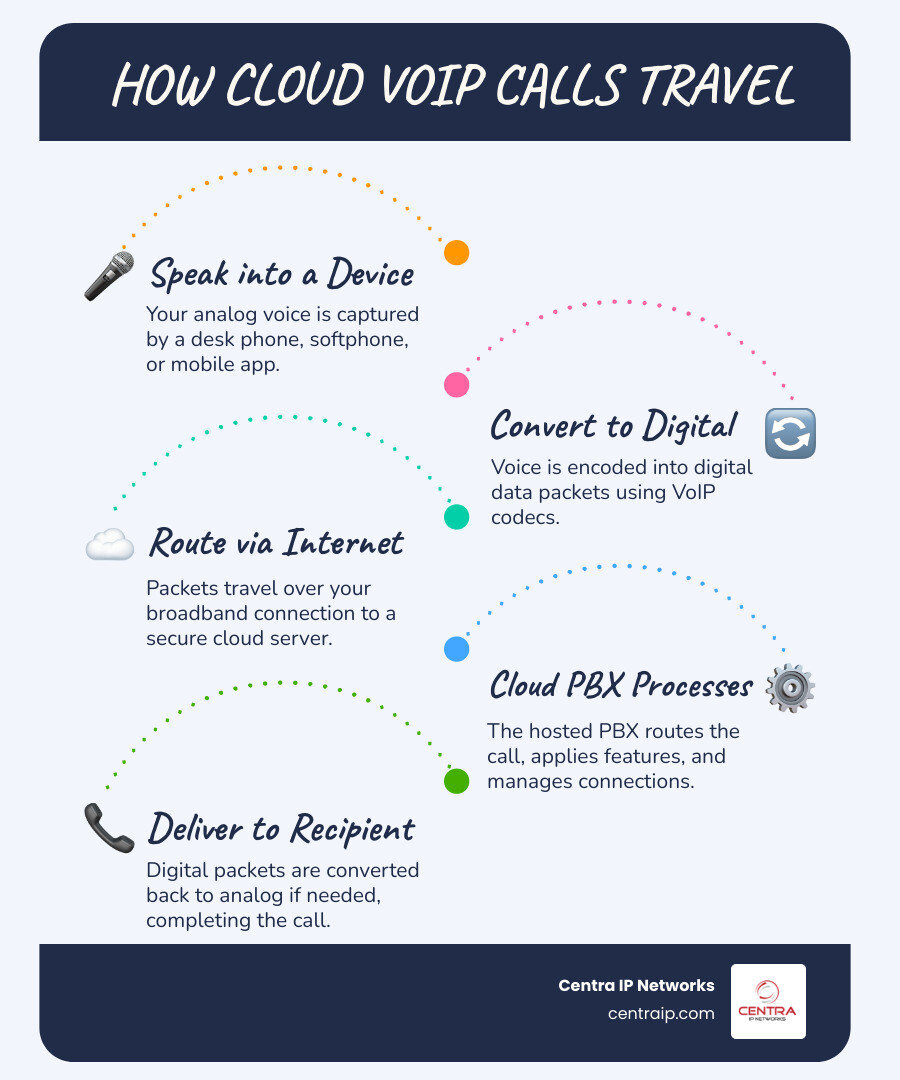
At its core, a cloud-based Voice over Internet Protocol (VoIP) service is a phone system that runs entirely over the internet. Instead of relying on physical copper wires running into your building, your voice is converted into digital data packets and transmitted across the web.
But how does this transition from physical sound to digital data happen? When you speak into a handset or a microphone, your analog voice is immediately converted into digital signals. These signals are compressed, broken into packets, and sent over your broadband connection to a secure cloud server. The cloud server (often called a hosted PBX) routes the call to the recipient. If they are on a traditional landline, the cloud server translates the digital packets back into analog signals before delivering the call.
This setup completely removes the need for expensive physical switchboards in your office. Because the brain of your phone system is hosted in the cloud, you can manage your entire setup from an online dashboard.
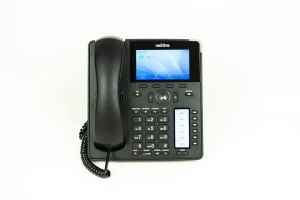
To understand what physical hardware you actually need on your desk, check out our breakdown of What is a VoIP Phone?. If you are still confused about how these terms differ from one another, we explain the nuances in VoIP vs Cloud-Based Phone System: What’s the Difference?.
How Cloud Based VoIP Services Route Your Calls
To get a bit more technical, cloud routing relies on Session Initiation Protocol (SIP). SIP trunking is the technology that establishes, maintains, and tears down the digital connection between two points.
When a customer dials your number, the call hits your cloud host’s servers. Based on the rules you have set up in your visual dial plan editor, the cloud server sends data packets to the correct IP addresses. This could be a physical desk phone in your Fort Worth office, a softphone application running on a laptop in Tampa, or a mobile app on a smartphone in Orlando.
For a complete, deep-dive look at this routing process and the infrastructure behind it, explore The Ultimate Guide to VoIP Phone Service.
Key Advantages Over Traditional Landlines
If you are still holding onto an old-school landline or an on-premise PBX, you are likely overpaying for a system that limits your business’s potential. Moving to cloud based VoIP services offers several immediate advantages:
- Substantial Cost Savings: Switching from a traditional landline to a cloud system saves teams an average of $10 per user every month. You also eliminate the cost of maintaining local phone lines and physical servers.
- No More Expensive Hardware Cycles: Traditional physical phone servers must be replaced every five to seven years. With cloud hosting, the hardware updates happen in our redundant data centers, entirely managed and paid for by the provider.
- True Business Mobility: Employees can make and receive calls from anywhere using their business number. Whether they are working from home in Clearwater or traveling outside of St. Petersburg, they stay connected.
- Fast Scalability: Need to add five new lines for a seasonal rush? You can set them up in minutes through an online portal without waiting for a technician to run new wires.
To see how these benefits directly impact your bottom line, read more about the Benefits of a Cloud-Based Phone System for Your Business. If you are debating between keeping your equipment local or moving to the cloud, we compare both options in Cloud-Based vs Premise-Based Phone Systems: Which One is Right for Your Business?.
Comparing the Top Cloud VoIP Providers for 2026
In 2026, the cloud phone market is no longer just about making voice calls. It has evolved into Unified Communications as a Service (UCaaS), merging voice, video, text, and AI tools into a single platform. If you want to understand the bigger picture of how these unified tools function, take a look at What is UCaaS?.
Let’s evaluate the top providers dominating the market this year to help you find the right fit.
RingCentral RingEX
RingCentral remains an industry heavyweight for unified communications. Its flagship RingEX platform brings together calling, SMS, team messaging, and video meetings in one highly polished interface.
- Standout AI Features: In 2026, the RingCentral AI Assistant has become a core feature. It works across calls, SMS, and team messages to summarize long conversations and automatically extract follow-up tasks.
- The Drawbacks: RingCentral’s SMS limits can feel restrictive, often capping users between 25 and 200 messages per month depending on the plan. Additional messages or campaigns can quickly drive up feature add-on costs.
Zoom Phone
Zoom has successfully leveraged its massive video conferencing popularity into a highly reliable, enterprise-grade phone system trusted by over 10 million users.
- Standout Features: Zoom Phone boasts an impressive 99.999% uptime SLA. It features an incredibly intuitive user interface that requires almost zero learning curve if your team already uses Zoom for meetings. Their 24/7 always-on AI Receptionist is excellent for routing calls and handling basic customer questions.
- The Drawbacks: To get the most out of Zoom Phone, you really need to be fully integrated into the Zoom Workplace ecosystem. If you prefer a different tool for video or team chat, it may feel slightly disjointed.
Nextiva
Nextiva is highly regarded for combining robust enterprise features with excellent customer support. Its unified “NEXT Platform” is designed to manage complete customer experiences.
- Standout Features: Nextiva connects communication channels with agentic AI tools. This allows businesses to build automated, end-to-end customer journeys. Their drag-and-drop call flow builder is highly visual and easy to use.
- The Drawbacks: Nextiva’s pricing structure can be complex, with costs heavily dependent on the length of your contract and the size of your team.
Dialpad
Dialpad has positioned itself as the “AI-first” cloud communications platform, focusing heavily on automated intelligence to streamline business workflows.
- Standout Features: Dialpad features an incredibly advanced agentic AI platform. It achieves unmatched real-time transcription and highly accurate sentiment analysis. It can automatically detect if a caller is frustrated and flag the call for a manager.
- The Drawbacks: Because Dialpad is so packed with advanced AI tools, it comes with a steeper learning curve than simpler, more traditional VoIP platforms.
Essential Features and AI Capabilities in Modern Telephony
Modern cloud based VoIP services do far more than just ring. When choosing a platform, look for these essential features to keep your business running smoothly:
- Interactive Voice Response (IVR) & Auto-Attendant: A virtual receptionist that greets callers and routes them to the right department (e.g., “Press 1 for Sales, Press 2 for Support”).
- Smart Call Queues: Instead of callers getting a busy signal, queues hold them in line with hold music or estimated wait times until an agent is free.
- CRM & Helpdesk Integrations: Native connections to tools like Salesforce, HubSpot, or Zendesk that automatically pull up customer records when the phone rings.
- Agentic AI & AI Receptionists: Autonomous tools capable of resolving routine issues—like booking appointments, checking order statuses, or processing basic transactions—without human intervention.
- Advanced AI Transcription: Platforms like 8×8 have achieved word error rates as low as 3.43% for AI call transcriptions, making it easy to search call histories for specific keywords.
Choosing the Best Cloud Based VoIP Services for Your Business Size
The ideal phone system depends heavily on the size and complexity of your organization:
- Solopreneurs & Micro-Teams: If you are running a small operation in Sarasota or Fort Worth, you need simplicity and low costs. Look for platforms like Grasshopper or Ooma Office that offer shared phone numbers and basic routing without complex enterprise features.
- Mid-Sized & Growing Teams: As your team grows, you need advanced call queues, CRM integrations, and detailed reporting. Platforms like Nextiva, Zoom Phone, or a customized UCaaS platform are excellent fits here.
- Enterprise Organizations: Large enterprises with offices spread across Dallas, Tampa, and Orlando require 99.999% uptime SLAs, deep compliance controls, and robust contact center features (CCaaS).
To explore how to align your phone system with your broader business growth, read our guide on Cloud-Based Business Phone Systems.
Security, Compliance, and Disaster Recovery
Security is non-negotiable when routing business communications through the cloud. If you operate in healthcare or financial services, you must ensure your provider meets strict regulatory standards:
- HIPAA & PCI DSS Compliance: Look for providers that offer secure, encrypted call recording and storage options that protect Patient Health Information (PHI) and credit card data.
- Advanced Encryption: Ensure your system uses Transport Layer Security (TLS) for call signaling and Secure Real-time Transport Protocol (SRTP) for media encryption to prevent eavesdropping.
- Disaster Recovery & Failover Routing: Because cloud systems are hosted in secure, redundant data centers, they are highly resilient. If a major storm hits Tampa or St. Petersburg and knocks out your office power, your calls are not lost. The system automatically detects the offline status and instantly routes incoming calls to backup mobile numbers or softphones.
Frequently Asked Questions about Cloud VoIP
Can I keep my existing phone numbers when migrating to a cloud VoIP service?
Yes, absolutely. The process of moving your existing phone numbers to a new provider is called “number porting.” Modern cloud providers have dedicated porting teams that coordinate with your old carrier to ensure a smooth transition with zero downtime. To learn more about why making this jump is worth the effort, check out Why VoIP?.
What happens to my cloud phone system if the office internet goes down?
Because your phone system lives in the cloud and not on a physical server in your office, your system never actually goes offline. If your local internet connection drops in Orlando or Clearwater, the cloud servers will instantly redirect your calls to backup routing destinations. This means calls can seamlessly ring on your employees’ mobile apps or be routed directly to voicemail-to-email systems. Read more about these safety nets in VoIP Phone Service Benefits.
How do AI features like real-time transcription and sentiment analysis improve business communications?
AI features save your team hours of manual work. Instead of listening to long call recordings, managers can read automated, highly accurate call summaries. Sentiment analysis monitors the tone of customer conversations in real-time, allowing you to quickly identify training opportunities or step in to help a frustrated customer before they hang up.
Conclusion
Transitioning to cloud based VoIP services is one of the easiest ways to cut overhead costs, improve customer satisfaction, and give your team the freedom to work from anywhere. But navigating the sea of providers, AI features, and compliance requirements can feel overwhelming.
That is where we come in. At Centra IP Networks, we deliver comprehensive Managed IT and Cloud Communications services tailored specifically for businesses across Dallas, Fort Worth, Orlando, Tampa, St. Petersburg, Clearwater, and Sarasota.
Our unique advantage is simple: we provide your phone systems, high-speed internet connectivity, and cloud solutions on one single platform, with a single bill, from a single trusted provider. By leveraging our 35+ industry partnerships, we design a customized, cost-effective communication solution that fits your business perfectly.
Ready to modernize your business communications and stop missing critical customer calls? Explore our Cloud-Based Phone Systems page or reach out to our local team today to find the perfect setup for your business.