
Internet Service in Tampa: Best Providers at a Glance
If you’re comparing internet service in Tampa, here’s a quick breakdown of the top providers by type, speed, and starting price:
| Provider | Type | Max Speed | Starting Price |
|---|---|---|---|
| Frontier | Fiber | 7 Gbps | $29.99/mo |
| EarthLink | Fiber | 5 Gbps | $59.95/mo |
| Spectrum | Cable | 2 Gbps | $30/mo |
| T-Mobile | 5G / Fiber | 2 Gbps | $50/mo |
| Verizon | 5G | Varies | $35/mo |
| AT&T Internet Air | Fixed Wireless | 300 Mbps | $28/mo |
| WOW! Internet | Cable | 1.2 Gbps | $20/mo |
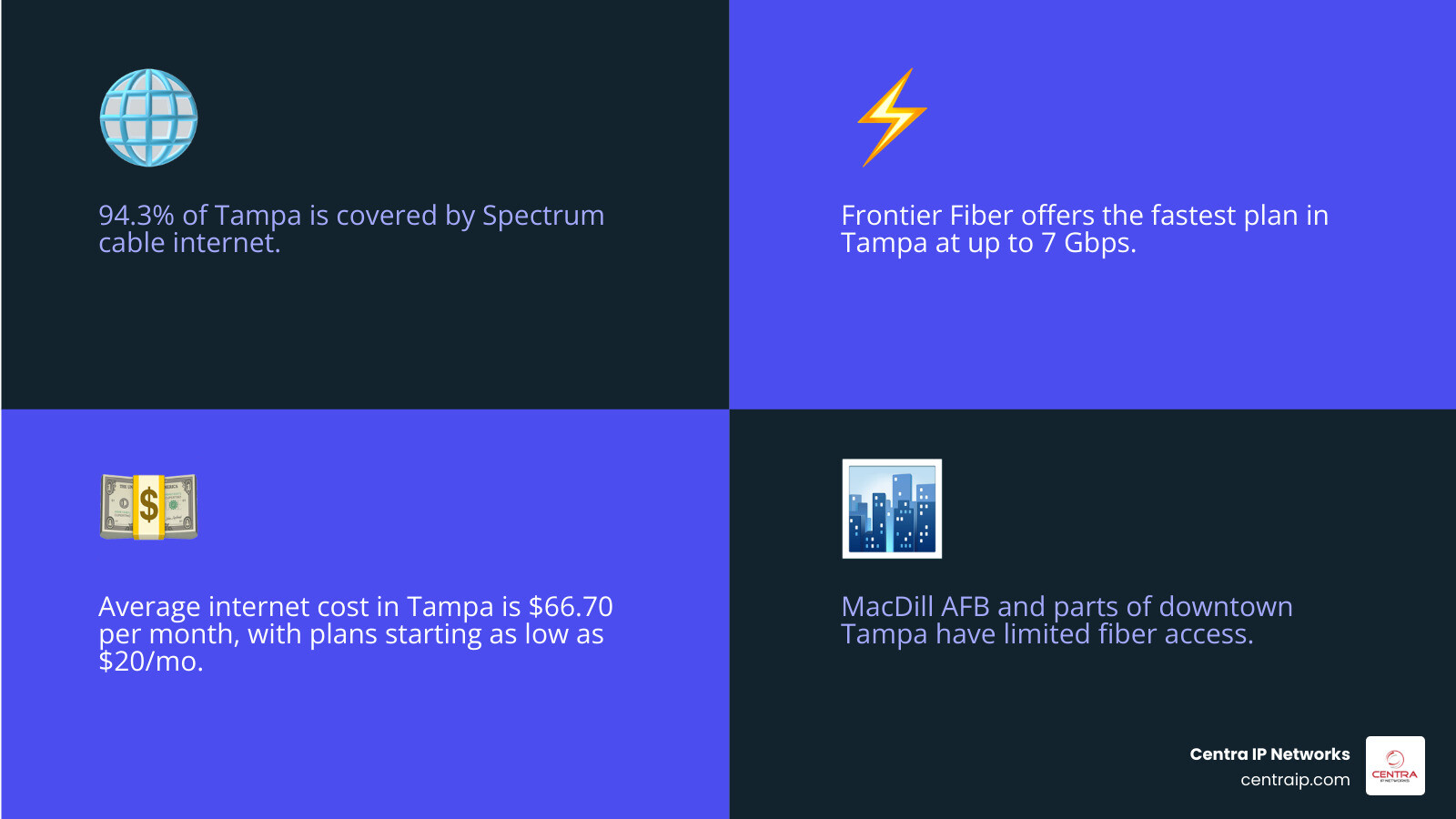
Tampa residents pay an average of $66.70 per month for internet. Speeds available in the area range from 10 Mbps all the way up to 7 Gbps.
The good news: Tampa is unusually well-served. Two major fiber networks — Frontier and EarthLink — compete directly in the area, which is rare for most U.S. cities. Spectrum’s cable network covers 94.3% of Tampa, and 5G home internet from T-Mobile and Verizon adds even more options.
The challenge? Coverage varies a lot by neighborhood. Some areas like MacDill Air Force Base and parts of downtown Tampa have limited fiber access. And with so many providers offering different speeds, contracts, and pricing structures, it’s easy to end up overpaying for the wrong plan.
This guide cuts through the noise so you can find the right fit for your home or business.
I’m Patrick Brangan, a business technology specialist with over 20 years of experience helping SMBs in Tampa source and consolidate internet service in Tampa alongside unified communications, managed IT, and security solutions. If you’re a business owner looking to simplify your vendor relationships while getting reliable connectivity, this guide is written with you in mind.
Top Internet Service Tampa Providers Compared
Choosing the right internet service in Tampa depends entirely on your specific address, budget, and bandwidth requirements. Let’s take a closer look at how the top providers stack up across Tampa FL and neighboring areas like St. Petersburg, Clearwater, and Sarasota.
Frontier Fiber
Frontier is currently the speed champion in Tampa, offering blazing-fast fiber-optic connections with speeds up to 7 Gbps (7,000 Mbps) in select neighborhoods. Because Frontier operates a pure fiber-to-the-home (FTTH) network, it delivers symmetrical upload and download speeds, which is a massive advantage for remote workers, gamers, and businesses. Their entry-level Fiber 500 plan starts at a highly competitive $29.99 per month, making it one of the best values in town if fiber is available at your physical address.
Spectrum Cable
With an impressive 94.3% coverage footprint across the Tampa metro area, Spectrum is the most widely available high-speed option. It relies on a Hybrid Fiber-Coaxial (HFC) network to deliver download speeds up to 2 Gbps. While Spectrum’s download speeds are excellent, its upload speeds are capped significantly lower (usually around 35 Mbps). However, for the average household that primarily streams and browses, Spectrum remains a highly reliable choice, with 81% of customers reporting that their speeds are consistently as fast as promised.
EarthLink Fiber
EarthLink operates as a major fiber provider in Tampa by leveraging local physical infrastructures to offer speeds up to 5 Gbps. What sets EarthLink apart is its focus on holistic digital security and customer lifestyle add-ons. Rather than just selling raw bandwidth, they bundle their plans with value-added services like EarthLink Protect (cybersecurity), EasyTech (remote IT support for all your household’s smart devices), and Guardian (parental monitoring software). EarthLink’s fiber plans start at $59.95 per month, and they frequently offer incentives like a $100 Mastercard gift card for switching.
Fiber Internet Service Tampa Options
When it comes to pure performance, nothing beats fiber-optic technology. Fiber transmits data as pulses of light through tiny strands of glass. This allows it to carry massive amounts of data over long distances without any signal degradation or slowing down during peak usage hours.
If you are looking for the absolute best Internet Service experience, you have three primary fiber options in the Tampa Bay area:
- Frontier Fiber: Offers tiered plans to fit different household sizes, including Fiber 500 (500/500 Mbps), Fiber 1 Gig (1000/1000 Mbps), Fiber 2 Gig (2000/2000 Mbps), and Fiber 5 Gig (5000/5000 Mbps). Their premium multi-gig plans include top-of-the-line Wi-Fi 7 hardware (like the eero Max 7 router, valued at $599) out of the box to ensure your wireless home network can handle those extreme speeds.
- EarthLink Fiber: Reaches up to 64.1% of Tampa with symmetrical speeds up to 5 Gbps. It is an excellent option for users who want premium customer support and bundled cyber safety tools without worrying about data caps.
- T-Mobile Fiber: A relatively new but rapidly expanding player in the Tampa-St. Pete market. T-Mobile Fiber offers simple, contract-free plans ranging from 300 Mbps to 2 Gbps. Their 1 Gig plan runs around $70 per month (with AutoPay), and the 2 Gig plan is $80 per month. They include free professional installation and a Wi-Fi mesh access point if your home has coverage dead zones.
Cable and 5G Internet Service Tampa Alternatives
If pure fiber isn’t yet running down your street, or if you prefer a simpler, contract-free setup, you still have excellent high-speed alternatives.
Spectrum Cable
As the dominant cable provider, Spectrum is the go-to alternative for nearly every Tampa resident. It requires no annual contracts and often bundles well with mobile services. If you live slightly south of Tampa in Sarasota, Xfinity is the primary cable provider, offering plans like 300 Mbps with unlimited data for $45 per month under a reassuring 5-year price guarantee.
T-Mobile 5G Home Internet
For those tired of traditional wired cable companies, T-Mobile offers a completely wireless 5G Home Internet service. It uses the same cellular towers that power your mobile phone to deliver typical download speeds between 170 Mbps and 498 Mbps. For $50 a month, you get a plug-and-play 5G Gateway device that you can set up yourself in under 15 minutes. There are no annual contracts, no equipment fees, and no data caps.
Verizon 5G Home Internet
Operating on a similar fixed wireless access (FWA) model, Verizon 5G Home Internet starts as low as $35 per month if you enroll in Auto Pay and bundle it with an eligible Verizon mobile phone plan (or $60/mo standalone). Verizon provides a 3-year price guarantee on its standard plan and a 4-year guarantee on its 5G Home Plus plan, making it an incredibly budget-friendly, stable alternative to traditional cable.
Speed, Coverage, and Technology: Fiber vs. Cable vs. 5G
To truly understand which service is right for you, it helps to look under the hood at how these technologies deliver data to your home or business.
While fiber is the undisputed champion of speed and reliability, its physical deployment requires significant local infrastructure. Laying fiber cables involves running physical lines underground or on utility poles directly to your property. Because of this, we see noticeable fiber coverage gaps in historic commercial areas of downtown Tampa, as well as highly secured areas like MacDill Air Force Base.
If your business operates in an area where physical fiber is difficult to deploy, optimizing your internal network infrastructure becomes critical. Investing in professional Data Networking Tampa solutions—such as structured Ethernet cabling (Cat6 or Cat6a)—can help you squeeze every drop of performance out of your existing connection and eliminate local bottlenecks.
Symmetrical Fiber vs. Asymmetrical Cable and DSL
The single biggest technical difference between fiber and older technologies (like cable and DSL) is symmetrical speeds.
Symmetrical means your upload speed is exactly as fast as your download speed. Traditional cable networks are inherently asymmetrical; they prioritize download traffic (getting data to your screen) while leaving upload speeds incredibly slow. For example, a Spectrum cable plan might give you a fast 1,000 Mbps download speed, but cap your upload speed at a meager 35 Mbps.
Why does upload speed matter? In our modern digital landscape, we aren’t just consuming content—we are creating and sending it. Symmetrical speeds are vital for:
- Smooth, lag-free video conferencing (Zoom, Teams)
- Uploading large files to cloud storage or backing up servers
- Online gaming (which relies heavily on low latency and fast upload pings)
- Livestreaming and content creation
The expansion of pure fiber-optic networks is transforming the local digital landscape. For instance, IQ Fiber recently launched a 100% fiber-optic network in Pinellas County (including Clearwater and Largo), investing $100 million to bring symmetrical speeds up to 10 Gbps to the Gulf Coast with plans starting at $65 per month.
Just as physical utility planning is complex—as seen in municipal tariff filings like the TWENTY-FOURTH REVISED SHEET NO. 7.010 CANCELS TWENTY-THIRD REVISED SHEET NO. 7.010 which outline strict rules for physical electrical easements—routing fiber-optic cables requires careful engineering. But once in place, fiber uses up to 12 times less energy than traditional cable, making it both a high-performance and highly sustainable choice.
5G Home Internet Performance: T-Mobile vs. Verizon
For renters, students, or budget-conscious households, wireless 5G home internet is a game-changer. Both T-Mobile and Verizon offer plug-and-play setups that bypass the need for a technician to drill holes in your walls.
However, because 5G relies on wireless signals from local towers, its performance can be affected by physical obstructions (like thick concrete walls or heavy tree canopies) and network congestion. During peak evening hours, mobile phone users on the network are often prioritized, which can cause minor, temporary dips in your home internet speeds.
To combat this, T-Mobile now offers a dedicated “Home Internet Backup” plan. This is designed for remote workers who have a primary cable connection but want a secondary cellular backup to keep them online automatically if a storm knocks out their main line.
Finding the Best Value: Cheapest Plans and Promotions
While the average monthly cost of internet in Tampa sits around $66.70, you can find much cheaper entry-level options if you know where to look.
If budget is your primary concern, AT&T Internet Air is currently the cheapest wireless option in Tampa, with plans starting at just $28 per month for speeds up to 300 Mbps.
For wired cable connections, WOW! Internet offers incredibly cheap plans starting at $20 per month in Pinellas County. To protect against the classic “promo rate hike” after your first year, WOW! offers a unique “Price Lock for Life” add-on for an extra $5 per month, ensuring your bill stays flat forever.
When shopping for deals, always keep an eye out for:
- Autopay Discounts: Most providers (including T-Mobile, Verizon, and Spectrum) require you to enroll in paperless billing and automatic payments to get their lowest advertised price.
- Contract Terms: Fiber and 5G providers almost always operate on contract-free, month-to-month terms. Cable providers may offer a lower rate if you sign a 1-year agreement.
- Equipment Fees: Ensure the modem and router are included in the monthly price. Both T-Mobile and Verizon include the gateway for free, while some cable providers charge an extra $10 to $15 per month for Wi-Fi router rentals.
Frequently Asked Questions About Tampa Internet
What internet speeds do I need for streaming, gaming, and working from home?
For most households, your speed requirements depend on the number of connected devices and what you are doing online:
- 100 to 300 Mbps: Perfect for individuals or couples. This easily supports 4K streaming on one or two screens, remote working, and casual online gaming.
- 500 Mbps: The sweet spot for average families (3 to 4 people). This allows multiple users to stream, participate in video calls, and play games simultaneously without buffering.
- 1 Gbps (1000 Mbps) or higher: Best for large households with 5+ heavy internet users, smart home setups with dozens of connected IoT devices, or professionals who regularly upload and download massive media files.
Is satellite internet a good option for rural areas near Tampa?
Generally, no—unless you have absolutely no other wired or 5G options. Traditional satellite providers like Viasat and HughesNet suffer from high latency (lag) because the signal must travel to space and back, making real-time video calls and online gaming almost impossible. Furthermore, satellite connections are highly susceptible to weather interference, which is a major drawback during Florida’s frequent summer thunderstorms and hurricane seasons. If you live in a rural pocket near Tampa, check for 5G home internet availability first before turning to satellite.
How can I check which internet providers are available at my specific address?
Because coverage maps are highly localized, you should always use a provider’s online address checker before making a decision. Simply visit the website of your preferred ISP, enter your exact ZIP code and street address, and the system will show you exactly which speed tiers and technologies are physically wired to your home.
Conclusion
Finding the right internet service in Tampa doesn’t have to be a headache. Whether you are looking for the raw, symmetrical speed of Frontier Fiber, the widespread reliability of Spectrum Cable, or the contract-free simplicity of T-Mobile and Verizon 5G, Tampa has a solution for every digital lifestyle.
For local business owners, managing separate contracts for your internet, Business Phone Systems Tampa, and cybersecurity can quickly become overwhelming. That is where we come in.
At Centra IP Networks, we streamline your operations by offering comprehensive Managed IT Services Tampa, robust Cloud Services Tampa, and high-speed business Internet Service. We leverage over 35 industry-leading partnerships to build a customized, cost-effective solution tailored to your business, putting all your technology on a single platform with a single monthly bill.
Whether you need to upgrade your physical office with structured cabling, transition to a modern Tampa Business Phone Service, or implement secure Tampa Managed IT Services to protect your data, we are here to help.
Ready to simplify your business technology? Contact Centra IP Networks today to optimize your connectivity and IT infrastructure under one reliable roof.