
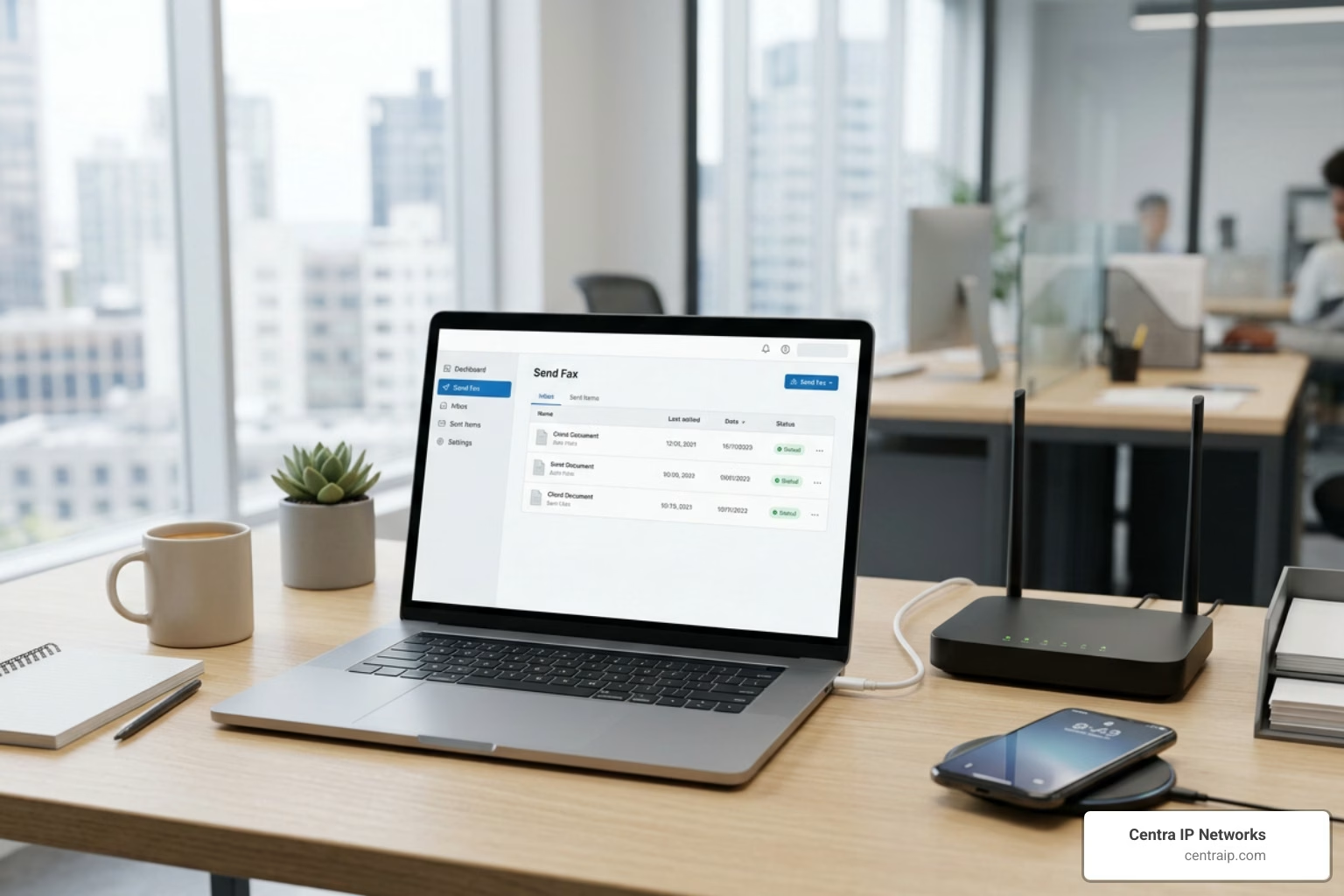
Why Cloud Based Fax Solutions Are Replacing Legacy Fax Infrastructure
Cloud based fax solutions let businesses send and receive faxes over the internet — no fax machines, no dedicated phone lines, no on-premises servers required.
Quick answer: What are the best cloud based fax solutions?
| Provider | Best For | Key Compliance |
|---|---|---|
| eFax | Enterprises, healthcare, legal | HIPAA, PCI, SOC, HITRUST |
| Retarus | High-volume enterprise faxing | HIPAA, SOC 1/2, ISO 27001 |
| FaxHub | Developers, API integration | HIPAA-ready, AES-256 |
| OpenText Core Fax | Large regulated organizations | HIPAA, SOC 2, GDPR |
| Documo (mFax) | Healthcare workflows | HIPAA |
| Concord Cloud Fax | Mid-market businesses | HIPAA, SOC 2 |
Fax isn’t going away. Healthcare, legal, finance, and government still require it — often because of compliance rules that were written before email even existed. But the old way of doing it (physical machines, toner, paper jams, dedicated analog lines) is expensive and slow.
The numbers tell the story clearly:
- 85% reduction in inbound fax costs when switching to cloud
- 60% reduction in document processing time
- 50% reduction in paper usage
- 30% boost in employee productivity
If you’re managing multiple IT vendors and looking to simplify — replacing your fax infrastructure is one of the fastest wins available.
I’m Patrick Brangan, and with over 20 years in business technology sales, I’ve helped hundreds of SMBs in the Dallas, Tampa, and Orlando markets consolidate their communications — including transitioning away from legacy fax machines to modern cloud based fax solutions. This guide breaks down exactly what’s available, what it costs, and how to choose the right fit for your business.
Easy cloud based fax solutions glossary:
Understanding Cloud Based Fax Solutions
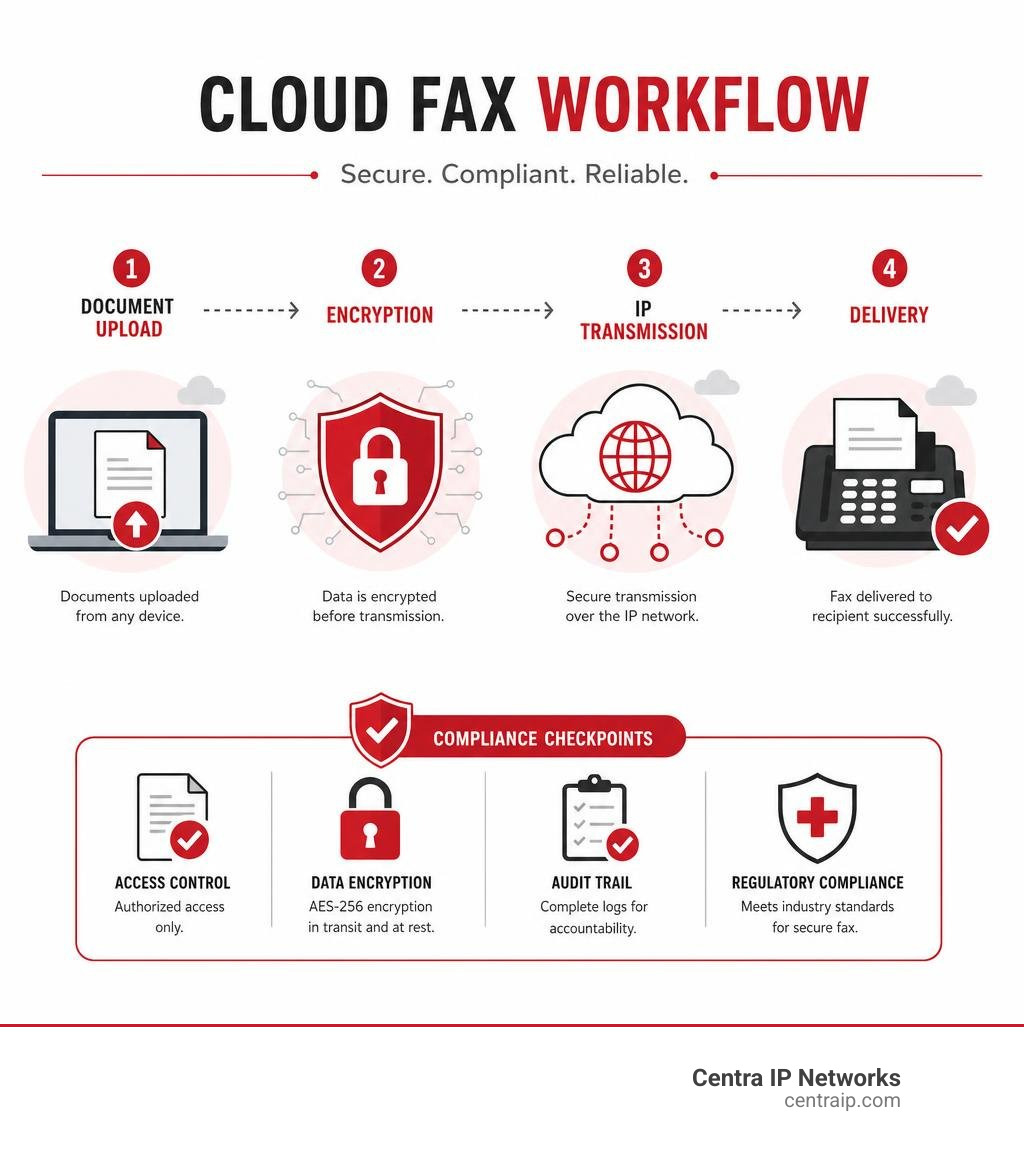
At its core, a cloud fax service digitizes the entire faxing process. Instead of transmitting data over the Public Switched Telephone Network (PSTN) using copper lines, these solutions route data securely over IP networks.
When you send a digital fax, your document is sent to an external, secure cloud server. The application converts the file (such as a PDF, Word document, or image) into a faxable format. If the recipient uses a traditional machine, the cloud server holds the transmission in a queue and sends it once the physical line is free. If the recipient also uses a digital solution, the document is transmitted instantly over the internet and delivered directly to their email, web portal, or integrated system.
This digital-first approach means your fax line is never “busy,” and you will never run out of paper or toner. To learn more about how this underlying technology works, check out our guide on What is Fax Over IP? Benefits and Best Practices for Businesses.
Traditional Fax vs. Cloud Based Fax Solutions
For decades, businesses accepted the limitations of analog faxing because there wasn’t a viable alternative. Today, comparing traditional setups to modern cloud systems reveals a stark contrast in cost, safety, and productivity.
| Feature | Traditional Fax Machine | On-Premises Fax Server | Cloud Based Fax |
|---|---|---|---|
| Infrastructure | Physical machine, analog phone lines | On-site server hardware, telephony cards | Pure cloud (no hardware required) |
| Upfront Cost | $200 – $800 per machine | Thousands in hardware & licensing | Zero capital expenditure |
| Maintenance | High (toner, paper, scanner cleaning) | High (IT staff, software updates, repairs) | None (handled by the provider) |
| Security | Low (documents sit on open trays) | Medium (requires manual firewall updates) | High (end-to-end encryption, audit logs) |
| Scalability | Hard (requires adding physical lines) | Hard (requires upgrading server capacity) | Instant (add users or capacity on demand) |
Traditional setups leave physical documents sitting in public printer trays, presenting a massive security risk. Moving to the cloud ensures that sensitive files are only accessible to authorized users. If you are a business owner operating in Fort Worth, Orlando, or Sarasota, check out our insights on the Top Secure Online Fax Services to Save Your Small Business to see how you can protect your data while slashing overhead.
Deployment Models: Pure Cloud, Hybrid, and On-Premises Alternatives
When planning your migration, you do not have to settle for a one-size-fits-all model. Modern enterprise platforms offer three main deployment strategies:
- Pure Cloud (SaaS): This is the most common model. The provider hosts all infrastructure, and users access the service via web portals, mobile apps, email-to-fax, or APIs. It requires zero on-site footprint and offers the fastest deployment.
- Hybrid Faxing: Perfect for organizations that aren’t ready to decommission their legacy systems entirely. A hybrid setup allows you to keep existing on-premises hardware (like multi-function printers) while routing the actual transmissions through a secure cloud gateway.
- Hosted Managed Services: The provider manages dedicated cloud infrastructure on your behalf. This model is highly favored by massive, regulated enterprises that require strict data sovereignty and custom configurations.
For a deeper dive into these enterprise architecture models, take a look at the capabilities of enterprise platforms like OpenText Core Fax.
Key Benefits, ROI, and Compliance Standards

Migrating to the cloud is not just about convenience; it delivers measurable financial and operational advantages.
Cost Savings, Scalability, and Industry Use Cases
Maintaining legacy fax infrastructure is a quiet drain on business capital. Between the hardware costs ($200 to $800 per machine), dedicated analog lines ($30 to $75 per month per line), and ongoing supplies, a multi-location business with 30 machines can easily spend $40,000 to $105,000 annually.
In contrast, the average enterprise reports $150,000 in annual savings after migrating to cloud-based systems. For example, a mid-sized healthcare provider recently unlocked $200,000 in cost savings alongside a 20% boost in operational efficiency.
These savings span several key industries:
- Healthcare: Clinics and hospitals handle massive volumes of patient referrals, lab results, and pre-authorizations. Cloud faxing speeds up document delivery to under 30 seconds, improving patient care response times.
- Legal: Firms must exchange legally binding, unalterable documents. Cloud faxing preserves the legal status of a fax while allowing remote legal teams to send files directly from their laptops or mobile devices.
- Finance: Banks and mortgage brokers process loan applications and wire-transfer authorizations. Cloud systems provide immutable audit trails to verify exactly when a document was sent, received, and viewed.
For a specialized look at how this applies to clinical settings, read about Documo’s Fax-to-Email for Healthcare.
Regulatory Compliance: HIPAA, PCI DSS, and GDPR
In regulated industries, faxing isn’t just a preference – it’s a legal requirement. However, standard email does not meet the strict security criteria of regulations like HIPAA, PCI DSS, and GDPR. For healthcare organizations, the U.S. Department of Health and Human Services provides official guidance on the HIPAA Security Rule, which sets national standards for protecting electronic protected health information.
Enterprise-grade cloud fax solutions solve this by implementing:
- AES 256-Bit Encryption: Documents are encrypted both while resting on cloud servers and while in transit across the network (using TLS 1.2).
- Business Associate Agreements (BAAs): Reputable providers will sign a BAA, legally binding them to safeguard Protected Health Information (PHI).
- Data Sovereignty: Providers allow you to choose where your data is stored (e.g., within the US, Canada, or the EU) to satisfy local privacy laws.
- User Access Controls: Multi-factor authentication (MFA) and Single Sign-On (SSO) ensure only verified personnel can access incoming transmissions.
To learn more about how security is maintained during transmission, explore the enterprise compliance features of platforms like eFax.
AI and System Integrations in Modern Cloud Based Fax Solutions
Modern faxing has evolved far beyond simply sending static images. Today, cloud fax serves as an entry point for advanced document automation, powered by Artificial Intelligence (AI) and Machine Learning (ML).
With AI-enabled Optical Character Recognition (OCR), cloud systems can automatically read incoming faxes, classify the document type (such as an invoice, referral, or medical record), extract key data fields, and route the information directly into downstream business systems like Electronic Health Records (EHR), Enterprise Resource Planning (ERP), or Customer Relationship Management (CRM) platforms.
Some platforms even offer specialized AI skill files that integrate directly with assistants like ChatGPT or Claude, allowing users to send faxes via simple conversational prompts. For a look at how automated document workflows can transform your business processes, see B2B Cloud Fax Services from Esker.
The Ultimate List of Cloud Fax Providers
Selecting the right provider depends on your business size, required integrations, and compliance needs. Let’s look at how the top industry platforms stack up.
Top Enterprise Cloud Fax Platforms
1. eFax Corporate
As a global leader in digital faxing, eFax is highly trusted by Fortune 500 companies and heavily regulated enterprises. It offers robust security certifications (including HITRUST, PCI, and SOC compliance) and integrates seamlessly with third-party cloud storage and enterprise applications.
- Best For: Large enterprises, healthcare networks, and legal firms.
- Gartner Peer Insights Rating: 3.5 / 5 stars.
2. Retarus Cloud Fax
Retarus provides a powerful, highly scalable enterprise fax portal designed for collaborative team environments. It features “Delivery Assist” to help resolve delivery failures, supports custom cover page templates designed in Microsoft Word, and manages massive, high-volume seasonal spikes without splitting files.
- Best For: High-volume corporate environments and automated application-to-fax workflows.
- Gartner Peer Insights Rating: 4.6 / 5 stars.
- More Information: Retarus Enterprise Fax Portal
3. FaxHub
FaxHub is a modern, developer-friendly cloud fax service that is fast, reliable, and incredibly simple to use. It features a full REST API with 35 endpoints, native mobile apps with automatic black-and-white conversion, and a unique AI assistant integration skill file.
- Key Stats: 99.7% delivery rate, less than 30 seconds average delivery time, and over 50,000 faxes sent.
- Best For: Developers, startups, and SMBs looking for a fast, modern API-driven service.
- More Information: FaxHub Online Faxing
4. mFax (by Documo)
mFax focuses on delivering a user-friendly, highly secure, and HIPAA-compliant faxing experience. It is built from the ground up for modern web browsers and offers excellent administration tools for managing multiple departments or clinics.
- Best For: Healthcare practices and remote teams.
- Gartner Peer Insights Rating: 5.0 / 5 stars.
5. Concord Cloud Fax
Concord is a reliable, enterprise-grade cloud fax network designed for high-volume document transmission. It is widely used in the healthcare sector for its seamless integration with major EHR platforms and its robust security infrastructure.
- Best For: Mid-market businesses and healthcare systems.
- Gartner Peer Insights Rating: 4.0 / 5 stars.
To see how these and other market leaders compare side-by-side on features and pricing, check out our comprehensive breakdown of Cloud Fax Providers That Actually Work and our detailed Digital Fax Service for Business: A Complete Comparison.
Frequently Asked Questions about Cloud Fax
Making the switch to digital faxing often brings up practical questions. Here are the answers to the most common queries we receive from business owners in Texas and Florida.
How difficult is it to migrate from legacy fax systems to the cloud?
Not difficult at all. Modern cloud providers support phased migration strategies. If you have a complex setup, you can use a hybrid model—routing some traffic through the cloud while keeping your physical machines active—until you are ready for a full transition. This ensures zero downtime and keeps your daily business operations running smoothly.
Is cloud faxing actually more secure than traditional faxing?
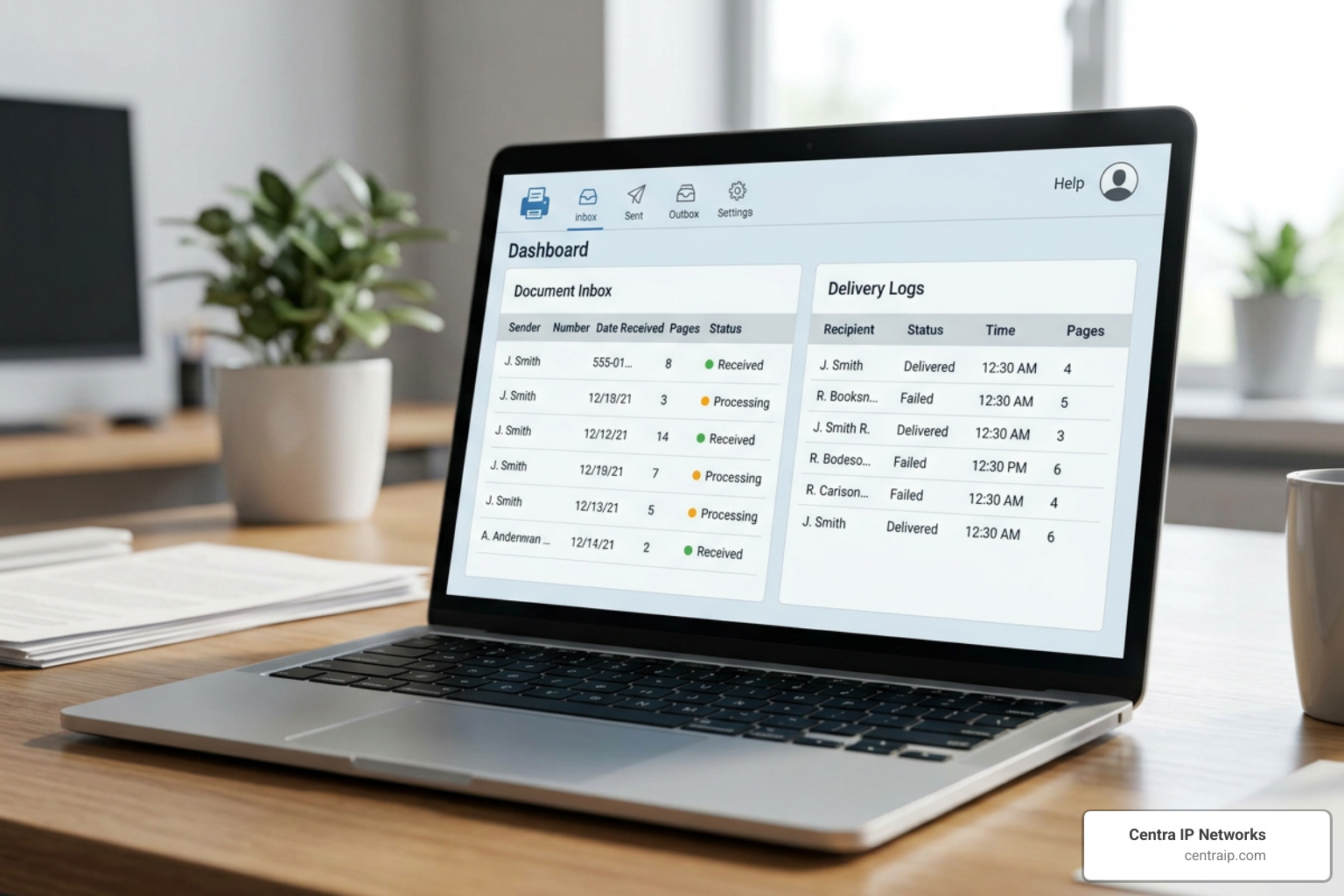
Yes, by a wide margin. Traditional faxes sit on open paper trays where anyone walking by can view sensitive, private information. Cloud-based faxes are delivered directly to secure digital inboxes, encrypted with AES-256 protocols, and protected by user-specific login credentials. Additionally, cloud systems generate immutable audit logs, giving you a clear, tamper-proof record of every transmission.
To understand how these protocols compare to other secure business systems, read The Ultimate Guide to Business Surveillance Systems.
Can I keep my existing fax numbers when moving to a cloud solution?
Absolutely. You can port your existing fax numbers over to your new cloud provider for free. The porting process typically takes between 2 to 5 business days, and during this transition, your service remains completely uninterrupted. You won’t have to change your marketing materials, business cards, or patient forms.
Conclusion
Transitioning your business to a cloud-based fax solution is one of the easiest ways to eliminate unnecessary hardware, lower your monthly operating costs, and strengthen your data compliance.
At Centra IP Networks, we specialize in helping businesses across Dallas, Fort Worth, Orlando, Tampa, St. Petersburg, Clearwater, and Sarasota simplify their technology. Through our unified platform, we deliver comprehensive Managed IT and Cloud Communications—including phone systems, high-speed internet, and cloud faxing—all on a single, consolidated bill. By leveraging our 35+ industry partnerships, we design tailored, cost-effective solutions that allow your team to work securely from anywhere.
Ready to retire your legacy fax machines and upgrade your business workflows? Get started with Centra IP Faxing Solutions today.