
Commercial CCTV Cameras: A Fast Guide for Business Buyers
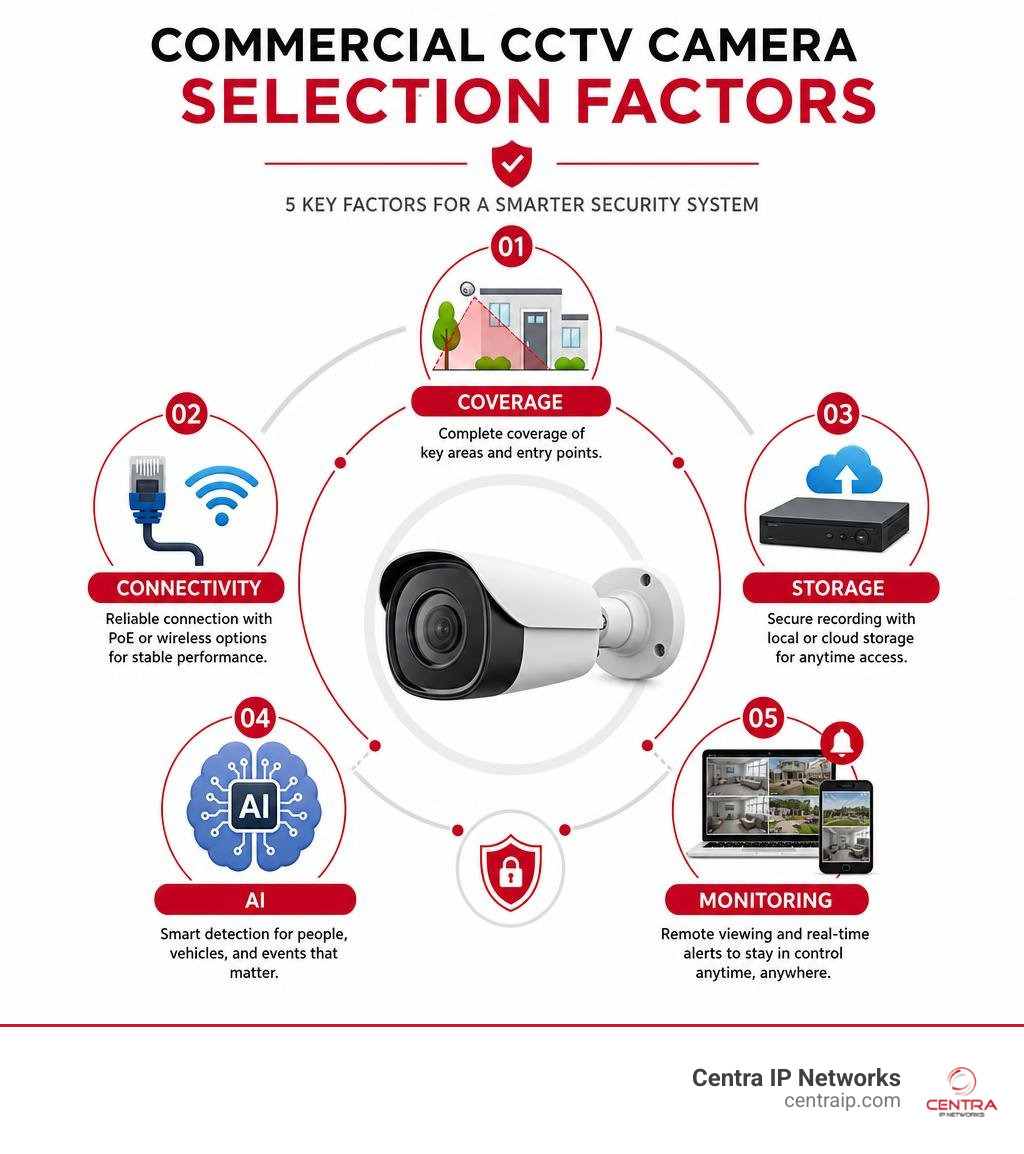
Commercial CCTV cameras are business-grade video systems built for dependable 24/7 recording, wider coverage, remote access, and growth across one or many locations. For most businesses, the best starting point is an IP camera system with PoE wiring, an NVR or cloud video platform, and AI alerts that distinguish people and vehicles from ordinary motion.
| What to compare | Best fit for most businesses |
|---|---|
| Connectivity | PoE IP cameras for stable power and data over one Ethernet cable |
| Recording | Local NVR for continuous recording; cloud storage for easier remote management |
| Camera types | Dome or turret indoors, bullet cameras outdoors, PTZ for large areas |
| Image quality | 4K at entrances, cash areas, and vehicle lanes where details matter |
| Smart features | Person/vehicle detection, night vision, remote viewing, and intrusion alerts |
| Coverage plan | Entrances, exits, cash handling, inventory, loading docks, hallways, and parking areas |
The goal is not simply to record an incident. A well-designed system can deter theft, support safety reviews, verify access events, and help leaders see what is happening across the business without juggling another disconnected vendor or app.
I am Patrick Brangan, and I have more than 20 years of experience helping small and mid-sized organizations select and deploy technology, including commercial CCTV cameras, managed IT, communications, and access solutions. My work includes fast, multi-system installations for business sites that need reliable coverage without unnecessary complexity.
Comparing Wired, Wireless, and PoE Commercial CCTV Cameras
Selecting the right commercial security architecture requires balancing network stability, installation speed, and long-term operating costs. As technology evolves through 2026, businesses across Dallas, Fort Worth, Orlando, Tampa, St. Petersburg, Clearwater, and Sarasota are increasingly replacing legacy analog setups with high-throughput network video architectures. Understanding the physical transmission medium is the first critical step toward building a bulletproof security foundation. To explore full system designs, read our comprehensive Commercial Video Surveillance System Guide.
Commercial CCTV Cameras vs Residential Systems
A frequent error made by growing businesses is installing off-the-shelf residential cameras to protect commercial property. While consumer cameras may seem cost-effective initially, they fail under the demands of a business environment.
- Hardware Durability and Housing: Consumer cameras feature light plastic enclosures designed for occasional residential outdoor exposure. Commercial CCTV cameras utilize heavy-duty metal alloys, achieving IP66 or IP67 weather-resistance ratings alongside IK10 vandal-proof certifications. IK10 enclosures are engineered to withstand 20 joules of direct physical impact, making them resilient against intentional damage or workplace accidents.
- Continuous 24/7 Duty Cycles: Residential Wi-Fi cameras rely primarily on motion-triggered recording clips to preserve battery life and minimize cloud bandwidth. Commercial units are built with industrial-grade image sensors and heat-dissipating heatsinks engineered for uninterrupted, non-stop 24/7 high-bitrate recording year after year.
- System Scalability and Multi-Zone Support: Consumer apps struggle when scaling past a handful of cameras. Commercial Video Management Software (VMS) allows enterprises to scale seamlessly from 4 to 256 or more channels across multiple facilities under a single interface.
- Regulatory and Federal Compliance: Commercial surveillance often requires strict security standards, including National Defense Authorization Act (NDAA) compliance. NDAA compliance ensures that security hardware contains no prohibited components, guaranteeing acceptance for government-affiliated contracts, banking, and regulated enterprise applications.
Wired Coax vs PoE IP vs Wireless Architectures
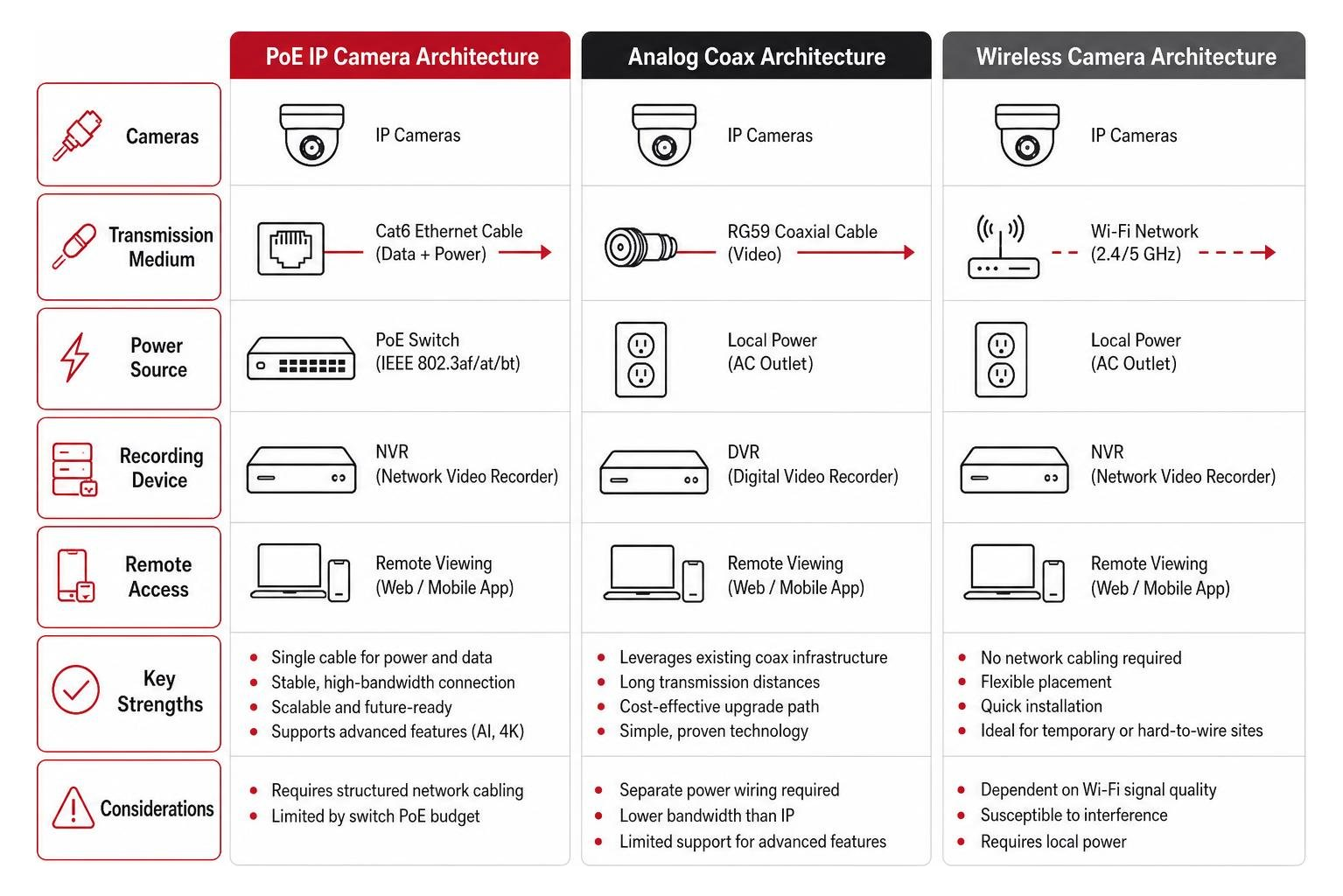
When selecting network infrastructure, businesses typically choose between three core transmission architectures:
- Analog Coaxial (RG59 Siamese Cabling): Traditional analog surveillance relies on RG59 coaxial cables to stream video to a central Digital Video Recorder (DVR), with separate power wiring. While high-definition analog (HD-over-Coax) can reach 4K resolutions, it lacks edge-AI processing and dynamic networking capabilities. However, for facilities with existing coaxial infrastructure, coax-to-Ethernet converters or hybrid DVRs offer a practical bridge without requiring full rewiring.
- Power over Ethernet (PoE) IP Systems: Modern commercial standards center around Power over Ethernet (PoE) technology utilizing Category 6 (Cat6) network cabling. Powered by standard IEEE 802.3af/at/bt PoE switches, a single Ethernet cable supplies both high-speed data transmission and low-voltage DC power to each camera at distances up to 328 feet (100 meters). This single-cable design simplifies installation, eliminates local electrical outlet requirements, and ensures reliable network performance.
- Wireless (Wi-Fi) Cameras: Wireless systems eliminate structural network cabling, offering convenience for leased spaces, historic structures, or temporary job sites. However, wireless cameras still require physical power wiring (unless battery-powered, which is unviable for 24/7 commercial duty) and remain susceptible to RF interference, network congestion, and signal dropouts.
| Feature / Architecture | Wired Coax (DVR) | Wired PoE IP (NVR / Cloud) | Wireless (Wi-Fi / Cellular) |
|---|---|---|---|
| Primary Cabling | RG59 Coaxial + Power | Single Cat5e/Cat6 Ethernet Cable | None (Wireless Data) |
| Power Supply | External Power Supply Box | Power over Ethernet (PoE Switch) | Local AC Outlet or Solar/Battery |
| Max Image Resolution | Up to 4K (Analog HD) | 4K, 12MP, 30MP+ Ultra HD | Typically 1080p to 2K (Bandwidth Capped) |
| Edge AI & Analytics | Limited (Handled by DVR) | Advanced On-Camera Processing | Basic Motion / Limited Person Detection |
| Interference Susceptibility | Low (Shielded Cable) | Immunity to Wireless Interference | High (Wi-Fi Congestion / Physical Walls) |
| Best Use Case | Retrofits with Existing Wiring | Permanent Commercial Facilities | Temporary Sites, Leased Offices |
Core Components and Storage Solutions
A robust commercial video surveillance setup relies on hardware, software, and storage working together seamlessly. Investing in top-tier camera lenses yields little value if recorded video cannot be retrieved during an investigation. Learn more about evaluating system frameworks in our detailed post on How to Choose the Best Enterprise Security Camera System for Your Business.
Essential Hardware and VMS Integration
Every business-grade installation depends on a tightly integrated security stack:
- IP Security Cameras: High-performance optical sensors capture physical activity across designated zones.
- Network Video Recorder (NVR) or Cloud Connector: Dedicated NVRs house multi-bay surveillance-grade hard drives (such as Western Digital Purple or Seagate SkyHawk) configured in RAID arrays to ensure video redundancy and uninterrupted continuous recording.
- PoE Network Switches: Managed PoE switches provide regulated power delivery, VLAN network segregation, and bandwidth management across all security channels.
- Video Management Software (VMS): The central software engine that allows operators to view live feeds, execute plain-language AI video searches, manage user permissions, and export forensic evidence clips.
- Integrated Physical Access Control and Life-Safety: Combining video streams with cloud access control door readers, motion sensors, and mass notification systems creates a unified defense ecosystem. For instance, integration with Registered Communications Distribution Designer (RCDD) compliant cabling standards ensures all low-voltage pathways maintain optimal bandwidth and system uptime.
On-Premise NVR vs Cloud Storage Solutions
Deciding where video footage is stored and processed directly affects operating expenses, system security, and network performance. For a deeper look at cloud implementation strategies, see our guide on How Cloud-Based Video Surveillance Adds Security.
- On-Premise NVR Systems: Local recording hardware stores raw video feeds directly onto internal hard drives. This traditional model involves higher initial hardware investment but incurs no recurring monthly subscription fees. Systems operate continuously within a closed-circuit network, even during internet outages. However, physical NVRs remain vulnerable to localized theft, hardware failure, or fire damage unless backed up off-site.
- Cloud-Based Video Surveillance (VSaaS): Cloud systems stream recorded footage directly or via an edge connector to secure off-site cloud datacenters. Cloud models trade large initial capital expenditures for manageable monthly subscriptions. Benefits include zero on-site recording hardware maintenance, end-to-end data encryption, automatic firmware updates, and seamless multi-site remote management via web browsers or mobile apps.
- Hybrid Storage Architectures: To balance bandwidth management with long-term data retention compliance, modern enterprises often select hybrid storage. Hybrid cameras record video locally onto high-capacity onboard microSD storage (up to 512GB or 1TB) or a local NVR, while simultaneously backing up critical motion events and AI metadata to the cloud.
Camera Form Factors, AI Features, and Business Applications

Selecting the right camera housing and sensor technology ensures optimal coverage across diverse commercial applications. To evaluate specialized camera designs, read our guide on 10 Different Types of Security Cameras for Business.
Matching Camera Types to Business Environments
No single camera form factor suits every operational environment. Deploying the right device style prevents dynamic visual blind spots and ensures high-quality forensic detail.
- Dome Cameras: Featuring discreet, vandal-resistant glass or polycarbonate domes, dome cameras blend smoothly into commercial ceiling tiles. They are standard choices for indoor retail sales floors, hotel lobbies, corporate offices, and stairwells. Their dome housing makes it difficult for passersby to see where the lens is aimed, adding a psychological deterrent.
- Bullet Cameras: Distinctive bullet-shaped housings act as visible deterrents along outdoor perimeters, parking structures, and loading docks. Their forward-projecting designs allow space for high-power infrared (IR) illuminators and varifocal telephoto lenses capable of capturing long-distance perimeter activity.
- Turret (Eyeball) Cameras: Combining the discreet footprint of a dome with the installation ease of a bullet camera, turrets feature a ball-and-socket design that eliminates internal glass reflections from infrared LEDs. They are highly effective for indoor corridors, building overhangs, and cash-handling stations.
- Pan-Tilt-Zoom (PTZ) Cameras: Equipped with motorized assemblies, PTZ cameras pan 360 degrees, tilt, and zoom optically (ranging from 25x to 40x optical zoom) to track moving targets across wide open spaces like auto dealerships, shipping yards, and stadiums. Dual-channel designs combine a panoramic 180-degree fixed overview sensor with a second motorized tracking PTZ lens in a single housing.
- Fisheye Panoramic Cameras: Utilizing ultra-wide panoramic lenses, a single 360-degree fisheye camera mounted centrally on a ceiling provides complete situational awareness across expansive floor spaces, effectively replacing four traditional fixed cameras.
- Decentralized Industrial Smart Cameras: High-durability units like the MOBOTIX M ONE Smart IP Camera & AI Video Surveillance offer salt-water resistant, glass-fiber reinforced housings capable of operating in extreme temperatures (-40°C to 65°C). Their serverless architecture executes deep learning analytics on the edge without requiring dedicated NVR hardware.
AI Analytics, Active Deterrence, and Night Vision
Modern commercial CCTV cameras have evolved beyond simple video capture devices into real-time threat-detection tools.
- AI Object Classification: Legacy motion detection triggered false alerts from moving tree branches, rain, shadows, or passing headlights. Modern edge AI uses deep learning to classify human shapes and motor vehicles instantly, reducing false alerts by 70% to 90%. Plain-language natural language search lets security managers search video archives for specific criteria—such as “red shirt near entrance”—retrieving forensic evidence in seconds rather than hours.
- Active Deterrence Lighting and Audio: Rather than passively recording crime, active deterrence cameras trigger built-in red and blue strobe lights, white spotlights, and warning sirens or custom voice prompts when loitering or perimeter intrusion is detected.
- Wide Dynamic Range (WDR): High-contrast commercial settings—such as glass office foyers or dark warehouse bays facing open loading dock doors—create severe glare and dark shadows. True hardware WDR (rated from 120dB up to 140dB) takes multiple exposure samples per frame to balance bright highlights and deep shadow details, preserving image clarity.
- Low-Light Color Starlight Performance: Advanced large-format CMOS sensors with wide F1.0 apertures capture full-color video in extreme low-light environments down to 0.0001 Lux without relying solely on harsh infrared illumination.
Deployment Strategy, Operational Benefits, and Brand Selection
System placement directly impacts camera performance. Poor positioning can render high-resolution 4K sensors ineffective if key ingress pathways remain unmonitored. Review operational frameworks in our Surveillance Systems Complete Guide 2026.
Camera Placement Strategies and Operational Value
A complete commercial survey identifies critical risk zones to eliminate security blind spots:
- Ingress and Egress Points: Position 4K high-resolution cameras at all public and employee access doors at eye level to capture clear facial images and badge interactions.
- Cash-Handling and Point-of-Sale (POS): Mount high-definition turret cameras directly above cash registers and transaction counters to resolve register discrepancies and deter employee theft.
- Loading Docks and Inventory Stockrooms: Monitor inventory loading bays to track freight handling, confirm delivery timelines, and eliminate stock shrinkage.
- Perimeter Fences and Parking Facilities: Deploy bullet or PTZ cameras with license plate recognition (LPR) along driveways and parking lots to monitor vehicle entry and deter vandalism.
In addition to security, video surveillance supports daily operations. Businesses use video streams to verify OSHA safety compliance, audit employee workflows, resolve slip-and-fall liability claims, and monitor customer foot traffic heatmaps.
Modern hardware features like motorized Pan-Tilt-Roll-Zoom (PTRZ) controls simplify installation and adjustments. Devices such as the NDE-8514-RT Fixed dome 8MP HDR 12-40mm PTRZ IP66 FLEXIDOME IP starlight 8000i allow installers to adjust field of view and focus remotely via network applications, eliminating manual ladder adjustments.
Professional Monitoring vs DIY Operations
Businesses must choose how video alerts are processed in real time:
- Self-Monitoring (DIY Apps): System managers receive push notifications on mobile devices when motion occurs. While this approach avoids monthly fees, it relies heavily on staff availability off-hours, leading to missed alerts or alert fatigue.
- 24/7 Professional Central Station Monitoring: Video streams link directly to a UL-listed central monitoring station. When an after-hours perimeter breach occurs, professional operators review live video within seconds, issue live voice warnings over two-way audio, and dispatch emergency responders immediately.
- Redundant Network Connectivity: Professional installations incorporate cellular backup modules (providing dedicated data allowances) to keep system alerts online even if primary broadand lines are cut.
Evaluating Brands for Commercial CCTV Cameras
Choosing the right manufacturing brand depends on property scale, regulatory requirements, and technical complexity:
- Lorex: Ideal for small to mid-sized businesses (SMBs) seeking direct-ownership PoE IP systems with local NVR storage, strong 4K resolutions, and zero required monthly subscription fees.
- ADT Commercial: Well-suited for enterprises requiring fully managed, professionally monitored security packages integrated with fire, intrusion, and access control under structured long-term service contracts.
- Ring / Arlo: Consumer-centric wireless options best suited for very small office suites or temporary leased spaces. However, their reliance on cloud subscriptions and battery power makes them unsuited for continuous enterprise recording.
- Avigilon / Enterprise IP Ecosystems: Built for large-scale enterprise campuses, critical infrastructure, and high-security sites. These platforms provide advanced neural-network AI analytics, broad third-party integrations, and flexible deployment across cloud and on-premise VMS platforms.
- Active Deterrence Specialized Hardware: High-performance multi-sensor units—such as the active deterrence PTZ series from Zhejiang Dahua Technology Co., Ltd.—combine panoramic wide-angle monitoring with motorized 25x tracking, red-blue strobe alarms, and specialized AI uniform/PPE compliance detection for complex commercial and industrial sites.
Frequently Asked Questions about Commercial Surveillance
How many channels or cameras does a commercial business need?
Camera counts depend on square footage, site layout, and risk factors:
- Small Business / Retail Store (1,000 – 3,000 sq ft): Typically requires 4 to 8 camera channels to cover front entryways, cash registers, rear exits, and stockrooms.
- Medium Commercial Building / Office (5,000 – 15,000 sq ft): Requires 8 to 16 channels to monitor reception areas, main corridors, server rooms, exterior perimeters, and parking lanes.
- Large Industrial Warehouse / Enterprise Campus (20,000+ sq ft): Utilizes 32 to 64+ channels (scaling up to 256 channels across NVR clusters) using multi-sensor fisheye, bullet, and PTZ cameras to protect expansive loading docks, perimeters, and multi-building facilities.
Are 4K resolution and AI analytics worth the investment for businesses?
Yes. Standard 1080p full HD video utilizes 2 million pixels per frame, whereas 4K Ultra HD provides over 8 million pixels (a 400% increase in pixel density). This extra clarity allows security teams to digitally zoom in on recorded footage to read license plates or identify facial features without pixelation. Combining 4K clarity with edge AI analytics transforms cameras from passive recording devices into active security tools, eliminating up to 90% of false motion alerts and dramatically speeding up evidence searches.
What visual metrics determine how far a security camera can see?
Commercial camera range is calculated using international DORI visual standards (EN-62676-4), which define target detail per foot at varying distances:
- Detection (25 ppm / pixels per meter): Determines whether a person or vehicle is present in the field of view.
- Observation (62 ppm): Captures general characteristic details, such as clothing color.
- Recognition (125 ppm): Verifies with high probability whether an individual matches a known person.
- Identification (250 ppm): Delivers precise facial image detail or license plate readability required for law enforcement evidence.
Optical zoom lenses (e.g., 12mm to 40mm varifocal or 40x optical PTZ zoom) extend target identification distances beyond 400 feet, whereas wide-angle 2.8mm fixed lenses deliver wide room coverage up to 30 feet.
Conclusion
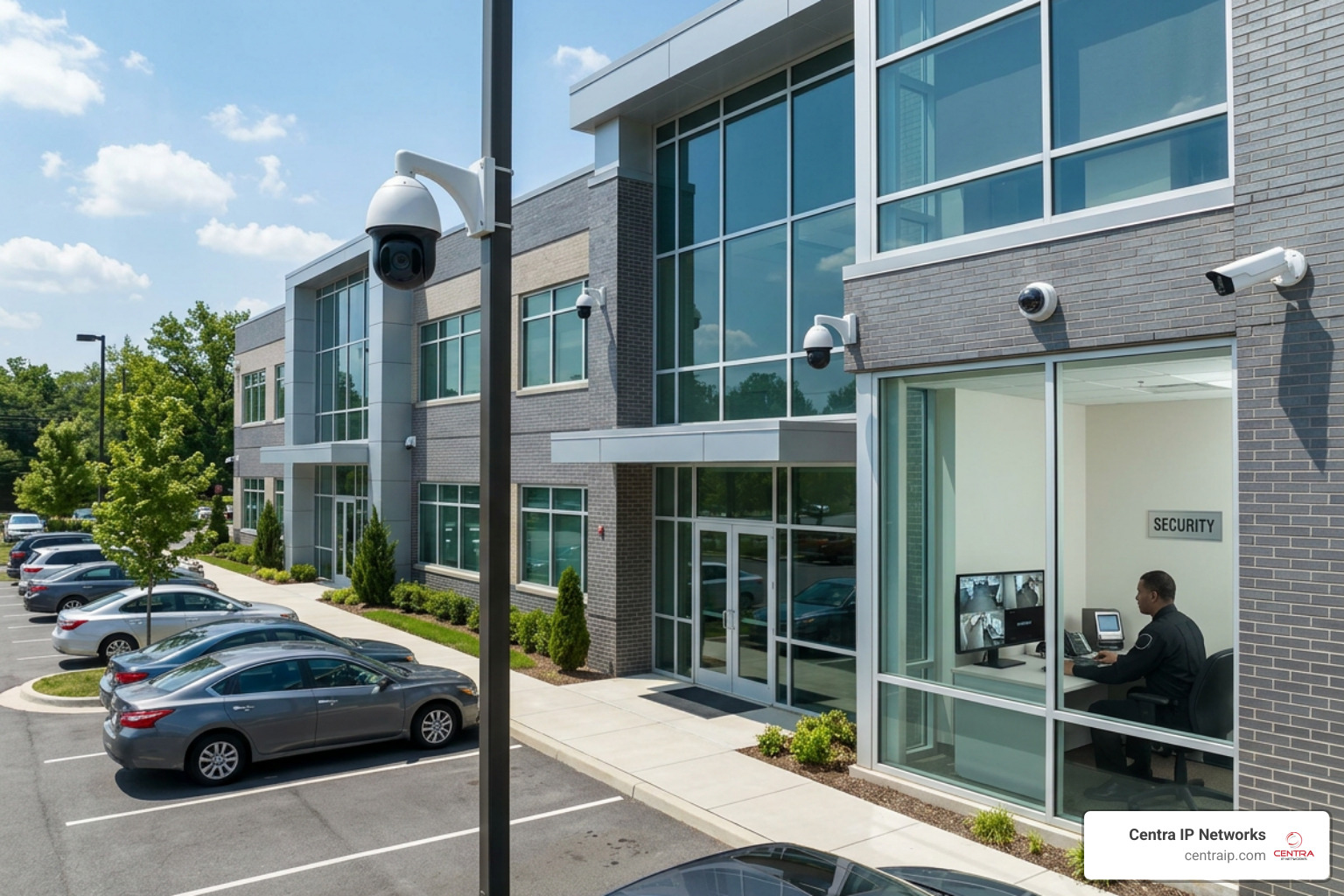
Investing in modern commercial CCTV cameras protects your business assets, streamlines daily operations, safeguards employees, and ensures long-term regulatory compliance. Moving away from consumer-grade wireless units in favor of industrial PoE IP platforms backed by AI video analytics gives you reliable, actionable visibility across your facilities.
At Centra IP Networks, we simplify commercial security integration. Rather than managing fragmented vendors, telecom bills, and IT software support separately, we deliver unified Managed IT, Cloud Communications, access control, and smart IP video surveillance on one platform—backed by a single predictable bill and expert local service across Dallas, Fort Worth, Orlando, Tampa, St. Petersburg, Clearwater, and Sarasota.
Ready to upgrade your business security with flexible, zero-friction commercial surveillance? Explore our modern Cloud Surveillance Services or contact our engineering team today to schedule a comprehensive on-site security review.