
Why Modern Businesses Are Switching to Cloud-Based Phone Systems
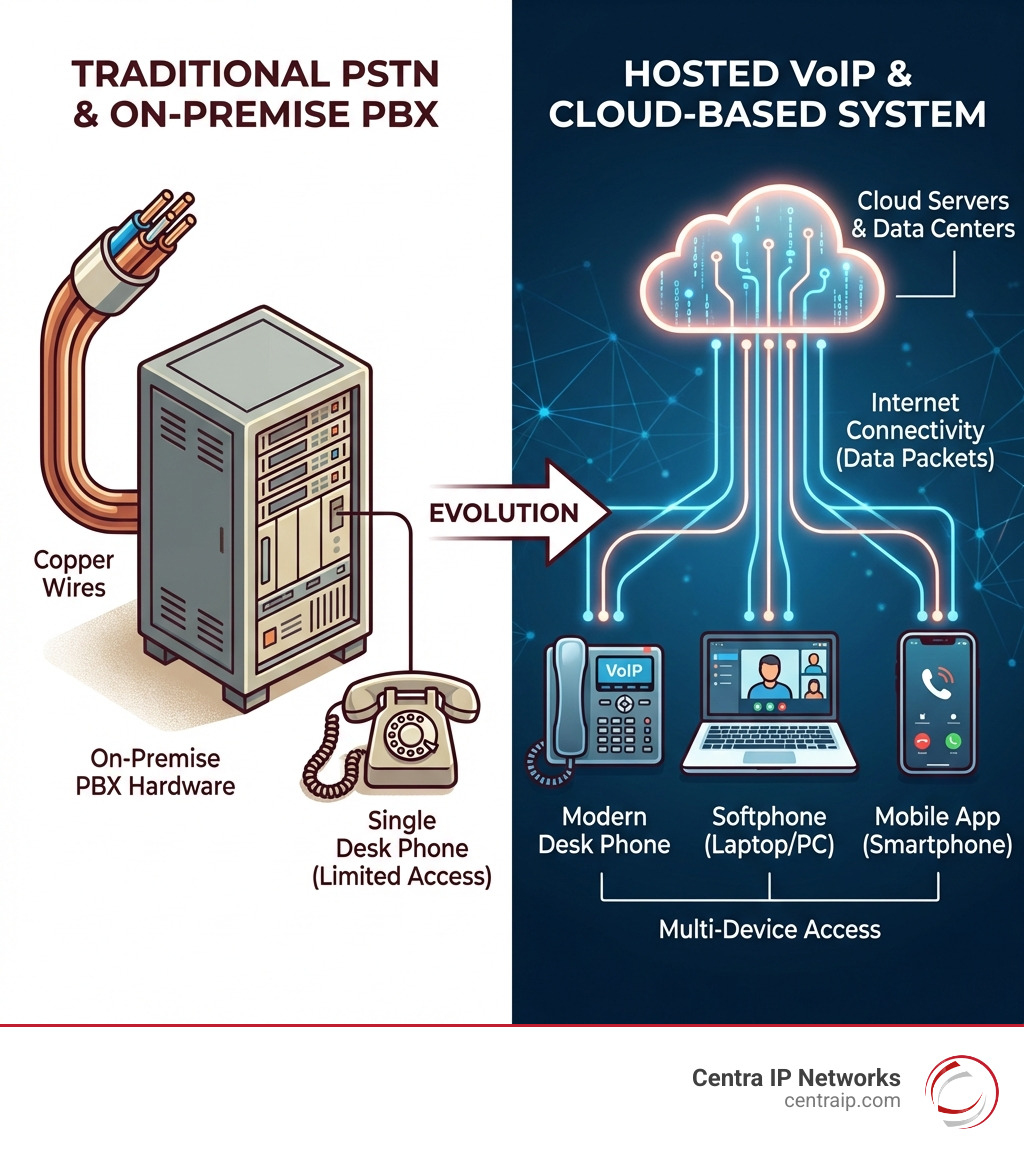
Hosted VoIP for business is changing how companies communicate. Instead of relying on traditional copper phone lines, hosted VoIP delivers voice calls as digital data packets over your internet connection—managed entirely by a cloud-based provider.
Quick Answer:
- What it is: A cloud phone system where your provider hosts all equipment and software in secure data centers
- How it works: Converts voice into digital data packets transmitted over the internet
- Key benefits: 50% lower costs, remote work support, advanced features like auto-attendants and call analytics
- Typical cost: $15-$40 per user per month
- Setup: No on-site hardware required—just internet-connected devices
The shift is undeniable. Household landline use has dropped to just over 40%, and the global VoIP market is projected to reach $264.27 billion by 2029. Traditional phone systems are being phased out, and businesses that stick with old PSTN infrastructure face rising costs, limited features, and maintenance headaches.
Hosted VoIP eliminates these problems. You get enterprise-grade calling, video conferencing, team messaging, and CRM integration—all managed through one simple web portal. No expensive hardware. No on-site IT burden. Just reliable, feature-rich communication that scales with your business.
I’m Patrick Brangan, and with over 20 years of experience helping SMBs in Dallas, Tampa, and Orlando implement hosted VoIP for business solutions, I’ve seen how companies save thousands while gaining flexibility and modern features. My team at Centra IP Networks specializes in unified communications that eliminate the need for multiple vendors and complex systems.
What is Hosted VoIP for Business and How Does It Work?

To understand hosted VoIP for business, it helps to think of it as the “Netflix” of phone systems. In the old days, if you wanted to watch a movie, you needed a physical DVD and a player in your living room. Today, you just stream it from a central server. Hosted VoIP works the same way.
Voice over Internet Protocol (VoIP)
At its core, VoIP technology stands for Voice over Internet Protocol. When you speak into a handset or a headset, the system slices your voice into tiny “digital data packets.” These packets travel across the internet like cars on a highway. Once they reach the recipient, they are reassembled into the original sound of your voice-all in a fraction of a second.
If you’d like a simple third-party overview of the underlying concept, see Voice over IP.
The Role of the Service Provider
In a “hosted” model, the “brain” of your phone system (the Private Branch Exchange or PBX) doesn’t live in a dusty closet in your office. It lives in our secure, redundant data centers. We act as a virtual switchboard, routing your calls, managing your voicemails, and powering your features remotely. This eliminates the need for you to buy, house, or maintain expensive server hardware.
Hardware and Connectivity
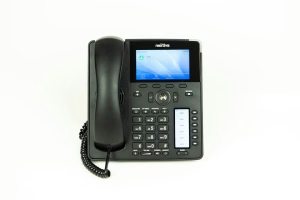
What do you actually need on your desk? You have options. Many businesses choose a dedicated VoIP phone, which looks like a traditional desk phone but plugs into an Ethernet port instead of a wall jack. Others skip the desk phone entirely and use “softphones”-apps on their laptops or smartphones.
The most critical requirement is a reliable internet connection. Because your voice is traveling as data, your bandwidth needs to be stable. We often recommend “traffic shaping” or Quality of Service (QoS) settings on your router to ensure that voice data always gets the “fast lane” over less urgent traffic like email or web browsing.
Key Benefits of Hosted VoIP for Business
If you are still on the fence about ditching your traditional landlines, the numbers tell a compelling story. The global VoIP services market was valued at $151.21 billion in 2024 and is expected to climb to $264.27 billion by 2029. Businesses aren’t just switching because it’s “new”—they’re switching because it’s better for the bottom line.
Drastic Cost Reduction
Traditional phone systems are expensive to install and even more expensive to move or change. With hosted VoIP for business, you move from a Capital Expenditure (CapEx) model to an Operational Expenditure (OpEx) model. You don’t have to buy a $10,000 server; you simply pay a monthly fee per user. Research shows that VoIP proves to be an inexpensive option, often cutting monthly phone bills by up to 50%.
Effortless Scalability
Are you hiring five new people in Fort Worth next month? In the old days, that meant calling a technician to wire new jacks and add cards to your PBX. With hosted VoIP, you just log into a dashboard, add five users, and plug in their phones. It’s that simple.
Disaster Recovery and Reliability
What happens if a storm hits Tampa and your office loses power? With a traditional system, your phones go dead. With a hosted system, the “brain” is still running in our data center. You can instantly reroute calls to employees’ mobile phones or a secondary location in St. Petersburg, ensuring you never miss a customer inquiry.
Comparison: Hosted VoIP vs. Traditional PSTN
| Feature | Hosted VoIP | Traditional PSTN (Landline) |
|---|---|---|
| Setup Cost | Low (Plug-and-play) | High (Hardware & Wiring) |
| Monthly Cost | Low (Per-user subscription) | High (Maintenance & Line fees) |
| Flexibility | Work from anywhere | Tied to a physical desk |
| Features | Included (Video, SMS, AI) | Extra (If available at all) |
| Maintenance | Managed by provider | Managed by you / Local tech |
Essential Features and the Evolution to UCaaS
Modern VoIP phone features today go far beyond just making and receiving calls. When you move to the cloud, your phone system becomes a powerful productivity tool.
- Auto-Attendant: A “virtual receptionist” that greets callers and directs them to the right department.
- Call Recording: Essential for training and compliance, allowing you to store and review conversations in the cloud.
- HD Voice Quality: VoIP calls often sound twice as clear as traditional analog calls because they use high-bandwidth codecs.
- AI-Driven Analytics: Get real-time data on call volumes, wait times, and even the “sentiment” of a conversation.
- CRM Integration: When a client calls, their HubSpot or Salesforce record can automatically pop up on your screen, giving your team instant context.
The Role of UCaaS in Hosted VoIP for Business
The industry is moving toward something called Unified Communications as a Service (UCaaS). Think of this as Hosted VoIP on steroids. Instead of having separate apps for your phone, your video meetings, and your team chat, UCaaS brings everything into one place.
By using Centra IP cloud-based phone systems, your team can start a conversation on their desk phone, “flip” it to their mobile app as they walk to their car, and then turn it into a video conference once they get home. It creates a synchronized workflow that is perfect for the hybrid work environments common in Dallas and Fort Worth today.
Implementation: Costs, Setup, and Challenges
Moving to hosted VoIP for business is generally much faster than a traditional install, but it does require some planning.
Understanding the Costs
Hosted VoIP costs generally vary between $10 and $40+ per user per month. Basic plans typically range from $15–$25, while more advanced plans that include AI features, extensive integrations, and unlimited video conferencing range from $25–$40+. Unlike landlines, these costs usually include your long-distance and many advanced features that would otherwise be “add-ons.”
The Setup Process
- Network Assessment: We check your internet bandwidth and router settings to ensure you can handle the voice traffic.
- Feature Configuration: We help you design your “call flow”—how the auto-attendant greets people and where calls go after hours.
- Number Porting: We work with your old carrier to move your existing business numbers over to the new system.
- Hardware Deployment: You plug in your new IP phones or download the softphone apps.
- Training: We show your team how to use the new features to make their lives easier.
Potential Challenges
The biggest challenge is internet dependency. If your internet goes down, your desk phones go down. However, because the system is hosted, you can mitigate this by having calls automatically failover to mobile apps using cellular data. We also focus heavily on security protocols, implementing end-to-end encryption and multi-factor authentication (MFA) to keep your conversations private.
Choosing the Right Hosted VoIP for Business Provider
Not all providers are created equal. When searching for the best VoIP providers, look for these non-negotiables:
- Uptime SLAs: Look for “five-nines” (99.999%) uptime guarantees.
- Security Standards: Ensure they have a robust security and privacy policy and are compliant with regulations like HIPAA if you’re in healthcare.
- Local Support: For businesses in Dallas or Tampa, having a provider who understands the local infrastructure is a huge advantage.
Frequently Asked Questions about Hosted VoIP
What is the difference between Hosted VoIP, Hosted PBX, and Cloud VoIP?
These terms are often used interchangeably, but there are subtle differences. Cloud VoIP is the broadest term for any internet-based voice service. Hosted VoIP specifically means the provider manages the hardware for you. Hosted PBX is a type of hosted VoIP that specifically replicates the complex routing features of a traditional office “Private Branch Exchange” system.
Can I keep my existing business phone number when switching?
Yes! The FCC requires carriers to allow “number porting.” We handle the paperwork to ensure your transition is seamless and your customers never know you changed systems—except for the better call quality.
What happens to my phone system if the office internet goes down?
This is a common concern. Because your system is “hosted” in the cloud, it never actually goes down. If your office loses internet, our system detects the disconnect and can automatically route calls to your employees’ smartphones or a backup office location. You stay in business even when the local wires fail.
Conclusion
The transition to hosted VoIP for business isn’t just a trend; it’s a necessary evolution for companies that want to stay competitive. By moving your communications to the cloud, you gain the flexibility to support remote work, the power of advanced AI analytics, and the cost savings of a modern infrastructure.
At Centra IP Networks, we pride ourselves on being more than just a vendor. We are your technology partner. We offer comprehensive Managed IT and Cloud Communications services across Dallas, Fort Worth, Orlando, and Tampa. Our unique value is providing your phone system, internet connectivity, and cloud solutions on one platform with a single bill.
Ready to modernize your communication? Let us help you find a custom, cost-effective solution that fits your specific needs. Explore our business phone systems in Dallas, TX and beyond to see how we can empower your business today.