

Understanding Hosted Voice Over IP Solutions: Architecture and Mechanics
Hosted Voice over IP solutions are cloud-delivered business phone systems that route voice calls over broadband through off-site provider data centers instead of on-premises PBX hardware. Employees can make and receive calls using IP desk phones, desktop softphones, or mobile apps, while the provider manages call routing, system updates, redundancy, and security. This model replaces legacy copper infrastructure and on-site server closets with a predictable subscription service.
When an employee speaks into a handset or softphone app, their analog voice signal is converted into digital data packets. These packets are compressed using audio codecs and transmitted across an internet connection using Session Initiation Protocol (SIP). A managed cloud data center processes these packets, handles call signaling, and routes the stream to the destination network—whether that is another IP endpoint or the public switched telephone network (PSTN).
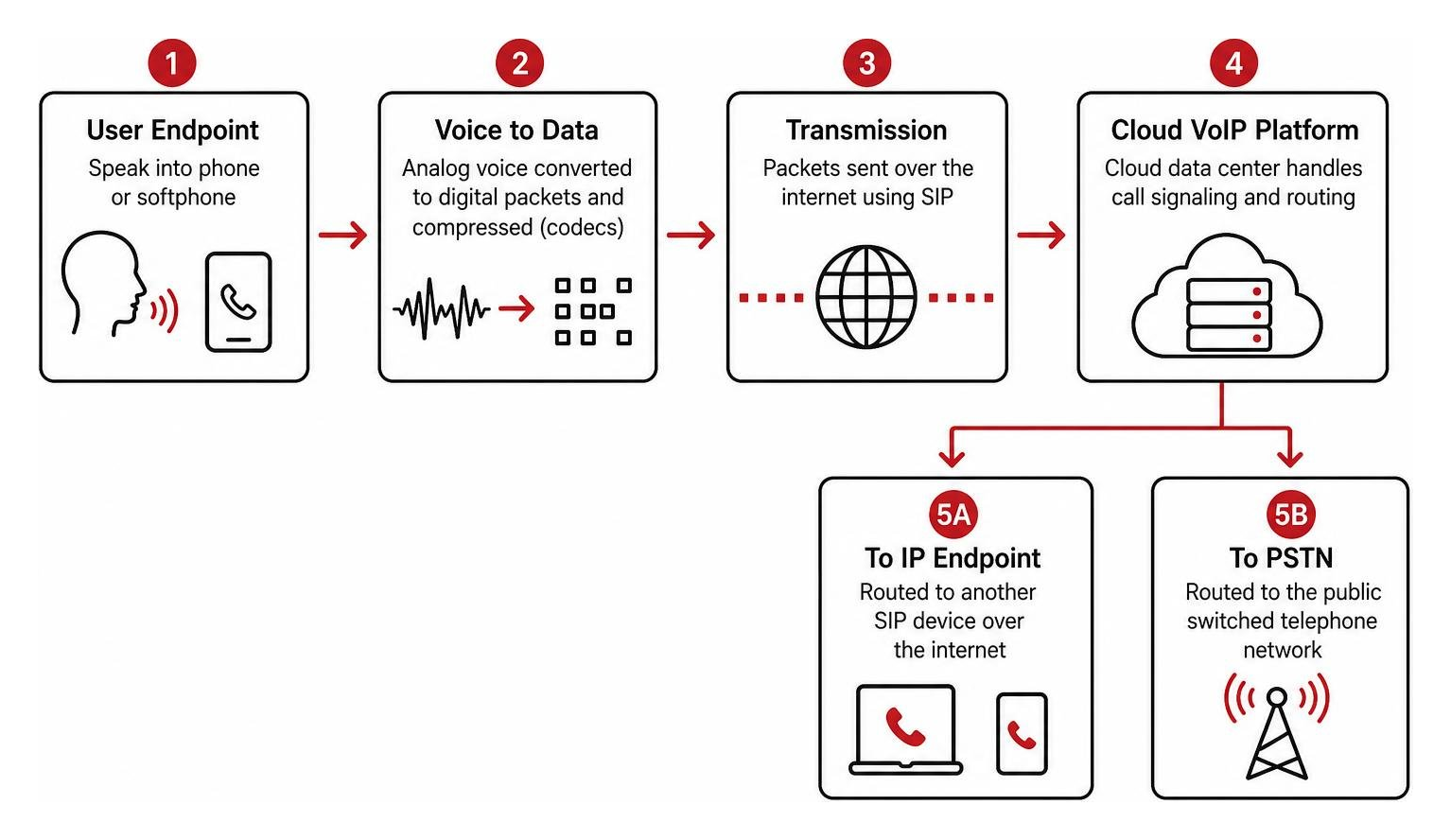
Because voice packets travel across data networks, network quality dictates call clarity. Top-tier providers guarantee call latency under 30 ms and maintain Service Level Agreements (SLAs) promising 99.999% uptime (often called “five-nines” reliability). If you want an in-depth breakdown of these cloud frameworks, check out The Ultimate Guide to Hosted VoIP for Your Business. You can also explore our comparison on VoIP vs Landline for Business: Key Differences Explained to see how digital transmission outpaces aging analog circuits.
How Hosted PBX Powers Voice Networks
A Private Branch Exchange (PBX) is the internal switching system that manages incoming, outgoing, and inter-office calls. Historically, a PBX was a bulky metal cabinet bolted to an IT room wall, requiring specialized technicians to change basic routing rules.
A hosted PBX moves that entire switching matrix into secure, off-site cloud servers. The system handles call routing, extension-to-extension dialing, multi-level auto-attendants (interactive voice response or IVR), ring groups, and digital voicemail without requiring physical hardware on your premises. Employees dial three- or four-digit extensions to reach colleagues across different offices or remote desks instantly. To explore how internet protocols handle voice encoding and transmission, read about the brilliance of Voice over Internet Protocol.
Hosted VoIP vs. On-Premises Systems vs. UCaaS
Navigating telecommunications terminology can feel confusing, but the differences boil down to where the software lives and what tools are bundled together:
- On-Premises VoIP: The PBX hardware resides physically inside your building. Your internal IT staff handles maintenance, software patches, hardware replacements, and SIP trunk licensing. While it offers deep control, it carries high capital expense and substantial administrative overhead.
- Hosted VoIP: The voice infrastructure lives in provider-managed data centers. Your provider handles all system updates, redundancy, and security patches. You connect using IP desk phones, desktop software, or mobile apps for a predictable monthly fee.
- Unified Communications as a Service (UCaaS): UCaaS takes hosted VoIP and merges it into a comprehensive communications suite. Alongside standard phone service, UCaaS bundles HD video conferencing, team chat, SMS/MMS messaging, virtual whiteboards, and deep CRM integrations into a single pane of glass.
To determine which infrastructure model fits your operational goals, review our detailed guide on cloud-based vs premise-based phone systems.
Top Hosted VoIP Providers for 2026
The cloud telephony landscape has evolved rapidly, with platforms integrating artificial intelligence, advanced call routing, and omnichannel engagement tools. Below is an evaluation of the top hosted voice platforms available in 2026.
| Provider | Starting Price (Per User/Mo) | Standout Feature | Best For |
|---|---|---|---|
| Nextiva | $15 – $23 | Omnichannel communication hub & CRM integration | Customer-facing sales & support teams |
| Zoom Phone | $10.50 – $15 | Seamless video elevation & AI Receptionist | Hybrid teams seeking low-cost scalability |
| RingCentral | $20 – $30 | Robust enterprise app ecosystem & 99.999% SLA | Mid-market and large enterprises |
| Dialpad | $15 – $25 | Real-time Voice Intelligence & live transcription | Fast-growing teams needing native AI insights |
| Zoho Voice | Pay-as-you-go / Tiered | Native Zoho CRM integration & flexible credit pools | Small businesses in the Zoho application suite |
To evaluate how these systems align with your wider IT strategy, consult The Ultimate Guide to Comparing Cloud Phone Systems.
Nextiva: Best Omnichannel Customer Platform
Nextiva bridges traditional telephony and complete customer experience management. Rather than operating as an isolated dialer, Nextiva pulls voice calls, team messaging, video meetings, SMS, and customer interaction histories into a unified dashboard.
Key Strengths:
- Deep CRM Connectors: Works seamlessly with platforms like Salesforce, HubSpot, Zendesk, and Zoho, allowing agents to place calls and view customer history with one click.
- Intelligent Call Management: Includes multi-level auto attendants, skill-based routing, and live call analytics.
- Built-in Collaboration: Provides native team chat, file sharing, and video conferencing within the primary desktop and mobile applications.
Nextiva is an ideal choice for customer-facing teams in Dallas, Fort Worth, or our Florida markets looking to streamline customer communication without stitching together multiple disconnected tools.
Zoom Phone: Best Low-Cost Scalability with AI
Zoom expanded from video meetings into enterprise cloud telephony with Zoom Phone. Built directly on the familiar Zoom platform, it allows users to alternate between a phone call, a team chat, and a full video conference with a single click.
Key Strengths:
- AI-Powered Documentation: Zoom’s AI companion generates automated post-call summaries, prioritizes voicemails, and extracts action items.
- Cost Efficiency: With entry plans starting around $10.50 per user per month, it is an accessible, feature-rich cloud voice solution.
- Broad Hardware Support: Compatible with major IP hardware manufacturers, including Poly, Yealink, and Mitel.
For businesses looking for quick deployment and minimal end-user training, Zoom Phone provides an intuitive and cost-effective voice platform.
RingCentral: Best Enterprise UCaaS Ecosystem
RingCentral remains an industry benchmark for enterprise-grade unified communications. Its platform is engineered for high-volume environments that require global reach, advanced security certifications, and extensive software integrations.
Key Strengths:
- Extensive Integrations: Offers an app marketplace with hundreds of pre-built connectors for Microsoft 365, Google Workspace, ServiceNow, and enterprise CRMs.
- Enterprise Reliability: Backed by a financially backed 99.999% SLA and geographically redundant data centers worldwide.
- Advanced Administrative Control: Provides granular role-based permissions, detailed quality-of-service (QoS) analytics, and comprehensive audit logs.
RingCentral is suited for growing organizations needing a reliable platform capable of handling distributed offices and high call volumes.
Dialpad: Best Native AI and Analytics
Dialpad was built from the ground up with proprietary artificial intelligence (Dialpad Ai). Instead of bolting third-party AI plugins onto legacy code, Dialpad processes voice conversations in real time directly within the audio stream.
Key Strengths:
- Live Voice Intelligence: Delivers real-time call transcription, live sentiment analysis, and automated action-item tracking during every conversation.
- Real-Time Agent Assistance: Automatically detects customer questions and surfaces internal battle cards or knowledge-base articles to agents while they are on the line.
- Modern Softphone Interface: Sleek, lightweight desktop and mobile applications allow employees to manage calls, texts, and meetings from any device.
Dialpad is an excellent option for inside sales teams, customer service departments, and modern remote operations that rely on conversational data.
Zoho Voice: Best Built-In CRM Telephony
Zoho Voice is a cloud-based business phone system designed to integrate natively with the Zoho software ecosystem. It allows organizations to manage inbound and outbound calling directly from their CRM and helpdesk interfaces.
Key Strengths:
- Contextual CRM Calling: Users place calls, log notes, and review customer tickets directly inside Zoho CRM and Zoho Desk without toggling windows.
- Flexible International Dialing: Offers virtual phone numbers across dozens of countries with flexible pay-as-you-go voice credits or unlimited packages.
- Zero-Hardware Footprint: Operates smoothly through standard web browsers, mobile apps, and browser extensions with no physical phones required.
For small businesses already invested in the Zoho ecosystem, Zoho Voice offers a straightforward, budget-friendly calling setup.
Key Benefits and Business Use Cases of Cloud Telephony
Switching to a modern cloud telephony system delivers operational and financial advantages. A startup SMB can save 90 percent on their telecom installation by going with a VoIP solution instead of building out a hardware PBX. State agencies and enterprise organizations often rely on certified public frameworks like Hosted Voice over IP Services (VoIP) to standardize their communications infrastructure.
Key business use cases include:
- Multi-Location and Hybrid Operations: Multi-site businesses—such as retail chains or professional service firms across Tampa, St Petersburg, Clearwater, and Sarasota—can connect every branch under a single phone system. Staff can transfer calls between locations, dial internal extensions, and manage business numbers whether working in the office or from home.
- Contact Center Routing and Customer Retention: Given that 85% of missed callers never call back, capturing inbound leads is critical. Modern hosted voice systems offer automatic call distribution (ACD), interactive voice response (IVR), and in-queue callbacks so callers never encounter a busy signal.
- Disaster Recovery and Business Continuity: If a severe storm or power failure takes out an office in Orlando or Dallas, calls automatically reroute to secondary locations, mobile devices, or backup softphones with zero downtime.
- Consolidated Operations: Pairing cloud voice with your internet access and managed IT simplifies vendor management. To see how cloud communications enhance organizational productivity, read our guide on why VoIP is needed for your business.
Evaluating Hardware Requirements for Hosted Voice Over IP Solutions
One advantage of hosted systems is hardware flexibility. Businesses can choose the physical equipment or software endpoints that best fit their workflow:
- IP Desk Phones: Purpose-built desktop handsets (such as the Poly Edge E-Series) connect directly via Ethernet or Wi-Fi, providing dedicated line keys, HD audio, and full speakerphone capabilities.
- DECT Cordless Handsets: Ideal for warehouses, retail floors, or medical facilities where staff need to move around while staying reachable.
- Softphones and Mobile Apps: Desktop and smartphone applications eliminate the need for physical desk phones entirely, turning laptops and mobile devices into full business extensions.
- Analog Telephone Adapters (ATAs): Small hardware bridges that connect legacy analog devices—such as warehouse paging horns, door buzzers, or traditional fax machines—to your digital VoIP network.
If you are evaluating physical handsets for your team, read our overview on what is a VoIP phone to find the right hardware match.
Core Features in Modern Hosted Voice Over IP Solutions
When auditing potential phone systems, verify that your chosen platform includes essential calling, administrative, and compliance features:
- Intelligent Auto Attendants (IVR): Greets inbound callers and guides them to the correct department with customizable audio menus.
- Voicemail-to-Email & Transcription: Converts voicemails into text summaries and delivers audio files directly to user inboxes for fast review.
- Ring Groups and Call Queuing: Distributes incoming calls simultaneously or sequentially across teams to minimize hold times.
- Virtual eFax and SMS/MMS: Enables teams to send and receive text messages and HIPAA-compliant digital faxes directly from their business numbers.
- Call Recording and Analytics: Records calls for quality assurance and compliance while tracking metrics like call volume, hold times, and missed calls.
To explore these features in detail, consult our overview of VoIP phone systems for business.
Pricing Models, Total Cost of Ownership, and Implementation

Understanding the total cost of ownership (TCO) helps you evaluate hosted voice platforms accurately. Traditional phone systems require significant capital expense (CapEx) for hardware, line cards, and professional cabling, followed by recurring maintenance contracts. Cloud telephony shifts these costs to an operating expense (OpEx) model, providing predictable monthly billing.
Most hosted providers offer two primary pricing structures:
- Per-User, Per-Month Subscriptions: The most common model, typically ranging from $15 to $35 per user monthly depending on feature tiers (basic voice vs. enterprise UCaaS with AI analytics).
- Usage-Based or Pay-As-You-Go: Charges a lower baseline fee per line combined with metered per-minute calling rates, which can benefit low-volume hospitality or seasonal businesses.
When planning your migration, review these essential implementation steps:
- Bandwidth Assessment: Ensure your internet connection delivers roughly 100 kbps of symmetrical bandwidth per concurrent call.
- Local Network Optimization: Configure Quality of Service (QoS) rules on your routers to prioritize voice packets over standard web traffic, preventing jitter and call drops.
- Number Porting Coordination: Coordinate with your provider to port existing local, toll-free, and direct-inward-dial (DID) numbers smoothly with zero disruption to inbound calls.
For small businesses planning a transition, our guide on VoIP business lines 101 covers everything you need to know. For broader purchasing insights, explore The Ultimate Guide to VoIP Phone Service.
Frequently Asked Questions About Hosted VoIP
How reliable is a hosted VoIP solution compared to a traditional PBX?
Hosted voice solutions are generally more reliable than legacy on-premises phone systems. Traditional PBX setups have single points of failure: if a local power line is cut, a storm hits your building, or the server board fails, your phone lines go down.
Cloud VoIP providers operate across geographically redundant data centers with automatic failover. If an internet outage affects your local facility, calls automatically route to mobile apps, secondary branch offices, or backup numbers, keeping your business accessible.
Can businesses keep existing phone numbers when migrating to hosted voice?
Yes. Under FCC regulations, businesses have the legal right to retain their phone numbers when switching providers through a process called Local Number Portability (LNP).
You can port your existing local numbers, toll-free lines, direct inward dials (DIDs), and virtual fax lines. Your new provider manages carrier coordination behind the scenes using a Letter of Authorization (LOA), ensuring your numbers transfer over smoothly with no downtime.
What internet bandwidth is needed to support clear voice quality?
A standard uncompressed VoIP call uses the G.711 codec, requiring approximately 85 to 100 kbps of symmetrical upload and download bandwidth per active call.
For an office where 15 employees might be on the phone simultaneously, you need roughly 1.5 Mbps of dedicated, stable bandwidth allocated specifically for voice. More important than raw speed is network quality: your connection should maintain low latency (under 50 ms), minimal jitter (under 20 ms), and zero packet loss. Enabling Quality of Service (QoS) on your office router ensures voice packets always receive priority over general web traffic.
Conclusion: Upgrading to Cloud-Powered Business Communications
Migrating to a cloud telephony platform does more than replace aging desk phones—it modernizes how your business connects with clients, supports hybrid teams, and safeguards revenue. Modern voice systems eliminate unpredictable maintenance fees, scale effortlessly as your team grows, and bring voice, messaging, and video into a single workflow.
At Centra IP Networks, we eliminate the complexity of dealing with separate phone, internet, IT, and cabling vendors. We deliver comprehensive Managed IT and Cloud Communications on one unified platform with a single monthly bill and dedicated, local support. By leveraging over 35 premier technology partnerships, we design, deploy, and support customized voice architectures tailored to your exact operational requirements.
Whether your business operates in Dallas, Fort Worth, Orlando, Tampa, St Petersburg, Clearwater, or Sarasota, our engineering team is here to help you modernize your communications.
Explore our fully managed business phone systems today or schedule a consultation with our technology team to design a phone system built for the future.