Introduction
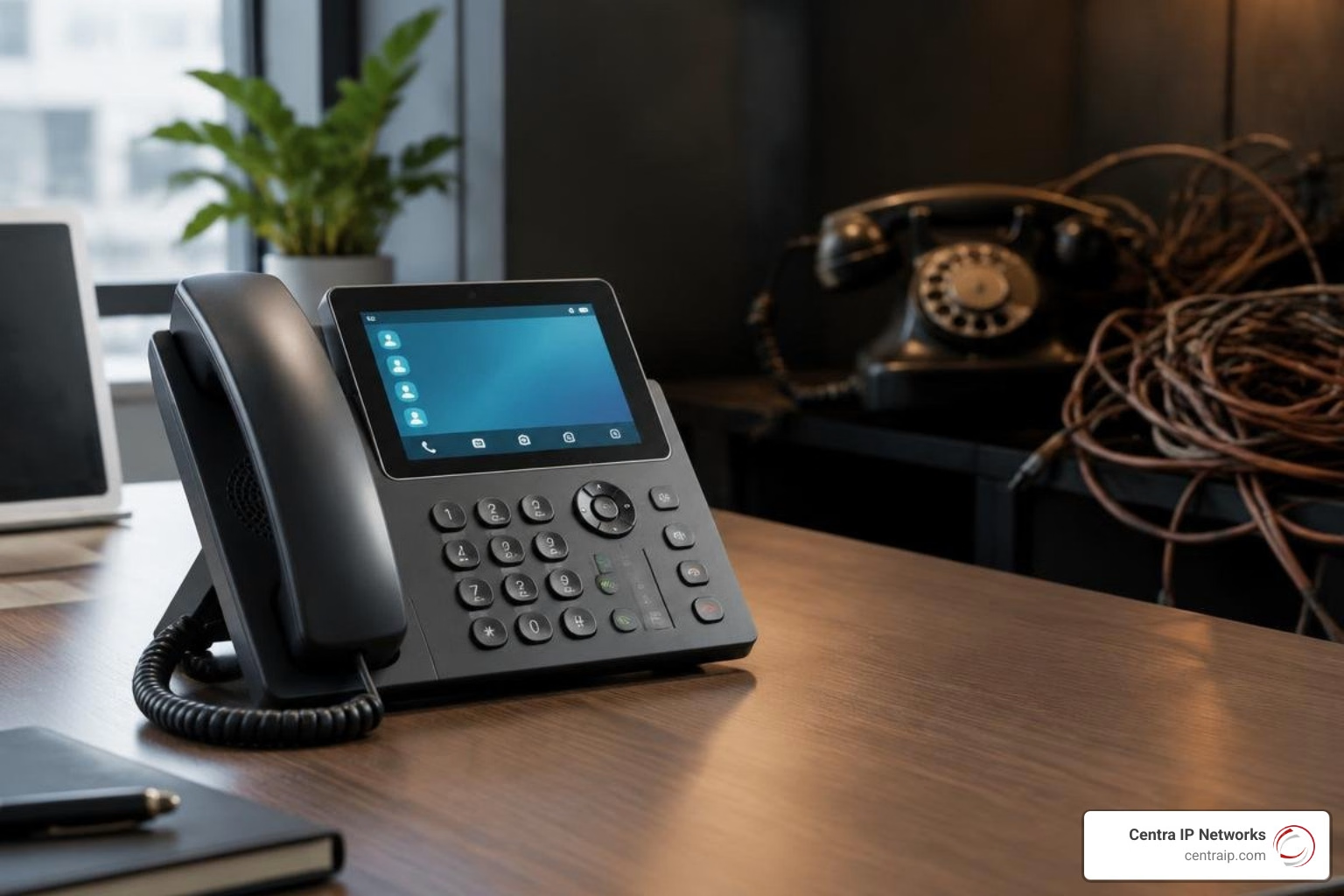
Businesses can get free SIP trunking through permanent zero-channel-fee providers like IPComms, which charge only for per-minute usage and DID rentals, or through trial credits from platforms such as Twilio and SIPStation. These models eliminate fixed monthly channel fees while keeping pay-as-you-go call costs. Legacy telecommunication setups have long burdened companies with expensive physical circuits, rigid contracts, and massive operational overhead. In previous decades, connecting an on-premises PBX to the Public Switched Telephone Network (PSTN) meant buying Primary Rate Interface (PRI) bundles in fixed increments of 23 channels. If you needed 24 lines, you had to buy 46—paying a hefty monthly fee for copper dial tones you rarely used.
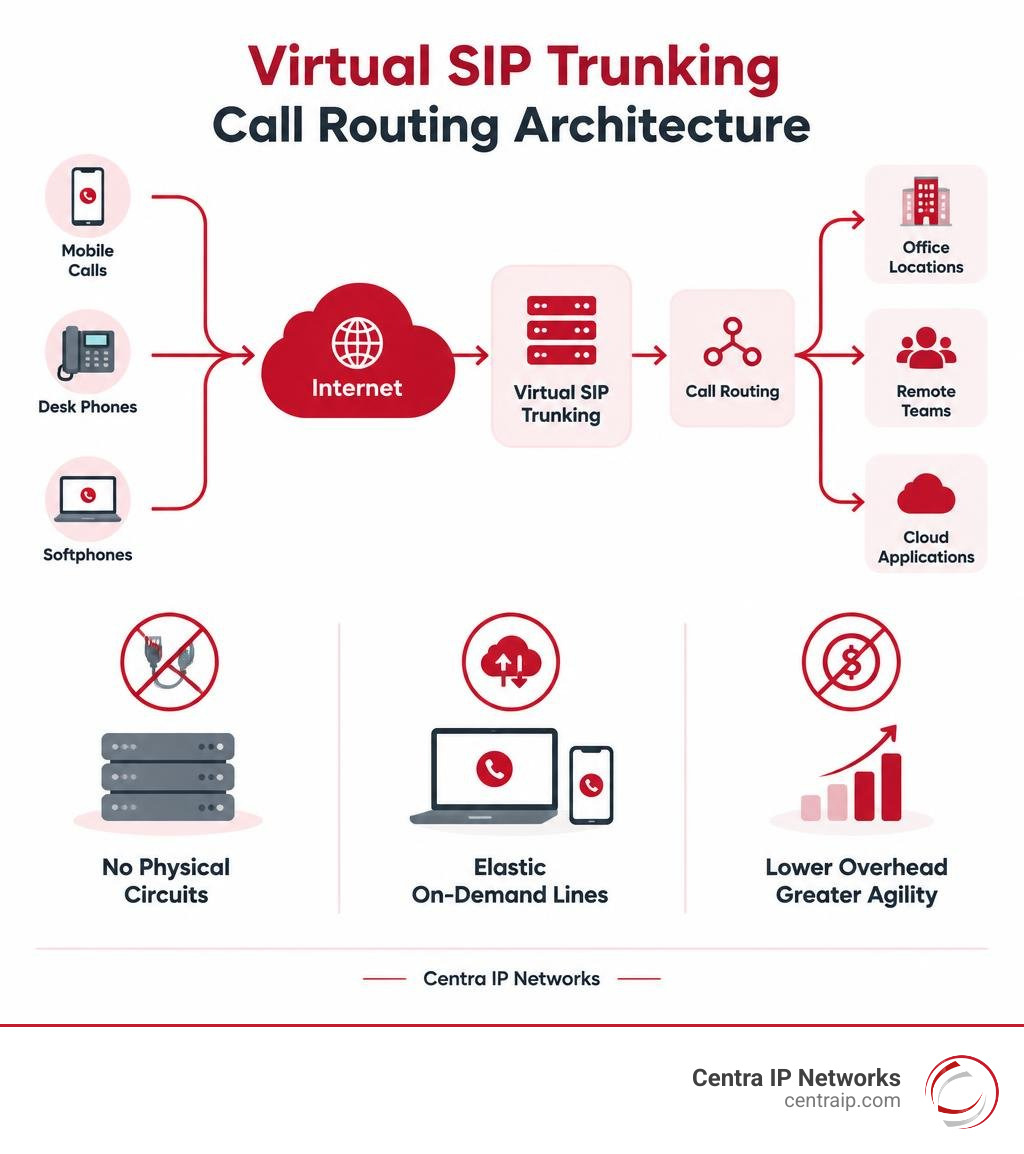
As we navigate telecom architectures in 2026, virtual routing has effectively rendered fixed line bundles obsolete. Virtual SIP trunking uses your existing data connection to create elastic, internet-based phone lines on demand. This shift allows modern businesses to break free from traditional telecom monopolies, drastically reducing overhead while unlocking unprecedented agility. For a broader technical overview, see the Session Initiation Protocol specification maintained by the Internet Engineering Task Force.
Understanding the Mechanics of SIP Trunking Free Models
To understand how zero-dollar voice services work, you must separate the virtual circuit from the traffic passing through it. In traditional telephony, carriers charge for three distinct items: the physical trunk connection, the individual concurrent channels (the capacity to handle simultaneous calls), and the metered usage (minutes and phone numbers).
How SIP Trunking Free Models Actually Function
When an operator provides a free SIP trunk, they remove the fixed monthly subscription fee for the virtual pipe itself. Instead of charging $20 to $30 per channel each month, they configure an endpoint on their Session Border Controller (SBC) and allow your Private Branch Exchange (PBX) to authenticate without an upfront seat license.
In this model, you maintain total flexibility:
- Zero-Dollar Channels: You pay $0 to establish and maintain the trunk registration.
- Pay-As-You-Go Minutes: You are billed only for the precise fractions of a cent consumed during inbound or outbound calls.
- DID Provisioning: Direct Inward Dialing (DID) phone numbers are leased individually for small monthly fees (typically $1.00 to $2.00 each).
Taking time to explore everything you need to know about free SIP trunking makes it clear that while access is unmetered, your overall telecommunication spend depends entirely on call duration and destination routing.
The Three Categories: Permanent Free, Commercial Trials, and Open Source
Not every complimentary offering operates under the same technical framework. Before integrating a service into your PBX, you must identify which category it occupies:
- Permanent Zero-Channel-Fee Trunks: Commercial-grade providers charge nothing for trunk registration or channel concurrency, earning revenue strictly through metered PSTN termination and DID rentals.
- Commercial Free Trials: Established carriers offer time-boxed access (such as 14 to 30 days) or a small bucket of test credits ($10 to $20) so engineers can validate call quality and API endpoints before transitioning to a standard billing tier.
- Open-Source & Community SIP Nodes: Volunteer-run or hobbyist networks provide free peering and SIP URI calling. While helpful for academic labs, these nodes lack commercial PSTN gateways, offer no formal service agreements, and frequently suffer from unpredictable routing.
Understanding these distinctions is critical when evaluating enterprise SIP trunk circuit design for your organizational infrastructure.
Top Free SIP Trunk Providers Compared
Evaluating zero-cost voice services requires looking past promotional headlines to examine channel caps, security implementations, carrier-grade uptime Service Level Agreements (SLAs), and per-minute termination rates.
IPComms: Best for Permanent Zero-Channel Fee Trunks
IPComms provides a permanent $0-per-channel enterprise SIP trunking framework designed for long-term production use. Operating under this pay-per-use architecture since 2002, they do not impose arbitrary channel limitations, allowing your PBX to scale concurrent calls naturally based on your available internet bandwidth.
- DID Pricing: Standard local DIDs cost approximately $1.50 per month, with toll-free numbers around $2.00 per month.
- Usage Rates: Domestic outbound termination sits at roughly $0.010 per minute, with inbound traffic billed at $0.009 per minute.
- Reliability & Security: Backed by a 99.99% uptime SLA (less than 4.3 minutes of unplanned downtime per month), featuring native TLS signaling encryption and SRTP media encryption.
- PBX Compatibility: Native support for Asterisk PJSIP, FreePBX, and 3CX platforms.
Twilio Elastic SIP Trunking: Best for Developer Testing and Global Scalability
Twilio provides developer-first infrastructure, allowing organizations to provision SIP endpoints across 100 countries in minutes. Rather than offering a permanent free tier, Twilio supplies free trial credits with no upfront credit card requirement, letting engineers test API call controls and global routing logic across advanced SIP trunking connectivity setups.
- Elastic Concurrency: Automatically scales channels up or down to absorb massive traffic spikes without manual trunk adjustments.
- Advanced Integrations: Pairs smoothly with automated speech pipelines and programmable workflows.
- Pricing Transition: Once trial credits expire, services transition to competitive pay-as-you-go termination rates alongside nominal monthly DID fees.
FreePBX SIPStation: Best for Native PBX Integration and Burstable Capacity
SIPStation is built into the FreePBX administrative interface, allowing administrators to activate service directly from the management console without entering manual trunk strings.
- Trial Structure: Offers a full 21-day free trial that includes a complimentary test DID and outbound test minutes.
- Burstable Trunks: Dynamically bursts channels during sudden inbound surges, preventing callers from receiving busy signals.
- Trunk Grouping: Allows multi-site businesses to pool calling resources across multiple locations under a unified account.
Sonetel and Linphone: Best for Low-Volume Micro-Businesses and Labs
For micro-businesses, educational testing, or standalone softphone setups, lightweight freemium platforms offer targeted utility:
- Sonetel: Provides free global inbound routing via web widgets, softphones, and chat endpoints. Monthly outbound caps (often 300 to 500 minutes) and per-minute international fees apply when dialing traditional PSTN endpoints.
- Linphone: An open-source SIP service and software suite ideal for lab experiments, SIP URI inter-device dialing, and testing video or audio codecs over secure TLS/SRTP channels without PSTN bridge fees.
Free SIP Trunking Provider Comparison Matrix
| Provider | Model Type | Channel Limit | Monthly DID Cost | Outbound Minute Rate | Uptime SLA | Security (TLS/SRTP) |
|---|---|---|---|---|---|---|
| IPComms | Permanent Free Trunk | Unlimited | ~$1.50/mo | ~$0.010/min | 99.99% | Included |
| Twilio | Trial Credit ($15-$20) | Elastic / Unlimited | ~$1.15/mo | ~$0.007-$0.014/min | 99.95% | Included |
| SIPStation | 21-Day Free Trial | Burstable | Included in Trial | Metered post-trial | 99.99% | Included |
| Sonetel | Freemium (300-500 min) | 1-2 Channels | ~$1.79/mo | Metered Rates | Best Effort | Optional Add-on |
| Linphone | Open-Source / SIP URI | Unlimited (SIP-to-SIP) | N/A (No PSTN) | N/A (Free URI Calls) | Community | Included |
The True Cost and Security Risks of “Free” SIP Trunks
While cutting fixed subscription costs is an attractive prospect, operating voice infrastructure without analyzing usage costs, network protection, and regulatory requirements can expose your organization to severe vulnerabilities.
Hidden Telephony Expenses vs. Traditional Channel Pricing
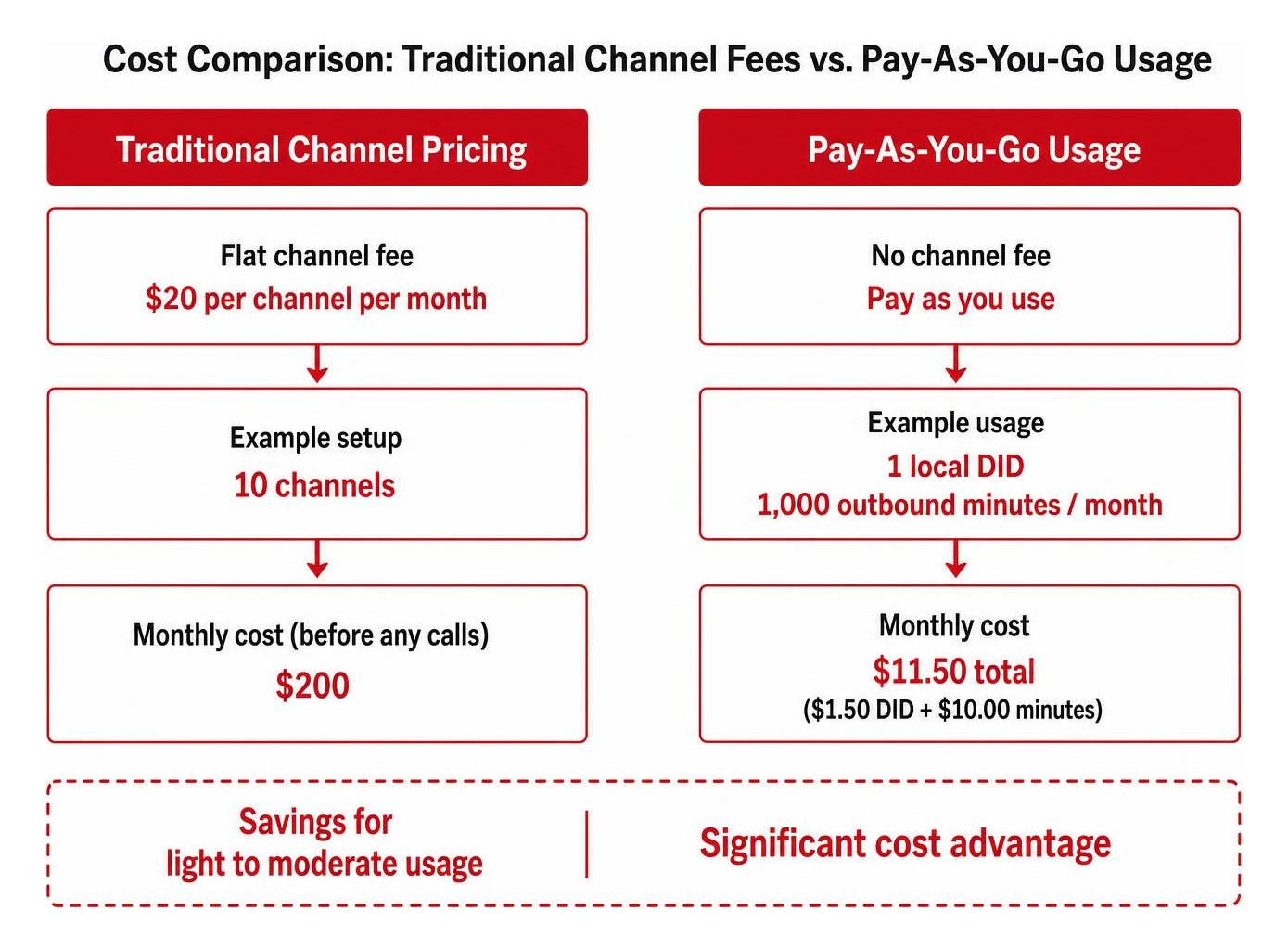
To properly evaluate zero-dollar trunks, compare them against legacy per-channel rates. A typical provider charging a flat $20 per channel per month means a 10-channel trunk costs $200 monthly before placing a single call.
By contrast, on a zero-channel-fee trunk, a small business with one local DID making 1,000 outbound minutes per month pays roughly $11.50 total ($1.50 for the DID plus $10.00 in minutes). For light to moderate usage, the savings are substantial.
However, unmonitored metered accounts present significant financial risks if left unprotected. Communications fraud drained an estimated $38.95 billion globally from carriers and enterprises in 2023, while industry studies regularly show toll fraud losses topping $7.5 billion from compromised PBX endpoints alone. A compromised PBX on an unmetered SIP trunk can generate tens of thousands of dollars in unauthorized international calls overnight.
Understanding the difference between raw connectivity and managed voice circuits is vital; review our analysis on distinguishing SIP trunks and lines to protect your network from these exposures.
Critical Security, Compliance, and PBX Compatibility Gaps
Deploying unmanaged or free-tier SIP services without strict security controls introduces distinct architectural risks:
- Signaling & Media Interception: Basic community trunks often lack default TLS signaling and SRTP media stream encryption, leaving voice packets vulnerable to packet-sniffing over public internet routes.
- Toll Fraud Exposure: Free accounts that lack automated rate-limiting, IP whitelisting, or country-code blocking can be brute-forced to route high-rate destination traffic.
- E911 Non-Compliance: Emergency calling requires Kari’s Law and RAY BAUM’S Act compliance, routing calls directly to the local Public Safety Answering Point (PSAP) with validated dispatchable location data. Many basic or community trunks do not support native E911 registration.
- PBX Integration Complexity: Modern PBX platforms—such as FreePBX 15+, Asterisk using the modern
chan_pjsipdriver, 3CX, and FreeSWITCH—require exact NAT traversal, Session Border Controllers (SBC), and specific port configurations (UDP/TCP 5060 for SIP signaling, UDP 10000–20000 for RTP audio) to prevent persistent one-way audio failures.
Choosing the Right Trunk: When to Upgrade
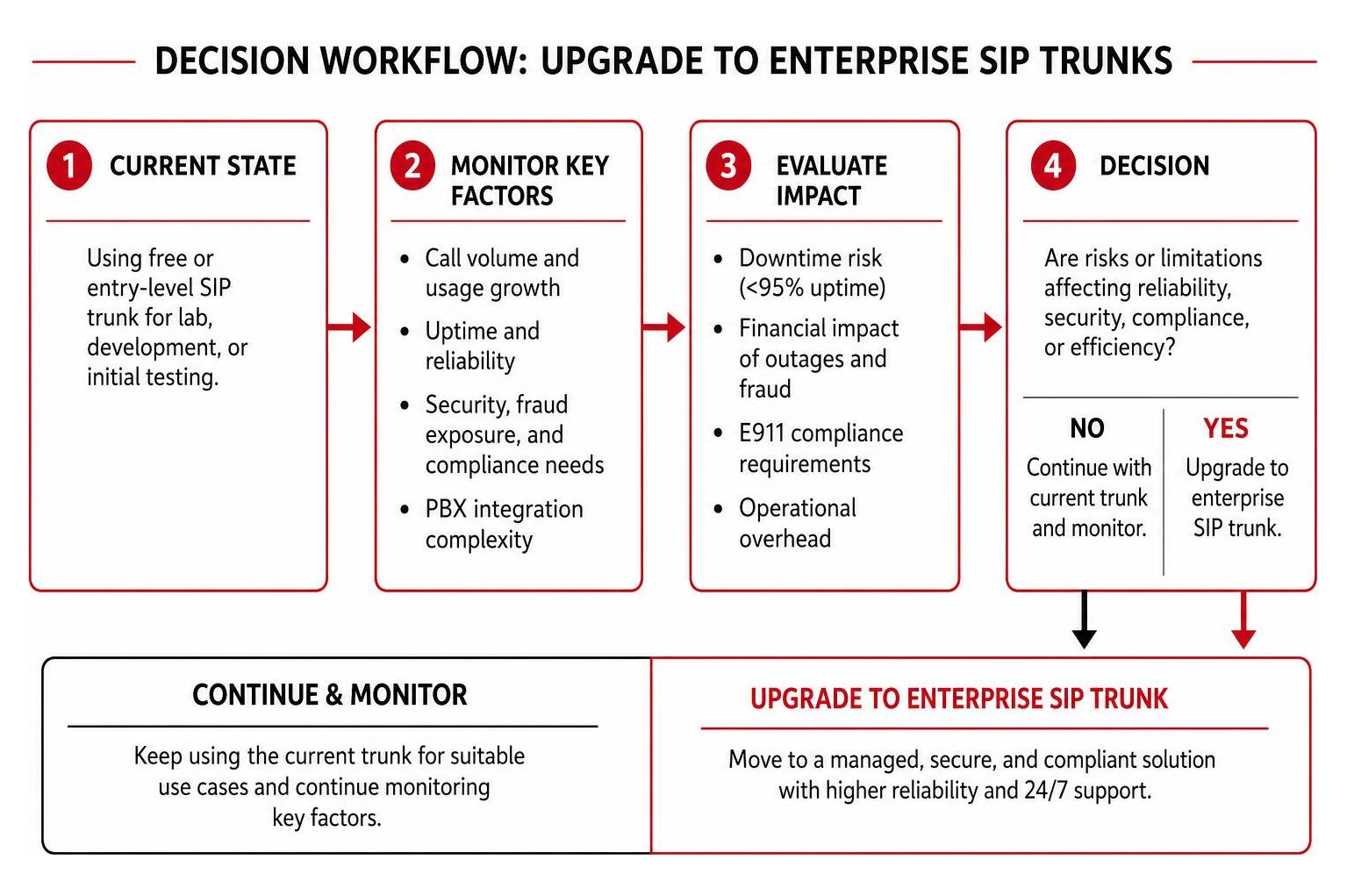
Free and entry-level SIP trunks serve a clear purpose during lab evaluations, software development, and initial sandbox testing. However, as organizational call volume grows, the technical limitations of unsupported services quickly impact operations.
When to Transition Beyond SIP Trunking Free Tiers
Approximately 40% of organizations deploying free SIP accounts convert to enterprise paid tiers within 90 days. The reason comes down to service reliability. Community and unmanaged SIP nodes frequently report uptime below 95%—which translates to over 36 hours of unscheduled downtime every year.
In enterprise environments, one hour of voice service loss costs most firms over $100,000, with enterprise outages exceeding $300,000 to $1,000,000+ in lost transactions and operational disruption.
You should upgrade your voice infrastructure when you experience:
- Capacity Saturation: Frequent call-rejection notices during peak business hours.
- Quality Degradation: High packet jitter, elevated latency, or dropped calls resulting from shared, unmanaged network nodes.
- Compliance Requirements: Mandatory HIPAA, PCI-DSS, or financial data retention policies requiring signed Business Associate Agreements (BAAs) and call encryption.
- Mission-Critical Operations: The need for 24/7/365 dedicated human technical support and a 99.999% uptime guarantee.
Discover the long-term operational advantages by reviewing the strategic benefits of business SIP trunking and assessing complete hosted VoIP transition strategies.
Frequently Asked Questions About Free SIP Trunks
Are free SIP trunks safe for commercial business operations?
Free SIP trunks can be safe if the provider implements carrier-grade security controls, including TLS signaling encryption, SRTP audio streams, IP-authenticated access lists, and aggressive outbound toll fraud monitoring. However, unmanaged or community-grade trunks that rely on cleartext transmission over public internet paths should never be used for confidential business calls.
Do free SIP trunking services support E911 emergency dialing?
Most entry-level trial and community SIP trunks do not include native E911 emergency dialing. Legally compliant E911 services require dedicated address verification and real-time integration with regional PSAP databases, which carries an associated carrier registration cost. Commercial operations must verify that their chosen provider supports E911 compliance before routing live production traffic.
Which PBX systems work best with free SIP trunks?
Standard SIP trunks integrate with any RFC-compliant IP-PBX. The most reliable platforms include FreePBX 15+ (using the modern PJSIP channel driver), Asterisk, 3CX, and FreeSWITCH. Setting up these systems correctly requires opening port 5060 for SIP signaling, forwarding RTP media port ranges (typically UDP 10000–20000), and configuring network firewalls to avoid NAT routing errors. Explore additional infrastructure advantages in our overview of key VoIP phone system benefits.
Conclusion
Zero-dollar SIP trunks provide an efficient, cost-effective way to validate VoIP configurations, build development sandboxes, and eliminate wasteful monthly channel fees for low-volume calling. However, as your business grows, relying on unmanaged connections can introduce risks around toll fraud, compliance gaps, and unrecoverable downtime.
At Centra IP Networks, we eliminate these operational headaches. We deliver fully managed IT and cloud communications services—including carrier-grade voice systems, high-speed internet connectivity, and advanced cloud solutions—consolidated onto a single platform with one bill and a single dedicated support provider. Supporting multi-location businesses across Dallas, Fort Worth, Orlando, Tampa, St. Petersburg, Clearwater, and Sarasota, we leverage over 35 top-tier industry partnerships to tailor voice networks that deliver 99.999% uptime, airtight encryption, and predictable, cost-effective scaling.
Take the guesswork out of your voice infrastructure. Upgrade your communications by exploring our scalable advanced SIP trunking services today.