Cybersecurity Solutions Tampa Businesses Need in 2026
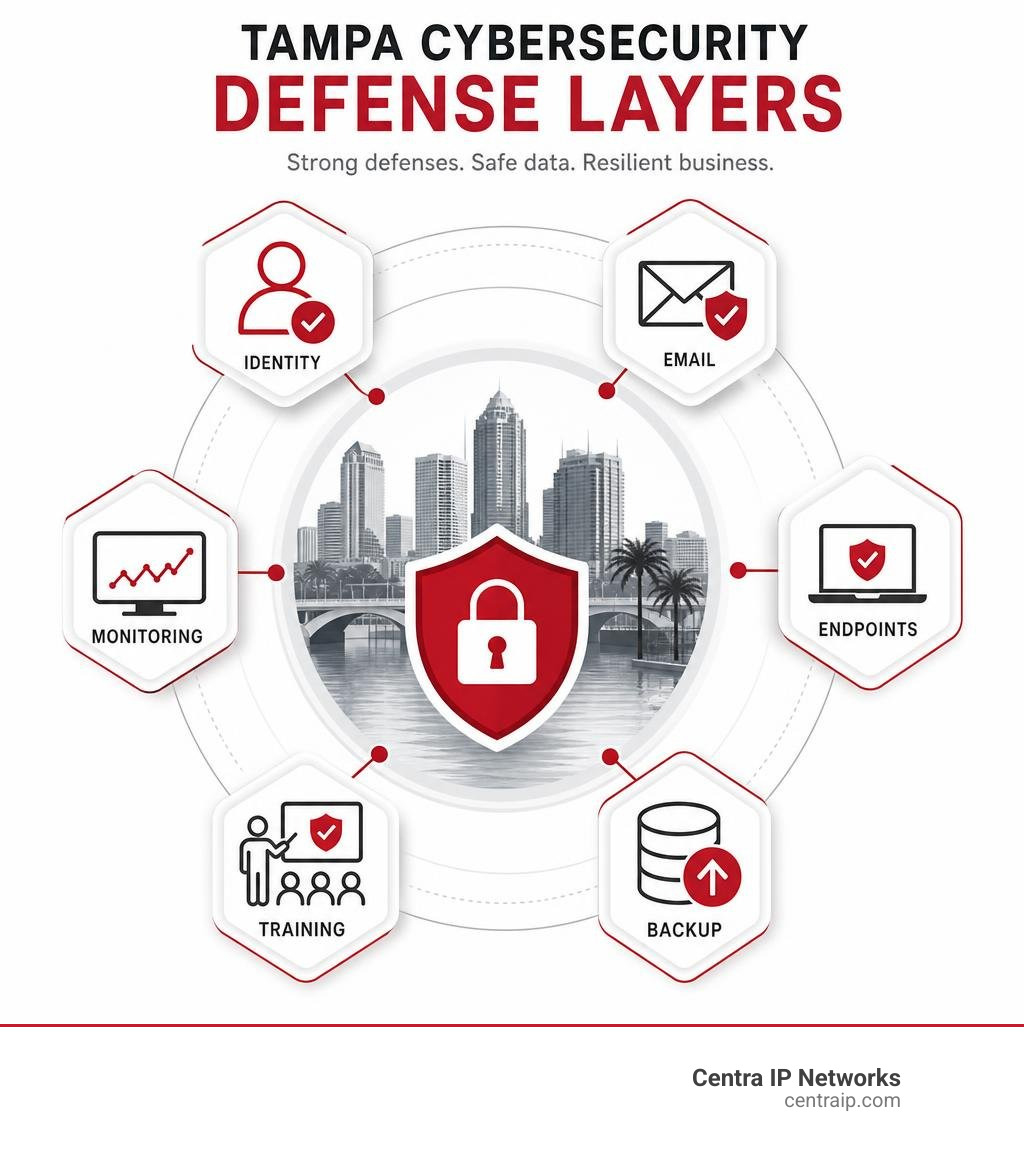
The right cybersecurity solutions Tampa businesses need combine prevention, fast detection, and reliable recovery. Start with multi-factor authentication, protected email, endpoint detection and response (EDR), secure backups, employee phishing training, and 24/7 monitoring for systems that hold sensitive data.
Tampa’s growing tech, healthcare, financial, real estate, and defense sectors create more opportunity – and a larger target for ransomware, stolen credentials, business email compromise, and vendor-related breaches. Florida residents and businesses lost $874.72 million to cybercrime in 2022, and the state ranked fourth for data breaches. A firewall and antivirus tool still matter, but they cannot stop every attack.
The practical goal is simple: reduce the chance of a breach, spot suspicious activity quickly when prevention fails, and restore operations without paying a ransom or suffering long downtime. That means pairing security tools with clear access rules, tested backups, incident response plans, and staff who know how to report suspicious messages.
I’m Patrick Brangan, a business technology specialist with more than 20 years of experience helping small and midsize organizations simplify communications, managed IT, and cybersecurity solutions Tampa businesses can manage within a predictable budget. The next sections break down the local threats, compliance needs, and security layers that deserve priority.
The 2026 Threat Landscape and Cybersecurity Solutions Tampa Businesses Rely On
Tampa’s economic surge has reshaped our regional business landscape. Between 2017 and 2023, the number of technology firms across Tampa grew by 24%, with local IT roles expanding over 30%. With more than a quarter of Florida’s tech workforce anchored right here in the Tampa Bay area, we are operating in a thriving hub of innovation.
However, rapid digital expansion brings concentrated risk. Modern digital assets require robust, hardened network backbones such as optimized Data Networking Tampa architectures to resist sophisticated intrusion attempts.

Why Florida Ranks Among Top Targets for Cyber Attacks
Florida has firmly established itself among the top targets nationwide for organized cybercriminals. In 2022 alone, Floridians lost $874.72 million to cyber fraud and network intrusions, ranking the state third-worst in the nation for total financial losses and fourth for total reported data breaches.
Across the United States, data breaches cost an average of $9.44 million, while the global average breach cost stands at $4.88 million. Tampa’s rapid influx of financial services, healthcare startups, defense contractors, and remote-first corporate headquarters makes our local commercial ecosystem an attractive target for automated and human-operated cyber attacks.
Key Threats: Ransomware, Supply Chain Breaches, and BEC
Threat actors continually adjust their tactics to exploit our regional business rhythms. The prominent threat vectors challenging local organizations in 2026 include:
- Targeted Ransomware Syndicates: Modern ransomware campaigns do not simply lock servers; they exfiltrate sensitive files and threaten public release. With over 1,377 ransomware incidents reported nationally in a single year, downtime costs often outpace ransom demands.
- Supply Chain and Third-Party Exploits: Supply chain intrusions have surged by 430%. Approximately 49% of organizations have suffered a breach originating from a third-party vendor over the past 12 months.
- Business Email Compromise (BEC) and Regional Phishing: Attackers deploy hyper-localized social engineering, such as real estate closing scams or fraudulent hurricane-recovery communications, to deceive staff into transferring funds or handing over administrative credentials. Evaluating How Safe Is Your Company’s Data? has become a core operational priority for leadership teams across the Bay.
Navigating Florida Regulations and Regulatory Compliance Mandates
Operating in Florida requires strict adherence to both state-level data privacy statutes and industry-specific federal frameworks. Implementing verifiable Data Security Compliance protections protects your business from punitive regulatory fines and civil liabilities.
Aligning with the Florida Cybersecurity Act and FIPA
The Florida Information Protection Act (FIPA) mandates that commercial entities holding personal identifying information (PII) implement reasonable technical safeguards and notify affected residents within 30 days of discovering a breach. Failing to meet these notice windows carries statutory penalties reaching up to $500,000.
Additionally, the Florida Cybersecurity Act establishes baseline security standards for public entities and provides legal frameworks encouraging commercial enterprises to adopt recognized guidelines, such as the NIST Cybersecurity Framework, to establish statutory safe harbors against liability claims.
CMMC and NIST 800-171 Compliance for Tampa Defense Contractors
With MacDill Air Force Base anchoring U.S. Central Command (USCENTCOM) and U.S. Special Operations Command (USSOCOM), Tampa serves as an essential hub for defense contractors and suppliers. Over 300,000 companies across the Defense Industrial Base (DIB) must comply with the Department of Defense’s Cybersecurity Maturity Model Certification (CMMC) program.
Defense contractors handling Controlled Unclassified Information (CUI) must implement all 110 security controls outlined in NIST SP 800-171 and maintain verified Supplier Performance Risk System (SPRS) scores. For organizations navigating mandatory third-party assessments, partnering with an authorized C3PAO helps validate readiness before formal audits. Small teams and SBIR awardees can isolate CUI within secure virtual enclaves to achieve audit readiness without overhauling their entire corporate IT network.
Industry Frameworks: Healthcare, Finance, and Enterprise Standards
Commercial businesses across Tampa must align with vertical-specific data privacy mandates:
- Healthcare (HIPAA/HITECH): Medical practices, clinics, and health-tech providers must enforce technical safeguards, role-based access control, and end-to-end data encryption. Implementing specialized Managed IT Services for Healthcare ensures electronic Protected Health Information (ePHI) remains secure.
- Financial Services & Accounting: CPA practices and financial institutions subject to the FTC Safeguards Rule, FINRA, and SOX must deploy continuous endpoint logging, multi-factor authentication, and secure document vaults. Dedicated Managed IT Services for Accounting Firms keep sensitive tax records and customer financial assets protected against credential theft.
- Payment Card Industry (PCI DSS 4.0): Retailers, hospitality groups, and e-commerce platforms must maintain strict network segmentation, recurring vulnerability scans, and continuous access logs around payment environments.
- SOC 2 Type II: SaaS providers and enterprise B2B vendors must prove operational integrity across the Trust Services Criteria (Security, Availability, Processing Integrity, Confidentiality, and Privacy).
Core Architecture: Proactive Detection, EDR, and Zero Trust
Preventive measures alone cannot stop 100% of modern cyber threats. Under the NIST Cybersecurity Framework (CSF) 2.0—which structures cybersecurity around Govern, Identify, Protect, Detect, Respond, and Recover—SMBs that invest solely in protection inevitably struggle when attackers bypass basic boundary defenses.
Resilient defenses require pairing zero trust identity controls with high-performance Cloud Services Tampa platforms to reduce the network attack surface.
Evaluating MSP vs. MSSP Cybersecurity Solutions Tampa
Understanding whether you need a Managed Service Provider (MSP), a Managed Security Service Provider (MSSP), or a hybrid provider is critical to balancing operational reliability with threat defense.
| Service Feature | Standard Managed IT (MSP) | Dedicated Security (MSSP) | Unified IT & Security Platform |
|---|---|---|---|
| Primary Focus | Uptime, system maintenance, and user support | Threat hunting, intrusion defense, and GRC | Seamless IT workflows combined with advanced threat defense |
| Monitoring Window | Business hours remote monitoring | 24/7/365 Security Operations Center (SOC) | Continuous 24/7 monitoring, IT support, and active SOC |
| Threat Detection | Basic antivirus, firewall, and patch updates | Behavioral EDR, SIEM log analysis, and XDR | Integrated Zero Trust, EDR, SIEM, and automated containment |
| Compliance Support | Basic data backup and workstation compliance | In-depth audit readiness (CMMC, HIPAA, SOC 2) | Full compliance alignment with active security enforcement |
| Vendor Model | Separate vendor for telecom and network IT | Isolated security vendor requiring custom integration | Unified single platform, single provider, and single bill |
Reviewing our specialized guides on Tampa Managed IT Services and vetted Managed IT Service Providers Tampa can help your leadership team select the right operational balance.
Deploying Zero Trust Architecture and Cloud Security
Traditional cybersecurity relied on a “castle-and-moat” model: trust everything inside the network and block everything outside. Today, identity has replaced the physical firewall as the primary security perimeter.
Zero Trust operates on one simple rule: never trust, always verify. Implementing Zero Trust architecture involves:
- Continuous Identity Verification: Requiring Multi-Factor Authentication (MFA) and Conditional Access policies that evaluate user identity, location, device health, and login anomalies before granting system access.
- Least-Privileged Access: Limiting employee credentials strictly to the specific applications and data folders required for their job roles, preventing unauthorized lateral movement.
- Privileged Access Management (PAM): Restricting administrative access with just-in-time permissions to stop credential-stuffing attacks from compromising domain controllers.
- Micro-Segmentation: Dividing corporate networks into isolated subnets so a compromised workstation cannot infect core accounting databases or offsite backups.
Continuous Monitoring: SIEM, EDR, and 24/7 SOC Integration
When preventative controls fail, rapid detection is the difference between an isolated event and an enterprise-wide disaster. Basic antivirus software relies on known file signatures, which are ineffective against zero-day vulnerabilities and fileless malware.
- Endpoint Detection and Response (EDR): EDR agents continuously record endpoint activity, using behavioral analytics and AI to spot unauthorized PowerShell scripts, memory injection, or privilege escalation. Suspicious endpoints are isolated from the network automatically in seconds.
- Security Information and Event Management (SIEM): SIEM platforms aggregate, normalize, and analyze real-time logs across firewalls, cloud services, domain controllers, and endpoint devices, correlating separate events to uncover covert intrusion attempts.
- 24/7 Security Operations Center (SOC): Automated alerts require human validation. A 24/7 SOC provides specialized security analysts who investigate anomalies around the clock, stopping adversaries before they achieve data exfiltration or execute ransomware payloads.
Strengthening the Human Firewall and Disaster Recovery
A comprehensive defense blends technology, trained personnel, and resilient business continuity systems.

Employee Security Awareness Training and Phishing Defense
Basic cyber hygiene can mitigate up to 98% of common cyber attacks. Because 82% of corporate breaches involve a human element—such as clicking phishing lures, falling for social engineering, or reusing weak passwords—regular workforce education is essential.
Effective security awareness programs should include:
- Monthly Phishing Simulations: Testing employees with realistic email lures mirroring current attacks, including fake invoice adjustments, executive impersonation, and urgent file-share notifications.
- Micro-Learning Modules: Delivering concise, engaging training sessions on password management, public Wi-Fi risks, and multi-factor authentication fatigue attacks.
- Clear Incident Reporting Channels: Equipping staff with a one-click mechanism to flag suspicious emails directly to the security team without fear of disciplinary blowback.
Business Continuity, Backup, and Disaster Recovery Planning
Ransomware syndicates deliberately seek out and delete online backups before deploying encryption. Surviving an attack without paying a ransom requires immutable, isolated backup systems.
Implementing the 3-2-1 backup strategy ensures business continuity:
- Maintain 3 copies of your data (1 primary copy and 2 backups).
- Store files on 2 different storage media types.
- Keep 1 copy completely offsite in an immutable, air-gapped cloud environment.
Establishing strict Recovery Point Objectives (RPO) and Recovery Time Objectives (RTO) ensures critical applications can be restored within hours. Leveraging our comprehensive Managed Disaster Recovery Services delivers continuous system replication, safeguarding your operations against ransomware disruptions, hardware failures, and severe weather events.
Maximizing ROI and Selecting Cybersecurity Solutions Tampa Enterprises Trust
Investing in cybersecurity is an operational enabler that builds business resilience and shortens enterprise sales cycles. With 78% of local companies reporting tech talent shortages, partnering with an established regional provider solves internal hiring challenges while controlling IT expenditures.
Cost Predictability and Evaluating Security Investment ROI
Viewing cybersecurity strictly as an overhead expense ignores the real financial savings of proactive risk mitigation. An effective security program provides measurable financial return:
- Breach Avoidance: Eliminating the operational downtime, legal liabilities, forensic expenses, and brand damage associated with the average $4.88M breach.
- Cyber Insurance Premium Reductions: Insurance underwriters require proof of MFA enforcement, EDR deployment, 24/7 monitoring, and immutable backups before issuing policies. Meeting these criteria unlocks better coverage rates.
- Shortened Sales Cycles: Enterprise clients and government entities require prospective vendors to pass rigorous security questionnaires. Having documented NIST, SOC 2, or CMMC security controls can cut B2B vendor vetting timelines by several weeks.
- Flat-Rate Predictability: Consolidating security operations into predictable monthly subscriptions eliminates surprise invoices from emergency incident response engagements.
Selecting Strategic Cybersecurity Solutions Tampa SMBs Need
When evaluating security partners in the Tampa FL market, prioritize providers that deliver:
- Fast SLA Response Times: Look for partners that provide rapid helpdesk support and sub-minute response metrics for critical network security alarms.
- Onsite and Remote Engineering: While 24/7 remote monitoring catches digital threats, having certified engineers available for on-premise hardware remediation across the Tampa Bay area is vital.
- Integrated Infrastructure and Single-Bill Simplicity: Managing fragmented vendors for internet connectivity, VoIP phone systems, cloud workspaces, and security monitoring creates operational friction.
At Centra IP Networks, we eliminate vendor overlap by delivering comprehensive Managed IT, cloud solutions, and voice services under a unified platform with a single monthly bill. Contact our team today to evaluate your infrastructure and close your security gaps.
Frequently Asked Questions About Cybersecurity Solutions in Tampa
What is the difference between traditional IT support and managed cybersecurity?
Traditional IT support operates primarily on a reactive “break-fix” model, focusing on resolving user tickets, configuring hardware, updating software, and maintaining basic server uptime.
Managed cybersecurity focuses proactively on safeguarding corporate networks against unauthorized access and advanced digital threats. This includes deploying Zero Trust architectures, maintaining continuous endpoint detection (EDR), aggregating network telemetry into a SIEM, hunting active threats via a 24/7 SOC, and aligning systems with regulatory compliance frameworks.
How do defense contractors in Tampa prepare for CMMC certification?
Defense industrial base suppliers should follow a structured five-step path to CMMC compliance:
- Conduct a Readiness Assessment: Perform an initial gap analysis mapping current network controls against the 110 requirements in NIST SP 800-171.
- Implement Secure Enclaves: When a full-network overhaul is cost-prohibitive, isolate Controlled Unclassified Information (CUI) within a compliant cloud enclave designed for your user footprint.
- Draft Core Documentation: Build and update your System Security Plan (SSP), Plan of Action and Milestones (POA&M), and corporate incident response policies.
- Remediate Identified Deficiencies: Enforce technical controls, including FIPS-validated encryption, multi-factor authentication, and privileged access management.
- Continuous Monitoring and C3PAO Audit: Maintain active logging, update your SPRS score, and engage an authorized C3PAO to conduct your formal certification audit.
How often should a Tampa business conduct a cybersecurity assessment?
Most organizations should conduct an external vulnerability assessment and infrastructure audit at least once a year. However, businesses handling sensitive data in regulated industries (such as healthcare, finance, or defense contracting) should perform vulnerability scans continuously and schedule professional manual penetration testing bi-annually or whenever major changes are made to their cloud architecture or network infrastructure.
Conclusion
Securing your business requires an active, multi-layered defense strategy. With Florida ranking among the top targets for cybercrime, relying on basic firewalls and legacy antivirus software leaves your critical data vulnerable to credential theft, ransomware extortion, and supply chain disruptions.
At Centra IP Networks, we protect and empower businesses across Dallas, Fort Worth, Orlando, Tampa, St. Petersburg, Clearwater, and Sarasota. By consolidating your managed IT, cybersecurity, voice communications, and connectivity under one roof, we eliminate vendor finger-pointing, reduce IT overhead, and deliver enterprise-grade protection.
Strengthen your business with high-speed business connectivity and managed protection backed by a single, accountable technology partner.