

Why Cloud Phone Systems Are Easier to Compare Than Legacy PBX
Cloud phone systems move business calling from on-site PBX hardware to provider-managed cloud infrastructure. They let employees make and receive calls through desk phones, computers, and mobile apps while adding features such as call routing, team messaging, recording, and CRM integration.
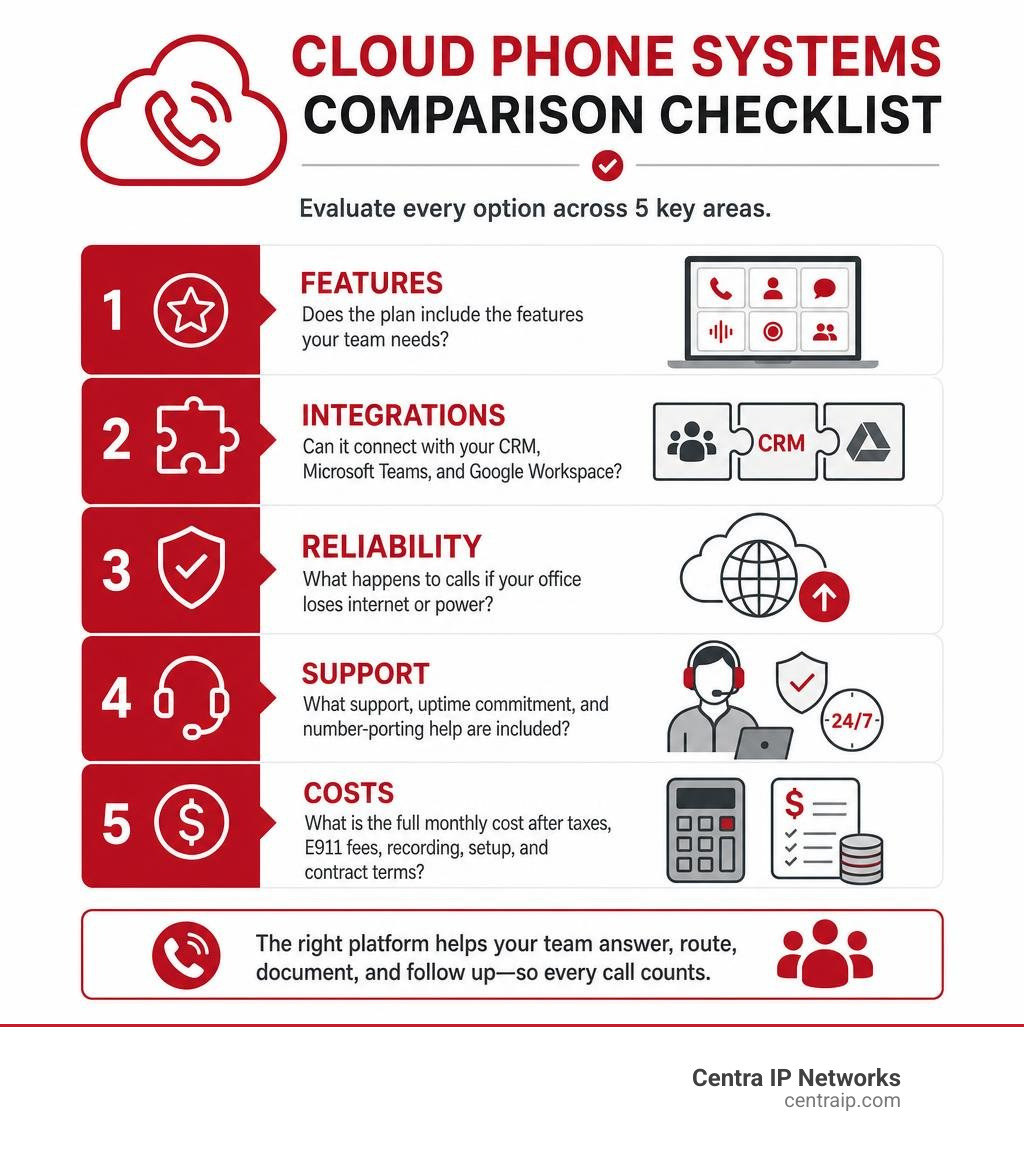
When comparing options, focus on five practical questions:
- Does the plan include the features your team needs, or are key tools sold as add-ons?
- Can it connect with your CRM, Microsoft Teams, and Google Workspace?
- What happens to calls if your office loses internet or power?
- What support, uptime commitment, and number-porting help are included?
- What is the full monthly cost after taxes, E911 fees, recording, setup, and contract terms?
This matters because a missed call can be a missed customer: research cited by providers suggests that 85% of callers who do not reach a business may not call again. The right platform gives your team one reliable place to answer, route, document, and follow up on those conversations, without adding another complicated vendor relationship.
I’m Patrick Brangan, with more than 20 years of experience helping small and midsize businesses select and manage technology solutions. My work with Cloud phone systems, managed IT, networks, and connected devices helps organizations simplify their technology while keeping teams reachable.
Core Architecture: How Cloud Phone Systems Compare to Legacy PBX and Standard VoIP
To choose the right communications tool, it helps to understand the underlying architecture. A traditional Private Branch Exchange (PBX) relies on physical copper wiring, on-premises switching boxes, and Public Switched Telephone Network (PSTN) trunks.
In contrast, an Introduction to Cloud-Based Phone Systems shows how modern systems convert analog audio into digital data packets. Using Session Initiation Protocol (SIP) trunking and packet switching, your voice data travels securely over standard broadband to geo-redundant data centers.
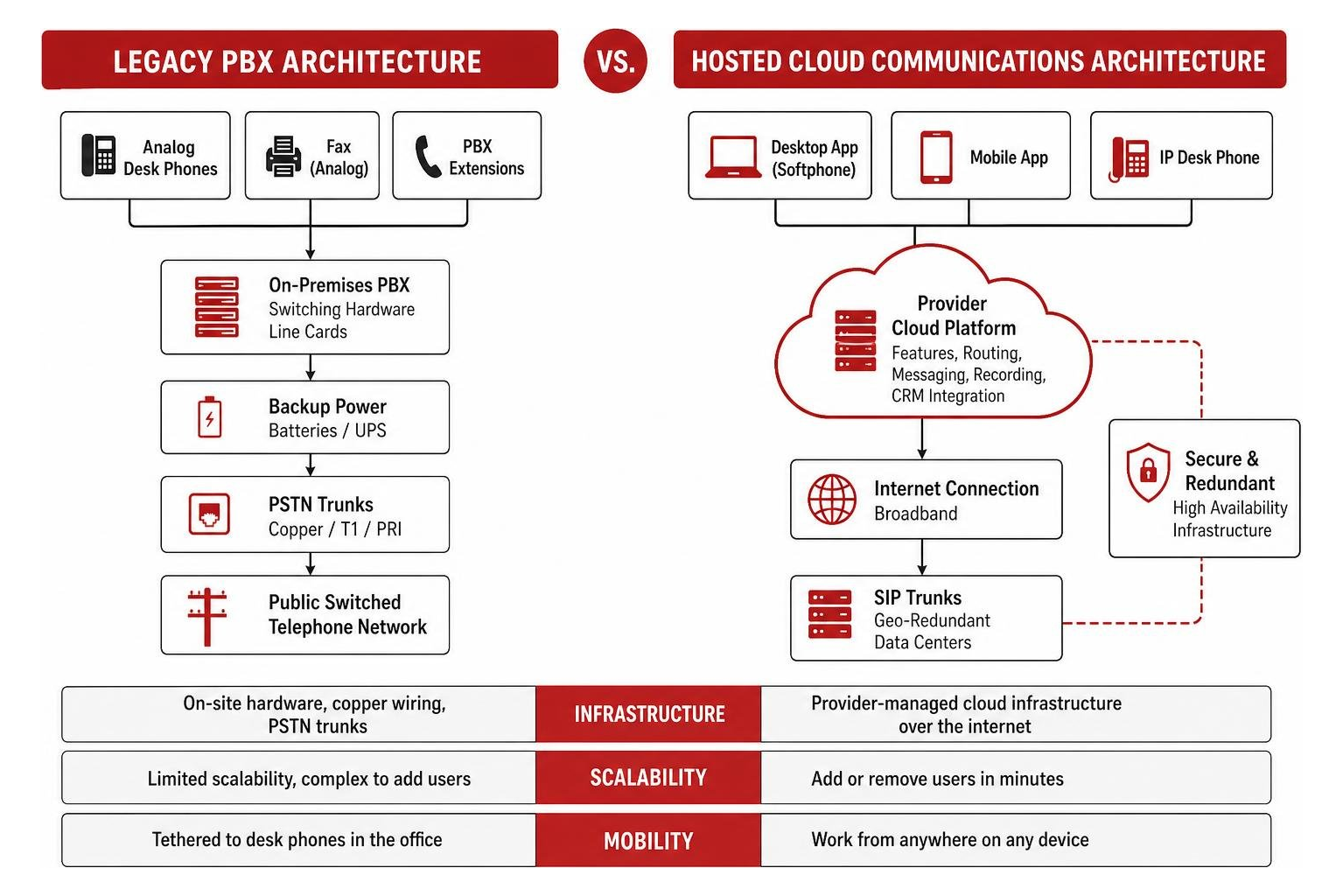
When evaluating Cloud-Based vs Premise-Based Phone Systems: Which One is Right for Your Business?, the differences become obvious:
- Hardware footprint: Legacy systems require dedicated closet space, backup batteries, and proprietary line cards. Cloud platforms operate via lightweight softphone apps on laptops, smartphones, or standard IP desk phones.
- Scalability: Adding an extension on a legacy PBX often means running physical copper cables and purchasing new licensing cards. Cloud setups let you add or remove users with a couple of clicks in an online admin dashboard.
- Mobility: Traditional PBX systems tether workers to physical desks. Cloud platforms let your team answer calls, send business texts, or join video conferences whether they are in Dallas, Fort Worth, Orlando, or working remotely.
On-Premises Hardware vs Hosted UCaaS Platforms
Maintaining legacy PBX hardware comes with heavy capital expenditures and ongoing service contracts. When an on-premises board fails, you must wait for an expensive telecom technician to diagnose the issue on-site.
Hosted Unified Communications as a Service (UCaaS) removes physical server maintenance by shifting the infrastructure to carrier-grade data centers. Understanding What is a Cloud Infrastructure? clarifies why this model works: enterprise providers manage hardware updates, security patches, and server cooling off-site, drastically reducing maintenance labor and eliminating surprise replacement costs.
Network Prerequisites, Bandwidth, and Quality of Service (QoS)
Because cloud voice transmits data over your internet connection, network health is essential. A single uncompressed voice call generally requires around 85 to 100 kbps of symmetric upload and download bandwidth.
To prevent jitter, latency, and packet drops, your local network should use Quality of Service (QoS) traffic shaping. QoS prioritizes real-time voice packets over general web traffic, ensuring that an employee downloading a massive file in another room will not cause your sales call to break up. A solid foundation built on Cloud-Based Infrastructure: The Ultimate Guide to Moving Beyond Physical Servers ensures your voice and data channels operate cleanly on shared internet lines.
Advanced Features and AI Innovations Transforming Business Telephony
Modern communications have evolved past simple dial tones. By adopting Cloud-Based Business Phone Systems, organizations gain access to intelligent automation tools that eliminate manual tasks and streamline operations.

Artificial intelligence now plays an active role in daily telephony workflows. Natural language virtual receptionists can answer routine inquiries, schedule appointments directly into calendars, and route urgent calls based on caller intent. Industry data indicates that automated SMS workflows and AI response agents can deliver near-instant speed-to-lead follow-ups, resolving after-hours calls and capturing revenue opportunities that would otherwise be lost.
Essential Features of Modern Cloud Phone Systems
Every reliable business phone system should include a core set of productivity tools right out of the box:
- Multi-Level IVR & Visual Call Routing: Direct callers efficiently using intuitive auto-attendants and visual routing schedules based on business hours.
- Automated Voicemail Transcription: Convert voicemails to text and deliver them directly to email or SMS so your team can triage messages quickly.
- Compliant Call Recording: Utilizing Cloud-Based Call Recording: Why It’s Essential for Modern Businesses helps maintain quality control, resolve client disputes, and support team training.
- Digital Cloud Faxing: Modern platforms integrate secure digital faxing directly into email clients, eliminating clunky standalone fax machines. Reviewing The Complete Guide to HIPAA Compliant Cloud Fax ensures your digital transmissions meet necessary privacy rules.
CRM Integrations and Unified Collaboration Workspaces
Siloed conversations slow teams down. Direct Cloud Phone System CRM Integration bridges the gap between customer records and daily phone calls. When an incoming call connects, caller details automatically appear inside platforms like Salesforce or HubSpot, logging interaction histories and call recordings without manual entry.
Integrating voice calling into collaboration tools like Microsoft Teams or Google Workspace allows employees to manage calls, team chat, SMS messaging, and video meetings within a single desktop interface, saving time and keeping communications organized.
Evaluating Total Cost of Ownership, Pricing Models, and Hidden Fees
Evaluating the total cost of ownership (TCO) across different vendors requires looking beyond base subscription prices. The table below outlines how standard delivery models compare across key factors:
| Feature / Model Dimension | Traditional On-Premise PBX | Standard Multi-Tenant UCaaS | Centra IP Unified Communications |
|---|---|---|---|
| Upfront Hardware Costs | High ($5,000–$50,000+ for servers & cards) | Low (Software-based or standard IP phones) | Low (BYOD, IP phones, softphone apps) |
| Monthly Pricing Model | Fixed line rentals + maintenance contracts | $20 – $45 /user/month (tiered features) | Predictable flat-rate per user/month |
| Feature Accessibility | Add-on modules required | Basic features often paywalled behind top tiers | Full-featured communications standard |
| Deployment Timeline | 4 to 8 weeks on-site wiring | 1 to 3 weeks self-service setup | Rapid deployment (<24 hours available) |
| Contract Flexibility | 3 to 5-year hardware lock-in | Annual contracts with auto-renewal windows | Flexible month-to-month or customized terms |
Reviewing the practical Benefits of a Cloud-Based Phone System for Your Business shows that removing on-premise hardware can lower overall telecom expenses by up to 50%, while eliminating maintenance fees and hardware replacement cycles.
The Hidden Fee Trap and Contract Lock-In Risks
When comparing vendor quotes, watch out for fine print. Many providers advertise an entry-level rate of $19.99 per user, only for the final bill to double due to:
- Mandatory compliance recovery fees and administrative charges
- Separate add-on fees for essential tools like call recording, CRM integration, or digital faxing
- E911 regulatory surcharges and international dialing markups
- Restrictive auto-renewal clauses with narrow 30-to-60-day cancellation windows
Look for providers offering transparent billing without hidden feature gates or surprise fees.
Deployment Speed, Number Porting, and Zero-Downtime Migration
Migrating to a cloud platform does not have to disrupt daily operations. While traditional telecom cutovers often took weeks, modern cloud migrations can be completed within 24 to 48 hours.
Number porting is managed by submitting a standard Letter of Authorization (LOA) alongside a recent copy of your phone bill. During the transition, temporary call forwarding rules route incoming traffic to your new virtual system, ensuring zero missed calls while numbers transfer behind the scenes.
Reliability, Disaster Recovery, and Enterprise Regulatory Standards
Enterprise operations demand carrier-grade reliability. Leading cloud platforms back their networks with a 99.999% (“five-nines”) uptime Service Level Agreement (SLA), translating to less than six minutes of unplanned downtime per calendar year.

This level of availability relies on geo-redundant data center architectures. If an unexpected power outage or severed fiber line impacts an office in Tampa, St Petersburg, Clearwater, or Sarasota, cloud systems automatically redirect incoming traffic to secondary internet connections, mobile applications, or alternate office locations without dropping active callers. Aligning your communications with principles from The Executive Guide to Secure Enterprise Cloud Storage ensures consistent operational continuity.
Industry Compliance Requirements for Cloud Phone Systems
Regulated industries must adhere to strict data security standards. Modern cloud phone systems provide built-in protections for:
- Healthcare (HIPAA): Encrypted voice transmission, secure voicemail storage, and Business Associate Agreements (BAAs).
- Financial Services (SOX & PCI DSS): Automated pause-and-resume recording features to redact credit card details and payment information.
- Education & Public Sector (FERPA & FIPS): Immutable audit logs, encrypted archives, and role-based administrative permissions.
Organizations operating customer support teams can explore What is a Cloud-Based Call Center? Features and Benefits to implement advanced security controls and quality monitoring across high-volume environments.
Frequently Asked Questions About Cloud Telephony
What happens to incoming business calls if our local internet connection fails?
If your local internet drops, your cloud phone system continues operating normally in the cloud. Incoming calls follow automated disaster recovery routing rules, instantly forwarding callers to mobile softphone apps, backup cellular numbers, or alternate branch offices without caller disruption.
How does number porting work when switching from a legacy PBX carrier?
Number porting transfers your existing business numbers to your new cloud platform. You provide an LOA and a recent utility bill to verify ownership. The cloud provider coordinates the transfer with the losing carrier, scheduling a precise cutover time to prevent service interruptions.
How do AI-powered voice agents assist with after-hours call handling?
AI voice agents act as conversational virtual receptionists. They answer incoming calls 24/7, answer common questions, schedule appointments, and capture caller intent. If an urgent inquiry comes through, the system can trigger immediate SMS notifications to on-call staff.
Conclusion: Selecting the Ideal Platform for Scalable Business Communications
Selecting the right communications platform comes down to finding a balance between modern features, enterprise reliability, straightforward pricing, and dedicated support. Modernizing your communications allows your business to capture every customer lead, support flexible remote work, and eliminate outdated on-site hardware costs.
At Centra IP Networks, we provide comprehensive Managed IT and Cloud Communications designed to keep your business connected. By combining phone systems, high-speed internet, and cloud infrastructure onto a single platform with one clear bill, we eliminate vendor finger-pointing.
Whether you need to upgrade a single location or connect multiple offices across Dallas, Fort Worth, Orlando, Tampa, St Petersburg, Clearwater, or Sarasota, our team leverages 35+ industry partnerships to deliver reliable, customized communications. Explore our scalable Cloud-Based Phone Systems to modernize your operations today.