What Is an IP Desk Phone — and Is It Right for Your Business?
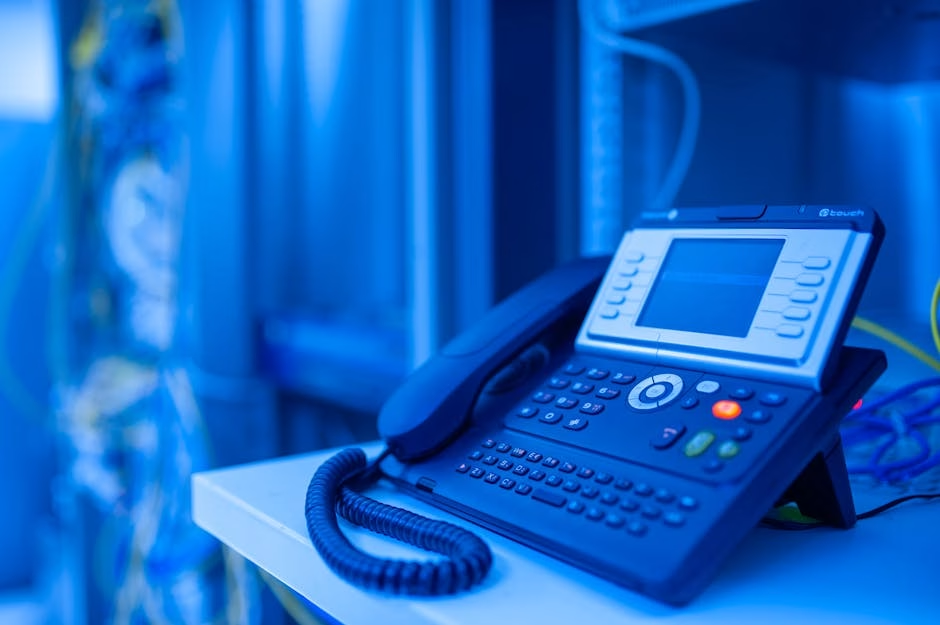
An ip desk phone is a business telephone that makes and receives calls over the internet instead of traditional copper phone lines. If you’re trying to decide whether to switch, here’s the short answer:
Best IP desk phones by use case:
| Use Case | Recommended Type |
|---|---|
| General office staff | Entry-level SIP desk phone (e.g., Yealink T3 series) |
| Managers and power users | Mid-range multi-line IP phone (e.g., Yealink T4/T5, Poly Edge E series) |
| Executives | Premium video IP phone with touchscreen |
| Hot-desking / remote work | Wi-Fi enabled or softphone-compatible model |
| Call centers | Multi-line IP phone with expansion module support |
IP desk phones connect through your existing internet connection via an Ethernet cable or Wi-Fi. They use a protocol called SIP (Session Initiation Protocol) to send voice as digital data packets — the same way email or a website travels over the internet. This means no phone jack required, lower monthly costs, and a lot more features than a traditional landline.
The global VoIP market was valued at $132.47 billion in 2023 and is projected to reach $326.27 billion by 2032 — a clear signal that businesses of all sizes are making the switch.
I’m Patrick Brangan, a unified communications specialist with 20+ years of experience helping SMBs choose and deploy ip desk phone systems across Dallas, Tampa, and Orlando. In this guide, I’ll walk you through everything you need to know to make a confident, cost-effective decision for your business.
How the IP Desk Phone Works and Differs from Landlines
To understand why the ip desk phone has become the gold standard for modern offices in Fort Worth and Clearwater, we have to look under the hood. Traditional landlines rely on the Public Switched Telephone Network (PSTN), which uses physical copper wires and “circuit switching” to maintain a dedicated connection for the duration of a call. It’s reliable, but it’s also rigid and expensive to maintain.
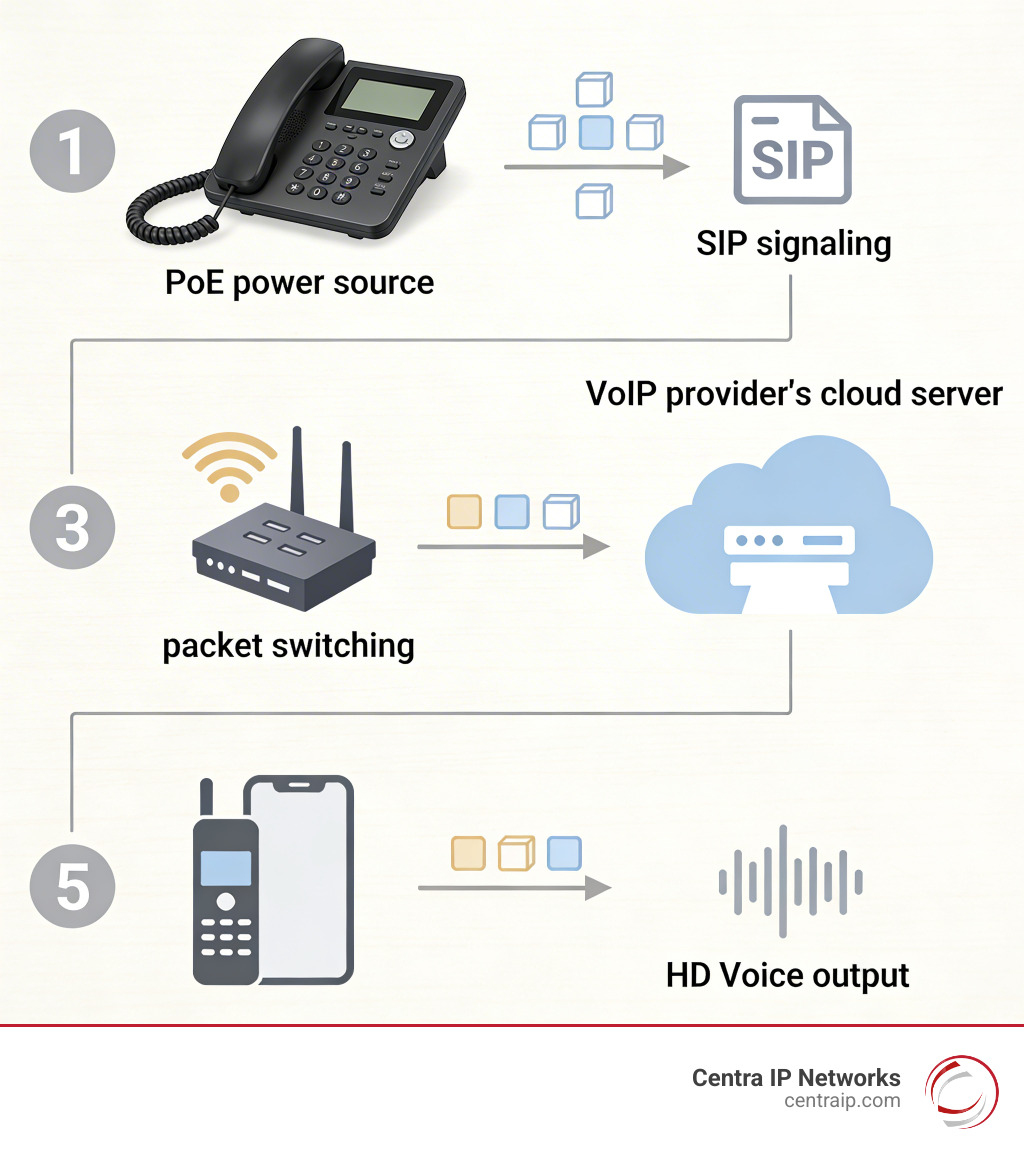
An ip desk phone, however, operates on “packet switching.” When you speak into the handset, your voice is chopped up into tiny digital data packets. These packets are sent over your local area network (LAN) via Ethernet or Wi-Fi using the SIP protocol (Session Initiation Protocol). SIP acts like a digital traffic controller, establishing the connection, managing the call, and tearing it down when you hang up. For a deeper dive into the hardware itself, check out our guide on What is a VoIP Phone?.
The “HD Voice” Advantage
One of the most immediate differences you’ll notice is the sound quality. Traditional landlines have a very narrow frequency range. Modern IP phones often use the OPUS or G.722 codecs, which provide “HD Voice.” This technology uses roughly double the audio frequency range of a landline, making voices sound crisp, clear, and much more natural. It’s the difference between listening to an old AM radio and a high-fidelity digital recording.
Key Differences at a Glance
| Feature | Traditional Landline | IP Desk Phone |
|---|---|---|
| Connectivity | Copper RJ-11 Phone Jack | Ethernet (RJ-45) or Wi-Fi |
| Technology | Circuit Switching (PSTN) | Packet Switching (VoIP/SIP) |
| Audio Quality | Standard Definition | HD Voice (Wideband Audio) |
| Scalability | Requires new physical wiring | Plug-and-play via internet |
| Features | Basic (Hold, Transfer) | Advanced (Video, CRM Integration, AI) |
| Mobility | Tied to a physical wall jack | Can be moved to any internet port |
Making the jump to an internet-based system isn’t just about changing the hardware; it’s about modernizing your entire workflow. You can learn more about why this shift is essential in our article on IP Phone Systems Explained: Why Your Business Needs This Upgrade.
Types of IP Desk Phones and Essential Features
The beauty of the ip desk phone market today is the sheer variety. Whether you are a small non-profit in Sarasota or a large law firm in Dallas, there is a device tailored to your specific “desk duty.”
Leading Manufacturers and Series
When we consult with clients, we typically look at the “Big Three” of the hardware world:
- Cisco: A true industry titan. Cisco has shipped 2.5 times more IP phones than its closest competitor, with over 100 million units sold globally since 1998. Their 8800 Series is a favorite for mid-to-large enterprises, offering high-quality wideband audio and optional video capabilities.
- Poly (formerly Polycom): Known for their “legendary” audio. The Poly Edge E series features NoiseBlockAI and Acoustic Fence technology, which are lifesavers in open-office plans in Tampa or Orlando where background chatter is constant.
- Yealink: These are the “Swiss Army Knives” of the industry. The Yealink T5 series offers everything from smart business phones with adjustable screens to models with built-in Wi-Fi and Bluetooth.
For a comprehensive look at what these devices can actually do beyond just making calls, see our breakdown of VoIP Phone Features Today. If you are looking for the absolute cutting edge, you might want to Learn more about the Cisco 9800 Series, which introduces AI-powered audio and desk reservation features.
Essential Features of a Modern IP Desk Phone
When shopping for an ip desk phone, don’t just look at the number of buttons. Consider these technical “must-haves”:
- Power over Ethernet (PoE): This allows the phone to draw power directly from the Ethernet cable. This means fewer wires cluttering the desk and no need for a bulky “wall wart” power adapter at every station.
- Bluetooth 5.2: Essential for modern professionals. It allows you to pair your mobile phone or a high-quality wireless headset seamlessly. We’ve written extensively about Choosing the Right Headset for Work to complement these devices.
- Wi-Fi 6 Support: In older buildings in St. Petersburg or Clearwater where running new Ethernet cable is difficult or expensive, Wi-Fi-enabled desk phones are a game-changer.
- Gigabit Ethernet Pass-through: Most IP phones have two ports on the back. You plug the wall jack into the phone, and then plug your PC into the phone. A “Gigabit” switch ensures your computer’s internet speed isn’t throttled by the phone.
Sustainability and the Modern IP Desk Phone
Sustainability is no longer just a buzzword; it’s a procurement requirement for many Florida and Texas businesses. Manufacturers are responding by using circular design principles. For instance, the Cisco Desk Phone 9800 Series uses more than 74% post-consumer recycled (PCR) plastics. These devices are also EnergyStar certified and include energy-saving modes that power down the screen during off-hours. You can find the full environmental specs in the Cisco 9800 Series Sustainability Data Sheet.
Choosing the Right IP Desk Phone System for Your Business
Selecting the hardware is only half the battle; you also need a provider that understands the local landscape. At Centra IP Networks, we specialize in providing tailored solutions for companies in Dallas, Fort Worth, Orlando, and across the Tampa Bay area.
The global VoIP market is booming, and for good reason. As businesses move away from legacy systems, they are looking for scalability. With an ip desk phone system, adding a new employee is as simple as ordering a handset and plugging it in. There’s no need to wait for a technician to come out and punch down new wires in a closet.
Managed Solutions and Hardware as a Service (HaaS)
One hurdle for many small businesses is the upfront cost of high-end hardware. That’s why we often recommend Hardware as a Service. Instead of a massive capital expenditure (CAPEX), you can get the latest Cisco or Yealink technology for a predictable monthly subscription. This ensures your team always has the latest features and that your hardware is covered by a comprehensive warranty.
Whether you are looking for VoIP Phones for Tampa, Orlando and Dallas Companies or a complete overhaul of your communication stack, we provide everything on one platform with a single bill. This “single pane of glass” management style is why more than 95% of Fortune 500 companies use similar collaboration solutions — and we bring that same level of sophistication to local businesses. For more on the strategic benefits, read about VoIP Phone Systems for Business.
Frequently Asked Questions about IP Desk Phones
Switching to a new technology always brings up questions. Here are the ones we hear most often from our clients in the field.
Can I use an IP phone as a normal phone?
Absolutely. In fact, for the person making the call, the experience is almost identical to a “normal” phone. You lift the handset, dial the number, and talk. The difference is all on the back end. You can even keep your existing business phone numbers through a process called “porting.” The only major change is that your phone now plugs into an internet router or network switch instead of a wall-mounted phone jack.
Do VoIP phones have a monthly fee?
The hardware itself doesn’t have a “fee” once you own it, but the service does. Think of it like a cell phone: you can buy the device, but you still need a monthly plan from a provider to make calls. However, because VoIP uses the internet, these monthly fees are typically significantly lower than traditional business landline rates, often including unlimited long distance and advanced features like auto-attendants at no extra cost.
What is the difference between an IP phone and a softphone?
This is a great question for the hybrid work era.
- IP Desk Phone: A physical piece of hardware that sits on your desk. It’s always “on,” has a dedicated handset, and provides the best audio quality.
- Softphone: An application that runs on your computer, tablet, or smartphone. It mimics the functions of a desk phone, allowing you to take your business extension with you anywhere you have an internet connection.
Most modern businesses use a combination of both. You might have a high-end ip desk phone in your office in Dallas but use a softphone app on your laptop when visiting clients in Sarasota. You can find More info about VoIP softphone apps on our blog.
Conclusion
The shift to the ip desk phone is more than just a hardware upgrade; it’s a move toward a more flexible, sustainable, and cost-effective way of doing business. From the AI-driven noise cancellation of the newest Cisco models to the rugged mobility of DECT handsets for warehouses, there is a solution for every “desk duty” imaginable.
At Centra IP Networks, we pride ourselves on being more than just a vendor. We are your local partners in Dallas, Tampa, and beyond, helping you navigate the complex world of Managed IT and Unified Communications. By putting your phone system, internet connectivity, and cloud solutions on a single platform, we eliminate the headache of dealing with multiple providers and confusing bills.
Ready to clear the clutter and upgrade your office communication? Explore our cloud-based phone systems or contact us today for a tailored consultation. Let’s get your business connected with the right technology for the modern world.