What Is Future-Proof Technology — and Why Does It Matter Right Now?
Future-proof technology refers to systems, hardware, and software designed to remain useful and adaptable as new demands, threats, and innovations emerge — without requiring a complete overhaul every few years.
Here’s a quick breakdown of what it means in practice:
| Pillar | What It Means |
|---|---|
| Scalability | Grows with your business without breaking |
| Flexibility | Adapts to new tools, workflows, and integrations |
| Interoperability | Works with other systems, old and new |
| Security | Stays protected as threats evolve |
| Modularity | Lets you upgrade parts without replacing everything |
The honest truth? No technology is 100% future-proof. As one industry perspective puts it, the goal isn’t prediction — it’s preparation. You’re not trying to see the future. You’re building systems that can bend without breaking when the future arrives.
For businesses managing multiple vendors, juggling aging hardware, and trying to adopt AI tools — this distinction matters enormously. Outdated systems don’t just slow you down. They create security gaps, frustrated employees, and hidden costs that compound over time.
I’m Patrick Brangan, a business technology specialist with 20+ years of experience helping SMBs cut through the noise and build future proof technology solutions across unified communications, managed IT, and security. In this guide, I’ll walk you through exactly how to build a tech foundation that lasts.

Future proof technology basics:
The Core Characteristics of Future-Proof Technology
When we talk about future-proof systems, we are looking for specific DNA markers that suggest a product or system won’t be in a landfill by next Christmas. These characteristics—scalability, flexibility, and interoperability—act as the insurance policy for your IT budget.
Scalability is the ability of a system to handle growth. If your business in Dallas or Orlando adds fifty employees tomorrow, your phone system shouldn’t require a week of downtime and a new server rack to accommodate them. Flexibility means your tools can pivot; perhaps you start with simple voice calls but later need to integrate video conferencing and AI-driven analytics.
Interoperability is perhaps the most critical “quiet” feature. It’s the ability of different systems to talk to one another using open standards and modular architecture. When technology is built on proprietary “walled gardens,” you get stuck. When it’s built on open APIs (Application Programming Interfaces), it can plug into the next big thing without a fuss.
Why True Future-Proof Technology is a Moving Target
We have to be honest: the phrase “future-proof” is a bit of a misnomer. Technology moves at a breakneck pace, and what is cutting-edge today is often legacy tomorrow. True future-proofing is less about buying a “final” product and more about a continuous process of adaptation.
The biggest enemy of longevity is technical debt—the cost of “easy” or “cheap” decisions made in the past that now prevent you from moving forward. For example, if you chose a bargain-bin on-premise PBX five years ago, you might now find it impossible to integrate with modern AI agents or remote work tools. Rapid obsolescence happens when we prioritize the “now” over the “next.” By focusing on preparation over exact prediction, we build systems that are ready for whatever 2026 and beyond might throw at us.
Sustainable Design and Interoperability
Building a digital world that lasts requires an “API-first” mindset. This means choosing software and hardware that are designed from the ground up to integrate with other ecosystems. We call this ecosystem synergy.
In our work across Florida and Texas, we see that the most resilient businesses are those that avoid “monolithic” software. Instead, they use integrated suites where the CRM, the phone system, and the security cameras all share data. This reduces friction and ensures that when one part of the stack needs an upgrade, the entire house of cards doesn’t come tumbling down.
The Strategy of “Separates”: Balancing Hardware and Software
One of the smartest ways to approach future proof technology is to borrow a page from high-end audio. Audiophiles often use “separates”—a standalone amplifier, a separate turntable, and individual speakers—rather than an all-in-one shelf system. Why? Because different components age at different speeds.

Physical components governed by the laws of physics—like speakers, amplifiers, or high-quality server cabinets—can last for decades. However, digital components—like the processors in an AV receiver or a streaming device—become obsolete quickly as new software standards emerge.
| Component Type | Expected Lifespan | Why? |
|---|---|---|
| Speakers / Amps | 15 – 25 Years | Physics-based; sound quality standards change slowly. |
| Structured Cabling | 10 – 15 Years | High-quality copper or fiber has massive “headroom.” |
| AV Receivers | 3 – 5 Years | New HDMI standards and codecs (like Dolby Atmos) change constantly. |
| Smartphones / IoT | 2 – 4 Years | Battery degradation and processing power demands. |
By separating the “brains” (software/processors) from the “brawn” (hardware/infrastructure), you can upgrade the inexpensive digital parts while keeping the expensive physical foundation.
Avoiding Common Mistakes in Tech Procurement
We’ve seen it all: businesses chasing “promised” features that never arrive in a firmware update, or buying cheap hardware that lacks the processing power to handle next year’s security encryption.
One major pitfall is vendor lock-in. If you buy a system that only works with one specific brand of cable or one specific file format, you are at their mercy. Choosing the right file formats and open-standard hardware ensures that you own your data and your destiny. Don’t buy technology for what it might do in a future update; buy it for what it can do today and how easily it can be replaced tomorrow.
Investing in High-Quality Infrastructure
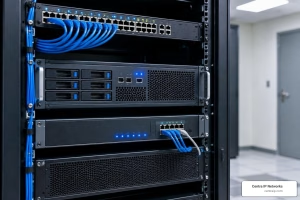
In IT, you often “pay now or pay later.” High-quality infrastructure—like enterprise-grade routers and high-performance cabling—offers a significant performance overhead. This “extra” power might seem like overkill today, but it’s what allows you to future-proof with a unified communications solution as your data needs grow.
Physical durability matters too. In the humid climates of Tampa or Clearwater, or the heat of Fort Worth, entry-level hardware often fails due to poor thermal management. Investing in hardware with a higher build quality ensures business continuity and a much better long-term ROI.
Building the Foundation: Network Modernization and AI Readiness
If your network is the “road” your data travels on, then AI is a fleet of heavy-duty semi-trucks. Most legacy networks were built for the “bicycle traffic” of simple emails and basic web browsing. To be ready for 2026, your network needs a massive upgrade.
Modernization means moving away from “flat” network architectures where everything is on one big, messy loop. Instead, we use network segmentation to isolate sensitive data and AI workloads. We also implement Quality of Service (QoS) to prioritize critical traffic. For instance, your IP phone system should always have priority over an employee downloading a large file, ensuring your voice calls never drop or jitter.
Whether you are choosing between on-premise vs. cloud PBX, the underlying network is what will determine your success.
How Infrastructure Enables Effective AI Adoption
You can have the most advanced AI chatbot in the world, but if your network has high latency, that bot will be slow and frustrating for customers. Statistics show that integrating an AI chatbot solution can result in a 40% reduction in response time and a 25% increase in customer satisfaction—but only if the data can move freely.
AI requires continuous data movement and consistent uptime. This is where the advancements of VoIP technology come into play. Modern cloud-based systems are designed to handle the high-speed data exchanges that AI requires, turning your communication system into a data-gathering powerhouse rather than just a way to talk.
Actionable Steps to Implement Future-Proof Technology by 2026
Ready to get started? Here is your roadmap for the next 24 months:
- Audit Your Connectivity: If you aren’t on fiber internet yet, you’re already behind. Fiber provides the symmetrical speeds (upload and download) necessary for cloud operations. Use tools like BroadbandNow to check availability in your specific ZIP code in Sarasota or St. Petersburg.
- Prioritize Cybersecurity: Future-proofing isn’t just about speed; it’s about survival. Implement Multi-Factor Authentication (MFA) and regular vulnerability scans as non-negotiables.
- Move to the Cloud: Transitioning your phone system and data storage to the cloud allows for automatic updates and scalability that on-premise hardware can’t match.
- Train Your Team: The best technology is useless if your team doesn’t know how to use it. Stay ahead of trends in business communications by fostering a culture of continuous learning.
Industry Frontiers: From Quantum Computing to 6G
While we focus on 2026, the tech giants are looking even further ahead. IBM, for example, has released a Quantum Roadmap that aims to deliver “IBM Quantum Starling” by 2029. This fault-tolerant quantum computer will be capable of running circuits with 100 million gates on 200 logical qubits.
What does this mean for you? It means that the encryption we use today will eventually be vulnerable. Future proof technology isn’t just about faster internet; it’s about preparing for a world where “quantum-safe” cryptography is a requirement for data sovereignty.
The Evolution of Connectivity with 6G and IMT-2030
While we are still perfecting 5G, the ITU (International Telecommunication Union) has already laid out the technical requirements for 6G, known as IMT-2030. This next generation of connectivity will focus on “ubiquitous intelligence”—connecting not just people and phones, but integrating sensing and communication into the very fabric of our cities.
This shift will redefine the future of work. Imagine a world where your network doesn’t just send data, but actually “senses” the environment to optimize performance in real-time.
Quantum Resistance and Long-Term Security
To protect against future quantum threats, researchers are developing fault-tolerant quantum memory and new cryptographic codes. For example, “Bivariate bicycle (BB) codes” are being tested because they require 10x fewer qubits to correct errors than previous methods.
For the average business in Dallas or Tampa, this means that your future security providers will likely move toward “lattice-based encryption.” This is the “high-level” version of future-proofing—making sure your data remains private even when computers become millions of times more powerful than they are today.
Frequently Asked Questions about Future-Proofing
How can businesses distinguish between components that age slowly and those that become obsolete quickly?
The rule of thumb is “Physics vs. Processing.” Components that rely on physical quality—like high-end speakers, copper cabling, and server racks—age slowly because the standards for physical excellence don’t change often. Components that rely on software and processing power—like routers, smartphones, and AV receivers—age quickly because software demands and encryption standards evolve every few years.
What role does network modernization play in supporting AI workloads?
AI is data-hungry and latency-sensitive. A legacy, “flat” network will choke under the constant data streams required by AI agents. Modernization provides the necessary “pipes” (bandwidth) and “traffic lights” (QoS) to ensure AI tools can function without slowing down the rest of your business operations.
What are the most common mistakes companies make when trying to future-proof?
The most common mistakes include:
- Chasing Hype: Buying gear for “promised” future features that aren’t yet active.
- Buying Cheap: Selecting consumer-grade hardware for business needs, leading to frequent failures and lack of security.
- Vendor Lock-in: Buying proprietary systems that don’t use open APIs, making it impossible to switch or integrate with other tools later.
Conclusion
At Centra IP Networks, we believe that technology should serve your business, not the other way around. By focusing on future proof technology, we help you move away from the “break-fix” cycle and toward a world of seamless, scalable growth.
Our mission is to provide businesses across Texas and Florida with a unified platform for Managed IT and Cloud Communications. Whether you need a cloud-based phone system, a robust fiber connection, or a complete network overhaul, we bring all your services under one provider with a single, transparent bill.
Don’t wait for the future to break your current systems. Let’s build a foundation that is ready for whatever comes next. Reach out to us today to start your journey toward a truly future-proof digital world.