
What Is a Cloud Application Platform and How Does It Work?
At its core, a cloud application platform provides a fully managed runtime environment that eliminates the need to provision, configure, and manage underlying servers, storage, or operating systems. Instead of spending valuable time setting up virtual machines or configuring networking parameters, development teams simply upload their source code or container images. The platform automatically handles code compilation, dependency resolution, execution, and continuous health monitoring.
This shift abstracts away complex lifecycle management tasks. Modern platforms automatically deploy incoming code changes, manage background worker processes, and connect databases seamlessly through standardized service bindings. Understanding what is a cloud infrastructure helps illustrate how these abstractions sit directly on top of bare-metal hardware and hypervisors to deliver a streamlined developer experience.
Cloud Architecture vs On-Premise Infrastructure
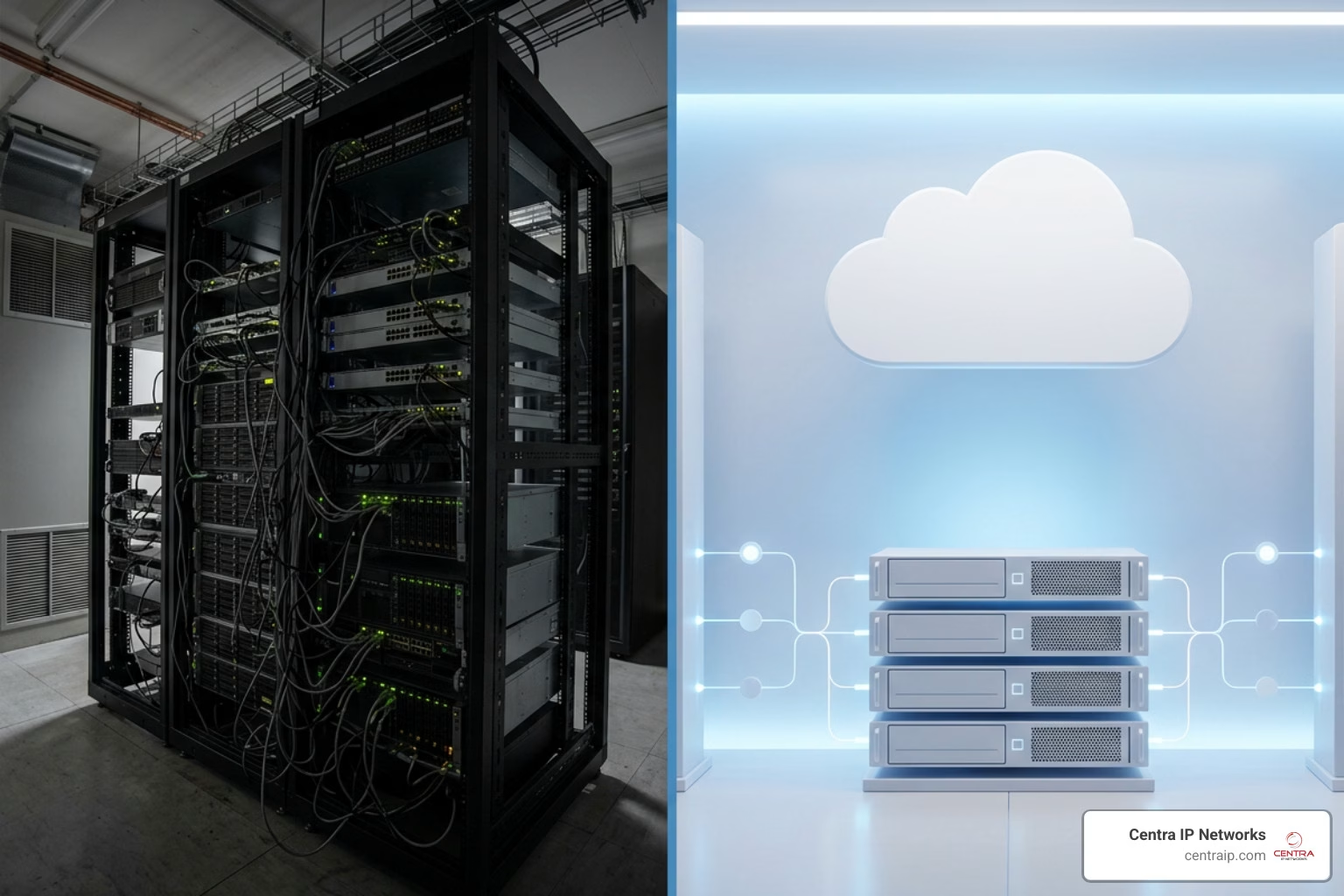
Transitioning from traditional on-premise setups to a cloud platform fundamentally changes operational overhead. In an on-premise model, organizations incur heavy capital expenditures (CapEx) to purchase physical hardware, maintain cooling and data center facilities, and manually handle operating system upgrades, security patches, and network routing.
Cloud platforms convert these capital expenses into operational expenses (OpEx) while shifting system maintenance responsibilities directly to the platform vendor.
| Feature / Metric | On-Premise Infrastructure | Cloud Application Platform |
|---|---|---|
| Resource Provisioning | Weeks or months for hardware procurement | Seconds or minutes via automated APIs |
| Scaling Capability | Manual installation of physical servers | Automated load-based autoscaling |
| System Maintenance | In-house IT handles patches, firmware, & OS | Vendor-managed zero-downtime updates |
| Cost Model | High upfront CapEx + recurring facility costs | Flexible pay-as-you-go subscription OpEx |
| SLA Guarantees | Dependent on local redundancy setup | Enterprise SLAs (e.g., up to 99.999% availability) |
Core Components of Platform Services
A complete cloud application platform unifies several key technical components into a cohesive ecosystem:
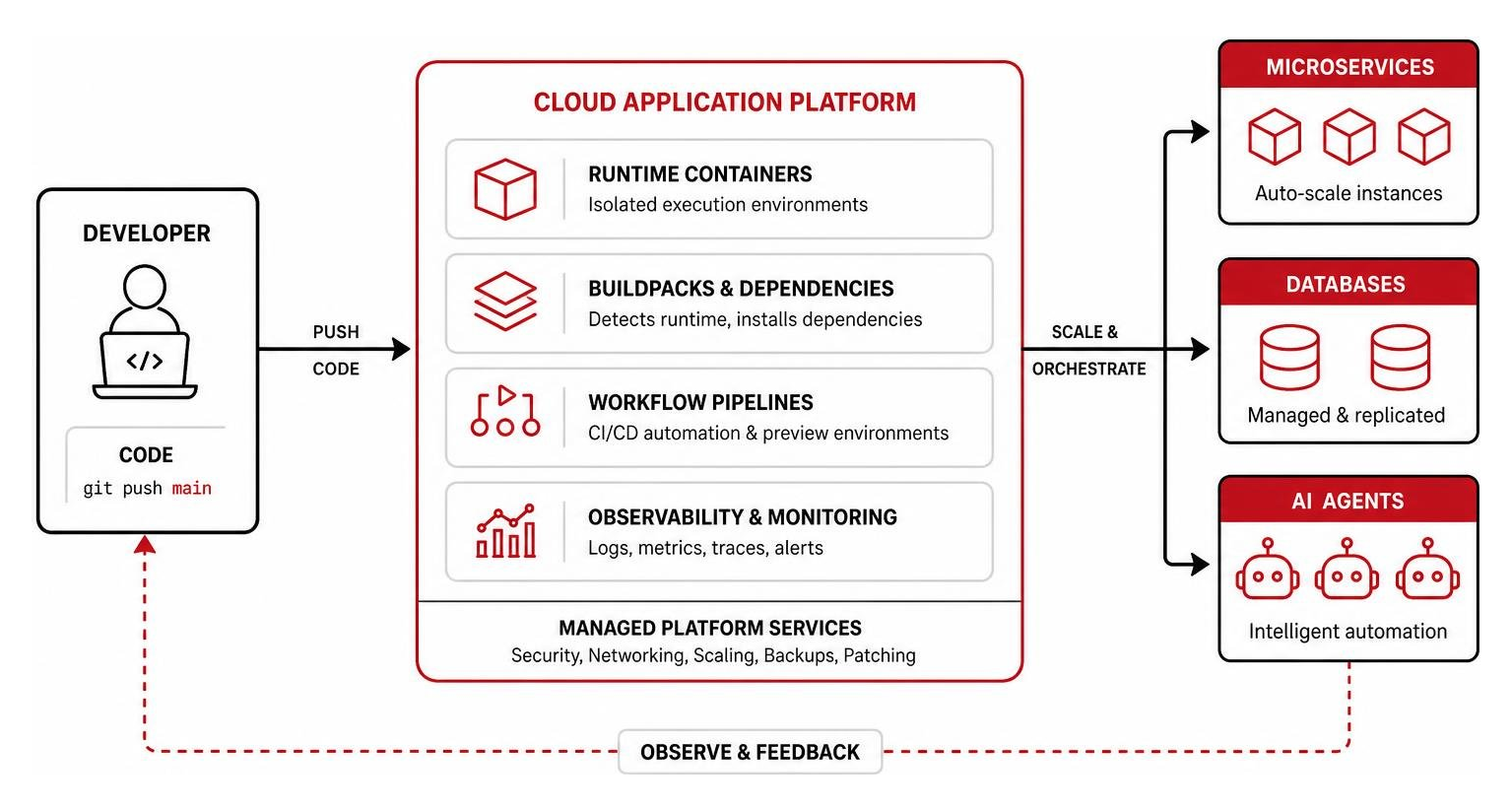
- Runtime Containers & Execution Environments: Smart containers (such as Heroku Dynos or Google Cloud Run containers) execute application code cleanly isolated from other tenants.
- Buildpacks & Dependencies: Automated build toolchains detect runtime environments (Node.js, Python, Java, Go, Ruby) and assemble code dependencies automatically without requiring manual Dockerfile scripts.
- Workflow Pipelines & Automation: Integrated continuous integration and continuous deployment (CI/CD) pipelines automatically spin up disposable preview environments for incoming code pull requests.
- Observability & Monitoring Metrics: Integrated telemetry dashboards collect logs, traces, system events, and application performance metrics in real time to provide complete visibility.
To dive deeper into how these building blocks empower engineering teams, check out our guide on how platform as a service is the developer’s cloud secret.
Key Benefits and Types of Cloud Application Platforms
Adopting a cloud application platform fundamentally accelerates product delivery and improves organizational agility. By removing infrastructure management from the engineering workflow, software teams focus exclusively on writing business logic that drives customer value.
Primary Advantages for Developers and Enterprises
The strategic advantages of modern platform adoption impact both day-to-day coding and high-level enterprise budgets:
- Zero-Ops Workflows: Developers can push code directly to production using familiar tools like Git (
git push heroku main), bypassing complex server administration entirely. - Measurable Productivity Gains: Research by Forrester indicates that adopting a fully managed PaaS can reduce DevOps toil by 35% and boost developer productivity by up to 40%, yielding a 286% return on investment over three years.
- Dynamic Autoscaling: Systems adjust compute capacity instantly during unpredictable traffic spikes, scaling up during peak usage and down to zero during off-peak hours to avoid paying for idle resources.
- Reduced Total Cost of Ownership: Eliminating dedicated server management and manual security patching allows businesses to redirect technology spending toward core product features.
Modern Architecture Types of a Cloud Application Platform
Different application workloads require varying levels of infrastructure abstraction:
- Platform as a Service (PaaS): Provides fully managed execution environments, standard runtime stacks, and managed data stores (e.g., Heroku Platform, Upsun).
- Serverless & Event-Driven Platforms: Computes code on demand in response to HTTP requests or event triggers without running persistent server instances (e.g., AWS Lambda, Cloudflare Workers).
- Container Orchestration Engines: Runs custom Docker containers with high architectural flexibility while abstracting server hardware configuration (e.g., Google Cloud Run, Red Hat OpenShift).
- Low-Code & No-Code Platforms: Uses graphical drag-and-drop interfaces and visual templates to empower business analysts and non-technical staff to build functional software.
- Agentic PaaS: The newest evolution in platform design, purpose-built to orchestrate, govern, and host autonomous AI agents, multi-agent frameworks, and vector search workloads safely (e.g., VMware Tanzu Platform).
Top Cloud Application Platforms to Watch in 2026
The platform ecosystem spans massive hyperscaler providers, developer-first hosting platforms, and specialized enterprise orchestration layers.
| Platform | Primary Focus | Best For | Standout Features |
|---|---|---|---|
| AWS Elastic Beanstalk | Hyperscaler Infrastructure | Enterprise AWS Workloads | Broad toolchain integration (300+ AWS services) |
| Google Cloud App Engine | Managed Serverless Web Apps | Multi-Language Web Projects | Zero-config autoscaling, $300 starter credit |
| Heroku | Developer Experience & Simplicity | Startups & Mid-Market Apps | 150+ add-ons, 380+ buildpacks, Heroku Connect |
| Render | Modern Zero-Ops Cloud Hosting | Fast-Growing SaaS & APIs | Ephemeral previews, cost-effective scaling |
| VMware Tanzu | Agentic Private Cloud PaaS | Highly Regulated Enterprises | Model Context Protocol gateways, Zero-Trust |
| Upsun | Multi-Cloud Infrastructure | Flexible Global Deployments | Guardrails across AWS, Azure, GCP, & OVHcloud |
Leading Hyperscaler Application Platforms
- AWS Elastic Beanstalk: Deploys web applications on Amazon Web Services while automatically handling load balancing, provisioning, autoscaling, and health monitoring. It is ideal for organizations deeply embedded in the AWS ecosystem.
- Google Cloud App Engine & Cloud Run: Provides a fully managed platform with zero server management. App Engine supports popular stacks like Python, Node.js, Java, and Go, while Cloud Run allows developers to run arbitrary stateless containers.
- Microsoft Azure App Service: Integrates smoothly with enterprise Active Directory and Microsoft 365 toolchains, supporting enterprise web and mobile backend applications with enterprise security compliance.
Developer-Centric PaaS Platforms
- Heroku: A pioneer in developer simplicity, Heroku offers managed dyno runtimes, Heroku Postgres with
pgvectorsupport, and native Salesforce integration via Heroku Connect. Its ecosystem features over 150 third-party add-ons and 380 buildpacks. - Render: A fast-growing modern cloud platform trusted by over 6 million builders. Render provides an intuitive alternative to hyperscaler complexity, supporting automatic Git deployments, private networking, and managed databases. In fact, migrating from GCP to Render saved one enterprise customer over $60,000 annually.
- Upsun: Delivers flexible cloud infrastructure with built-in governance guardrails. It supports over 10 runtime languages and enables seamless deployment across multi-cloud environments including AWS, Azure, GCP, and IBM Cloud.
- VMware Tanzu Platform: Purpose-built as an “Agentic PaaS” for private cloud setups, Tanzu accelerates app modernization, reduces legacy tech debt, and implements automated zero-trust compliance for enterprise Java and Spring applications.
AI Integration, Security, and Cost Optimization
Modern software development requires platforms that support specialized artificial intelligence tools while enforcing strict cybersecurity frameworks.
Key Features to Look For in a Cloud Application Platform
When evaluating a cloud application platform, technology leaders should prioritize the following core capabilities:
- Multi-Cloud Portability: Prevents strict vendor lock-in by supporting cross-cloud deployments or containerized standard runtimes.
- Zero-Trust Security & Governance: Enforces fine-grained Identity and Access Management (IAM), role-based permissions, and continuous runtime vulnerability scanning.
- Native CI/CD Integration: Automatically links code repositories (GitHub, GitLab) to build pipelines and isolated preview environments.
- Integrated AI Workflows: Provides native hosting for Model Context Protocol (MCP) servers, managed inference APIs, and vector similarity search tools like
pgvectordirectly inside managed databases.
AI Workflows, Compliance, and Cost Management
As artificial intelligence shifts from simple chatbots to autonomous agents, cloud platforms are adding native support for vector databases and agent governance. For instance, hosting pgvector on managed PostgreSQL enables retrieval-augmented generation (RAG) applications directly inside the app environment. Modern platforms also offer dedicated MCP gateways that manage API tools and context safely.
Security remains non-negotiable. Leading cloud platforms automate compliance verification for frameworks like HIPAA, SOC 2 Type 2, ISO 27001, PCI-DSS, and GDPR through automated data encryption at rest (AES-128) and in transit, private isolated networking, and continuous patching. To learn more about protecting your cloud stack, read our guide on why cloud security is your business’s new best friend.
Finally, managing cloud spend requires proactive oversight. Organizations can optimize costs by leveraging dynamic autoscaling rules, selecting pay-as-you-go billing models, setting strict budget threshold alerts, and removing idle non-production staging environments.
Frequently Asked Questions
What is the difference between PaaS and IaaS?
Infrastructure as a Service (IaaS) provides raw, virtualized computing resources such as virtual machines, raw storage blocks, and virtual routers (e.g., AWS EC2). The client remains responsible for managing the operating system, middleware, software runtimes, and security updates.
In contrast, Platform as a Service (PaaS) abstracts away the underlying operating system and virtual hardware entirely, providing a fully managed runtime where developers simply upload code or container images.
How do cloud application platforms handle security and compliance?
Cloud application platforms handle security using a shared responsibility model. The platform vendor manages underlying physical data center security, hardware isolation, kernel updates, system vulnerability patching, and automated data encryption.
Most major platforms offer pre-audited compliance controls for standards like SOC 2, HIPAA, ISO 27001, and GDPR. Users only need to configure application-level access controls and keep their custom code dependencies secure.
What are the typical cost models for cloud platforms?
Cloud platforms generally offer three pricing approaches:
- Pay-As-You-Go: Users pay strictly for consumed compute seconds, memory allocation, network data transfer, and active database storage.
- Tiered Monthly Subscriptions: Fixed monthly fees based on resource allocation tiers (e.g., dyno sizes, container memory limits, or managed database tiers).
- Resource Usage Billing: Pricing calculated per active instance hour, combined with storage usage metrics and outbound bandwidth consumption.
Conclusion
Choosing the right cloud application platform is one of the most critical decisions an engineering team can make. By shifting away from manual infrastructure management toward automated deployment pipelines, zero-ops runtimes, and integrated AI capabilities, businesses significantly boost developer efficiency and accelerate speed-to-market.
At Centra IP Networks, we help businesses across Dallas, Fort Worth, Orlando, Tampa, St. Petersburg, Clearwater, and Sarasota simplify their IT footprint. We provide comprehensive Managed IT and Cloud Communications services on a single platform — giving you one point of contact, one predictable bill, and access to over 35 strategic technology partnerships tailored to your operational goals.
Whether you are looking to modernize legacy application workflows, strengthen your cloud security controls, or streamline your connectivity infrastructure, our expert team is ready to assist. Explore our full suite of cloud services today to discover how easy managing your technology can be.