

Why Modern Businesses Are Making the Switch to IP-Based Communication
An ip phone system uses Voice over Internet Protocol (VoIP) technology to transmit voice calls over your internet connection instead of traditional copper phone lines. This digital approach eliminates the need for separate voice and data networks, reduces costs, and unlocks advanced features like auto-attendants, call recording, video conferencing, and seamless mobile integration.
Quick Answer: What is an IP Phone System?
- Technology: Converts analog voice into digital data packets transmitted over the internet
- Cost: Typically $20-$50 per user per month, saving up to 50% vs. traditional landlines
- Deployment: Available as cloud-hosted (no on-site hardware) or on-premises solutions
- Hardware: Works with desk phones, computer softphones, or mobile apps
- Features: Auto-attendant, call recording, CRM integration, HD voice, video calling
- Requirements: Reliable internet connection (minimum 1 Mbps per user)
If you’re managing multiple IT vendors and dealing with outdated phone systems that can’t support your remote workforce, you’re not alone. Over 200,000 businesses worldwide have already made the switch to IP-based communication, and the global IP phone system market has grown to over $20 billion annually.
Traditional phone systems lock you into expensive per-line charges, require costly on-site hardware, and offer limited flexibility for remote workers. IP phone systems eliminate these pain points by running on your existing internet connection and providing a single unified platform for voice, video, and messaging.
The shift to digital communication isn’t just about cost savings—it’s about giving your team the tools they need to work from anywhere while maintaining professional call quality and features. Whether your employees are in the Dallas office, working from home in Tampa, or meeting clients in Orlando, an IP phone system keeps everyone connected on the same business number with full access to company features.
As Patrick Brangan with over 20 years of experience in business technology, I’ve helped hundreds of SMBs across Dallas, Tampa, and Orlando transition to modern IP phone systems that reduce vendor complexity and cut communication costs. My focus has always been on delivering complete unified communication solutions that consolidate voice, data, and security into one manageable platform.
What is an IP Phone System and How Does It Work?
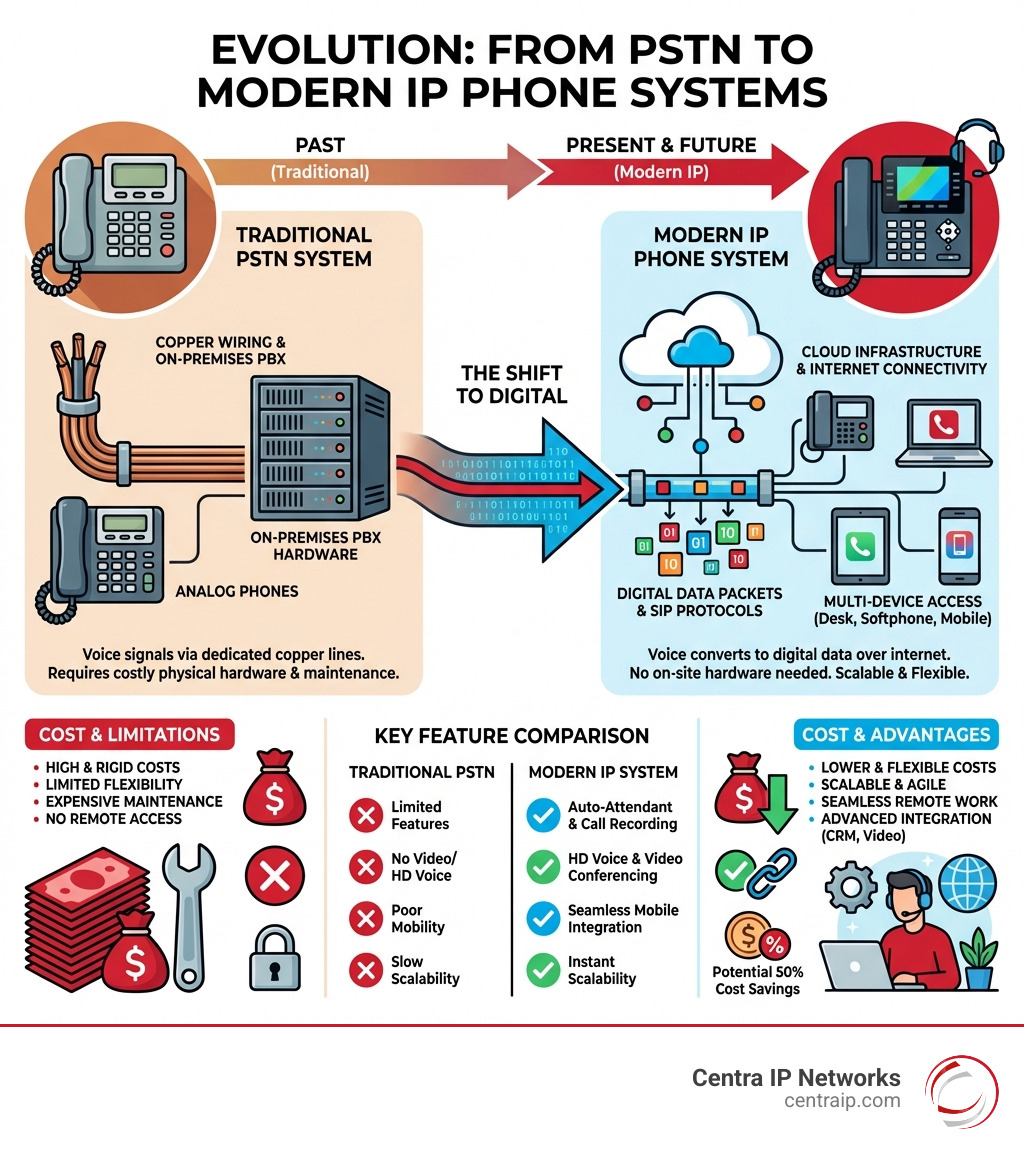
To understand an ip phone system, we first have to look at what it replaces. For decades, businesses relied on the Public Switched Telephone Network (PSTN). This was a “circuit-switched” system that required physical copper wires to run from the phone company to your office in Dallas or Tampa. It was reliable, but it was also rigid, expensive, and about as modern as a floppy disk.
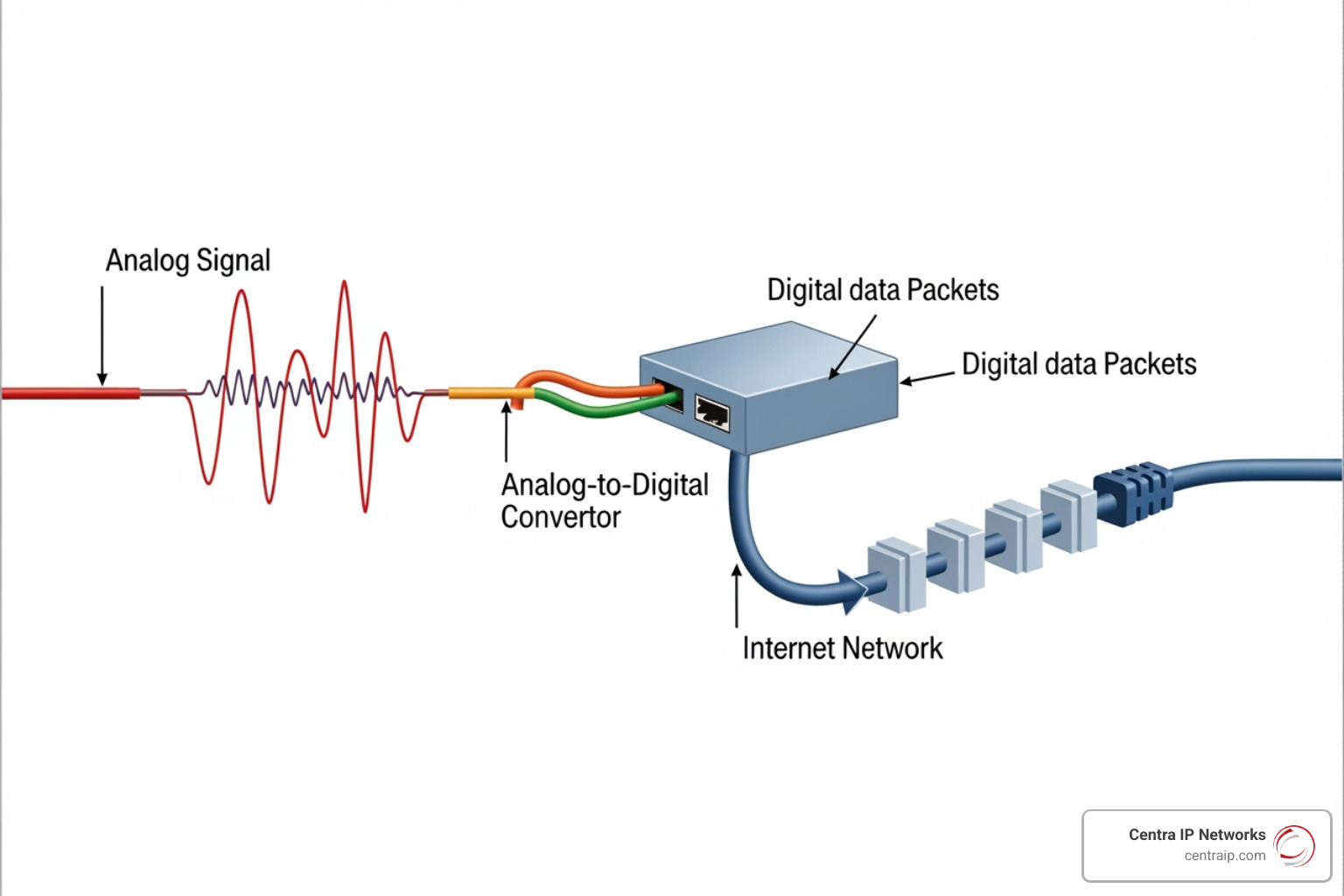
An ip phone system, often referred to as a VoIP (Voice over Internet Protocol) system, flips the script. Instead of sending electrical signals over copper, it converts your voice into digital data packets. These packets travel over the same broadband internet connection you use to check email or stream video.
The global IP telephony market is currently valued at over $20 billion and continues to grow because it offers a clear advantage in cost and flexibility. When you speak into an IP phone, the device uses a “codec” (coder-decoder) to turn your voice into data. These packets are then routed across the internet to the receiver, where they are reassembled into crystal-clear audio.
To get a better handle on how this compares to what you might currently have, check out our guide on VoIP vs Landline for Business.
The Difference Between VoIP and IP Telephony
In casual conversation, people often use “VoIP” and “IP Telephony” interchangeably, but if we’re being technical (and we are!), there is a subtle difference.
- VoIP (Voice over Internet Protocol): This is the specific technology that allows voice calls to be sent over the internet. Think of it as the “engine” that powers the communication.
- IP Telephony: This is the broader concept. It encompasses the entire infrastructure—the hardware, the software, the digital packets, and the network—that allows for a full suite of communication services (including fax, messaging, and video).
Essentially, an ip phone system uses VoIP to function within the broader world of IP telephony. If you’re curious about the physical devices themselves, you can learn more about What is a VoIP Phone and how they differ from the dusty old handset sitting on your desk right now.
How an IP Phone System Handles Data
The “magic” happens through a series of protocols. The most common is SIP (Session Initiation Protocol). Think of SIP as the digital operator that starts, manages, and ends your call. While SIP handles the “handshake” between two phones, RTP (Real-time Transport Protocol) handles the actual delivery of the voice data packets.
For this to work smoothly in your Fort Worth or Sarasota office, your network needs to be healthy. Because voice data is “real-time,” it doesn’t like delays. If your internet is congested, you might experience:
- Latency: A delay between when you speak and when the other person hears you.
- Jitter: When data packets arrive out of order, making the audio sound like a robot in a blender.
This is why we emphasize Why VoIP requires a solid network foundation. With modern broadband and the right router settings, these issues are easily solved, resulting in audio quality that often sounds twice as clear as a traditional landline.
Key Benefits of Upgrading Your Business Communications
If you’re still on the fence about whether an ip phone system is worth the trouble, let’s talk about the “why.” Beyond just sounding better, it changes how your business operates.
- Massive Cost Savings: Businesses that switch to unlimited VoIP plans can save up to 50% on their monthly bills. You no longer need to pay for individual “lines” from the phone company.
- Scalability: Need to add five new employees in your Orlando branch? In the old days, that meant calling a technician to run new wires. With an ip phone system, you just buy a phone, plug it in, and add a user in a web portal.
- Sustainability: We are proud to partner with leaders like Cisco. Their Cisco 9800 Series desk phones are built with more than 74% post-consumer recycled (PCR) plastics, helping your business go green while staying connected.
For a deeper dive into how these systems specifically help organizations, see our resource on VoIP Phone Systems for Business.
Advanced Features of a Modern IP Phone System
The real power of an ip phone system lies in its features. Most of these come standard, whereas traditional systems would charge you extra for every single one.
- Auto-Attendant: A professional “virtual receptionist” that greets callers and routes them to the right department.
- CRM Integration: Imagine your phone system talking to your Salesforce or HubSpot account. When a client calls, their record pops up on your screen before you even say “hello.”
- Presence Monitoring: See at a glance if your colleague in Clearwater is on a call, available, or away from their desk.
- HD Voice: Wideband audio technology makes calls sound natural and clear, reducing “listener fatigue” during long meetings.
Modern systems even offer advanced queue dashboards that allow supervisors to monitor calls, “whisper” to agents during a live call to help them out, or “barge” into a call if things are going south.
Supporting Remote Work and Global Mobility
The “office” isn’t a single building anymore. Whether your team is spread across St. Petersburg or working from a coffee shop in Dallas, an ip phone system keeps them unified.
Using Softphones (apps on a computer) or mobile apps, your employees can make and receive calls using their business number from their personal smartphone. This protects their privacy and ensures a professional appearance for your company.
For those who still prefer a physical desk, tools like the Cisco Webex Desk Hub allow for “hotdesking.” An employee can walk up to any desk in the office, tap their phone to the station, and that desk phone instantly becomes their extension with all their settings and contacts.
Comparing On-Premises vs. Cloud-Based IP Phone Systems
When choosing an ip phone system, you have two main paths: On-Premises or Cloud-Based (Hosted). Here’s how they stack up:
| Feature | On-Premises IP PBX | Cloud-Based (Hosted) VoIP |
|---|---|---|
| Hardware | Server kept in your office closet | No server; hosted by provider |
| Upfront Cost | High (buying the equipment) | Low (usually just the phones) |
| Maintenance | Your IT team handles it | The provider handles it |
| Scalability | Limited by hardware capacity | Virtually unlimited |
| Best For | Large enterprises with strict data control | SMBs looking for flexibility and low cost |
We offer both Premise-based Phone Systems and Cloud-based Phone Systems. If you’re struggling to decide, our blog post on PBX vs Cloud breaks down the decision-making process in detail.
Choosing the Right IP Phone System Hardware
While softphones are great, many businesses still want the tactile feel of a desk phone. The market is full of high-quality options:
- Cisco 8800 Series: The gold standard for executive desks, offering superior video and voice.
- Cisco 7800 Series: Reliable, energy-efficient phones perfect for general office use.
- Yealink: Known for their excellent compatibility with platforms like Microsoft Teams and Zoom.
- VoIP Gateways: If you have expensive analog equipment (like fax machines) you aren’t ready to give up, VoIP Gateways act as a bridge, allowing old tech to work on your new IP network.
Setting Up and Securing Your Network for VoIP
Setting up an ip phone system isn’t just about plugging in a few phones. To ensure high-quality calls, your network needs to be optimized.
- Bandwidth: You need about 100 Kbps (0.1 Mbps) of upload and download speed per concurrent call. For most modern offices in Dallas or Orlando, this is a breeze, but it’s worth checking.
- QoS (Quality of Service): This is a setting on your router that tells it to prioritize “voice” traffic over “data” traffic. This ensures that if someone starts a large file download, your phone call doesn’t start breaking up.
- E911 Compliance: Because IP phones can be moved anywhere, you must ensure your provider has E911 (Enhanced 911) set up, which links a physical address to each extension so emergency services know where to go.
For a smooth implementation, we recommend looking at our comprehensive IP Phone Systems services to ensure your infrastructure is ready.
Important Security Features in an IP Phone System
Because your phone calls are now data traveling over the internet, security is paramount. You wouldn’t leave your email unencrypted, and you shouldn’t leave your phone calls exposed either.
- TLS (Transport Layer Security): Encrypts the “signaling” of the call so hackers can’t see who you are calling.
- SRTP (Secure Real-time Transport Protocol): Encrypts the actual voice data, ensuring that even if someone intercepted the packets, they would just hear gibberish.
- SBCs (Session Border Controllers): Think of an SBC as a specialized firewall for your phone system. It protects against “denial of service” attacks and ensures only authorized traffic gets through. You can upgrade your security with SBCs to protect your remote workers.
Cisco provides a great security overview of how their modern handsets protect user data through multi-factor authentication and secure boot processes.
Frequently Asked Questions about IP Telephony
What is the difference between an IP phone and a regular phone?
A regular phone uses analog signals over copper wires (PSTN). An IP phone is essentially a mini-computer that converts sound into digital data. IP phones offer much higher audio quality (HD Voice), can handle multiple calls on one “line,” and can be moved to any internet jack in the world while keeping the same number.
Can I use my existing internet for an IP phone system?
In 99% of cases, yes! As long as you have a stable broadband connection with at least 1 Mbps of upload/download speed, you can run an ip phone system. However, we always recommend a network assessment to ensure your router supports QoS to keep call quality high during peak office hours.
How much does an IP phone system cost?
Most businesses move to a subscription model, paying between $20 and $50 per user per month. This usually includes all your long-distance calling and features. If you don’t want to buy hardware upfront, we offer Hardware as a Service (HaaS) options, allowing you to get the latest Cisco or Yealink phones for a small monthly fee instead of a large capital expense.
Conclusion
The transition to an ip phone system is no longer a luxury—it’s a necessity for any business that wants to stay competitive, support a mobile workforce, and reduce overhead. With over 100 million Cisco IP phones sold and millions of FreePBX installations worldwide, the technology is proven, secure, and ready for your business.
At Centra IP Networks, we specialize in making this transition painless. Our unique value is providing Managed IT, internet connectivity, and cloud communications all on one platform. That means one provider, one bill, and one point of contact for everything from your cybersecurity in Fort Worth to your phone system in Tampa.
We leverage over 35 partnerships to tailor a solution that fits your specific needs and budget. Whether you are looking for the sustainability of the Cisco 9800 series or the flexibility of a fully hosted cloud platform, we are here to help.
Ready to leave the copper wires behind? Upgrade to a Cloud-based Phone System today and see how Centra IP Networks can streamline your business communications across Dallas, Orlando, Tampa, and beyond.

