

Why Every New Business Needs a Dedicated Phone Line
Getting a new business phone line is one of the smartest first moves you can make as a business owner. It separates your personal and professional life, builds customer trust, and sets you up to grow without communication chaos.
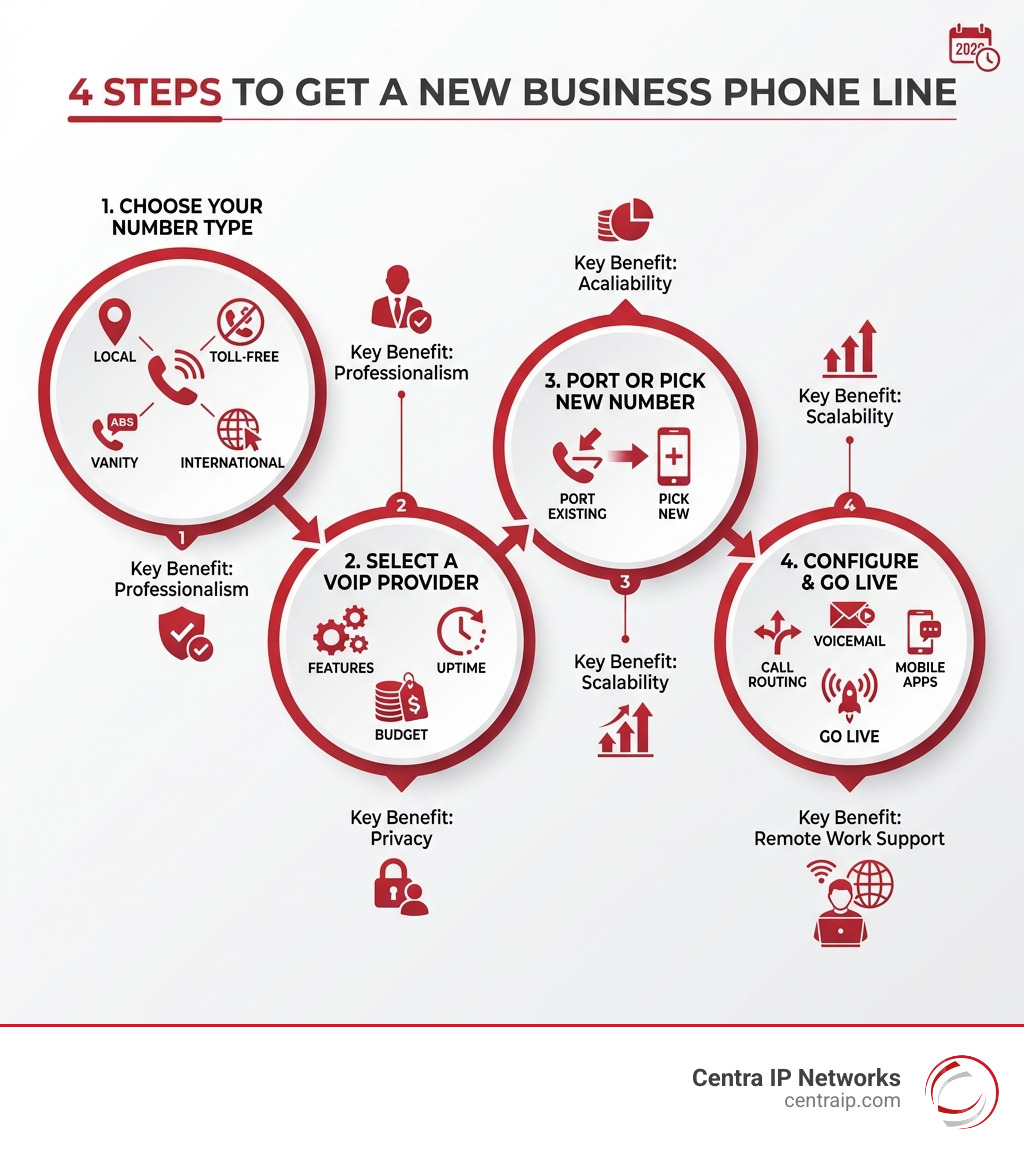
Here’s how to get a new business phone line — fast:
- Choose your number type — local, toll-free, vanity, or international
- Pick a provider — look for VoIP-based systems with reliable uptime and the features you need
- Port your existing number (if needed) — most providers handle this for you
- Configure and go live — set up call routing, voicemail, and apps in minutes
More than 60% of customers still prefer to call small businesses rather than email or chat. If you’re using a personal number, you’re leaving a bad first impression — and risking your privacy.
A dedicated business line isn’t just about looking professional. It’s about being ready for customers, partners, vendors, and growth — from day one.
Whether you’re a solopreneur juggling every call yourself or a small team spread across multiple locations, the right business phone setup changes everything. Modern cloud-based systems (called VoIP) make it faster and cheaper than ever to get started — often for less than $20–30 per month, with no hardware required.
I’m Patrick Brangan, and with over 20 years of experience helping SMBs across Dallas, Tampa, and Orlando set up the right communication solutions, I’ve guided hundreds of businesses through the process of choosing and deploying a new business phone line that actually fits how they work. Let me walk you through everything you need to know.
Why Your Startup Needs a Professional Communication Strategy
In the early days of a startup, it is tempting to just “use what you have.” Usually, that means your personal cell phone. But as we’ve seen with our clients in Fort Worth and Sarasota, that “temporary” fix quickly becomes a permanent headache. A professional communication strategy isn’t just a luxury; it’s a foundational tool that saves business costs by preventing missed opportunities and streamlining how you work.
Using a dedicated phone system allows you to set clear boundaries. When your phone rings at 7:00 PM on a Tuesday, you’ll know immediately if it’s a high-value client or your cousin asking about dinner plans. This separation is vital for maintaining your sanity and ensuring that your business life doesn’t swallow your personal life whole.
Furthermore, privacy is a major concern. Giving your personal number to every vendor, contractor, and “tire-kicker” who visits your website is a recipe for endless spam. A professional line acts as a shield, keeping your private data private while providing a public-facing portal for your brand.
Why Your Startup Needs a Dedicated New Business Phone Line
For solopreneurs, the need for a new business phone line is often about perception. You might be working from your kitchen table in St. Petersburg, but with a professional IVR (Interactive Voice Response) and a polished voicemail greeting, you sound like a major player. It builds instant credibility.
Beyond perception, it’s about the customer experience. If a customer calls and hears a generic “Hey, leave a message” or, worse, a full mailbox, they will likely hang up and call your competitor. A dedicated line ensures calls are routed correctly, whether that’s to your mobile app, a colleague, or a professional answering service. Following 4 Simple Steps to Get a Business Phone Number can take you from “guy with a cell phone” to “established local business” in less than an afternoon.
Understanding the PSTN Big Switch Off
If you are thinking about getting a traditional “landline” from the local phone company, we have some news: the clock is ticking. Globally, the telecommunications industry is moving away from the old copper-wire network known as the PSTN (Public Switched Telephone Network).
In the UK, for example, there has been a stop-sell on new PSTN lines since September 2023, with a full retirement date set for January 2027. While timelines vary in the US, major carriers like BT and Verizon are aggressively moving toward all-digital infrastructures. This means that a new business phone line today must be a VoIP (Voice over Internet Protocol) line to be future-proof. Buying old analogue technology now is like buying a VCR in the age of Netflix—it’s a dead end. For those just starting out, checking out A starter pack for businesses can help you understand why digital-first is the only way to go.

How to Set Up Your New Business Phone Line in 4 Steps
Setting up a modern system is surprisingly simple. You don’t need a “phone closet” full of tangled wires or a technician to drill holes in your walls. Most Cloud-Based Phone Systems can be configured entirely through a web browser.
The implementation process is designed to be agile. You can start with one line today and add ten more tomorrow as you hire staff in Clearwater or Dallas. This scalability is the hallmark of modern VoIP.
Choosing the Right Type of Number for Your New Business Phone Line
Your phone number is a part of your brand identity. Before you sign up, you need to decide which “flavor” of number fits your goals.
| Number Type | Best For | Key Benefit |
|---|---|---|
| Local Number | Brick-and-mortar shops | Builds local trust and community presence. |
| Toll-Free | National sales/support | Makes it free for customers to call you. |
| Vanity Number | Marketing campaigns | High recall (e.g., 1-800-FLOWERS). |
| International | Global expansion | Allows overseas customers to call at local rates. |
If you are a service provider specifically targeting Business Phone Systems Dallas, having a 214 or 972 area code tells your customers you are right there in the neighborhood. On the other hand, if you want to look like a massive national corporation, a 1-800 or 1-888 number is the way to go. If you’re wondering How Do I Get a Virtual Phone Number?, the answer is usually as simple as selecting your preferred area code from a drop-down menu during signup.
Step 1: Define Your Feature Requirements
Don’t just buy a “dial tone.” Modern VoIP Phone Systems for Business come packed with tools that can automate your workday. Ask yourself:
- Do I need an Auto-attendant (the “Press 1 for Sales” menu)?
- Is Call Recording necessary for training or legal compliance?
- Do I want my calls to log automatically in my CRM (like Salesforce or HubSpot)?
- Do I need IVR to route calls to different departments or locations?
Step 2: Select a Provider and Port Your Number
Choosing a provider is about more than just the lowest price. You need to look for a “99.99% uptime assurance.” In business, if your phones are down, your “Open” sign is effectively turned off.
If you already have a number that your customers know by heart, don’t worry—you can keep it. The process is called “number porting.” When learning How to Get a Business Phone Number, the most important tip is: Do not cancel your old service until the port is complete. Your new provider will work with your old one to move the number over seamlessly.
Step 3: Configure Your Call Routing and IVR
This is where the magic happens. You can create a “Virtual Receptionist” that greets callers professionally. You can set up “Ring Groups” so that when a customer calls the sales line, every phone in your sales department rings simultaneously.
You can also set “Business Hours” so that calls after 5:00 PM go to a specific after-hours voicemail or are forwarded to an on-call technician. This ensures you never miss a lead while still protecting your family time.
Step 4: Deploy Mobile and Desktop Apps
The beauty of a new business phone line in the 2020s is that it isn’t tied to a desk. By installing mobile and desktop apps, your smartphone becomes your office extension.
Through a feature called “Twinning,” your office desk phone and your mobile app can ring at the same time. You can start a call on your laptop in your Orlando office and “flip” it to your cell phone as you walk to your car without the caller ever knowing. If you’re still asking What is a VoIP Phone?, think of it as a software-powered communication hub that lives on the devices you already own.
Key Features for Modern Business Growth
Once your new business phone line is live, you can start leveraging advanced features that drive growth.
- AI Transcription: No more scribbling notes during a call. AI can transcribe your conversations and provide a summary of action items.
- Video Conferencing: Most modern systems include built-in video meetings, allowing you to jump from a voice call to a face-to-face presentation with one click.
- Presence Technology: This allows you to see if your teammates in Tampa are “Available,” “Busy,” or “Away,” reducing “phone tag” and improving internal workflow.
Supporting Remote and Multi-Location Teams
Whether you have a team member in Fort Worth and another in St. Petersburg, a cloud-based system brings them under one roof. Unified communications mean that everyone uses the same platform for voice, video, and chat.
For businesses looking into Business Phone Systems Orlando, the ability to manage multiple locations from a single web portal is a game-changer. You can see call volumes for all your offices in real-time, ensuring that you have enough staff to handle the “Monday morning rush” no matter where they are physically located.
Frequently Asked Questions about Business Phone Lines
Can I keep my existing phone number when switching?
Absolutely. This is a standard industry practice called “Number Porting.” As long as your number is active and you are the authorized owner, you can move it to a new provider. Just make sure to have a recent copy of your phone bill handy, as your new provider will need the exact account details to request the transfer.
Are there free options for a new business phone line?
There are free services like the basic version of Google Voice, but they come with significant “professionalism gaps.” Most free services lack multi-user support, professional greetings, and advanced routing. Additionally, many VoIP-based free numbers are blocked by banks and apps for Two-Factor Authentication (2FA) texts. For a real business, the $20 or $30 a month for a professional line is an investment that pays for itself in the first saved lead.
What internet speed do I need for a VoIP system?
You don’t need a “NASA-grade” connection, but stability is key. A general rule of thumb is that a broadband connection with 20 Mbps download speed is usually enough for 10-15 employees. If you are a solo operator, even a basic “Decent” connection (10 Mbps) will work fine. To be sure, you can use the Ofcom checker or a similar speed test tool to ensure your latency is low enough for high-quality voice calls.
Conclusion
At Centra IP Networks, we believe that communication should be the easiest part of your business, not the most complicated. We specialize in taking the stress out of technology by providing Managed IT and Cloud Communications on a single platform.
With over 35 partnerships, we don’t believe in “one size fits all.” We tailor solutions to fit your specific needs in Dallas, Orlando, Tampa, and beyond—all on a single bill with one point of contact. Ready to stop using your personal cell and start building a brand? Get started with a Cloud-Based Phone System today and give your business the voice it deserves.


