
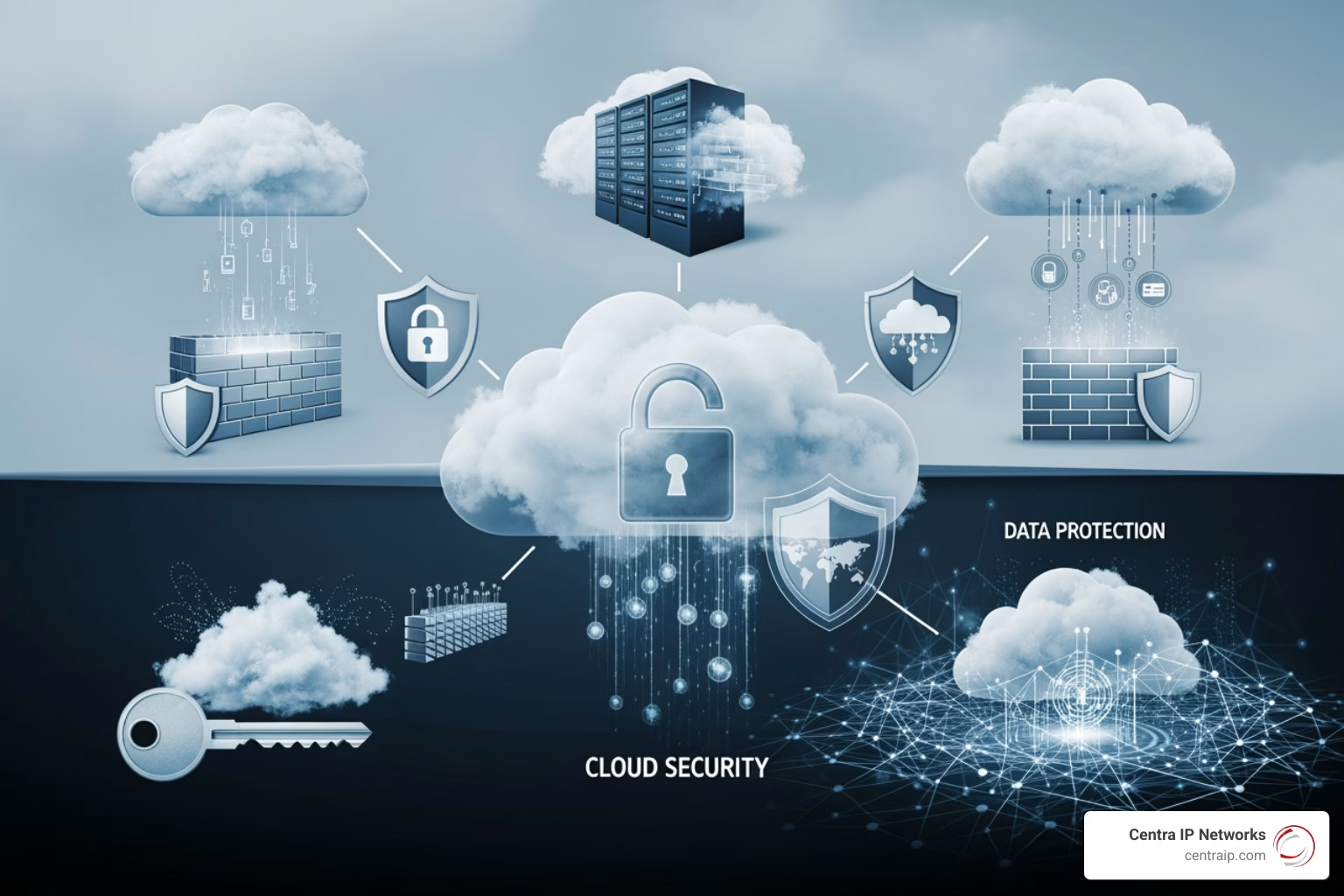
Defining the Shared Responsibility Model
If you are new to cloud and security, the “Shared Responsibility Model” is the most important concept to master. It is the legal and operational framework that defines who does what. As we mentioned in the intro, the global market for cloud security to reach more than $124 billion by 2034, and a large part of that growth is driven by businesses finally realizing they have a role to play in this partnership.
In a traditional on-premises setup, you owned the whole stack—from the physical locks on the server room door to the software updates on the desktop. In the cloud, that burden is shared. The Cloud Service Provider (CSP), like Google Cloud or AWS, is responsible for the security of the cloud. This includes the physical data centers, the hardware, and the virtualization layer. You, the customer, are responsible for security in the cloud.
The specifics of your duties change depending on which cloud service model you use:
- Infrastructure as a Service (IaaS): You rent the digital “dirt” and “bricks.” The provider secures the physical server, but you are responsible for the operating system, the apps, and the data.
- Platform as a Service (PaaS): The provider handles the OS and middleware. You just focus on the code and the data.
- Software as a Service (SaaS): The provider handles almost everything. Your primary job is managing who has access to the account and protecting the data you put into it.
For our clients in the public sector, the FedRAMP Marketplace Cloud Security provides a great visualization of how these responsibilities shift. Even in the most managed SaaS environment, you can never fully outsource the responsibility for your own data.
Understanding Your Role in Cloud and Security
We often see businesses fall into the trap of thinking, “It’s in the cloud, so it’s backed up and safe.” This is a dangerous myth. You still maintain 100% ownership of your data. If a disgruntled employee deletes your customer database because you didn’t revoke their access, that is a customer-side failure, not a provider failure.
How Safe Is Your Company’s Data? depends heavily on your identity and access management (IAM) and configuration management. Accountability remains with you. If you misconfigure a storage bucket and leave it open to the public internet—a mistake made by over a third of organizations—the provider isn’t the one who will be answering to regulators; you will.
Modern Threats in the Cloud and Security Landscape
The cloud is a target-rich environment. Because cloud resources are often accessible via the public internet, attackers don’t need to break into your office; they just need one weak password or one unpatched vulnerability.
One of the unique risks in cloud and security is multi-tenancy. While providers use strong isolation (like Google’s gVisor or Titan chips), you are technically sharing hardware with other companies. A more common risk, however, is Shadow IT. This happens when an employee signs up for a cloud service (like a file-sharing site) using a corporate email without IT’s knowledge. These “shadow” apps aren’t monitored, aren’t patched, and represent a massive back door into your business.
We also see a staggering number of unpatched assets. Research shows nearly a third of all cloud assets are neglected, containing an average of 115 vulnerabilities each. Then there is the human element. The rise of AI-powered phishing vs humans has changed the game. AI can now craft perfect, context-aware emails that mimic your coworkers’ tone, leading to higher success rates for data breaches and insider threats.
Advanced Challenges in Cloud and Security
As companies move toward modern architectures, the security challenges become more “cloud-native.” We aren’t just protecting servers anymore; we are protecting microservices and APIs.
In a dynamic environment, workloads spin up and down automatically. Traditional security tools that rely on static IP addresses can’t keep up. This is why DevSecOps is so vital—it’s the practice of “shifting left” and building security into the code before it ever goes live. As detailed in the book Building Secure and Reliable Systems, security must be a continuous loop, not a final checkbox.
Essential Components of a Robust Security Posture
To stay safe, you need a multi-layered defense. It’s not just about one tool; it’s about a “posture.” Here is how the two heavy hitters of cloud protection compare:
| Feature | CSPM (Cloud Security Posture Management) | CWPP (Cloud Workload Protection Platform) |
|---|---|---|
| Primary Focus | Configuration and Compliance | The “Inside” of the Workload |
| What it Does | Scans for misconfigured buckets, open ports, and compliance drift. | Protects VMs, containers, and serverless functions from malware and exploits. |
| Best For | Preventing “accidental” exposure. | Protecting against active attacks in runtime. |
Beyond these, you need a few “must-haves”:
- Identity and Access Management (IAM): This is your new perimeter. You must use Multi-Factor Authentication (MFA). If you’re wondering Why Do We Need a Firewall? in the cloud, the answer is that cloud-native firewalls (like Google Cloud Armor) protect your apps from DDoS attacks and malicious web traffic.
- Data Loss Prevention (DLP): Tools that scan your data to ensure sensitive info (like credit card numbers) isn’t being shared inappropriately.
- SIEM (Security Information and Event Management): A central “brain” that collects logs from all your cloud services to spot suspicious patterns.
- Encryption: You should encrypt data at rest, in transit, and even in use (using “Confidential Computing”). As the Google security overview highlights, encryption should be the default, not an afterthought.
Embracing Zero Trust for Cloud and Security
The old way of thinking was “Trust, but verify.” The Zero Trust way is “Never trust, always verify.” In a Zero Trust model, it doesn’t matter if you are sitting in our Dallas office or a coffee shop in Orlando; the system treats you as a potential threat until you prove otherwise.
Zero Trust relies on three main pillars:
- Least Privilege: Give users only the access they need for the specific task at hand.
- Micro-segmentation: Break your network into tiny zones so that if an attacker gets into one “room,” they can’t access the rest of the “house.”
- Continuous Verification: Constantly checking the device’s health and the user’s identity.
Google’s BeyondCorp is a famous example of this. It eliminates the need for traditional VPNs. While Understanding VPNs and How They Impact Your Business is still important for legacy systems, Zero Trust is the future of cloud and security.
Compliance, Governance, and Regulatory Frameworks
For businesses in Texas and Florida, compliance isn’t just a suggestion; it’s often the law. Whether you are in healthcare (HIPAA) or finance (PCI DSS), the cloud adds a layer of complexity to audits.
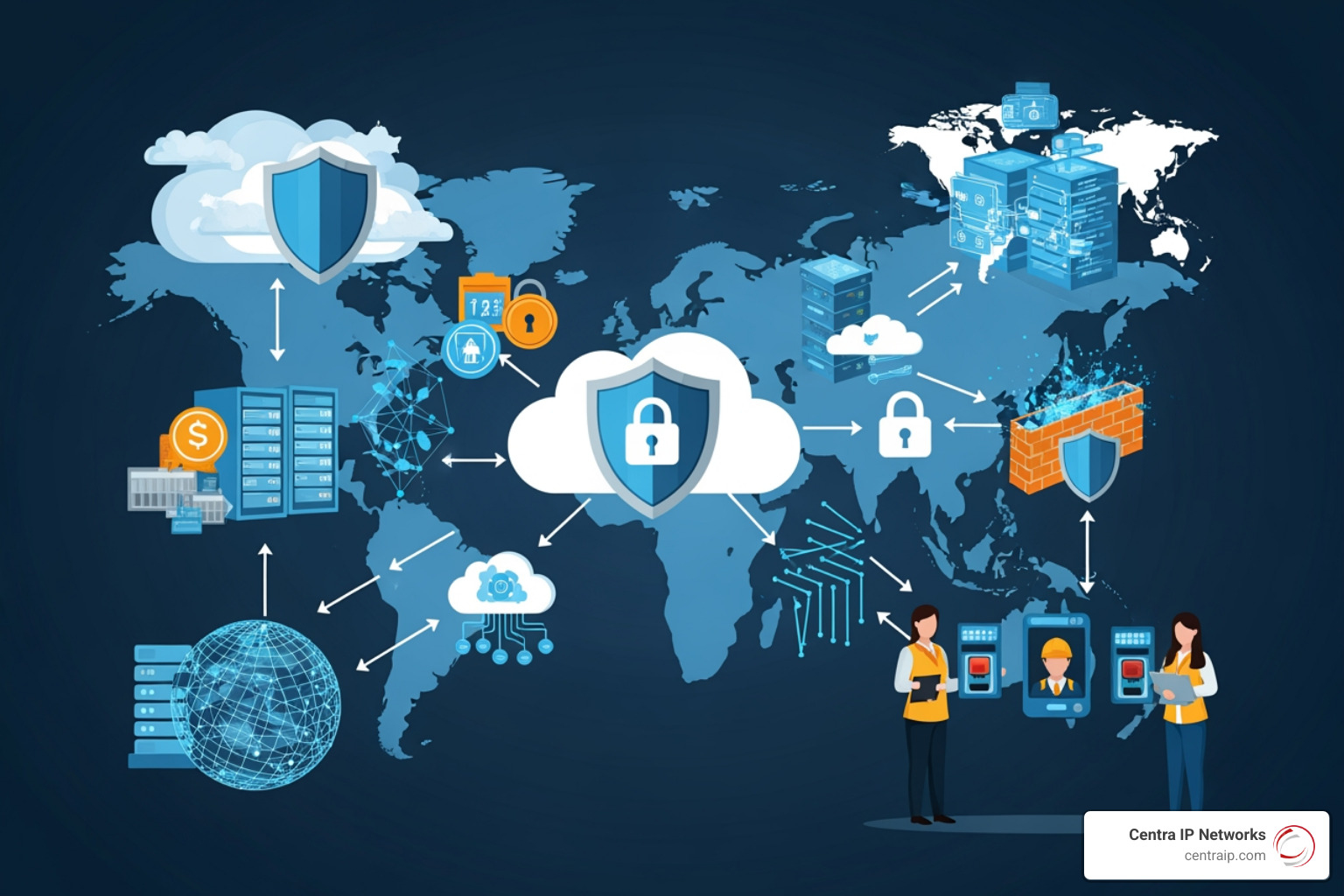
If you work with the government, you’ll need to get familiar with several frameworks:
- NIST SP 800-53: The “gold standard” of security controls.
- FISMA: The law that holds federal agencies accountable for their security.
- FedRAMP: A standardized approach for security assessment for cloud products.
- DoD Impact Levels: Specific security tiers (IL2, IL4, IL5, IL6) based on how sensitive the information is.
Managing this risk requires a structured approach. The Risk Management Framework for Information Systems and Organizations Revision 2 NIST SP 800-37 provides the guidelines for this. At Centra IP, we help businesses steer Data Security Compliance so they don’t have to become experts in federal law just to move to the cloud.
Advanced Cloud-Native Challenges and AI Risks
We are entering the era of AI-driven cloud and security challenges. While 84% of organizations use AI, many are doing so without a safety net.
The risks are twofold. First, the AI models themselves can be attacked. Prompt injection is a new threat where attackers “trick” an AI into revealing sensitive data or ignoring security rules. Second, attackers are using AI to automate their attacks. They can now launch thousands of personalized, polymorphic attacks that change their “fingerprint” to avoid detection.
To combat this, Google introduced the Secure AI Framework (SAIF), which provides a roadmap for securing AI systems. This includes protecting the “supply chain” of AI—the data and packages used to train the models—and ensuring runtime protection for AI workloads.
Best Practices for Implementing Robust Cloud Security
Building a secure cloud isn’t a “one and done” project. It’s a culture. Here are the steps we recommend for every business:
- Continuous Monitoring: You can’t fix what you can’t see. Use tools that give you 24/7 visibility into your cloud assets.
- Staff Education: Your team is your first line of defense. Regular training on phishing and social engineering is essential.
- Password Hygiene: Implement Five Things You Can Do to Help Beat Back Password Hackers, starting with a strong MFA policy.
- AI-SPM: If you are using AI, you need AI Security Posture Management to monitor your models and data for vulnerabilities.
- Vulnerability Management: Don’t just scan; remediate. Prioritize patching the assets that are actually exposed to the internet.
- Incident Response: Have a plan. Know exactly who to call and what to do when a breach is detected.
- Audit Logs: Keep a record of everything. If something goes wrong, you’ll need those logs to figure out how it happened and satisfy regulators.
Frequently Asked Questions about Cloud Security
What is the difference between cloud security and cybersecurity?
Cybersecurity is the broad umbrella that covers protecting all digital assets. Cloud security is a specialized branch of cybersecurity. It focuses specifically on the unique challenges of the cloud, like the shared responsibility model, multi-tenancy, and the lack of a physical perimeter.
Why is the shared responsibility model important for my business?
It’s important because it defines your legal and financial liability. If your data is stolen because you failed to configure your security settings correctly, the cloud provider is not responsible. Understanding the model ensures you don’t leave “gaps” in your defense.
How does AI impact cloud security risks and solutions?
AI is a double-edged sword. It allows attackers to automate sophisticated phishing and malware at a massive scale. However, it also gives defenders (like us!) the ability to analyze billions of data points in real-time to spot threats that a human would miss.
Conclusion
Navigating cloud and security can feel like trying to map a storm while you’re standing in the middle of it. But you don’t have to do it alone. At Centra IP Networks, we specialize in taking that complexity and turning it into a single, manageable platform.
Whether you are in Dallas, Fort Worth, or anywhere across Florida from Tampa to Orlando, our goal is to provide you with comprehensive Managed IT and Cloud Services that keep your business running smoothly. By bringing your phone systems, internet, and cloud security under one roof with a single provider and a single bill, we eliminate the “vendor finger-pointing” and ensure your business continuity.
The cloud is your business’s best friend for growth—let us make sure it’s also your most secure asset. Reach out to us today to see how we can tailor a cost-effective security solution for your unique needs.