
Why 1080p Is Still the Most Practical Choice for Everyday Security
A 2 megapixel CCTV camera — also called a 1080p camera — remains the most widely used security camera resolution for homes and small businesses in 2026. Here’s a quick summary of what you need to know:
- Resolution: 1920 x 1080 pixels (2 million pixels total)
- Best for: Homes, small offices, retail stores, and small commercial properties
- Night vision: Typically 65–100 ft infrared range
- Power options: PoE (single cable) or 12V DC
- Compatibility: Works with TVI, AHD, CVI, and analog DVRs
- Price range: Roughly $100–$180 per camera depending on features
- Storage: microSD up to 256–512GB, or NVR/cloud recording
1080p cameras hit a sweet spot. They deliver clear, usable footage without the heavy storage and bandwidth demands of 4K or 8MP systems. For most everyday surveillance needs, they do the job well — and at a cost that makes sense.
That said, not all 2MP cameras are built the same. Lens size, weatherproofing, night vision range, smart analytics, and DVR compatibility all vary widely between models. Knowing what to look for saves you time, money, and headaches down the road.
I’m Patrick Brangan, and over the past 20+ years of deploying security camera systems for small and medium-sized businesses, I’ve specified and installed countless 2 megapixel CCTV camera setups across a wide range of environments — from retail stores to multi-site commercial properties. That hands-on experience is what shapes everything in this guide.
What is a 2MP Security Camera and How Does It Compare?
When we talk about a 2 megapixel CCTV camera, we are referring to a camera that captures images containing roughly two million pixels. Specifically, the resolution is 1920 pixels horizontally by 1080 pixels vertically. This is the exact same aspect ratio and pixel count as the Full HD television or monitor you likely use every day.
For years, 1080p has been the industry standard for general surveillance. But with the rise of 4MP (2K) and 8MP (4K) options, many property owners wonder if 2MP is still relevant. The truth is, while higher resolution cameras capture more raw detail, they also demand significantly more resources.
To help you visualize how these resolutions stack up, let’s look at how they compare across key performance metrics:
| Resolution Label | Pixel Count | Image Clarity | Bandwidth & Storage Needs | Best Suited For |
|---|---|---|---|---|
| 2MP (1080p) | 1920 x 1080 | Good for general monitoring & close-range ID | Low (highly efficient) | Homes, small retail, indoor offices |
| 4MP (2K) | 2560 x 1440 | Very sharp; allows moderate digital zooming | Medium | Medium offices, parking lots |
| 8MP (4K) | 3840 x 2160 | Extremely detailed; excellent digital zoom | High (requires robust network) | Large commercial spaces, license plate capture |
While a higher-resolution camera is fantastic for zooming in on a license plate fifty feet away, it is often overkill for monitoring a standard storefront, a residential driveway, or an office lobby. In fact, choosing the right resolution is a balancing act between the level of detail you actually need and the infrastructure required to support it. For a deeper look at how proper camera planning protects your bottom line, check out our guide on the benefits of security cameras for businesses.
Resolution vs. Storage: The 1080p Sweet Spot
One of the most significant advantages of a 2 megapixel CCTV camera is its efficiency. Every pixel captured by a camera must be compressed, transmitted across your network, and stored on a hard drive or cloud server.
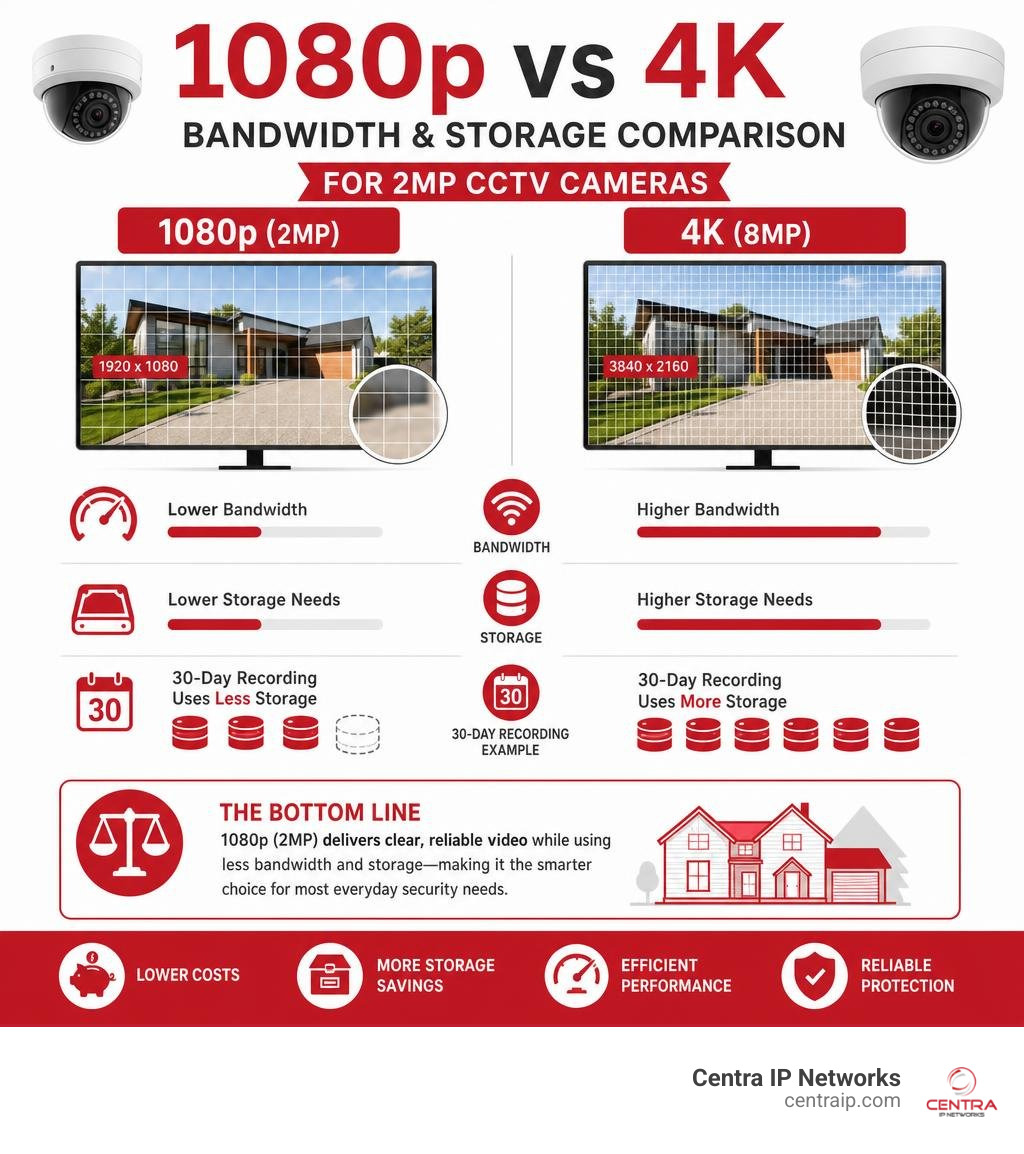
An 8MP (4K) camera generates four times the data of a 1080p camera. Without expensive network upgrades and massive hard drive arrays, a system composed entirely of 4K cameras can easily choke your local network bandwidth and fill up your storage drives in a matter of days.
This is where the 1080p sweet spot shines. Modern 2MP cameras utilize advanced compression standards like H.265 and H.265+. These codecs compress video files up to 70% more efficiently than older H.264 standards without sacrificing image quality.
Furthermore, because the file sizes are manageable, 2MP cameras are highly compatible with edge storage (recording directly to an on-board microSD card). For example, compact models like the DS-2CD2423G2-IW (W) 2 MP Fixed Cube Network Camera support microSD cards up to 512 GB. This allows you to store weeks of continuous or motion-triggered footage directly on the device, eliminating the immediate need for an expensive network video recorder (NVR) or high-bandwidth cloud subscriptions.
Benefits and Limitations of 1080p Surveillance
Like any technology, 1080p cameras come with their own set of pros and cons. Understanding these trade-offs ensures you deploy them in environments where they can truly succeed.
The Benefits:
- Outstanding Cost Efficiency: Because the sensors are highly mature and inexpensive to manufacture, 2MP cameras offer incredible value. You can secure an entire property with multiple 1080p cameras for the price of just one or two high-end 4K cameras.
- Low Network and Storage Overhead: Your internet connection and local network won’t suffer from lag, and your storage drives will last much longer before needing to overwrite old footage.
- Simplified Installation: Many 2MP systems are built for plug-and-play simplicity, making them incredibly easy to deploy and maintain.
- Excellent Low-Light Performance: Because a 2MP sensor has fewer pixels spread across its surface compared to a 4K sensor of the same size, each individual pixel is physically larger. Larger pixels gather light more effectively, often resulting in cleaner, less noisy nighttime footage.
The Limitations:
- Digital Zoom Constraints: If you need to zoom in on a piece of footage captured from a distance—such as a tiny detail on a person’s clothing fifty feet away—a 1080p image will quickly become pixelated.
- Limited Facial Identification Range: In the security industry, we use “DORI” distances (Detect, Observe, Recognize, Identify) to measure camera effectiveness. A typical 2MP camera with a 2.8mm lens can easily detect activity at nearly 200 feet, but you can only reliably identify an unfamiliar face within about 20 feet of the camera.
For many properties, mixing and matching camera resolutions is the smartest approach. You might use 1080p cameras for general hallway and office monitoring, while reserving a higher-resolution camera for the main entrance or cash register. To explore how to design the perfect layout for your commercial space, take a look at our review of the best small business CCTV system options.
Choosing the Right 2 Megapixel CCTV Camera for Your Property
Selecting the right camera goes beyond just picking a resolution. You must match the camera’s physical form factor, lens, and internal features to the specific environment it will protect.
Form Factors: Bullet, Dome, Turret, and PTZ
The physical shape of your 2 megapixel CCTV camera dictates where it should be mounted and how visible it will be to the public.
- Bullet Cameras: These cylindrical, highly visible cameras act as an excellent visual deterrent. They are easy to adjust during installation and are perfect for long-range outdoor monitoring, such as driveways, perimeters, and building exteriors.
- Dome Cameras: Housed in a vandal-resistant plastic or metal dome, these cameras are low-profile and blend seamlessly into ceilings. Because it is difficult for onlookers to tell exactly where the lens is pointing, they are highly popular in retail stores and office lobbies.
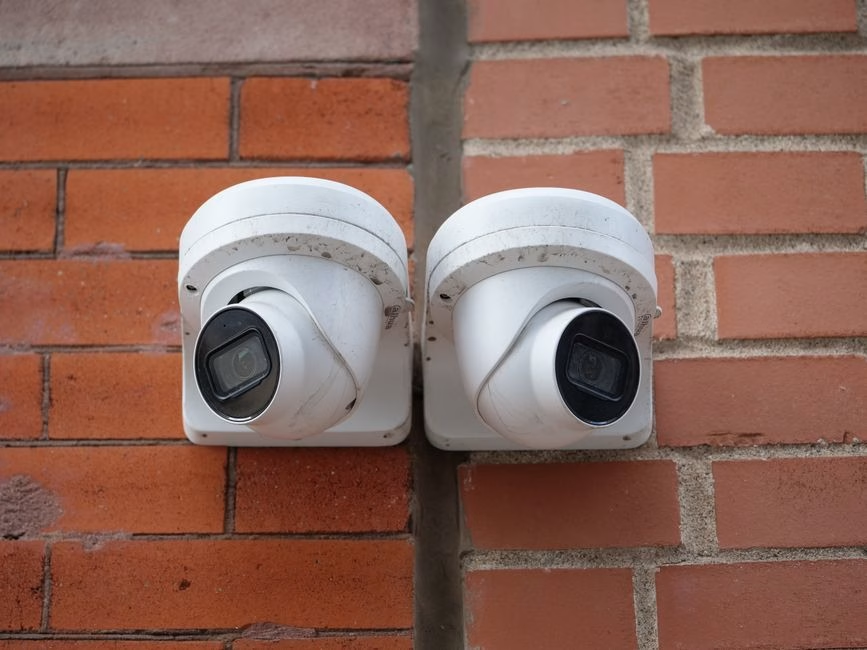
- Turret (Eyeball) Cameras: Combining the easy adjustment of a bullet camera with the clean look of a dome, turret cameras feature a ball-and-socket joint. They lack a glass dome cover, which completely eliminates the risk of infrared light reflecting back into the lens at night.
- PTZ (Pan-Tilt-Zoom) Cameras: These motorized cameras can rotate 360 degrees, tilt up and down, and zoom in on targets. They are ideal for large open spaces like parking lots where an operator or AI tracking system needs to follow movement.
To learn more about matching these form factors to your specific business layout, read our guide on 10 different types of security cameras for business.
Key Features to Look For in a 2 Megapixel CCTV Camera
When shopping for a 2MP camera, don’t let the low price tag fool you into buying a bare-bones model. Look for these essential features to get the most out of your investment:
- Weatherproofing (IP66/IP67 Rating): If the camera is going outdoors, ensure it has at least an IP67 rating. This guarantees the housing is completely dust-tight and can survive heavy downpours or extreme temperatures.
- Advanced Light Management (True WDR): Wide Dynamic Range (WDR), measured in decibels (dB), is crucial for cameras facing glass doors or bright windows. A camera with 120dB True WDR can balance out dark shadows and bright highlights, ensuring you can still see faces in front of a bright background.
- On-Board Audio: Many modern 2MP cameras feature a built-in microphone with an audio pickup range of up to 30 feet, allowing you to capture critical environmental sounds alongside your video.
- Smart AI Analytics: Basic motion detection triggers an alert every time a shadow shifts or a leaf blows past. Look for cameras that offer smart human and vehicle classification, which filters out false alarms and only alerts you when a real threat is detected.
For instance, rugged outdoor options like the DS-2CD1T23G2-I(UF) 2 MP Fixed Bullet Network Camera combine an IP67 weatherproof rating, built-in audio, and smart human/vehicle classification into a highly durable, cost-effective package.
How a 2 Megapixel CCTV Camera Integrates with Modern DVRs and NVRs
Depending on your existing infrastructure, 2MP cameras can connect to your security system in two primary ways:
- IP Network Systems (NVRs): These cameras use Power over Ethernet (PoE) to transmit high-definition digital video and receive power over a single CAT5e or CAT6 network cable. This is the cleanest, most modern way to build a security system, allowing for easy remote management and deep integration with cloud storage.
- Analog Over Coax Systems (DVRs): If your building is already wired with older RG59 coaxial cables, you don’t need to rip them out. Many 2MP cameras are “4-in-1” hybrid models. By using a physical switch on the camera cable, you can set the video output to match your specific DVR format—whether it’s TVI, CVI, AHD, or traditional analog CVBS.
By integrating these cameras with a modern hybrid recorder, you can easily bridge the gap between physical on-site storage and the cloud. To understand how to leverage these hybrid setups for ultimate flexibility, dive into our article on cloud-based video surveillance.
Frequently Asked Questions About 1080p Cameras
Are 2MP cameras NDAA compliant?
Yes, many 2MP cameras are fully NDAA (National Defense Authorization Act) compliant, but it depends entirely on the manufacturer of the internal chipset. NDAA compliance restricts federal agencies and government-funded entities from installing telecommunications and surveillance equipment from specific blacklisted Chinese manufacturers.
If you are securing a government facility, a school, a financial institution, or a business that holds federal contracts in the Dallas, Fort Worth, or Tampa Bay areas, verifying NDAA compliance is absolutely essential. Many reputable manufacturers build dedicated NDAA-compliant 2MP lines specifically for these sensitive installations.
How do 2MP cameras perform in low-light or nighttime conditions?
Surprisingly well! Because the pixels on a 2MP sensor are physically larger than those on a highly packed 4K sensor, they excel at gathering ambient light.
Most quality 2MP cameras feature built-in infrared (IR) LEDs that provide invisible light to illuminate dark areas up to 100 feet away. Advanced models utilize EXIR (Extended Infrared) technology, which distributes the IR light evenly across the entire frame, eliminating the “hot spot” in the center of the image that often blinds older cameras. Some high-end 2MP cameras can even capture full-color video in near-total darkness using ultra-low-light sensors (operating down to 0.002 Lux) or warm visible-light LEDs.
Can I view my 1080p security cameras remotely?
Absolutely. When your 2 megapixel CCTV camera is connected to a network-enabled NVR, a hybrid DVR, or directly to your local router via Wi-Fi or Ethernet, you can access the live feed from anywhere in the world.
Most modern surveillance platforms provide free mobile apps for iOS and Android, as well as desktop software for Windows and Mac. These apps allow you to view live feeds, scrub through recorded footage, adjust settings, and receive instant push notifications the moment a smart AI sensor detects a person or vehicle on your property.
Conclusion
At the end of the day, security isn’t about buying the most expensive, highest-resolution hardware on the market—it’s about deploying the right tool for the job. For the vast majority of homes and businesses, a properly positioned, feature-rich 2 megapixel CCTV camera provides all the clarity, reliability, and security you need, without breaking your budget or crushing your local network.
At Centra IP Networks, we believe that managing your business technology should be simple. That’s why we offer comprehensive Managed IT and Cloud Communications services—including custom-designed physical security and surveillance solutions—all on one unified platform with a single provider and a single, clear bill.
Whether you need to secure a corporate office in Dallas or Fort Worth, protect a retail storefront in Orlando, or deploy a multi-site camera system across Tampa, St. Petersburg, Clearwater, and Sarasota, we leverage our 35+ industry partnerships to deliver tailored, cost-effective solutions that protect your bottom line.
Ready to take the guesswork out of your property’s security? Check out the ultimate guide to business surveillance systems to plan your next upgrade, or reach out to our team today to design a system that perfectly fits your needs.