

Why Network Security Can’t Wait—And Why You Shouldn’t Manage It Alone
Managed network security is the practice of outsourcing your organization’s network security operations—including firewalls, intrusion detection, threat monitoring, and incident response—to a specialized third-party provider called a Managed Security Service Provider (MSSP). Instead of building and maintaining an in-house security team, businesses rely on expert providers who deliver 24/7 monitoring, advanced threat intelligence, and rapid response from global Security Operations Centers (SOCs).
Quick Answer: What You Need to Know
- What it is: Outsourced security monitoring and management delivered by MSSPs
- What it includes: Firewall management, intrusion detection/prevention (IDS/IPS), VPN services, vulnerability assessments, and 24/7 threat monitoring
- Why businesses use it: Cost savings, access to specialized expertise, faster threat response, and protection against a rapidly evolving threat landscape
- Who needs it: Any organization—from small businesses to large enterprises—that lacks the resources, time, or expertise to manage security in-house
- Key benefit: Enterprise-level protection without the overhead of hiring, training, and retaining an internal security team
The reality is stark: the global average cost of a data breach now exceeds $4.88 million, with companies taking an average of 168 days just to identify a breach and another 51 days to recover. Meanwhile, 74% of organizations still manage IT security in-house, even as 82% of IT professionals acknowledge they either already work with—or plan to partner with—a managed security service provider.
The cybersecurity landscape has fundamentally changed. Threats are more sophisticated, compliance requirements are more demanding, and the shortage of skilled security professionals makes it nearly impossible for most businesses to keep pace. At the same time, the managed security services market has grown to a staggering $29.8 billion, expanding at a 14% annual growth rate—more than double the 6% growth rate of traditional network security.
For businesses managing multiple IT vendors and seeking to consolidate services, managed network security offers a compelling solution: proactive defense, expert oversight, and simplified operations, all without the complexity or cost of building an internal security team.
I’m Patrick Brangan, and over my 20+ years as a business technology expert serving SMBs across Dallas, Tampa, and Orlando, I’ve seen how managed network security transforms organizations—enabling them to focus on growth while experts handle the increasingly complex challenge of staying secure. In this guide, I’ll walk you through exactly what managed network security is, which services and technologies matter most, and how to choose the right partner for your business.
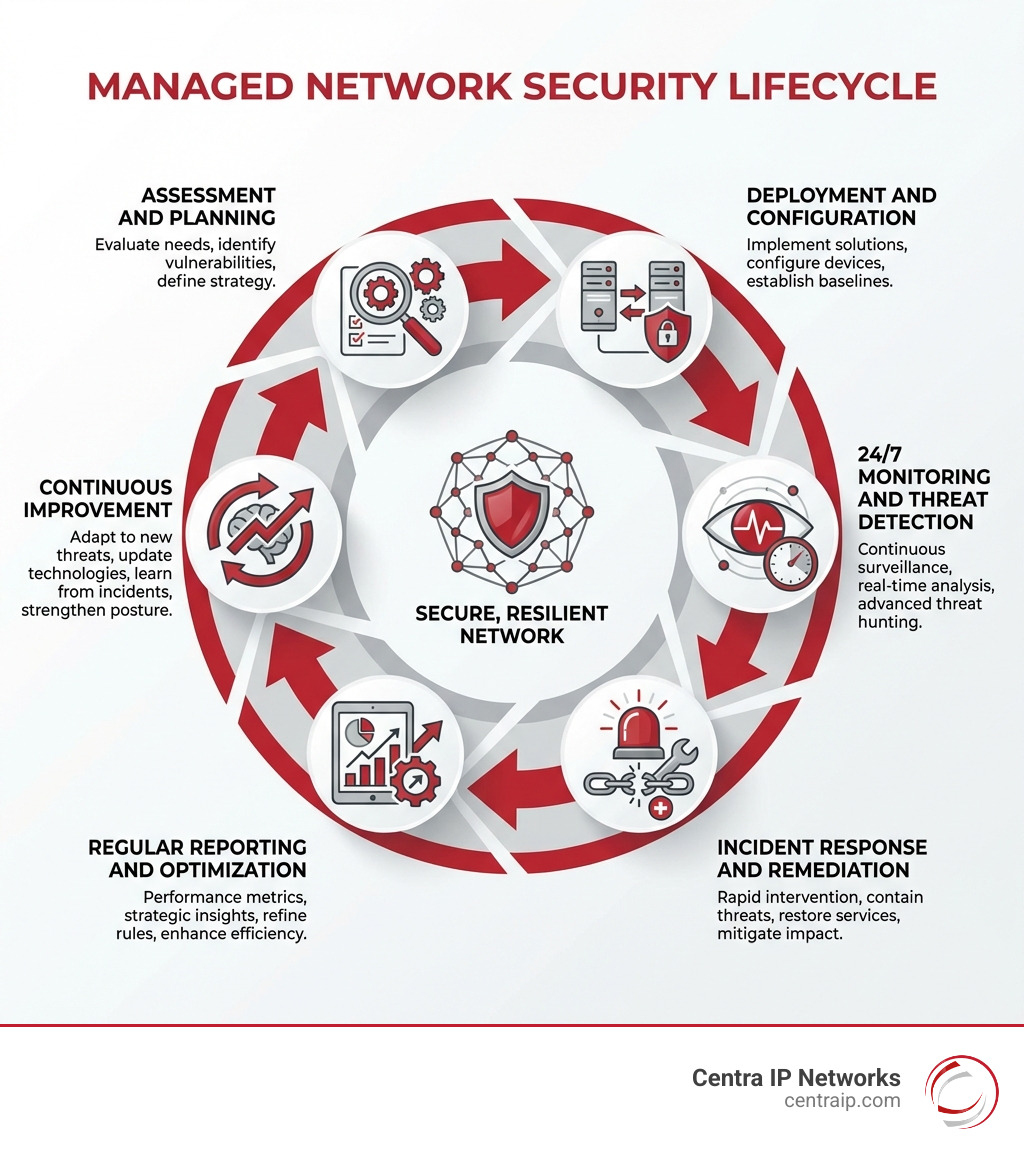
What is Managed Network Security?

At its simplest, Managed network security is a professional service where we take the burden of protecting your digital perimeter off your plate. Think of it as hiring a world-class security team that never sleeps, never takes a vacation, and has seen every trick in the hacker’s playbook.
But what does that look like in practice? It starts with a Managed Service Provider or a specialized Managed Security Service Provider (MSSP). While a standard MSP handles your general IT needs—like fixing a printer or setting up email—an MSSP is the “Special Ops” unit focused exclusively on security. They provide remote monitoring and 24/7/365 oversight of your entire network.
The historical evolution of MSSPs dates back to the mid-1990s, when Internet Service Providers (ISPs) began managing firewalls for customers. Today, the service is far more advanced, utilizing global Security Operations Centers (SOCs) and near real-time threat intelligence. These providers don’t just wait for an alarm to go off; they use advanced event analysis and data correlation to spot “smoke” before there’s ever a “fire.”
The Core Services of Managed Network Security
When you sign up for Managed network security, you aren’t just getting a software license; you’re getting a suite of integrated defenses. We often call this “defense in depth.”
- Managed Firewall: This is your first line of defense. But Why Do We Need a Firewall if we have antivirus? Because a firewall acts as a gatekeeper for your entire network, filtering traffic based on complex security rules. An MSSP manages the configuration, updates, and policy design so you don’t have to.
- Intrusion Detection (IDS) & Intrusion Prevention (IPS): If the firewall is the gatekeeper, IDS/IPS is the security guard patrolling the hallways. IDS watches for suspicious activity, while IPS actively blocks it.
- Unified Threat Management (UTM): This is the “Swiss Army Knife” of security. It combines firewalls, content filtering, and antivirus into a single, managed solution.
- VPN Management: For our clients in Dallas or Tampa with remote workers, managed VPNs ensure that data traveling between a home office and the corporate headquarters remains encrypted and secure.
- Secure SD-WAN: This technology simplifies networking across multiple locations (like branch offices in Orlando and Clearwater) while prioritizing security and performance.
These tools are often bundled within broader Managed IT Services to provide a holistic approach to technology management.
Managed Network Security Technologies
We don’t expect you to be an expert in the “Alphabet Soup” of security hardware, but it helps to know who the heavy hitters are. Most top-tier managed services use “best-of-breed” vendors such as:
- Fortinet: Known for their high-performance Next-Generation Firewalls (NGFW).
- Cisco & Palo Alto: Industry leaders in enterprise-grade security fabric.
Modern solutions also lean heavily on AI-driven automation. Instead of a human having to manually check every single alert (which leads to “alert fatigue”), AI can filter out the noise and identify true threats instantly. This is often integrated with SIEM (Security Information and Event Management) for deep logging and Endpoint Detection and Response (EDR) to protect every laptop and mobile device in your fleet.
Advanced Managed Network Security Solutions
For organizations with more complex needs, we move into advanced architectures:
- SASE (Secure Access Service Edge): This converges network and security into a single cloud-delivered service. It’s perfect for the modern, “work-from-anywhere” world.
- Zero Trust Network Access (ZTNA): The philosophy here is “never trust, always verify.” No one gets access to anything on the network without proving who they are and that their device is safe.
- Cloud Connect: We can integrate your network directly with providers like AWS or Azure as if they were a local node on your network, ensuring Data Networking is both fast and secure.
- Vulnerability Assessments: Regular, proactive “stress tests” of your network to find and patch holes before a hacker does.
Why Businesses are Prioritizing Managed Security
If you feel like the news is full of data breach headlines, you’re right. According to IBM’s 2024 cost of a data breach report, the average cost has hit $4.88 million. For a small business in Fort Worth or Sarasota, a hit like that isn’t just a setback—it’s often the end of the road.
Beyond the cost, there are three primary drivers for the shift toward managed services:
- The Talent Shortage: There simply aren’t enough cybersecurity experts to go around. Trying to hire one in-house in a competitive market like Tampa or Dallas is expensive and difficult.
- Alert Fatigue: Internal IT teams are often overwhelmed by thousands of security alerts every day. MSSPs use advanced tools to filter this noise, ensuring that real threats get the attention they deserve.
- Rapid Recovery: When an incident does happen, every minute counts. With an average hold time of just 1 minute and a Mean Time to Resolution (MTTR) of 4 hours from top providers, managed services ensure you get back to business fast.
This level of protection is becoming a standard part of Cybersecurity in Modern Business Telecommunications.
Key Benefits: From Compliance to Business Continuity
Why should you make the switch? Let’s look at the numbers.
| Feature | In-House Security | Managed Network Security |
|---|---|---|
| Monitoring | Usually 8/5 (Business Hours) | 24/7/365 |
| Expertise | Limited to 1-2 Generalists | Access to Global SOC Experts |
| Cost | High (Salaries, Benefits, Tools) | Predictable Monthly Fee |
| Uptime | Varies | 99.99% Guarantee |
| Response | Best Effort | 4-Hour MTTR |
Beyond the stats, the Benefits of Managed IT Services include massive scalability. As your business grows from Orlando to St. Petersburg, your security scales with you automatically. You also benefit from proactive threat hunting, where experts look for hidden dangers rather than just reacting to alarms.
How Managed Network Security Supports SMBs
Small and Medium-sized Businesses (SMBs) are actually more at risk than large corporations. Why? Because hackers know SMBs often have weaker defenses. Managed security levels the playing field, giving a 20-person office the same enterprise-level protection as a Fortune 500 company.
When comparing Managed IT vs In-House IT, the “flat-rate pricing” model is a huge win for SMBs. It turns a massive, unpredictable capital expense into a manageable operating cost, providing a significant competitive advantage.
Meeting Regulatory Compliance Requirements
If you handle patient records or credit card data, you know that Data Security Compliance is a nightmare to manage alone. Whether it’s HIPAA for healthcare, PCI DSS for retail, or GDPR, MSSPs provide the log management and audit readiness you need.
For instance, Managed IT Services for Healthcare in Florida must be particularly rigorous about data privacy. A managed partner ensures that every access attempt is logged and every vulnerability is patched, making your next audit a breeze.
Choosing the Right Managed Network Security Partner
Not all providers are created equal. When looking for a partner in the Dallas or Tampa areas, keep these factors in mind:
- Technical Expertise: Do they support a wide range of vendors (Cisco, Fortinet, Palo Alto)?
- Response Time SLAs: Don’t just take their word for it. Look for written guarantees on uptime and resolution times.
- Strategic Alignment: Your security partner should understand your business goals, not just your server rack. Use Managed IT Consulting Services to ensure your security roadmap matches your growth plan.
- Avoid Common Pitfalls: Be wary of providers who offer “set it and forget it” security. True security requires constant tuning, proactive threat hunting, and a partner who provides transparent reporting and regular strategy sessions to ensure your defenses evolve alongside new threats.
Frequently Asked Questions about Network Security
What is the difference between an MSP and an MSSP?
An MSP (Managed Service Provider) focuses on general IT administration and “keeping the lights on.” An MSSP (Managed Security Service Provider) is a specialist that focuses entirely on security monitoring, threat intelligence, and incident response. Many modern providers, like us, offer both as an integrated solution.
How does managed security improve business continuity?
By preventing breaches before they happen and offering a 99.99% uptime guarantee, managed security ensures your network stays online. If an incident does occur, the 4-hour MTTR (Mean Time to Resolution) ensures your downtime is kept to an absolute minimum.
Is managed network security affordable for small businesses?
Yes! In fact, it’s often cheaper than the alternative. When you factor in the cost of a single data breach ($4.88M average) or the salary of one full-time security expert ($100k+), a flat-rate monthly managed service is a bargain.
Conclusion
At Centra IP Networks, we believe security shouldn’t be a headache. We offer a comprehensive suite of services—from phone systems and internet connectivity to advanced cloud solutions—all on one platform with a single bill.
By leveraging our 35+ partnerships, we provide custom, cost-effective Managed network security solutions for businesses across Dallas, Fort Worth, Orlando, Tampa, and the surrounding regions. Don’t leave your business’s future to chance. Secure your business with our Cloud Services today and let us handle the “lurking shadows” while you focus on what you do best: growing your business.