

What Is Cloud Communication? (And Why It’s Replacing Traditional Phone Systems)
Cloud communication is the delivery of voice, video, messaging, and data services over the internet — hosted by a third-party provider instead of on-site hardware you own and maintain.
Here’s a quick summary of what you need to know:
| Question | Quick Answer |
|---|---|
| What is it? | Internet-based voice, video, and messaging — no on-premise hardware required |
| How is it different from traditional phones? | Replaces physical PBX systems with hosted, software-driven services |
| Main types | VoIP, UCaaS, CPaaS |
| Who is it for? | Businesses of any size looking to cut costs, scale fast, and support remote work |
| Is it secure? | Yes — top providers offer TLS, SRTP encryption, MFA, and compliance with HIPAA and GDPR |
| What does it cost? | Typically a predictable monthly per-user subscription, far lower than legacy hardware |
The way businesses communicate has changed dramatically. Not long ago, every office ran on bulky phone hardware, miles of wiring, and expensive maintenance contracts. Today, approximately 94% of companies worldwide are already using cloud technology — and that number keeps climbing.
The shift isn’t just about cutting costs. It’s about freedom. Freedom to work from anywhere, scale without buying new hardware, and give customers a better experience across every channel they prefer.
But with dozens of providers, service models, and pricing structures out there, choosing the right solution isn’t simple. This guide breaks it all down in plain language.
I’m Patrick Brangan, founder of Centra IP Networks, with over 20 years of experience helping SMBs in Dallas, Tampa, and Orlando navigate cloud communication decisions — from VoIP installs to full unified communications rollouts. In the next sections, we’ll walk through everything you need to compare providers confidently and find the right fit for your business.
Understanding Cloud Communication vs. On-Premise Telephony
To appreciate where we are in July 2026, we have to look at where we started. For decades, the backbone of office communication was the on-premise Private Branch Exchange (PBX). These massive physical cabinets sat in closet rooms, humming away while consuming electricity, requiring specialized technicians to configure, and demanding expensive copper lines from the local telecom monopoly.
When you transition to cloud communication, you are essentially moving that entire cabinet of physical switches, cards, and wires into secure, off-site data centers. Instead of routing calls over physical copper wires, your voice is converted into data packets and sent over your internet connection.
This fundamental shift unlocks massive benefits. First, it eliminates the need for heavy capital expenditures (CapEx). Instead of spending tens of thousands of dollars upfront on hardware that will become obsolete in five years, you pay a predictable monthly subscription (OpEx). Second, it removes the physical limitations of your office. If a storm hits Tampa or Dallas, a physical on-premise PBX goes dark. With a cloud system, your employees can simply open an app on their laptops or mobile phones from home and keep taking customer calls without missing a beat.

To explore which model fits your operational structure, check out our detailed guide on Cloud-Based vs Premise-Based Phone Systems: Which One is Right for Your Business?.
The Shift from Physical PBX to Hosted VoIP
In the old days, phone calls traveled over the Public Switched Telephone Network (PSTN), relying on physical circuits to establish a connection. Today, hosted Voice over Internet Protocol (VoIP) bypasses this legacy framework entirely by sending voice signals over IP networks.
This shift has been building momentum for years. For perspective, phone calls made using VoIP solutions rose from six million to over 41 million in the eight years leading up to 2018. This massive migration occurred because businesses realized they could eliminate complex hardware maintenance and extensive physical wiring. In places like Fort Worth, companies transitioning away from legacy infrastructures frequently look for regional cabling and network expertise to ensure their local network can support this digital shift.
Key Differences in Infrastructure and Cost
When evaluating on-premise vs. cloud options, you must look beyond the sticker price of the desk phones. A true comparison requires comprehensive Total Cost of Ownership (TCO) modeling and cash flow analysis.
On-premise systems come with hidden costs:
- Upfront server hardware and licensing fees.
- Dedicated IT staff or outsourced technicians for manual upgrades.
- High utility bills for running and cooling physical servers 24/7.
- Costly SIP trunking or analog line rentals.
With a cloud model, those expenses disappear. The service provider handles all hardware maintenance, software updates, security patches, and system redundancy in their own data centers. This allows businesses to scale their lines up or down dynamically based on seasonal demand without physical hardware changes. To better understand how the underlying framework supports these savings, read our explainer on What is a Cloud Infrastructure?.
Key Types of Cloud Communication Services
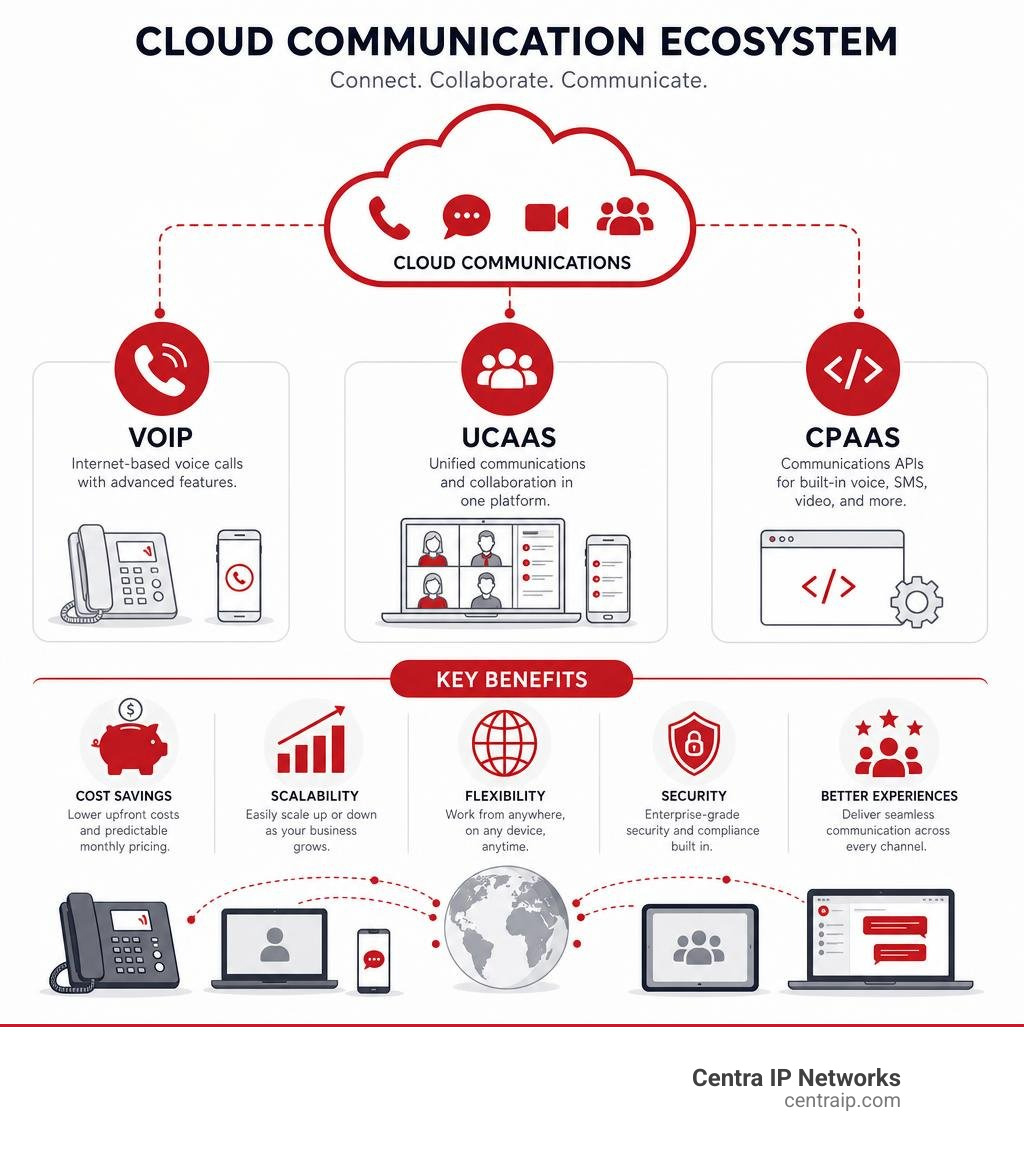
Navigating the cloud landscape means understanding a few common acronyms. The market is generally divided into three main service models:
| Feature | VoIP (Voice over IP) | UCaaS (Unified Communications) | CPaaS (Communications Platform) |
|---|---|---|---|
| Primary Focus | Voice calls over the internet | Unifying voice, video, chat, & SMS | Developer APIs to embed communication |
| Delivery Model | Plug-and-play phone service | All-in-one pre-built platform | Customizable code blocks & SDKs |
| Best For | Replacing traditional desk phones | General business collaboration | Custom app integration & automation |
To see how these services fit into a broader cloud strategy, take a look at The Definitive Guide to Cloud Solutions.
VoIP and Cloud-Based Phone Systems
Cloud-based VoIP is the foundational layer of modern business telephony. It handles virtual routing, inbound and outbound calling, and basic features like voicemail-to-email and auto-attendants. By utilizing IP telephony, businesses can run high-definition voice services over any standard broadband connection. Learn more about modern setups with our resource on Cloud-Based Business Phone Systems.
UCaaS: Unifying Your Cloud Communication Channels
Unified Communications as a Service (UCaaS) takes basic VoIP and supercharges it. Instead of using separate tools for phone calls, video conferencing, instant messaging, file sharing, and SMS, UCaaS consolidates all of these channels into a single, cohesive application.
For businesses with customer-facing teams, UCaaS platforms often include advanced features like call recording and real-time metrics. These tools are crucial for quality assurance and training. To understand why modern teams rely on these features, explore Cloud-Based Call Recording: Why It’s Essential for Modern Businesses.
CPaaS: Building Custom Cloud Communication Workflows
While UCaaS provides an out-of-the-box platform, Communications Platform as a Service (CPaaS) is designed for developers. CPaaS provides APIs and SDKs that allow businesses to embed communication features—like automated SMS alerts, in-app video calls, or voice verification—directly into their proprietary software.
For instance, an e-commerce platform might use CPaaS APIs to automatically text a customer when their package is out for delivery, or a healthcare clinic might use it to build a custom patient portal with built-in video chat. If you want to explore how custom APIs can transform your user experience, see Communications API platform: Chat, Voice, Video, AI concierge | Sendbird .
Business Benefits and Real-World Use Cases
Transitioning to the cloud offers tangible competitive advantages for organizations of all sizes.

By consolidating your tools, you can run a highly agile virtual contact center, allowing agents to access unified customer data and interaction histories from any location. This setup improves first-contact resolution rates and streamlines workflows. For a deeper dive into these capabilities, read What is Cloud-Based Call Center? Features and Benefits.
Supporting Remote and Hybrid Workforces
In 2026, hybrid and remote work are no longer temporary perks—they are standard operating procedures. Cloud communications allow distributed operations to function as a single, cohesive unit. Employees can access their business phone numbers, team chats, and files from any device, whether they are working from a home office in Clearwater, a coffee shop in Sarasota, or a corporate headquarters in Dallas.
This mobility is heavily supported by modern cloud storage solutions, which eliminate the need for on-premise file servers. To see how small businesses leverage these tools to keep remote teams aligned, check out Cloud Storage for Small Business.
Enhancing Customer Service and Sales Workflows
Cloud systems enable true omnichannel engagement, allowing your sales and support teams to meet customers on their terms—whether that’s via phone, SMS, email, or web chat.
The real magic happens when you integrate your cloud phone system with your Customer Relationship Management (CRM) platform (like Salesforce, HubSpot, or Zendesk). When a customer calls, a “screen pop” automatically displays their purchase history, open support tickets, and past interactions before the agent even says hello. To learn how to set this up, read about Cloud Phone System CRM Integration.
Security, Compliance, and Migration Risks
While the benefits of cloud migration are clear, moving your entire communication infrastructure to the internet requires careful planning around security and compliance.

Many businesses, especially in highly regulated sectors like healthcare, finance, or legal services, worry about data leaks and regulatory fines. Partnering with a specialized managed service provider can help mitigate these risks by implementing robust security frameworks and continuous monitoring.
Evaluating Security and Data Privacy
When comparing providers, you must audit their security protocols. Reputable cloud communication platforms utilize advanced encryption standards, including Transport Layer Security (TLS) for secure signaling and Secure Real-time Transport Protocol (SRTP) for encrypted voice data.
Additionally, look for features like:
- Enforced Multi-Factor Authentication (MFA)
- Single Sign-On (SSO) integration
- Compliance certifications such as HIPAA, SOC 2 Type II, GDPR, and PCI-DSS
To understand how secure cloud storage safeguards your business records, explore The Advantages of Cloud Storage Every Business Should Know.
Managing Migration Challenges and POTS Replacement
One of the most pressing migration challenges today is POTS (Plain Old Telephone Service) line replacement. Traditional copper lines are rapidly aging, becoming incredibly expensive, and being phased out by major carriers. Replacing these legacy lines with cloud-based alternatives is a low-hanging fruit for immediate cost reduction.
However, migrating to the cloud requires sufficient network bandwidth. If your local office network isn’t configured correctly, you may experience dropped calls, jitter, or lag. Even legacy tools like faxing must be modernized during this transition. To find reliable alternatives for your business, check out Cloud Fax Providers That Actually Work.
How to Choose the Right Cloud Communications Provider
With so many options on the market, choosing a provider can feel overwhelming. We recommend evaluating potential partners against these core criteria:
- Reliability and Uptime: Look for a provider that guarantees at least a 99.999% (“five-nines”) uptime, backed by multi-data center redundancy.
- Ease of Integration: Ensure the platform natively connects with your existing tech stack (CRMs, email, productivity suites).
- Customer Support: Look for 24/7/365 support with rapid response times, ideally from local technicians who understand your market.
- Pricing Model: Avoid hidden fees. Look for transparent, predictable pricing that fits your budget.
For specialized advice on navigating these options, you can consult with experienced IT advisors who can help align your technology with your business goals.
Assessing Business Needs and Scalability
Before signing a contract, audit your current user count, call volumes, and feature requirements. A small business with ten employees in Clearwater has very different needs than a multi-location enterprise spanning Dallas and Orlando.
Choose a platform that allows you to scale easily without requiring a complete system redesign. To learn how to manage these cloud assets efficiently, read What is Cloud Management? A Strategic Approach to Efficiency.
Regional Connectivity and Local Support
While the cloud is virtual, local network performance is highly physical. Your internet connection, local routing, and regional support matter.
For businesses operating in Texas and Florida, working with a provider that has a strong local presence in your market ensures that you get tailored support and reliable, low-latency routing.
- If you are located in West Florida, check out our Cloud Services Tampa solutions.
- If you are based in North Texas, explore our Cloud Services Dallas options.
- For companies in Central Florida and Sarasota, understanding regional performance factors and local network routing is key to ensuring high-quality voice and data services.
AI-Powered Features and Future Trends
The cloud communications space is evolving rapidly, driven by advancements in Artificial Intelligence (AI).
Industry events, such as the upcoming Cloud Connections 2026 | January 21-23 | Delray Beach … and past forums like Cloud Connections 2024 | Connect With The Best In Cloud | CCA , highlight how AI is shifting from a buzzword to an operational necessity.
The Rise of Autonomous AI Agents
We have moved past basic, frustrating auto-attendants. Today’s AI-powered voicebots and virtual assistants leverage real-time, multilingual speech recognition and translation to handle complex customer queries autonomously. By co-locating GPU compute at the telecommunications edge, providers can achieve end-to-end latency of under 500 milliseconds, making conversations with AI agents feel completely natural.
Furthermore, real-time sentiment analysis can monitor live calls, instantly alerting human managers if a customer becomes frustrated, and providing real-time coaching prompts to the agent on screen.
Transitioning to All-IP Networks
The FCC and global regulatory bodies are actively pushing the transition of all traditional telecom networks to an All-IP infrastructure. This shift requires new IP NNI (Network-to-Network Interface) standards to ensure seamless interconnection and interoperability between different carrier networks, making legacy analog systems completely obsolete.
Frequently Asked Questions about Cloud Communications
What is the difference between UCaaS and CPaaS?
UCaaS is a fully built, out-of-the-box platform that unifies voice, video, and chat into a single application for your employees. CPaaS provides developer APIs and SDKs, allowing you to build custom communication features directly into your own proprietary software or apps.
Is cloud communication secure for regulated industries?
Yes, provided you choose a reputable provider. Leading platforms offer robust data encryption (TLS and SRTP), multi-factor authentication, and maintain compliance certifications like HIPAA, SOC 2, and GDPR to safeguard sensitive customer data.
What are the bandwidth requirements for cloud telephony?
A standard high-quality VoIP call requires approximately 100 Kbps of both upload and download bandwidth. To ensure crystal-clear audio, businesses should utilize business-class broadband connections and configure Quality of Service (QoS) settings on their office routers to prioritize voice traffic over general web browsing.
Conclusion
Transitioning to cloud communication is one of the most impactful steps a business can take to reduce costs, support hybrid teams, and improve customer satisfaction. However, managing multiple vendors for your phones, internet, and cloud storage can quickly lead to “IT chaos.”
At Centra IP Networks, we do things differently. We consolidate your business phone systems, high-speed internet connectivity, and managed cloud solutions onto a single, cohesive platform with a single bill and a single point of contact. Leveraging over 35 strategic partnerships, we tailor cost-effective solutions specifically for businesses in Dallas, Fort Worth, Tampa, St. Petersburg, Clearwater, Sarasota, and Orlando.
Ready to simplify your business communications and eliminate vendor friction? Explore our Cloud-Based Phone Systems or reach out to us today for a free consultation.